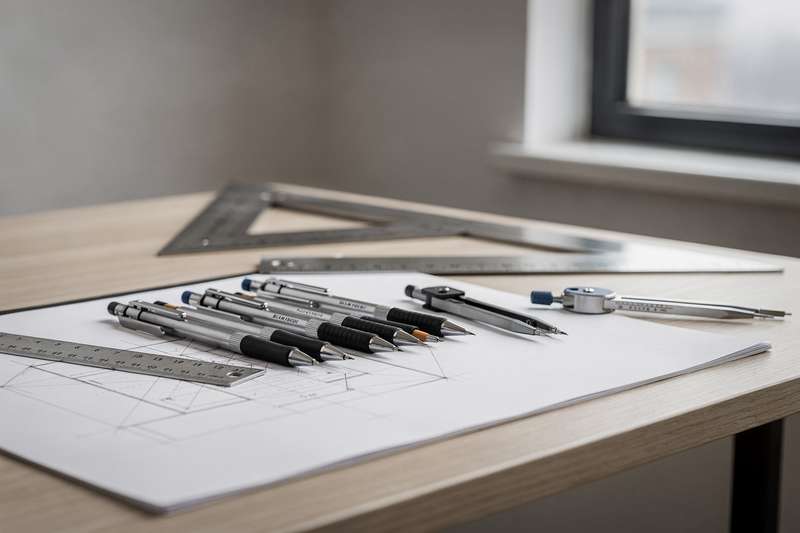
You’ve just cleared a corner of your desk, unrolled a fresh sheet of cartridge paper, and reached for your old school geometry set — only to find the compass slips under pressure, the pencil grades are a mystery, and the single fineliner you own has dried out. Whether you’re an architecture student trying to produce clean construction drawings, a hobbyist getting back into technical illustration, or a professional drafter working by hand alongside CAD, the frustration is the same: cheap or mismatched tools ruin the work before you’ve even started.
The UK market for technical drawing supplies has quietly improved over the past few years. You no longer have to spend a fortune to get tools that actually hold their settings, lay down consistent ink, or give you a reliable pencil grade. But the range is wide enough that picking the wrong starting point — say, a compass that wobbles at 10 cm radius, or a pencil set skewed entirely to soft sketching grades — can cost you time and money. This guide cuts through that noise and points you to specific products worth your attention.
How These Picks Were Evaluated
The shortlist here was built around a set of practical criteria: construction quality (metal versus flimsy plastic joints, ink system integrity, pencil casing), real-world usability for technical work specifically (not general art or journalling), verified buyer review patterns on amazon.co.uk, and value for money at each tier. Where possible, products with a meaningful number of verified UK reviews were prioritised, so you’re reading about tools that real people have used in real drawing sessions — not just warehouse listings. In a few cases where a product is genuinely useful but has a thin review count, that’s flagged directly. All five picks below cover distinct use cases so that whether you need a complete starter set, precision pens, reliable pencils, a drawing surface, or a specialist replacement component, there’s a clear recommendation.
Best Starter Set for Students and Hobbyists
The Liquidraw Technical Drawing Professional Set – 8 Piece is where most people new to technical drawing should start. It brings together a metal compass with spring bow head, dividers, and the other core geometry tools in one case, which immediately removes the guesswork of sourcing compatible pieces separately. Rated 4.2 out of 5 stars from 49 reviewers on amazon.co.uk, it’s a modest but honest score — good enough to suggest the fundamentals are solid, without over-promising precision at this price point.
The metal compass is the standout piece. Spring bow compasses hold their radius setting far better than friction-fit plastic ones, which is exactly what you need when you’re drawing repeated circles to the same diameter across a sheet. Many reviewers specifically mention that the compass feels sturdier than its budget price implies, though a few note that lead grade management matters — you’ll get the best results pairing it with a 2H or H grade lead for clean, consistent arcs rather than a soft B that smears. The dividers are a useful addition for transferring measurements directly from a scale or another part of the drawing without recalibrating.
The set’s limitations are honest ones. At this tier, the ruling pen and some of the smaller accessories are functional rather than fine instruments. If you’re producing work to professional submission standards — architectural drawings for planning, say — you’ll eventually want to supplement with purpose-built tools. But for GCSE and A-level design students, first-year architecture or engineering undergraduates, or anyone returning to hand drawing after years away, this set gives you everything you need to build the habit without a large upfront outlay.
One thing to note: with 49 reviews, the sample is smaller than ideal. The pattern of feedback is consistent and there are no red flags around structural failure or missing pieces, but treat it as a strong budget choice rather than an exhaustively proven tool. Buy it as your first compass set, and upgrade the specific pieces that see the most use once you know where your work takes you.
Best Fineliner Pens for Technical Drawing and Inking
For laying down ink lines with consistent weight, the Liquidraw Drawing Pens – Set of 4 offer a waterproof, black fineliner solution aimed squarely at architects, technical illustrators, and students. The set spans multiple nib widths, which is what you actually need for technical drawing — a single line weight produces flat, unreadable diagrams, whereas varying weights between construction lines, outlines, and hatching is standard drafting practice.
The waterproof ink formulation matters more than it might seem. If you’re working over pencil guidelines that you later erase, or adding watercolour washes over inked architectural drawings, a non-waterproof liner will bleed and feather badly. Waterproof fineliner ink bonds to the paper surface as it dries, so you can erase pencil beneath it (gently, with a soft eraser) without disturbing the ink layer. This is a technique every technical drafter relies on.
The honest caveat here is the review count: at the time of writing, only 3 verified reviews exist for this listing, all rating it 5 stars. That’s too thin a sample to draw confident conclusions from — you’re essentially taking the product’s specifications and brand positioning at face value. Liquidraw is a UK-registered brand with a broader product range on amazon.co.uk, and their graphite pencil set (reviewed separately below) has a much larger and equally positive review base, which gives some confidence in the brand’s quality control. But if you need certainty before committing, the pencil set is the lower-risk entry point to the brand, and you can return to these pens once they accumulate more buyer feedback.
That said, if you need waterproof black fineliners in multiple widths right now and are comfortable with limited social proof, the specification is right and the price sits in the accessible budget tier. Compare the nib range listed in the product description to your typical drawing workflow — if you regularly need lines from around 0.1 mm to 0.5 mm or wider, check that those widths are included before purchasing.
Best Graphite Pencil Set for Technical Drawing
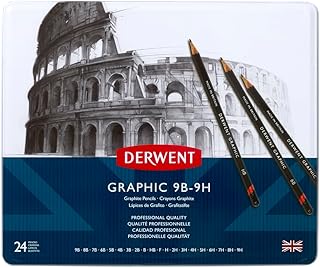
The Liquidraw Graphite Drawing Pencils – Set of 12 is the product in this guide with the most weight behind it: 4.6 out of 5 stars from 673 verified reviewers is a robust, trustworthy signal. The set covers 4 hard grades and 8 soft grades, delivered in a storage tin that keeps them organised and protected.
For technical drawing specifically, the hard grades are what you’ll reach for most. Grades like 4H, 3H, and 2H produce fine, light lines that are easy to erase cleanly and don’t smear when you rest your hand across them — exactly what you need for construction lines, dimension guides, and preliminary layouts that will later be inked or refined. The softer grades (HB through to the B range) come into play for final pencil-only presentation drawings, shading, and any freehand sketching that informs the technical work. Having the full range in one tin means you’re not caught out mid-project.
The storage tin deserves a mention. Pencil grades are stamped on the barrel, but when you’re reaching into a drawer in a hurry, having them laid out in order in a fitted tin is genuinely useful. Several reviewers mention the tin is robust enough to take on site visits or into a studio bag without the pencils rolling loose or snapping. The pencils are described as fitting a standard sharpener — check the product description for current compatibility details, but standard 7 mm barrel diameter is typical at this format.
One tradeoff worth naming: this is a 12-piece set with a bias toward soft grades (8 soft, 4 hard). Pure technical drafters who work almost exclusively in hard grades might find themselves burning through the H-range quickly and barely touching the softer ones. If that’s your workflow, you might supplement with a small additional pack of 4H or 5H pencils. But for most people — students, illustrators, and practitioners who move between technical and presentational drawing — the balance is sensible and the quality across the range is consistent.
Best Drawing Board for A3 Technical Work
A proper drawing surface transforms what’s possible with hand tools. The Preciva A3 Drawing Board is a multi-function technical drafting table with a parallel motion accessory, measuring 51 × 36.5 cm and working in metric — the standard for UK professional and academic drawing. It’s designed to give you a flat, stable base with a parallel rule that travels up and down the board smoothly, replacing the need for a T-square on a separate drawing board.
The parallel motion mechanism is the core feature to evaluate here. A parallel rule that doesn’t bind, drift, or wobble gives you consistent horizontal lines without repositioning your set square every time. This board’s parallel motion accessory is attached and tensioned through the board itself, which keeps the setup compact and portable — important if you’re moving between a desk and a studio or lecture room. The board surface is suited to A3 sheets, which covers the majority of academic and hobbyist work; if you regularly need A2 or A1, you’d need to look at larger professional boards.
The important caveat to acknowledge: this listing currently shows zero verified buyer reviews on amazon.co.uk. That’s unusual for a product that’s been listed for some time, and it means you’re relying on the specification description and the brand’s reputation rather than peer experience. Preciva makes other drawing and art products in the UK market, and the specification — parallel motion, metric system, A3 format — is coherent and well-described. But without reviews, there’s inherent uncertainty around build quality in practice: does the parallel rule stay true over time, is the surface smooth enough for fineliner work without tooth showing through? These are questions only sustained use can answer.
If you’re setting up a drawing workspace and need a parallel-motion board at a modest outlay, this is worth considering — but go in with eyes open. If you can find a product with stronger review backing in this category, that may offer more certainty. For someone converting a corner of a spare room into a proper drawing setup on a careful budget, though, the Preciva A3 represents a practical starting point.
Best Specialist Pen Nib for Professional Technical Pens
If you already own or are investing in a technical drawing pen system, the rOtring Isograph Technical Drawing Pen Replacement Nib – 0.35 mm is a category leader that has been proven across decades of professional use. With 4.5 out of 5 stars from 632 verified reviewers, this is one of the most confidently recommended specialist components in the UK technical drawing market.
The rOtring Isograph system is the benchmark for technical pen drawing. Isograph pens use a tubular nib with a weighted cleaning wire inside that keeps the ink channel clear during drawing and helps prevent drying. The 0.35 mm nib sits in the middle of the common width range — fine enough for detailed line work and annotation, wide enough not to clog with normal use. It’s the size most professionals reach for first when setting up a new pen, because it handles the majority of drawing tasks from outline to dimension lines without requiring a nib change mid-session.
This listing is specifically a replacement nib, not a complete pen — so it’s for people who already have an Isograph pen body, or who are buying a body separately and want the 0.35 mm width specifically. The Isograph nib system uses a proprietary fitting, and replacement nibs allow you to extend the life of a quality pen body significantly rather than discarding the whole instrument when the nib wears. Several reviewers note that the nib replacement is a worthwhile repair rather than a false economy — the Isograph body continues to perform well after nib replacement if properly maintained.
The main consideration is commitment: you’re buying into a system here, not a standalone tool. rOtring Isograph pens require specific Indian ink or Isograph-compatible drawing ink, regular cleaning, and some patience with the setup process. For a student who wants to dip a toe into technical pen drawing, a disposable fineliner is a lower-maintenance starting point. But for anyone serious about hand-inked technical work — architects, illustrators, or engineers who draw by hand regularly — the Isograph system is the professional standard, and this nib is the consumable that keeps it running.
What to Look For When Buying Technical Drawing Supplies
- Tool quality at the joints and mechanisms: In compasses and dividers, the joint quality determines whether your settings hold. Metal spring-bow compasses maintain a radius setting under drawing pressure; friction-fit plastic ones drift. For ruling pens and technical pens, look for ink channels made from stainless steel or brass rather than plastic — they resist corrosion and clean more reliably.
- Pencil grade range suited to your work type: Technical drawing calls predominantly for hard grades (2H to 4H) for construction and dimension lines, with HB and softer grades for presentations and annotations. A set biased heavily toward soft grades is a sketching set, not a drafting set. Check the grade breakdown before buying.
- Ink type compatibility: For technical pens and fineliners, waterproof pigment-based ink is the professional standard. It allows you to erase pencil guidelines beneath dried ink, withstands humidity, and scans or photocopies cleanly. Dye-based inks may bleed when wet and fade faster under light.
- Nib width selection: Different line weights are fundamental to readable technical drawing. Aim to have at least three widths available — typically something in the fine range (around 0.1–0.2 mm), a medium range (0.35–0.5 mm), and a heavier outline weight (0.7 mm or above). Single-width pen sets will limit what you can produce.
- Board size and parallel motion type: Match your board size to your typical sheet format — A3 covers most academic and hobbyist work, while professional architectural or engineering practice often needs A2 or larger. Parallel motion rules are more reliable than freestanding T-squares for consistent horizontal lines. Check whether the board surface is smooth enough for fineliner work — some cheaper boards have a texture that bleeds fine nibs.
- Storage and portability: If you move between a studio, a desk, and site visits, a set in a fitted tin or case is worth paying a small premium for. Loose pencils snap and lose their sharpness grade markings; unprotected compass legs bend and lose calibration.
- Review depth and recency on amazon.co.uk: A product with several hundred UK reviews over multiple years gives far more confidence than one with a handful of recent ratings. For specialist components like pen nibs, look for consistent comments about longevity rather than first-impression feedback alone.
Verdict
For most readers arriving at this guide — whether you’re a student setting up your first proper drawing kit, a hobbyist returning to technical illustration, or a practitioner who needs reliable hand tools alongside digital work — the single most impactful starting point is a quality graphite pencil set. The Liquidraw Graphite Drawing Pencils – Set of 12 earns the top recommendation here: 673 verified reviews at 4.6 stars is genuine confidence, the grade range covers both technical and presentation drawing, and the tin format keeps your pencils usable rather than scattered. From there, the Liquidraw Technical Drawing Professional Set – 8 Piece fills out your geometry tools for an affordable outlay, and if you’re serious about inked technical work, the rOtring Isograph replacement nib is the component that signals you’re working at a professional level. Build your kit incrementally — start with pencils, add a solid compass set, and invest in a pen system once you know you’ll use it consistently.
We were not paid to feature any specific product in this guide. All opinions are independent and based on publicly available specifications, verified buyer feedback patterns, and category research.
Quick Comparison Table




FAQ
What is the difference between a fineliner and a technical drawing pen?
Fineliners are disposable pens with a fixed, fibre-tipped nib — convenient and low-maintenance, but once the nib wears or the ink runs out, you discard the whole pen. Technical drawing pens (like the rOtring Isograph) use a precision tubular metal nib and are refillable with specialist drawing ink. They produce more consistent line widths over the nib’s lifespan and are the professional standard for hand-inked technical work, though they require regular cleaning and proper ink management.
Which pencil grades are best for technical drawing?
Hard grades — typically 2H, 3H, and 4H — are the workhorses of technical drawing. They produce fine, light lines that are easy to erase cleanly and don’t smear when your hand passes over them, making them ideal for construction lines, layouts, and dimension guides. HB is useful for annotations and general line work that needs to stay visible. Soft grades (B and above) are better suited to presentation shading and freehand sketching rather than precision drafting.
Do I need a parallel motion drawing board, or is a T-square enough?
For occasional or hobbyist use, a T-square on a flat board works fine. But a parallel motion board is noticeably more efficient for sustained technical work — the rule travels up and down the board on tensioned cords, staying perfectly horizontal without you having to reposition it from the board edge. This reduces errors and speeds up the drawing process considerably. If you’re doing regular technical work, the parallel motion board pays for itself in fewer alignment mistakes fairly quickly.
Can I use waterproof fineliner ink over graphite pencil lines and then erase the pencil?
Yes, and this is standard practice in technical drawing. Once waterproof pigment-based ink has fully dried on the paper — allow at least a minute or two, longer in humid conditions — you can erase the pencil guidelines beneath it with a soft, clean eraser without disturbing the ink. The key is to use a proper soft eraser (not a hard gum eraser that drags) and to work gently. Test on a spare sheet first if you’re working with a new ink or paper combination, as some rough papers can lift ink if erased aggressively.
What size drawing board do I need for academic or professional technical drawing?
A3 (roughly 42 × 59.4 cm) covers the vast majority of student and hobbyist work, including most architectural detail drawings, engineering diagrams, and design sheets. If you regularly work on A2 sheets — common in some architecture programmes and professional studios — you’ll need a correspondingly larger board. A3 boards are significantly more portable and affordable, so unless your course or practice specifically requires larger sheets, start at A3.
How do I maintain a rOtring Isograph or similar technical pen to prevent clogging?
The most common cause of clogging is letting the pen sit unused with ink in the nib for extended periods. After each drawing session, cap the pen immediately. If you’re not going to use it for more than a few days, flush the nib with clean water using the pen’s disassembly process (remove the nib unit and run it under a gentle flow of warm water). Use only compatible drawing ink — Indian ink or purpose-made technical pen ink — and avoid standard calligraphy or fountain pen ink, which often contains gum binders that dry hard and block fine metal nibs.