You ordered three bags of compost online last spring. One sat wet and airless around your container tomatoes for weeks, leading to root problems you only noticed when the plants started yellowing. Another was so lightweight that your hanging baskets dried out completely between waterings, even in mild weather. And the raised bed you filled with something labelled “garden soil” compacted into a solid, drainage-resistant slab after the first decent rainfall.
The frustration is built into how this category is sold. “Multi-purpose compost,” “potting mix,” “topsoil,” and “planting medium” are used interchangeably in many listings, even though they describe genuinely different products with different functions. Add in the fact that heavy bags of soil and compost are expensive to return and slow to redeliver, and a wrong buy stings twice.
This guide is for UK gardeners who want to order planting media online with confidence. Whether you’re filling a raised bed, refreshing compacted borders, or potting up containers and houseplants, the five picks below match specific scenarios to specific products — and are honest about where the evidence is strong and where it’s thinner.
How the Picks Were Evaluated
Each product was assessed against a consistent set of criteria: intended use (containers, open ground, raised beds, or soil conditioning), composition claims (organic content, peat-free status, added nutrients), bag size relative to practical value, and brand reputation in the UK market. Where listings carried verified buyer reviews, patterns in that feedback shaped each write-up directly. Two products in this selection — Rockberry Top Soil and Laeto Organic Manure — carry meaningful buyer review counts and hold strong ratings from buyers who have used them in UK gardens; those sections are grounded in real buyer experience. The remaining three products carry no verified buyer reviews at the time of writing. This is flagged clearly in each relevant section, and their inclusion rests on product specifications, listed ingredients, and brand positioning rather than aggregated buyer experience.
Best Premium Topsoil for Raised Beds and Lawns
The Rockberry Top Soil 25 Litre is the most evidence-backed product in this selection: it holds a 4.9 out of 5 rating from 21 verified buyers, making it the best-reviewed option among the picks here. For topsoil especially, that consistency matters — quality can vary significantly between batches and suppliers, so knowing real UK gardeners have had positive experiences with it adds genuine confidence.
What separates it from generic bags labelled “soil” is the quality processing behind it. The listing describes it as enriched, graded, and screened to an even texture — and crucially — lime-free and chalk-free. Proper screening removes stones, clumps, and debris, giving you a uniform material that performs consistently in raised beds and produces level surfaces on lawns. The lime-free status matters if you plan to grow acid-preferring plants such as blueberries, heathers, rhododendrons, or azaleas, all of which need low-pH conditions that lime-contaminated soil actively undermines.
The 25-litre bag suits smaller-scale projects: topping up a rockery, patching a lawn, improving a border section, or filling a compact raised planter. If you’re filling a standard raised bed from scratch — say 120cm × 60cm × 30cm deep — expect to need around eight or nine bags. Calculate your volume before ordering and buy in a single transaction rather than adding bags piecemeal; soil and compost settle after the first watering, so slightly overfilling is better than coming up short once plants are in.
On its own, topsoil is nutritionally sparse — it gives structure and weight but won’t sustain hungry plants through a full growing season without supplementary feed. The most effective approach for vegetable raised beds is to blend topsoil with well-rotted organic matter in roughly a 70:30 ratio. The Laeto Organic Manure in the next section pairs naturally with this approach, combining structural stability from the topsoil with slow-release nutrients from the organic matter.
Where this product isn’t the right choice: containers and pots. Topsoil is too dense for enclosed planting — it compacts around roots, limits aeration, and drains poorly in pots. For container work, the multi-purpose options later in this guide are the appropriate medium. For raised beds, borders, lawn repair, and rockery projects where graded topsoil is what you actually need, Rockberry is a confident first pick backed by real buyer evidence.
Best for Conditioning Tired Garden Soil
If your borders have been worked hard for several seasons without amendment — or if you’ve moved into a property where the soil looks compacted and pale — the Laeto Organic Manure Natural Soil Enrichment 50 Litre is exactly the kind of input that makes a lasting difference. It holds a 4.8 out of 5 from 17 verified buyers, a strong result for a product whose outcomes depend as much on the condition of your starting soil as on the product itself.
Organic manure functions differently from compost or topsoil. It’s a soil conditioner: you dig or fork it into existing beds and borders to improve structure, stimulate microbial activity, and release nutrients slowly over time. Clay soils become more workable and better-draining. Sandy soils that shed water too rapidly begin to retain moisture more effectively. These are improvements that compound year-on-year rather than simply carrying plants through one season.
The 50-litre bag is practical for treating a couple of borders or a medium-sized vegetable bed. Buyer feedback indicates gardeners are using it primarily for vegetable plots and established flower borders rather than for potting up containers — which aligns with where this type of product performs best. Organic manure is an input to blend into your existing soil, not a ready-to-use growing medium in its own right. Don’t use it as a container compost or expect it to function as a standalone potting mix.
The “natural soil enrichment” description suggests processed or well-rotted organic matter rather than raw manure. This distinction matters: raw manure can burn plant roots and carries pathogens that need months to break down safely before planting. A processed or kiln-dried product can be worked into soil and planted into relatively quickly. If you plan to apply it near actively growing plants or within a few weeks of planting, verify the processing status in the product description before ordering.
Timing matters considerably with this type of amendment: autumn or early winter is the ideal application window, giving soil biology several months to integrate the material before the spring growing season begins. An autumn application to beds you plan to plant in March or April produces noticeably richer, more workable soil than a hurried spring dig-in. A spring application four to six weeks before planting also works if you missed the autumn window. Applied consistently year after year, this kind of organic input gradually transforms the structure and fertility of tired UK garden soil in a way no single-season fix achieves.
Best Compost for Containers and Houseplants
The Laeto Multi Purpose Compost 60L is positioned as a potting soil suited to both garden planting and container growing, which makes it a flexible option if you don’t want to maintain separate bags for different jobs. It’s worth stating upfront that this product carries no verified buyer reviews on Amazon at the time of writing, so the assessment here draws on product specifications and brand positioning rather than aggregated buyer experience — factor that into your confidence level accordingly.
The 60-litre bag works well for container gardeners who need enough material to fill several pots or baskets in a single session without needing equipment to move it. Multi-purpose compost at this volume suits repotting established houseplants, filling hanging baskets and window boxes, refreshing container-grown shrubs, or blending with perlite or horticultural grit for plants that need sharper drainage. The listing describes it as suitable for both indoor and outdoor use, which points to a medium-weight blend rather than something ultra-lightweight or particularly dense.
If your project scales up — multiple raised planters, a serious container collection, or a series of grow bags — Laeto offers the same compost in a 120L bag and a 240L bag, both carrying the same product specification. The 240L option is equivalent to four standard 60L bags, reducing the number of delivery events significantly. Bear in mind that large compost bags at high moisture content can be very heavy — the 240L option in particular may need a trolley or two people to shift from the drop-off point.
One area worth checking before you order: the peat question. The UK has progressively discouraged peat use in home gardening, and many products that previously used peat as a base are reformulating with wood fibre, coir, or composted bark. Without detailed labelling visible in the Amazon listing itself, confirming the current peat status of this specific product requires checking the product description page directly — especially if environmental credentials matter to your purchasing decisions.
Without buyer reviews to draw on, the honest position is this: a flexible-volume compost from a brand offering multiple size options, suited to container planting and general garden use. A single-bag trial before committing to a larger order is the sensible approach — assess texture, drainage, and how your plants respond over a few weeks before scaling up.
Best All-Garden Multi-Purpose Compost
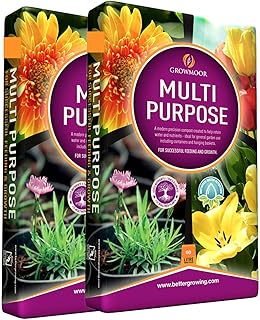
The Growmoor Multi-Purpose Compost for Use All Around the Garden is aimed at gardeners who want one product covering beds, borders, containers, and baskets without specialist blending. Like the other unreviewed picks in this guide, it carries no verified buyer reviews on Amazon at this point, so this write-up draws on product specifications and Growmoor’s standing as a recognised UK compost brand rather than direct buyer data.
Growmoor has supplied bagged compost to UK garden centres and retailers for several years, giving it more market context than newer, less-established listings. The 60L bag is a standard size for this category — enough to fill a good number of pots or to work into a border section. The product description references healthy growth, vibrant flowers, and strong roots, which suggests the inclusion of a starter nutrient charge rather than a purely structural, unfed medium. That’s useful if you’re filling containers and want the compost to carry plants through the first few weeks without immediate supplementary feed.
If you need more volume, a bundle of two 60L bags of the same compost is available through a separate listing: the CB FUELS 2 × 60L Growmoor Multi Purpose Potting Compost. It’s the same compost under a different seller account and pack count. If the pricing works out and you’re tackling a larger project, the bundle saves a delivery event.
The practical limitation of any multi-purpose compost applies here: it’s a reasonable compromise for most tasks rather than the ideal formulation for any specific one. It won’t drain sharply enough for cacti and succulents without amending with grit or perlite. It won’t be rich enough to carry hungry crops like tomatoes through an entire season without supplementary liquid feed. For general seasonal planting — summer bedding in containers, patio pots, mixed border top-dressing — it handles the job without requiring multiple specialist products alongside it.
If you’re leaving containers planted up outdoors through a UK winter, mixing in roughly 20% perlite or horticultural grit reduces the risk of roots sitting in waterlogged compost during extended wet periods. Store any unused material in a closed or tightly clipped bag in a sheltered spot — compost left in a split bag through wet autumn weather degrades quickly and loses its useful structure.
Best Eco-Conscious Potting Mix
The Munnie 60L Multi-Purpose Compost Soil Bag is marketed as an eco-friendly, nutrient-rich potting mix suitable for both outdoor plants and indoor growing. Like the other zero-review products in this guide, there are currently no verified buyer reviews on Amazon for this listing. The assessment below is based on the product’s stated credentials and market positioning, not buyer experience — that context is worth keeping in mind when weighing it against the reviewed options above.
The eco-friendly framing is the product’s main differentiator in this group. Peat-free composts have grown considerably in the UK market as gardeners and industry respond to government targets and RHS guidance discouraging peat use. Products with eco positioning typically use composted wood fibre, coir (coconut husk fibre), green compost, or a blend of these as their base material — though confirming the exact formulation requires checking the listing description directly rather than relying on marketing language alone.
At 60L, the bag suits a typical repotting session or seasonal planting project. The listing describes it as suitable for seeds, outdoor garden plants, and indoor houseplants — a wide range of applications that each carry genuinely different growing requirements. Seed compost performs best when it’s fine-textured and low in nutrients, to avoid scorching emerging seedlings. Indoor plant compost generally needs good moisture retention. Outdoor container media benefit from structural stability and free drainage. A single product claiming to serve all three is an ambitious positioning, and in practice, multi-purpose blends are a compromise rather than optimal for any individual use case. If you’re germinating seeds in volume, a dedicated seed compost will typically give better germination rates than a general potting mix.
Where Munnie could offer real value is for the gardener who prioritises environmental credentials alongside everyday function and wants a peat-free option for established outdoor or indoor containers. At 60L, it’s a low-commitment first trial — if the drainage and texture work well in your pots, scaling up on future orders is simple. If eco-sourcing is non-negotiable and other options don’t make their peat-free status sufficiently clear, this product’s positioning makes it worth a first-time test.
Without buyer reviews to draw on, treat this as a product worth monitoring as its review history develops. Eco-formulated composts can perform very well or can underperform on drainage and structure depending on their specific blend — until real buyer feedback accumulates, that distinction is difficult to call with certainty from the outside of the bag.
What to Look For When Buying Compost, Topsoil, or Planting Media
- Understand the product type before you order. Topsoil, multi-purpose compost, potting mix, and organic soil conditioner serve different functions. Topsoil adds structure and weight — right for raised beds and lawns, too dense for containers. Compost works in both settings but is lighter. Potting mix is formulated specifically for container drainage. Soil conditioner (organic manure) is dug into existing soil and is not a standalone growing medium.
- Check peat-free credentials explicitly. The UK is progressively phasing out peat for home gardeners. Look for listings that clearly state “peat-free” and verify the ingredient list where possible. A product simply described as “compost” may still contain peat unless stated otherwise — assume nothing and check the detail page directly.
- Calculate your volume before ordering. Multiply the length × width × depth of your project (all in metres) to get cubic metres, then multiply by 1,000 to convert to litres. A 120cm × 60cm × 20cm raised bed needs around 144 litres. Buy everything in one order — heavy bags are costly to return and compost in split bags outdoors loses quality quickly.
- Check pH requirements for your specific plants. Blueberries, rhododendrons, azaleas, and heathers all need acidic growing conditions (around pH 4.5–6.0). None of the five picks in this guide are marketed as ericaceous. If you’re growing acid-lovers, you need a specialist ericaceous compost — standard multi-purpose products or topsoil containing lime will actively work against these plants.
- Think about drainage before you plant. Container plants — especially indoors — are far more likely to suffer from overwatering than underwatering. For succulents, cacti, or any drainage-sensitive species, mix 20–30% perlite or horticultural grit into whichever compost you choose before planting. No general-purpose compost drains sharply enough for these plants without amendment.
- Factor in starter nutrients and when they run out. Many multi-purpose composts include a built-in fertiliser charge lasting roughly six to eight weeks. After that window, plants in containers need supplementary feeding. Check the listing to understand what’s included so you know when to begin a regular feeding programme — nutrient-starved plants in exhausted compost are a common and easily preventable problem.
- Plan delivery and storage logistics carefully. Bags of 60L or more can weigh 30–50kg when moist. Confirm your delivery address allows a safe drop-off and add clear instructions when ordering. Have a wheelbarrow or sack trolley ready. Store any opened surplus in a sheltered spot with the bag sealed — compost exposed to prolonged rain or direct sun in a split bag degrades and loses structure faster than most people expect.
Verdict
For the modal UK gardener — filling or refreshing raised beds, conditioning tired borders, and maintaining a container collection — the two products with verified buyer reviews offer the safest starting points in this selection. The Rockberry Top Soil 25 Litre holds the strongest buyer rating (4.9 out of 5 from 21 reviewers) and is the right choice for structural bed-building, lawn repair, and projects where real, graded topsoil is what the situation calls for. The Laeto Organic Manure Natural Soil Enrichment 50 Litre is the pick for improving existing borders, backed by a 4.8 out of 5 from 17 reviewers who found it consistently beneficial in UK growing conditions.
For general container planting and multi-purpose use, the three unreviewed options — Laeto Multi-Purpose, Growmoor, and Munnie — are all reasonable based on their specifications and positioning. Among the three, Growmoor’s longer UK market presence gives it a slight edge as a first-time order. Whichever you choose from that group, start with a single bag, assess the texture and drainage through one season, and scale up on future orders once you know how it performs in your specific growing conditions.
This guide was not paid for or sponsored by any brand or product manufacturer. All assessments are independent and based on publicly available product specifications, verified buyer feedback patterns where available, and category research.
Quick Comparison Table


FAQ
What is the difference between topsoil and multi-purpose compost?
Topsoil is real garden soil — denser and mineral-rich, suited to raised beds, lawns, and borders. Multi-purpose compost is lighter and rich in organic matter, designed for container growing and general planting. Topsoil gives structure; compost gives fertility and a root-friendly texture. For raised beds, blending both in a roughly 70:30 ratio gets you the practical benefits of each material.
Is peat-free compost as good as peat-based compost?
Modern peat-free composts perform well for most UK garden tasks, including container growing and seed sowing. Some gardeners find they dry out faster in summer and take longer to rewet once very dry — mixing in water-retaining granules or well-rotted organic matter helps manage this. Peat-free growing is strongly encouraged by the RHS and supported by UK government policy targeting the phase-out of peat in home gardening.
How much compost do I need for a raised bed?
Multiply the length × width × depth of your raised bed (all in metres) to get cubic metres, then multiply by 1,000 to convert to litres. A bed measuring 120cm × 60cm × 30cm needs roughly 216 litres — around four standard 60L bags. Order slightly more than your calculation to allow for natural settling and compression after the first few waterings.
Can I use multi-purpose compost for growing vegetables?
Yes — multi-purpose compost works well for vegetables in containers and raised beds. The key issue is supplementary feeding: any built-in nutrient charge is typically exhausted within six to eight weeks, after which plants need regular liquid or granular feed. Heavy-feeding crops like tomatoes, courgettes, and brassicas do best in a richer blend — consider mixing compost with well-rotted organic matter for these plants.
When is the best time to add organic manure to a garden?
Autumn to early winter is the ideal window — dig it into beds before the growing season to give soil biology several months to integrate the material fully. A spring application four to six weeks before planting also works if you missed the autumn, but autumn conditioning generally produces better results by the time summer crops go in.
Is it straightforward to order heavy compost bags for home delivery?
Yes, with some planning. Most couriers leave large garden bags at the threshold rather than carrying them through to the garden — add clear delivery instructions when ordering. Bags of 60L can weigh 30kg or more; have a wheelbarrow or sack trolley ready from the outset. Store any opened surplus in a sheltered spot with the bag sealed or tightly folded — compost in split bags exposed to prolonged wet weather loses structure and condition quickly.