Your garden pond earns its keep through the summer months: the fish circling at feeding time, the water lilies, the gentle backdrop of a pump working away. Then September arrives and the evenings close in. By seven o’clock the whole thing might as well not be there. You’ve probably already tried the first obvious fix — a few solar floating balls or some lanterns propped along the pond edge. In a UK garden, solar lights are a predictable let-down. By October they’re producing barely twenty minutes of faint glow before the charge runs dry, and the string of grey overcast days means they never fully recover between uses. You search for mains-powered underwater lights and immediately hit a wall of nearly identical product listings, all claiming IP68 waterproofing, all featuring the same stock photography of a glowing blue koi pond, most with descriptions that raise more questions than they answer.
That confusion is entirely understandable. Pond lighting is a relatively niche category, and the marketplace is dominated by similar-looking products with varying build quality. The difference between a set that works reliably across three seasons and one that floods and fails after the first hard frost is not always obvious from the listing. Get it right and your pond becomes a proper evening feature, with light moving through the water, the surface alive with colour, and the whole garden looking completely different after dark. Get it wrong and you are back on Amazon within a fortnight, returning a set of lights with a failed connector.
This guide covers five specific mains-powered pond lights available on Amazon UK right now, evaluated against real buyer feedback and the practical requirements of a UK garden pond. Each pick is assessed honestly, including where it falls short, so you can match the right product to your specific situation.
How These Picks Were Selected
The evaluation for this guide prioritised five main criteria. First, IP rating: only products carrying IP68 certification were considered for submersible use, since this rating indicates testing for continuous submersion rather than just splash resistance. Second, control method: the balance between the simplicity of a remote and the added capability of app control was assessed for practical garden use. Third, light head count and coverage: how many heads a set includes, and whether that translates realistically to the stated coverage area. Fourth, review pattern analysis: products with consistent complaints about connector failure, dim output, or short lifespan were excluded regardless of headline rating. Fifth, ease of installation: whether a typical garden owner with a standard outdoor socket could install the product without specialist help.
Review data from verified Amazon UK buyers was the primary evidence base, with particular weight given to long-term use reports from buyers who described using the lights across more than one season. Only mains-powered sets were included; solar pond lights are not dependable enough for the UK climate to merit a place in a guide aimed at results you can rely on.
Best Overall: NATPOW Pond Lights Mains Powered, RGB Submersible Lights
NATPOW Pond Lights Mains Powered, RGB Submersible Lights, IP68 Waterproof Aquarium Spot Lights Colour Changing with Remote/App Control is the most reviewed product in this guide, sitting at 143 reviews and a 4.2-star rating. That is the widest evidence base of any pick here, and the main reason it takes the top recommendation. In a category where a higher-rated product might have a dozen reviews from launch week, a 4.2-star set with over a hundred buyers behind it tells you considerably more about what to expect from real use.
The core design is a set of submersible RGB spotlight heads, each rated IP68, designed to sit on the pond floor and project light upwards through the water column. This placement creates the most effective result for a garden pond: light travelling through moving water produces a dynamic, rippling effect on the surface and illuminates the water itself rather than simply hitting it from the side. Fish become visible as silhouettes against a lit background, and plants in and around the water catch the reflected glow. It is a more engaging effect than you get from edge-mounted spotlights, and it is what most buyers are looking for when they picture a lit pond at night.
The RGB colour-changing function covers the expected range of red, green, and blue, with various combinations and a warm white mode. Remote and app control both feature, which matters for practical use once the lights are positioned on the pond floor. The remote works at standard garden distances and the app extends control flexibility for those who prefer their phone as the primary interface.
The honest limitations: at this price tier, the connectors between cable sections are the component most likely to cause problems. Some buyers report a connector starting to admit water after extended submerged use, particularly if not properly secured during installation. This is a category-wide issue rather than a specific NATPOW weakness, but it reinforces the importance of careful installation. Take time to engage each connector fully and consider running a small bead of waterproof sealant around each joint before submersing the set. The colour modes can also veer towards vivid rather than atmospheric; the warm white static mode is what you will use on most evenings, while the colour-cycling options are better suited to occasional entertaining than as a permanent garden setting.
For a standard UK garden pond in the two-to-five-metre range, wanting reliable mains-powered lighting with colour flexibility and solid buyer evidence behind it, this is the sensible starting point. The review base is substantial enough to trust, installation is straightforward via a plug-in transformer, and the underwater submersible effect delivers what most pond owners are looking for.
Best for App and Bluetooth Control: T-SUN RGB Pond Lights Mains Powered Submersible LED Underwater Fountain Spotlights
T-SUN RGB Pond Lights Mains Powered Submersible LED Underwater Fountain Spotlights with Bluetooth APP Control IP68 Waterproof for Aquariums carries the highest rating in this guide at 4.7 stars from 37 reviews, providing a promising early signal. The feature that sets it apart from everything else here is Bluetooth app control, and for garden use this is a more meaningful upgrade than it might first sound.
A standard infrared remote requires line of sight to the transformer. In a garden where the transformer is tucked behind a raised bed, beneath a deck, or inside a weatherproof housing, pointing the remote in roughly the right direction often becomes a mild irritation. You find yourself moving to get the right angle or holding the remote at arm’s length hoping for the best. Bluetooth removes that constraint entirely. The app on your phone connects to the receiver via Bluetooth with no line of sight required, which means adjusting colour, brightness, and mode from your garden chair is smooth and consistent without having to move.
Beyond the control method, the Bluetooth app interface typically gives you more granular colour selection than a button-cycling remote. Instead of stepping through preset colours in sequence, you can select from a full colour wheel. If you want a specific shade of warm amber, a deep teal, or a pale ice blue, you can dial it in precisely rather than accepting whatever preset cycle happens to be closest. For buyers who care about the exact colour temperature of their evening garden lighting, this is a real functional difference.
The submersible spotlight design with IP68 rating puts it on the same technical footing as the NATPOW set in terms of waterproofing and placement options. Where it differs is primarily in the control experience and, based on the early review pattern, in build quality that may be slightly better, though the smaller review sample makes this harder to state conclusively. What the early reviews consistently note is that the Bluetooth connectivity works reliably and the colour output is bright and accurate.
The limitation to be aware of is ecosystem compatibility: Bluetooth covers standard garden distances but will not integrate with Alexa, Google Home, or most smart home automation systems. If you want your pond lights tied into a broader home automation setup with scheduled routines, a Wi-Fi-connected device would be required. For most garden owners who simply want to turn the lights on and choose a colour without pointing a remote at the transformer, Bluetooth is entirely sufficient. The T-SUN is the pick for anyone who wants the best control experience at this price point.
Best Multi-Light Set with Timer: POPOSOAP RGB Underwater Pond Lights 6-in-1 with Timer
POPOSOAP RGB Underwater Pond Lights 6-in-1 with Timer, IP68 Waterproof stands apart from the other picks in this guide in two specific ways: the six-head configuration and the built-in timer. Both features are more useful for real-world pond owners than most of the supplementary options that pond light listings tend to emphasise.
Six individual light heads mean you can spread illumination across a proper area of the pond rather than clustering everything in one spot. A typical two-to-four-head set tends to create a well-lit zone and a darker zone, which is noticeable in a pond of any real size. With six heads you can position one near the pond inlet, one at the far end, one under a lily pad grouping, one directed at a piece of feature rock. The result is a more even spread of light across the whole water surface rather than one bright patch and a large dark area. This takes more planning during installation, since six cable runs need routing and six heads need positioning, but the visual result is significantly more polished than what a basic two or three-head set achieves in a mid-sized pond.
The timer feature deserves specific attention. Most pond lights are either on or off, controlled manually. A built-in timer lets you programme the lights to come on automatically as it gets dark and switch off at a set time, without needing a separate outdoor timer socket. That changes how you interact with the lights entirely. Rather than something you need to remember to operate, they become part of the garden’s automatic evening routine. You come home and the pond is already lit. You go to bed and the lights have already turned themselves off. For any buyer who wants properly low-maintenance pond lighting, this is the feature worth prioritising.
The rating is 4.5 stars from six reviews, which is a small sample. Take this as a promising early signal rather than a thoroughly validated conclusion; there is not yet enough volume of long-term buyer feedback to make confident statements about multi-season durability. What can be said is that no consistent failure mode has emerged in the early reviews, which is a reasonable starting point for a product in this category.
If your pond is in the three-to-six-metre range and you want coverage across the full surface with the convenience of automatic timer operation, the POPOSOAP 6-in-1 is worth considering. Plan the cable routing carefully before installation, since six heads on one cable run means committing to a specific layout, so test positions before you start securing anything permanently in place.
Best for Larger Ponds: T-SUNUS 8-in-1 Pond Lights Mains Powered with APP/Remote Control
T-SUNUS 8-in-1 Pond Lights Mains Powered with APP/Remote Control is the right consideration when you are dealing with a substantial garden pond, six metres or more across, where a four or six-head set would leave significant areas in darkness. Eight individual light heads give you the broadest coverage of any product in this guide and the flexibility to distribute lights across distinct zones of a large pond.
The 3.9-star rating from 23 reviews puts this in honest mid-tier territory. It is not the highest-rated product here, but the review pattern does not flag a consistent failure mode. The mixed-in lower ratings tend to reflect installation complexity rather than a fundamental product defect. With eight heads, routing and securing all the cable runs takes considerably more time than a simpler set, and buyers who underestimate that tend to leave frustrated reviews that do not reflect the product’s actual performance. Approach an 8-in-1 installation with a proper plan: mark out where each head will sit before you start, measure cable runs, and establish where the transformer will live. The process is manageable for a systematic installer.
App and remote control are both included, giving practical flexibility. The remote is useful for quick adjustments from close range; the app extends control to wherever you are in the garden. The RGB colour options follow the standard pattern for this category, covering static colours, a white mode, and various cycling or fade effects. Having both control methods means you are not dependent on your phone being charged for basic operation.
The honest trade-off with an eight-head set at this price point is individual light output per head. More heads at the same overall power input means each head produces less light than a dedicated high-output three or four-head set at a higher price. For a large pond where you want ambient illumination spread across the whole surface, that is the right trade-off; you are prioritising coverage rather than creating a single intense focal point. If you have a smaller pond and want to dramatically highlight one specific feature such as a waterfall inlet or a specimen plant at the water’s edge, fewer more powerful heads would serve you better than eight smaller ones.
For large wildlife ponds, formal koi ponds with significant surface area, or any water feature where spread matters more than intensity, the T-SUNUS 8-in-1 is the logical step up from the smaller sets in this guide. Plan the installation carefully and the results across a large water surface will be considerably more impressive than what any of the smaller sets can achieve.
Best for Landscape and Feature Spotlighting: NATPOW Pond Lights, RGB Underwater Spotlights Mains Powered
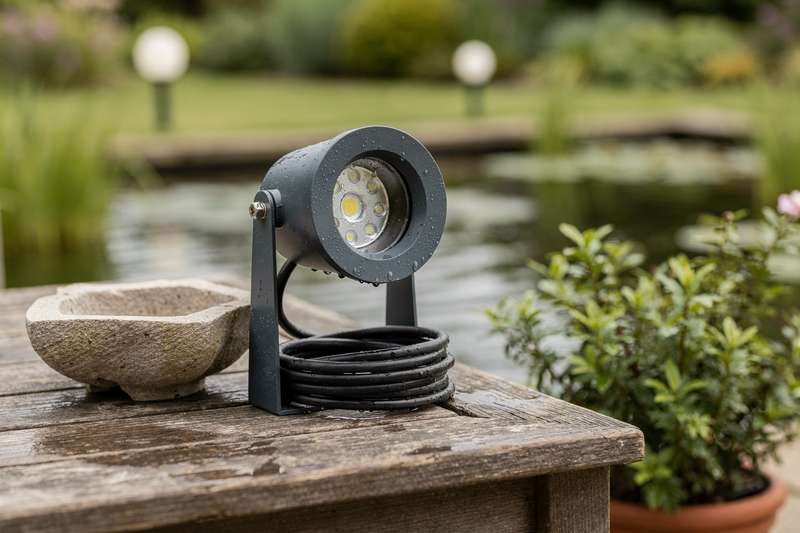
NATPOW Pond Lights, RGB Underwater Spotlights Mains Powered, IP68 Waterproof Aquarium Pond Light with Remote/APP Control, Submersible Landscape takes a different approach from the other picks in this guide. Where the submersible sets above are designed primarily to illuminate the water itself (sitting on the pond floor and projecting light upward), this product’s landscape spotlight orientation is built for directed feature lighting: highlighting specific elements at and around the pond edge rather than illuminating the water column from below.
The practical distinction matters more than it might initially seem. If you have a well-planted pond surround (ornamental grasses, irises, hostas, a specimen tree close to the water), directed spotlight lighting picking out those plants from below can be more visually interesting than making the water glow. The light grazes across plant stems and leaf textures, creates upward-thrown shadows, and frames the pond in a way that general underwater illumination does not achieve. Similarly, a pond built into a rockery often looks more compelling with spotlights picking out individual rock faces and plant pockets than with the water simply glowing from below.
The IP68 waterproof rating means these can be positioned at the waterline or shallowly submerged for a lower angle of effect, not purely on dry land. With 49 reviews and a 4.0-star rating, this is a well-enough-tested product to recommend with reasonable confidence; it has the second-largest review sample in this guide. Remote and app control are both included, matching the control feature set of the NATPOW submersible set, and the RGB colour options offer the same range of modes.
The consideration that makes this a distinct section rather than a duplicate NATPOW pick is how you will actually use it. If your pond sits in an open lawn with no particular planting or structural features around it, a landscape spotlight pointing at grass is not going to create a compelling effect; submersible lighting from below is the better choice for that scenario. But if your pond has interesting architecture (a waterfall outlet, a planted margin, a piece of decorative rock or driftwood), directed spotlights turn those features into evening focal points in a way that underwater illumination alone cannot match.
The ideal application is combining this with a submersible set: underwater lights to illuminate the water, and directed landscape spotlights to light the surround. Together, the two approaches create a more fully composed evening feature. If your budget allows only one set right now, choose based on what your pond offers — more to gain from illuminated water, or illuminated surroundings? That question answers the choice between this pick and the NATPOW submersible set reviewed above.
What to Look for When Buying Pond Lights
- IP rating and what it actually means: IP68 is the right baseline for any light permanently submerged. The IP (Ingress Protection) rating describes resistance to solids and liquids: 68 indicates full dust-tightness and tested continuous submersion at depth. IP67 covers submersion to one metre for 30 minutes, which is acceptable for very shallow or semi-submerged positions. Avoid anything rated IP65 or below for underwater placement; that rating covers water jets and spray, not sustained submersion in a pond.
- Light head count vs pond size: One or two heads suit a small container water feature or a single focal point. Three to four heads cover a garden pond up to roughly three metres across. Six heads are appropriate for a medium pond where you want spread across the full surface. Eight heads work for larger ponds where coverage matters more than intensity per head. More heads means more cable routing and more connectors to seal, so factor in installation effort as well as cost before choosing on head count alone.
- Control method: An infrared remote requires line of sight to the transformer, which can be awkward once the transformer is tucked away behind planting or under cover. Bluetooth app control removes that constraint and gives finer colour control via a full colour wheel. Wi-Fi integration allows smart home automation and scheduling but adds cost and setup complexity. For most pond owners, a remote or Bluetooth app is entirely sufficient; only pursue Wi-Fi connectivity if you specifically want the lights to integrate with a broader smart home system.
- Timer function: A built-in timer is more useful than most buyers initially recognise. It automates your evening lighting routine without requiring a separate outdoor timer socket. Check whether the timer is programmable (you set specific on/off times, ideal for daily use) or duration-based (runs for a set number of hours after manual activation, less convenient for a fixed routine).
- Connector and cable quality: The connector (the point where cable sections join) is the most common failure point across this product category, not the LED heads or the transformer. When installing any multi-head pond light set, engage each connector fully, follow the instructions carefully, and consider applying a small bead of silicone sealant around each joint before submersing the cable. That five-minute step during installation can prevent a mid-season replacement.
- Transformer placement: All mains-powered pond light sets in this category use a low-voltage transformer that must be kept dry and cannot be submerged or left in direct rain without shelter. Plan where the transformer will sit relative to your outdoor socket and the pond edge, and make sure the cable length from transformer to pond is sufficient for your specific layout before buying.
- Colour accuracy vs expectation: RGB colour in marketing photographs is captured in controlled dark environments with clear water, designed to show the lights at their most vivid. In a real garden pond with tinted water, varying depth, and ambient light from the house, the same lights look different. Warm white static mode is typically the most useful and most flattering setting in practice. Check that any product you consider includes a usable static white mode alongside the RGB options.
Verdict
For the typical UK garden pond (a feature pond in the two-to-five-metre range, a standard outdoor socket available, wanting dependable mains-powered lighting with colour flexibility and a straightforward installation), the NATPOW Pond Lights Mains Powered, RGB Submersible Lights is where to start. It carries the largest review base of any product in this guide, the feedback pattern is consistently solid on core criteria, and the combination of remote and app control is practical for garden use. Installation via a plug-in transformer is achievable for most garden owners without specialist help, and the underwater submersible effect is what most pond owners are looking for.
If Bluetooth app control and more precise colour selection are priorities, the T-SUN RGB set is the natural upgrade — the highest-rated product in this guide — and its Bluetooth interface is a genuine step up from infrared remote control in a garden setting. For larger ponds where coverage area matters more than intensity per head, the T-SUNUS 8-in-1 is the logical choice. And if your pond has distinctive surrounding planting or structural features that deserve as much attention as the water itself, the NATPOW landscape spotlight set is a strong complement to or substitute for a standard submersible set.
Whatever you choose: install connectors carefully, shelter the transformer, and test light positioning before dusk on installation day so you can see exactly what each head illuminates as the natural light fades. The difference between a thoughtfully installed and a hastily installed pond lighting set is significant, in both how it looks and how long it lasts.
We were not paid to feature any specific product in this guide. All opinions are independent and based on publicly available specifications, verified buyer feedback patterns, and category research.
Quick Comparison Table


FAQ
Are mains-powered pond lights safe to use in water?
Yes, provided you choose a product with an IP68 waterproof rating and the set uses a low-voltage transformer to step down from mains voltage before the cable enters the water. This configuration (transformer on dry land, low-voltage cable in the pond) is standard across mains-powered pond light sets and is the safe approach for garden pond use. Never use a standard household light near water, and never submerge any component that is not explicitly rated for it.
What is IP68 and why does it matter for pond lights?
IP68 is an ingress protection rating indicating a product has been tested for continuous submersion at depth, sealed against both dust and water under sustained conditions. For pond lights sitting on the pond floor permanently, IP68 is the minimum you should accept. IP67 covers submersion to one metre for 30 minutes and is adequate for very shallow or edge-mounted lights. Ratings below IP67 cover only splash or spray resistance and should not be used for any submersed application.
How many light heads do I need for my pond?
A rough guide: one to two heads for a small container water feature or a single focal point, three to four for a garden pond up to about three metres across, six heads for a medium pond where you want coverage across the full surface, and eight heads for larger ponds where spread matters more than intensity. It is generally better to slightly overspecify; adding a second set later means additional cable routing and another power connection to manage.
Can I leave pond lights in the water all year round in the UK?
IP68-rated pond lights are designed for continuous outdoor and underwater use, so year-round submersion is generally within their specification. The main UK-specific concern is hard frosts: when a shallow pond freezes solid, the expansion of ice places mechanical stress on light heads and connectors. Many pond owners remove lights during extended freezing periods as a precaution, inspecting and resealing connectors before reinstalling in spring. In milder UK winters, most buyers leave their lights submerged year-round without problems.
Do I need an electrician to install mains-powered pond lights?
Usually not, if you already have a functioning outdoor socket. Mains-powered pond light sets use a plug-in transformer that connects to your existing outdoor socket, with low-voltage cable running from there to the pond. No hardwiring is required for this type of installation. If you do not have an outdoor socket and need one installed, that work requires a qualified electrician and must comply with Part P building regulations in England and Wales.
Why do RGB pond lights look different from the product photos?
Product photography for pond lights is typically shot in completely dark conditions with clear water, designed to show the lights at their most vivid. In a real garden pond, water clarity, colour, depth, algae, and ambient light from the house all affect how the light appears. Green-tinted water shifts the colour of any light passing through it. The best approach is to maintain clear pond water and test light positions before dark on installation day, so you can see exactly what each head illuminates as the natural light fades.