Picture this: an HMRC letter arrives requesting documents related to your most recent tax return. You know the relevant paperwork exists — you’re certain of it — but twenty minutes later you’re on your hands and knees emptying a plastic crate in the spare room, surrounded by takeaway menus from 2022, birthday cards you meant to recycle, and a vehicle insurance certificate from a policy that expired eighteen months ago. Or it’s January, your energy supplier has raised your direct debit, and you want last year’s bills to make the case for reducing it — but they’re filed somewhere in a system that made sense when you set it up and has since become impenetrable.
Paper chaos is one of the most mundane and consistently underestimated sources of household stress. It doesn’t announce itself the way other problems do; it accumulates in small daily increments — two minutes here, ten minutes there — until a genuinely important document goes missing and the cost becomes real.
The solution is not complicated. It’s specific. The right filing product for your situation, set up correctly once, makes document retrieval a thirty-second task for the rest of the year. The wrong format — or no system at all — keeps sending you on paper hunts every time something official needs to be produced. The challenge is that “filing products” is a broader category than it appears. Lever arch files belong on a shelf for long-term archival; an accordion organiser belongs in a bag for portable sorting; a steel file box belongs on a desk for regular access; suspension files go inside the box to divide it into categories. Pick the wrong format for your workflow and you’ve solved nothing. This guide covers four distinct formats — one pick per format — matched to the specific scenarios where each one works best.
How These Picks Were Evaluated
All four products in this guide had limited buyer review data available, so this guide does not draw on aggregated buyer feedback. Instead, evaluation is grounded in detailed specification analysis, product design logic, material quality indicators, and practical category knowledge developed across a wide range of UK home and office filing products. Each pick was assessed against: explicit A4 compatibility (non-negotiable for UK documents), closure security and structural integrity under document load, capacity relative to typical UK household or small-office paper volumes, labelling flexibility, portability versus static-use suitability, and whether the product format logically serves its stated use case. Where the same product exists in multiple colour variants under different listings, only one representative listing is featured — other colours are noted within that section.
Best Portable Document Organiser — ABC life Expanding File Folder, 12 Pockets A4 Accordion File Organiser
If you’re a freelancer who carries invoices to client meetings, a landlord managing documents across multiple properties, or someone whose current “filing system” consists of papers spread across the kitchen worktop, the ABC life Expanding File Folder, 12 Pockets A4 Accordion File Organiser is the format that will improve your daily document management most immediately. It’s lightweight, self-contained, and requires no external storage infrastructure — the complete system lives in one portable unit that drops into a bag or sits on a desk without taking up much space.
The accordion format works differently from a ring binder or a plain folder. Instead of a single cavity you stack papers into, an accordion organiser has multiple individual pockets — twelve in this case — that expand independently of each other. Each pocket is a self-contained slot that keeps its contents separate from the adjacent one, even when you’re carrying the organiser at an angle or reaching into it quickly. Documents in one category stay in that category, which is not something you can rely on with a traditional flat folder once it’s been in use for a few weeks.
Twelve pockets is a well-chosen count for UK household and small-business needs. It’s enough to organise by month — January through December — making it an effective current-year receipts and expenses system for anyone who needs to produce records for self-assessment. Alternatively, set it up by broad category: utilities, insurance, banking, vehicle documents, medical correspondence, council tax, subscriptions, and a few spare pockets for documents that don’t fit neatly elsewhere. Either approach gives you a complete, portable document management system in a single unit.
Setting up the system takes less time than you might expect. Decide whether you want a temporal system (month by month) or a categorical one (by document type), write the labels, slide them into the tab holders on each coloured divider, and the organiser is ready to use. The rainbow colour scheme serves a practical purpose here: once you associate each colour with its category, you can locate the right pocket by colour before reading the label, which cuts retrieval time meaningfully once that association has become automatic.
The honest limitations are worth knowing upfront. An accordion organiser is an active-documents tool, not a long-term archival system. As individual pockets fill with a full year’s worth of documents, the organiser becomes unwieldy and retrieving papers from the back of a pocket gets awkward. The right approach is to use it as a current-year carrier: once a year is done, transfer the contents to lever arch files on a shelf and start fresh. Buyer feedback for this specific listing is limited; the recommendation is grounded in the format’s track record and the product’s specifications rather than customer review data.
When the organiser arrives, check the closure mechanism — a snap button or elastic cord closure keeps the unit sealed in a bag and prevents papers from shifting between pockets in transit. Without a secure closure, the categorisation falls apart quickly. The A4 sizing accommodates all standard UK documents without folding or trimming. For anyone who has been managing loose papers informally, this is the format that produces the most immediate and noticeable change to how organised documents feel from day to day.
Best for Colour-Coded Filing — Cathedral Products A4 Assorted Colour Suspension Files with Clip on Index Tabs and Inserts, Pack of 10
Suspension files are the classic format for desk-side and cabinet-based filing, and the Cathedral Products A4 Assorted Colour Suspension Files with Clip on Index Tabs and Inserts, Pack of 10 is the version that makes this format as practical as it can be for a UK home or small-office context. If you already own a steel file box, a filing cabinet, or a suspension file crate — or if you’re buying one alongside this pack — these ten colour-coded files give you a complete, labelled, ready-to-use filing setup from day one.
The suspension file format was designed for speed of access. Unlike a ring binder where you open the cover, locate a section, and flip through pages, a suspension file hangs openly from rails inside a box or cabinet — all the tab labels are visible simultaneously. You spot the right category, lift the file, and extract a document in a single motion. For a filing system you interact with several times a week, that speed advantage compounds into meaningful time savings over a year of regular use.
Cathedral Products is a well-established name in UK office supplies. Their suspension files are designed to A4 specification and hang from rails inside steel file boxes or standard filing cabinet drawers. The plastic frame along the top of each file is the structural load-bearer — it rests on the rails and keeps the file hanging upright under the weight of loaded documents. The quality of that frame matters: low-quality alternatives warp or soften over time, causing files to hang at an angle and making tabs difficult to read and documents awkward to retrieve.
The assorted colour set is what makes this pack particularly useful. When you open a file box with colour-coded hanging files inside, you identify your category visually before reading any label. Assign colours to categories consistently — utilities in one colour, financial records in another, insurance in a third — and the association becomes reflexive within days of use. The clip-on index tabs included in this pack hold paper inserts for writing category names; because the tabs are removable, you can relabel files as your system evolves without replacing the files themselves.
The key caveat before buying: suspension files are not freestanding. They need something to hang in — a steel file box with integrated rails, a filing cabinet drawer, or a dedicated suspension file crate. If you don’t already own compatible storage, budget for it separately. Ten files cover the core categories for most households and small-office setups; if your system needs more sections, order a second pack of the same product to maintain a consistent colour scheme across the box. Avoid overstuffing individual files — too many documents in a single slot slows retrieval and stresses the hanging frame over time.
This is the right purchase if you’re setting up or expanding a filing system in a fixed location — a home office, a kitchen cupboard, a study — and want colour-coded categories with labelling included from the outset. Buyer feedback is limited for this specific listing; the recommendation rests on Cathedral’s established UK office supplies track record and the practical, well-specified product design.
Best Lever Arch Files — Oxford A4 Lever Arch Files, 3 Pack of Pastel Glossy Filing Folders
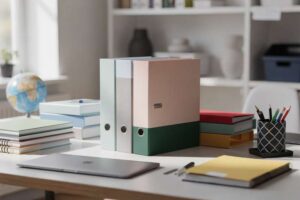
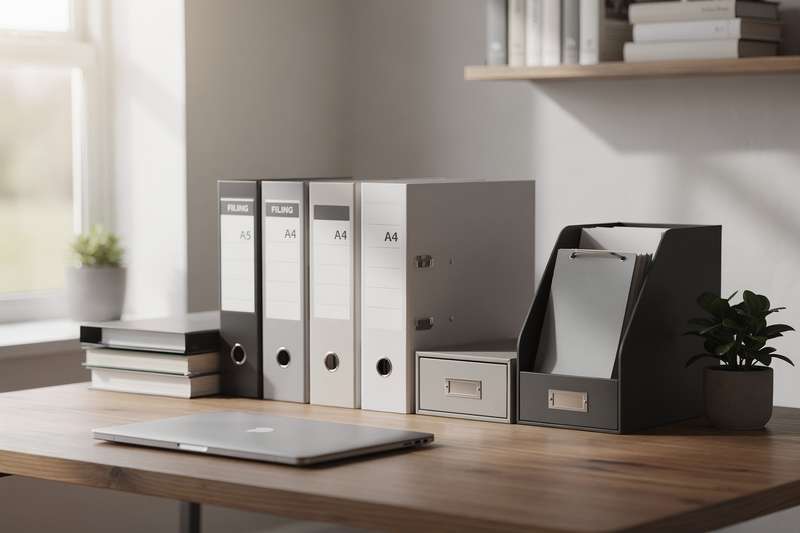
For documents that need to be permanently organised and kept accessible for months or years — annual tax records, vehicle service history, product warranties, mortgage paperwork, insurance certificates — lever arch files are the correct format. The Oxford A4 Lever Arch Files, 3 Pack of Pastel Glossy Filing Folders puts one of the most trusted names in UK office stationery behind a product that addresses the most common failure point of cheaper lever arch alternatives: the long-term reliability of the lever mechanism itself.
Oxford’s lever arch files are a fixture in UK accountancy practices, schools, and home offices because the lever mechanism is consistent over years of use. The arch inside a lever arch file opens and closes thousands of times across its working life while keeping both rings precisely aligned. If the rings develop even a slight offset — a common failure in cheaper binders — pages sit unevenly, document order becomes unreliable, and punched holes begin to tear under misaligned pressure. Oxford’s mechanism is built to a higher manufacturing tolerance, which matters when you need to retrieve a document from a binder that has been sitting on a shelf for three or four years.
The pastel glossy covers serve a practical purpose beyond visual appeal. Glossy card resists surface scuffing better than plain card or matte finishes, which matters for binders stored on open shelving and handled repeatedly over years. The pastel colouring lets you differentiate between multiple binders at a glance — a useful detail when you have several binders that would otherwise look identical from across the room. Labelling a pastel spine with a printed insert or a handwritten label is also easier to read at distance than a label applied over a dark or heavily patterned cover.
The 3-pack format is practical for UK home filing. Most households that use lever arch files need at least three: one for financial records (payslips, pension statements, tax correspondence), one for household utilities and contracts (energy supplier, broadband, council tax notices), and a third for miscellaneous important documents (vehicle records, insurance certificates, product warranties, medical correspondence). Getting three matching binders from a single order gives you a consistent, labelled shelf from the start rather than a patchwork of different products accumulated over time.
Lever arch files work best with hole-punched documents. Standard A4 hole punchers create two holes at the top of a page that slot directly onto the two-ring arch, keeping documents in a fixed, indexed order. Loose documents without holes can be placed in plastic wallets and added to the binder, but they tend to shift if the binder is moved frequently. For documents you access only occasionally and want kept in a fixed sequence — the defining characteristic of archival records — this format suits that purpose exactly.
The main limitation is that lever arch files are shelf-bound and not suited to frequent in-out retrieval of individual sheets. These are not documents you carry in a bag. For active current-year documents you handle regularly, use an accordion organiser or suspension files and move completed records to a lever arch binder at the end of each year. Buyer feedback for this specific Oxford listing is limited; the recommendation is grounded in Oxford’s category reputation and the practical utility of the 3-pack format for UK home archival needs.
Best Steel File Box — Cathedral Products A4 Steel File Box with Starter Pack of 5 Suspension Files (Black)
For anyone who wants a complete, self-contained filing station on a desk or in a cupboard without committing to a full filing cabinet, the Cathedral Products A4 Steel File Box with Starter Pack of 5 Suspension Files – Black is the most practical entry point to suspension file-based filing in the UK. It arrives as a working kit — the steel box, integrated hanging rails, and five suspension files included — so you can set up a functional filing system immediately after it arrives without ordering anything else first.
The steel construction is the core advantage over plastic equivalents. Steel holds its shape under the sustained weight of document-laden suspension files. A lower-quality plastic file box develops an outward bow in its sides as the weight increases — this causes files to angle inward, makes tab labels harder to see, and eventually makes the rails difficult to engage cleanly. Steel does not flex in this way. The box is heavier than a plastic equivalent, which matters if you plan to carry it between locations frequently, but for a unit that sits on a desk, a shelf, or in a cupboard, that rigidity works in your favour: the box stays put when you’re retrieving a document one-handed.
The starter pack of five suspension files gives you five immediately usable categories. For a household, that might be: utilities, banking and finance, insurance, vehicle documents, and a miscellaneous category. For a freelance or small-business setup: active clients, completed work, invoices, expenses, and admin. Either way, you’re operational as soon as you’ve written the tab labels. When you need to expand beyond five categories, the box accepts standard A4 suspension files from any compatible brand — including the Cathedral colour suspension file pack featured elsewhere in this guide, which slots straight in without requiring different equipment.
The Cathedral file box and the Cathedral suspension file pack are designed to work cohesively together, but the box is not limited to Cathedral files. Any standard A4 suspension file fits the integrated rails, giving you flexibility to expand as your needs grow. Adding the colour-coded Cathedral suspension files reviewed separately in this guide creates a visually organised, colour-differentiated system within the same box — a straightforward expansion that improves retrieval speed without replacing any existing components.
The lid fits securely, which matters if the box is stored in a cupboard or stacked with other items. The A4 interior accommodates standard UK documents without folding. The black finish is neutral and suitable for a professional desk environment. If you prefer a different colour, the same product is also available in grey, blue, red, and pastel pink under separate listings — identical specification, different shell colour. All colour variants are the same product at core; choose whichever suits your workspace.
The honest constraint is capacity. A compact file box holds a finite number of suspension files, and once those files are full, you’ll need a second box or a proper filing cabinet to continue expanding. For most households managing one to two years of active documents, a single box handles the load comfortably. For a growing small business with larger document volumes, treat this as a strong starting point rather than a permanent solution. Buyer feedback is limited for this listing; the recommendation reflects Cathedral’s established position in UK office filing and the practical logic of the all-in-one kit format.
What to Look For When Buying Filing Products
- A4 compatibility: UK documents — official letters, payslips, utility bills, bank statements, HMRC correspondence, and council tax notices — are almost universally A4 (210 × 297mm). Always verify that a filing product is explicitly A4-rated. Some products list “letter size,” which is an American standard slightly shorter than A4; a full A4 document in a letter-size folder or binder will buckle at the bottom. If a listing does not specify A4, check the dimensions: 297mm is the critical measurement.
- Format for your workflow: Choose the format that matches how you actually access documents. Suspension files in a box or cabinet suit broad categories you dip into regularly and want fast access to. Lever arch binders suit long-term archives kept by year or topic. Accordion organisers suit portable use and active current-year sorting. Many effective home filing systems combine two formats — accordion for the current year, lever arch for completed records — without any overlap between them.
- Material and structural quality: For file boxes, steel is significantly more durable than plastic under sustained document load. For suspension files, look for a reinforced plastic frame at the top that won’t warp under the weight of full files. For lever arch binders, the manufacturing tolerance of the lever mechanism determines longevity — a misaligned arch tears punched holes over time. For portable accordion folders, polypropylene (PP) covers are more tear-resistant than standard card.
- Closure security: Any portable filing product — accordion organisers, expanding folders — needs a secure closure to prevent papers from spilling in transit. Snap closures, elastic cord loops, and zip enclosures all function well. Open-topped designs are fine only for static storage. For file boxes, a well-fitting lid matters if the box will be moved between rooms, stacked, or stored in a cupboard where it isn’t always upright.
- Labelling flexibility: A filing system you can’t update as your needs change quickly becomes a source of friction. Look for products that include repositionable label tabs or insertable paper inserts rather than only space to write directly on the file itself. Clip-on index tabs that can be removed and replaced allow your category system to evolve without replacing the files or binders themselves.
- Capacity per pocket or binder: Lever arch files are typically measured by spine width — a 75mm spine holds roughly 750 sheets. Accordion pockets are usually quoted in sheet capacity per pocket. Suspension files can hold a substantial number of loose A4 pages, but overstuffing makes retrieval slow and stresses the hanging frame. Estimate your document volume and leave room to grow before committing to a capacity.
- Colour-coding: Assorted colour sets — whether suspension files, folder tabs, or differentiated binder spines — meaningfully speed up document retrieval by allowing visual identification before you’ve read a label. Where a colour-coded set and a monochrome equivalent are available at a similar price point, the colour-coded version pays back its cost in daily retrieval time savings over the life of the system.
Verdict
If you’re building a filing system from scratch and want the single most complete and immediately usable starting point, the Cathedral Products A4 Steel File Box with Starter Pack of 5 Suspension Files – Black gives you a working system out of the box — steel construction, integrated rails, and five suspension files ready to label and use. When those five categories are full or you need more sections, the Cathedral Products A4 Assorted Colour Suspension Files with Clip on Index Tabs and Inserts, Pack of 10 slots straight into the same box and adds a colour-coded layer without any new hardware.
For documents that have been processed and need long-term shelf-based storage, add a set of Oxford A4 Lever Arch Files — one per year or major topic — so current-year active documents live in the file box while completed records move to a labelled binder on a shelf. For anyone who regularly carries papers between locations, the ABC life Expanding File Folder, 12 Pockets A4 Accordion File Organiser functions as the portable layer of the same overall system.
These four formats cover the full document lifecycle — active portable sorting, desk-side quick access, and long-term archival on a shelf. A system that addresses all three stages gives every document a defined home, which is the point at which paper chaos stops being a recurring problem in your week.
We were not paid to feature any specific product in this guide. All opinions are independent and based on publicly available specifications, product descriptions, and category research across the office filing and organisation sector.
Quick Comparison Table


FAQ
What’s the difference between suspension files and lever arch files?
Suspension files hang from rails inside a file box or cabinet drawer and suit broad categories you access regularly — all tab labels are visible at once, so you can retrieve a document in a single motion. Lever arch files are ring binders that sit on a shelf, better suited for documents you want permanently ordered by date or topic, such as annual tax records or vehicle service history. Most functional home filing systems use suspension files for active current documents and lever arch files for completed archives.
Do A4 filing products work for standard UK household documents?
Yes. Virtually all UK official correspondence — HMRC letters, payslips, utility bills, bank statements, insurance documents, and council tax notices — is printed on A4 paper (210 × 297mm). Any filing product explicitly labelled A4 will accommodate these correctly. Avoid products that list only “letter size” without confirming A4 compatibility, as letter-size is an American standard slightly shorter than A4 and can cause documents to buckle at the bottom of the file.
How many suspension files do I typically need for a home filing system?
Most households function well with eight to twelve suspension files covering broad categories: utilities, banking and finance, insurance, council tax, vehicle documents, medical records, household contracts, and a miscellaneous catch-all. A pack of ten colour-coded files covers those basics comfortably for most setups. If your document volume grows, a second matching pack keeps the system visually consistent without introducing mismatched colours into the file box.
Can I use third-party suspension files in a Cathedral steel file box?
Generally yes. Standard A4 suspension files from most UK brands follow compatible frame dimensions and hang from the same rail spacing used in A4 file boxes. If you are mixing brands, verify that the files are explicitly rated for A4 — not “legal” or “letter” size — to ensure they sit correctly on the rails and the tab labels remain readable above the box edge.
What’s the most portable filing format for carrying documents between locations?
An accordion file organiser is the best format for portability. It’s lightweight, self-contained, separates multiple categories without any hanging hardware, and fits into a bag or briefcase. Look for a snap or elastic cord closure to prevent papers from spilling in transit, and confirm A4 sizing for standard UK documents. A 12-pocket version provides enough sections for a month-by-month receipts system or a category-based household setup in a single portable unit.
How do I keep my filing system from becoming disorganised over time?
File documents on the day they arrive rather than letting an in-tray pile accumulate — this single habit prevents most filing system failures. Keep your categories broad rather than hyper-specific, which makes it obvious where each document belongs and reduces the temptation to leave things unfiled. Transferring the previous year’s completed documents from your active file box into a lever arch binder at the start of each January keeps the active system clear and retrieval fast throughout the year.