Picture this: it’s 8:45am on the morning of your company training day. Sixty delegates are filing into the conference suite, coffees in hand, and you’ve got a stack of flimsy plastic badge holders — the ones you ordered in a hurry three days ago — a box of safety pins that keep springing open mid-conversation, and a table sign asking everyone to write their own name in marker. Half the finished badges are illegible from more than two feet away. One has already drifted to the carpet, face down. The delegate from Manchester has just stabbed her finger on a pin that wasn’t properly closed.
Or your scenario is quieter: the GP surgery where the receptionist’s laminated badge hasn’t been updated since a staff reshuffle two years ago. The high street shop where every team member’s badge looks different because no one ever agreed on a supplier. The school open day where parents can’t tell the teaching staff from the volunteers without a printed programme.
Badge problems come in different shapes, but they all cost you something — professionalism, time, or someone’s goodwill. Getting the right identification badge solution in place is one of those small logistics wins that compounds quietly, every single day. This guide is designed to help you choose the right one for your actual situation.
How We Chose These Picks
To build this guide, I worked through the UK Amazon catalogue for identification badge products — covering clear PVC badge holders, adhesive event badges, personalised printed options, and badge-making supplies. Each pick was assessed on five core criteria: fastening security (does the clip or pin hold reliably on different fabric types without damaging them?), legibility at a normal conversational distance, badge and insert dimensions relative to real-world needs, pack quantity matched to use case, and overall finish quality.
Four of the seven picks have genuine UK Amazon buyer reviews to draw from; where that data existed, I looked for persistent feedback patterns rather than outlier complaints. The remaining three have limited or no buyer review data at the time of writing, and I’ve flagged this openly in each relevant section — factor it in when making your decision.
Best for Everyday Office Use
The Name Badges with Crocodile Clip and Safety Pin Clear Name Badge Holders 5pcs handles its job without drama — which is exactly the quality you want from an everyday office badge holder. Rated 4.5 out of 5 stars by 123 UK buyers, this five-pack has enough real-world endorsement to give you confidence without being so ubiquitous that it’s lost its identity.
The defining practical feature is the dual-fastening system: a crocodile clip on one side and a safety pin on the other. In any environment where staff turn up in different clothing — a blazer one day, a cotton shirt the next, a department uniform that varies by team — this removes a daily decision. The crocodile clip grips firmly onto thicker lapels, belt loops, and lanyard rings; the safety pin handles lighter fabrics where a bulky clip would drag the material sideways. Over the course of a working day, grip security matters: a badge that shifts to a strange angle or drops to the floor mid-meeting isn’t doing its job.
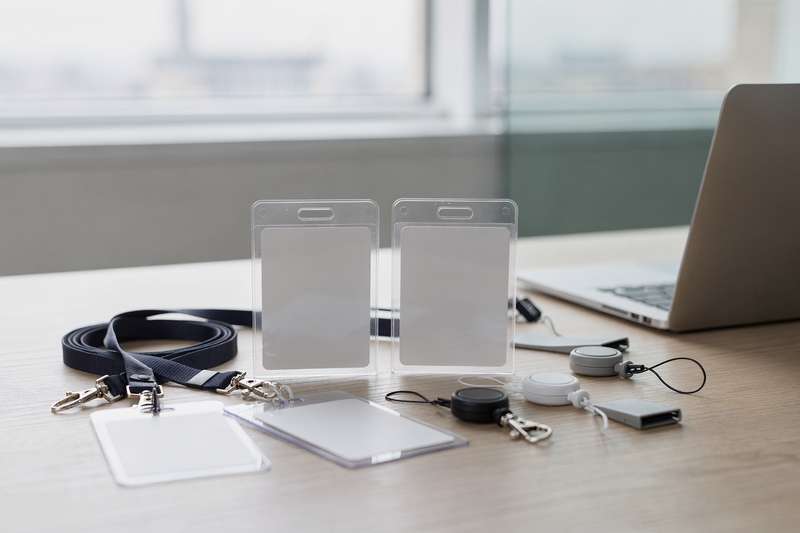
Inside the clear PVC sleeve, a standard insert card shows cleanly from the front. The transparency lets you check at a glance whether the card is centred, whether the print runs to a legible edge, and whether the insert is properly seated before the badge goes on. Because the sleeve is clear on both faces, you can print a secondary detail — a staff ID number, a role code, or a department indicator — on the reverse of the insert, visible through the back of the holder if your workflow uses it.
The 5-pack size is a genuine choice rather than a limitation. A small dental practice, a school department needing a few spares for occasional visitors, or a lean retail team doesn’t need a box of 50 holders gathering dust in the stationery cupboard. Buy what you’ll use, and reorder when you need more.
The tradeoffs are predictable. No insert cards are included, so you’ll need to source, print, or cut these separately — cut your stock slightly smaller than the sleeve opening to allow clean insertion without buckling. The clear PVC surface accumulates fingerprints across the front face by mid-afternoon, which looks untidy in customer-facing environments. And if you need 60 badges for a conference, ordering multiple 5-packs is neither cost-efficient nor practical — look at larger-quantity options for that scenario.
Best for Conferences and Networking Events
The Badgemaster Hello My Name is Name Badge 76 x 32mm (No Dome) Yellow Black has become a fixture at UK corporate events, and its 654 reviews averaging 4.6 out of 5 stars reflect sustained real-world performance across thousands of actual deployments.
The yellow-on-black colourway is the product’s strongest practical asset. High contrast is the single most important factor in badge legibility at distance, and yellow-on-black delivers it consistently. At a networking event, across a buffet table, or from the far side of a meeting room, you can read a name written on one of these badges without squinting or leaning in. The 76 x 32mm format — wide and relatively shallow — suits a bold first name written in thick marker. Write “JAMES” in large letters and it’s readable from two metres. Add a job title and company name beneath that, and the shallow height starts to feel constrained; know your use case before ordering in volume.
The flat no-dome surface is the right practical choice for most event applications. Dome versions have a glossier finish but are harder to write on cleanly — marker ink can pool unevenly on a curved surface, and writing in a hurry at the registration desk produces inconsistent results. The no-dome badge accepts permanent marker directly, dries quickly, and holds the ink well through the event. The domed variant, sold separately on Amazon UK, is better suited to pre-printed labels where writing on the day isn’t required.
Being adhesive-backed, these peel and stick directly to clothing. That’s a significant advantage at a busy registration desk: no clip mechanisms, no safety pin fumbling, no lanyard distribution. The adhesive performs reliably on cotton, polyester, and standard blazer fabrics without leaving residue. On delicate or expensive materials — silk, unlined knitwear, some synthetic blends — there’s a small residue risk, so it’s worth mentioning this to attendees whose garments may be sensitive.
These are single-use consumables. That’s the right model for events and entirely the wrong one for daily staff identification. If the same person will wear the same badge each workday for months, move to a reusable holder-and-insert system instead.
Best Bulk Pack for Ongoing Staff Needs
The EUROPEL Name Badge Holders Pack of 24 addresses something smaller packs leave open: it bundles the holders and blank insert cards together in a single purchase. The full product — Crocodile Clip & Safety Pin | Blank Card Inserts Included | 75x40mm Clear PVC | ID Holder for Office — tells you exactly what you’re getting: a self-contained system you can deploy on day one without supplementary orders.
The 24-pack sits in a genuinely useful middle ground — large enough to equip a small-to-medium team with a comfortable buffer of spares, small enough that you’re not managing surplus stock indefinitely. The 75x40mm format is a widely recognised UK office standard; third-party inserts, printable label sheets, and custom card printing services all tend to support this size or very close to it. If you ever decide to print inserts in-house rather than using the included blanks, you’re working within a well-supported format with widely available templates.
The included blank inserts are a meaningful practical detail. For a hotel with seasonal workers, a GP surgery with rotating locum doctors, or any organisation that regularly processes new team members, having the cards already in the box means you can hand a completed badge to a new starter on their first day without a separate stationery order. Print a sheet of names, cut to size, slot into the holders, and the onboarding process has one less loose end to chase.
The PVC construction and dual clip-and-pin fastening are standard across this category. Where the EUROPEL distinguishes itself is in clip build quality: the crocodile clip action feels slightly more substantial than some no-name equivalents and holds more securely on heavier fabrics — uniform shirts, structured blazers, hospitality tunics — without rotating sideways during a long shift.
A significant caveat: at the time of writing, there are no verified buyer reviews on the UK Amazon listing. I’m working from the product specification, the 75x40mm format’s established track record, and the brand’s reputation in UK office supplies. If you prefer to buy only products with on-platform review history, start with a small test quantity before equipping a full team.
Best Personalised Soft-Feel Badge
The Hippowarehouse Personalised Badge takes a different approach from holder-and-insert systems. Rather than a sleeve for a swappable card, you order a badge with your chosen text printed directly onto it and delivered as a finished item. Rated 4.1 out of 5 stars by 376 UK buyers, it’s a well-established option for businesses wanting a more permanent, polished result than a handwritten insert card can offer.
The case for this approach is straightforward: for a long-term team member whose name and role are settled, a direct-printed badge looks more deliberate than a card slid into a clear PVC sleeve. Customers notice the difference, even when they can’t articulate why. A bar where staff wear the same badge every shift, a salon where returning clients associate a stylist’s name with their experience, a boutique shop where the front-of-house detail is curated — in these settings, a cleanly printed badge signals that the detail has been thought about.
The 4.1 rating is honest rather than exceptional, which reflects the inherent challenge of ordering personalised products online. Colour representation is the most common issue: what looks accurate on a screen doesn’t always match what arrives in the post. Occasional reviewers flag that their chosen shade came through noticeably different — a red closer to orange, a navy reading as royal blue. This is an industry-wide challenge with online badge ordering, not a defect unique to this product, but it makes ordering a single test badge before equipping an entire team a sensible precaution. Check sizing options carefully against the garment and pinning position before committing to a quantity order.
Pin fastening is the attachment method here, reliable on most garments. If your team wears lanyard-based systems rather than pinned badges, this format won’t integrate neatly. But for the classic pinned name badge on a front-of-house uniform, the fastening is appropriate and durable. For pubs, salons, independent shops, and hospitality businesses where the team has settled roles and you want a badge that looks considered rather than assembled in a hurry, this is worth the small additional outlay over a generic holder.
Best Premium Personalised Acrylic Badge
The Personalised Acrylic Name Badge with Pin – Choice of 12 Colours and Text – Work, Schools, Pubs, Shops. steps up from soft-feel printed badges to a more structured, professional finish. Acrylic brings crispness to edges and clarity to printed colour in a way that makes the result look intentional — the kind of badge a well-run school or upmarket hospitality team hands to its permanent staff rather than something sourced at the last moment.
Twelve colour options is more choice than most badge formats in this category offer. Rather than picking from a handful of standard primaries, you can work through the colour chart and find something reasonably close to your brand palette — a specific shade of green for a school, a burgundy for a hotel dining room, a charcoal for a corporate team with a formal dress code. The result is a badge that reads as part of a considered system rather than an isolated purchase. Pin fastening suits the structured garments — blazers, uniform shirts, professional tunics — that typically accompany a badge of this quality level.
The finish also lends itself to longevity. A properly printed acrylic badge holds its appearance through repeated daily use better than soft-resin button badges or insert cards behind PVC. For a team member who will wear the same badge every working day for a year or more, the per-badge cost spread across its full lifespan is more competitive than the upfront price might suggest.
Full transparency: at the time of writing, there are no verified buyer reviews on the UK Amazon listing. The rating displayed on the product page draws from sources outside confirmed UK purchases. I’ve included this pick because the acrylic badge format is well-established and the product specification is clearly stated — but treat it differently from the reviewed picks in this guide. Order a single test badge in your chosen colour, check the match against your branding materials on a properly calibrated screen, and confirm quality before placing a team-wide order.
Best for Badge Making and Craft Projects
The Dyna-Living Badge Making Kit 100 Pcs 58mm (2.25inch) Badge Maker Supplies occupies a completely different space from every other product in this guide. This is not a ready-made badge — it’s a set of components for pressing your own 58mm button-style badges from scratch, rated 4.0 out of 5 stars by 80 UK buyers.
The intended use case is specific: school craft clubs and fetes, community fundraising stalls, birthday parties where making custom badges is part of the activity, charity events where attendees design their own keepsake, or any situation where badge-making is itself the point rather than a preparatory step. If you’re running a primary school art project, a youth club session, or a party where guests take home a personalised pin, this kit is built for those occasions. The 100-piece quantity gives you a full class project or event run with spares to cover mistakes.
The 58mm diameter is the right choice for working within a well-supported ecosystem. It’s the most widely used button badge size in the UK — free design templates are plentiful online, A4 print-and-cut sheets designed for this diameter are readily available, and most badge-making presses in UK schools and community centres are built for 58mm. You won’t be fighting an obscure format when sourcing templates or additional supplies.
One clarification the listing doesn’t always make prominent: this kit supplies the badge components — shells, clear mylar covers, and pin-back closures — but not the badge-making press itself. Assembling finished badges requires a separate press tool to crimp the components together. If you already have access to one (common in school craft rooms and community workshops), this kit covers everything else at a sensible price per badge. If you don’t have a press, factor that additional cost in before ordering.
Buyer feedback at the 4.0 level flags some component tolerance variability — occasionally a shell and back don’t crimp as cleanly as expected, leaving a slightly uneven badge edge. For a school project or a birthday party favour, this is cosmetic and unlikely to matter. For a finished product going on sale at a craft fair, inspect each badge before it leaves your hands. At this price point, for the right use case and with appropriate expectations, the kit delivers on its core purpose.
Best Large-Event Bulk Buy
The 50PCS Name Badges with Clip and Pin, Name Tag 9 x 5.5 cm Name Badge offers one of the larger single-pack quantities in this category on UK Amazon — 50 badge holders in one purchase, suited to conferences, trade exhibitions, school open days, or any event where you need enough badges for a full room without placing multiple separate orders.
The 9 x 5.5cm (90 x 55mm) format is the product’s defining characteristic. These badges are noticeably larger than the 75x40mm UK office standard, and that extra surface area changes what’s achievable on the insert card. At 90mm wide, you have room for a legible name in a substantial font size, a job title on the line below, and a company or organisation name beneath that — all without the text becoming cramped or shrinking below comfortable reading size at a normal conversational distance. For an event where attendees genuinely need to read each other’s names and roles across a table, the additional space has real practical value.
The dual clip-and-pin fastening is standard across this category. Offering both attachment options per holder means you can distribute badges to a mixed-dress-code room without anyone being caught out by an incompatible fastening — the clip handles thicker garments and lanyard loops, the pin handles lighter fabrics without pulling the material out of shape.
An honest caveat that deserves its own paragraph: at the time of writing, this listing has no star rating and no verified buyer reviews on Amazon UK. There is no aggregated real-world experience to draw from — no feedback on clip reliability, PVC clarity, or whether the stated 90 x 55mm dimensions match the physical product accurately. For a high-profile corporate event where badge quality reflects your organisation’s standards, order a small test quantity well in advance of the event date and evaluate them properly before committing to the full purchase. For an informal internal gathering or community event, the risk is considerably more manageable.
Note that the 90 x 55mm insert size is slightly non-standard. Standard credit-card format (85.6 x 54mm) is close but not identical — check your print template or insert stock dimensions against the actual holder before printing a large batch. Getting this wrong on the day of an event is an easily avoided frustration.
What to Look For When Buying Identification Badges
- Fastening type: The three main options are crocodile clip, safety pin, and adhesive. Crocodile clips work well on lanyards, belt loops, and thick lapels; safety pins are better on lighter fabrics where a clip might drag or distort the material. Adhesive-backed badges are fastest to apply at event registration desks but are single-use only. Many modern badge holders include both clip and pin on the same holder, giving you flexibility across a mixed team or event crowd without having to choose one or the other.
- Badge dimensions: The most common UK office format is 75x40mm — sufficient for a name and a short title on a standard insert card, and well-supported by third-party insert suppliers. Wider, shallower formats (around 76x32mm) suit events where a single large name is the goal. Larger formats (90x55mm) give room for multi-line text but require non-standard insert dimensions — always confirm your print template matches the holder before ordering in bulk to avoid mismatched stock on the day.
- Material and finish: Clear PVC holders are functional and cost-effective but attract fingerprints and look utilitarian. Acrylic personalised badges are more durable under daily use and project a more deliberate finish. Button-style soft badges suit casual, temporary, or craft contexts. Match the material to the impression you need to create and the longevity you require from the badge.
- Reusability: Insert-based holders can be reused indefinitely by swapping the card when a person or role changes. Adhesive name badges are single-use consumables — plan your event quantities accordingly. Personalised printed badges are semi-permanent, designed for one named person over a sustained period. Consider your staff turnover rate and event frequency when deciding which model is more economical for your situation.
- Insert compatibility and inclusion: Some badge holders come with blank insert cards included; others supply only the holder. If printing your own inserts, check the sleeve’s internal dimensions and cut your card stock slightly smaller than the opening to allow smooth insertion without buckling. Most word processors and label design tools can be set up to print a full sheet of correctly sized inserts in a single run, which saves significant time when onboarding multiple people at once.
- Pack quantity relative to use case: A 5-pack suits a small team with occasional spare requirements. A 24-pack equips a small-to-medium organisation with a comfortable buffer. A 50-pack or above is the right territory for conference registration or large-scale events. Avoid over-buying — PVC badge holders degrade slowly in extended storage, and surplus stock ties up budget that could be better spent elsewhere.
- Legibility at distance: The whole purpose of a name badge is to convey identity clearly and quickly. High-contrast colour combinations — dark text on white, or white text on a dark background — outperform low-contrast designs at any distance. When handwriting at an event, use a thick-tip permanent marker; ballpoint pen is effectively invisible from more than half a metre. Size the text to be readable from at least one to one-and-a-half metres without squinting — anything smaller defeats the purpose of wearing a badge at all.
Verdict
For most readers — whether you’re an office manager, events coordinator, school administrator, or small business owner trying to make the front-of-house feel more professional — the right pick comes down to one question: are these badges for a permanent team or a time-limited event?
For events, the Badgemaster Hello My Name is badge is the standout recommendation in this guide. Its 654 UK reviews and 4.6-star rating make it the lowest-risk purchase here, and it delivers on its core promise every time: peel, write, stick, done. The yellow-on-black contrast genuinely works at the distances that matter at a conference or networking session.
For a permanent office, school, or retail team, the EUROPEL 24-pack is the most practical setup choice when equipping people from scratch — the included inserts mean you’re operational on day one without a supplementary order. For an existing small team that just needs top-ups and spares, the clear 5-pack holders are the sensible standing order.
If brand presentation matters to your organisation and you want staff wearing something that looks deliberately designed rather than off-the-shelf, the Hippowarehouse Personalised Badge or the Personalised Acrylic Badge are both worth a small test order first. The acrylic option gives the more premium result; the Hippowarehouse has the stronger review base to draw from when making that comparison.
We were not paid to feature any specific product in this guide. All opinions are independent and based on publicly available specifications, verified buyer feedback patterns, and category research.
Quick Comparison Table


FAQ
What is the standard badge holder size for UK offices?
The most widely used format in UK offices is 75x40mm, which accommodates a name and a short job title on a standard insert card. This size is well-supported by third-party insert suppliers, printable label sheets, and custom card printing services, so you’re not locked into buying inserts from the same source as your holders.
What is the difference between a badge holder and a name badge?
A badge holder is a reusable clear PVC sleeve with a clip or pin attachment — you insert a printed or handwritten card and swap it when needed. A name badge is a finished item (adhesive, acrylic, or printed) that displays a specific name and is either a single-use consumable or a long-term personal item not designed to be swapped between wearers.
Can badge holders be reused by different people?
Yes — and this is one of the main advantages of a holder-and-insert system. Remove the existing card, insert a new one, and the holder is ready for the next person. This makes reusable holders well-suited to environments with frequent staff changes, temporary workers, or multi-day events where different attendees need to be badged across sessions.
What is the difference between a domed and a non-domed name badge?
A domed badge has a clear resin bubble applied over the printed surface, creating a slightly raised, glossy appearance that suits pre-printed labels. A non-domed (flat) badge has an uncoated surface that accepts permanent marker cleanly — making it the better choice for handwritten event badges filled in at the registration desk on the day. Domed badges are less practical for handwriting, as ink can bead rather than absorb cleanly on the curved surface.
Do I need a special machine to make button badges?
Yes — a badge-making component kit (shells, mylar covers, pin-backs) requires a separate badge-making press to crimp the parts together; the press is not included in most component kits. Basic 58mm presses are sold separately on Amazon UK, and many schools and community halls already own one — worth checking before purchasing a press alongside your supplies.
Which fastening type is best for name badges?
It depends on what your team or delegates will be wearing. Crocodile clips suit lanyards, thick lapels, and structured garment edges. Safety pins handle lighter fabrics more gracefully and avoid pulling the material out of shape. Adhesive-backed badges are fastest to apply in bulk but are single-use only. For maximum versatility across a mixed team or event crowd, choose a holder that includes both crocodile clip and safety pin — most current UK badge holders offer both on the same unit.