Picture this: it is October, the heating has just gone back on for the first time since spring, and by the third morning you notice condensation running down the bedroom window. A patch of dark mould appears in the corner of the bathroom — the kind you have scrubbed off twice already. You have searched for advice on reducing indoor humidity and found recommendations ranging from opening windows to buying industrial dehumidifiers. The trouble is, none of that tells you what the problem actually is in your specific home, right now, in specific rooms. Is your living room at 55% relative humidity or 75%? Is the conservatory safe for your wooden furniture? Is the nursery at a comfortable temperature for your baby?
A hygrometer answers those questions. For most UK households, getting that data does not require spending a fortune — the challenge is that typing “hygrometer” into Amazon returns dozens of near-identical-looking gadgets with titles so similar it is practically impossible to tell which ones are actually accurate and which are decorative thermometers that happen to show a humidity reading. You may have already bought one that turned out to be unreliable — showing 45% when the damp patch on your wall tells a different story. This guide cuts through that noise.
How These Picks Were Selected
The UK Amazon catalogue for hygrometers runs dozens of entries deep, with overlapping specifications and near-identical product photography. Narrowing down to the most useful picks involved filtering on a practical set of criteria: display readability, stated humidity accuracy, connectivity features such as Bluetooth and app integration, data logging capability, and suitability for specific environments including greenhouses, nurseries, and general living spaces. For products with meaningful buyer review counts — 50 or more — consistent review patterns were weighted heavily, particularly comments about real-world accuracy, longevity, and ease of daily use. Some products in this catalogue are newer UK listings with few or no published reviews; where that is the case, the relevant section says so plainly, and assessment draws on specification comparisons and the broader track record of the brand or product range. The Methodology here reflects what was actually possible with this specific catalogue, not an idealised process.
Best Overall Home Hygrometer
The G.CATACC Room Thermometer Indoor Hygrometer Temperature Humidity Meter is the most reviewed pick in this guide — close to 960 ratings averaging 4.6 out of 5 stars — and that buyer base is the strongest signal you have that a device at this price point actually does what it claims.
What makes it work in practice is that it focuses on doing one job without complication. The display shows both temperature and humidity simultaneously, giving you an at-a-glance picture of room conditions without needing to cycle through menus or modes. That matters more than it sounds when you are checking humidity during a busy morning routine — a clear, always-on dual reading is simply more practical than a device that requires interaction before it shows you anything useful.
Buyer feedback patterns are consistent in praising readability and the fact that readings align reasonably well with more expensive reference devices. There are occasional comments about allowing a couple of minutes for readings to stabilise after moving the unit to a new location, which is standard behaviour for capacitive humidity sensors at this tier. This is not a smart device — no Bluetooth, no app — so if you want remote monitoring, historical data logging, or smartphone alerts, the Govee Bluetooth model reviewed later in this guide is a better fit.
The G.CATACC works best in ambient indoor conditions within the normal domestic temperature range. It is not designed for steam-heavy environments like bathrooms used daily for hot showers, and it will not perform reliably in very cold unheated spaces. For standard living rooms, bedrooms, home offices, and kitchens, it sits comfortably within its operating range. The compact form factor suits shelf, windowsill, or desk placement without taking up noticeable space or looking out of place in a furnished room.
For the majority of UK homeowners who want to start monitoring household humidity — to understand a recurring mould problem, check whether a room is comfortable, or protect wooden furniture from humidity damage — this is the practical starting point. The near-1000 review count gives you the confidence that real buyers have put it to work and found it worth keeping.
Best for Greenhouses and Garden Monitoring
If you grow anything under glass or polytunnel — tomatoes, peppers, orchids, or winter salads — the TempPro Digital Greenhouse Thermo-Hygrometer, Max/Min Garden Thermometer offers something the generic room monitors cannot match: Max/Min temperature and humidity recording.
That Max/Min function is the headline feature for anyone managing plants in an unheated or partially heated structure. Knowing your greenhouse dropped to 4°C overnight — even though it was 19°C when you checked at lunchtime — determines whether your seedlings are at risk before it is too late to act. Plants respond to extremes rather than averages, and a device that only shows the current reading at the moment you check it is considerably less informative for greenhouse management than one that records what happened while you were asleep.
With 256 reviews at 4.4 stars, the TempPro has a meaningful body of UK buyer feedback. The device is built to handle greater temperature swings than a standard indoor sensor — relevant for any unheated structure in the UK, where overnight temperatures can drop sharply from September through April. The display is designed for clarity in variable lighting, which matters when you are stepping into a greenhouse on an overcast morning with limited natural light.
The honest trade-off is that this is a passive, display-only device. It records Max/Min readings and shows them on demand, but does not connect to your phone or send alerts. If you need to be notified when your greenhouse drops below a critical threshold without visiting in person, a Wi-Fi-connected smart sensor would be the more appropriate tool. For most hobbyist growers who visit daily, however, the Max/Min log covers what you actually need — you can see what the sensor recorded overnight as soon as you walk through the door.
Mounting is straightforward: the unit can be hung on a hook or placed on a shelf, letting you position it where it most accurately reflects conditions around your most sensitive plants. If you are running a kitchen garden greenhouse, allotment polytunnel, or a cold frame setup through the UK winter months, this is the most purpose-fit pick in this guide.
Best Budget Pick
The Boulton Small Digital Hygrometer Room Temperature Thermometer sits at the entry end of the price range and makes no attempt to hide it — the design is minimal, the display is compact, and the feature set is stripped back to three essentials: temperature reading, humidity reading, and a comfort-level face icon.
That face icon — a simple expression indicating whether current humidity sits within a comfortable range — is more practical than it appears at first glance. It means you do not need to remember that 40–60% is the healthy humidity zone to get a fast answer. The icon does the interpretation for you, which works well in a shared household, a rental property you are checking for damp, or any situation where you want a quick yes-or-no rather than a percentage to decode. With 51 reviews averaging 4.2 stars, the Boulton has enough real-world feedback to confirm the device is functional and delivers on the basics described in its listing.
The LCD display is compact — readable at arm’s length but not comfortably from across a room. If you plan to mount it somewhere and check it from a few metres away, a model with a larger display would serve you better. On a desk, bedside table, or shelf where you will naturally be within a metre of it, the size is entirely adequate. For bedrooms, home offices, or smaller living rooms, it fits without difficulty.
There are no smart features, no app, and no data logging — just a live current reading in a small form factor at an accessible entry price. The clear trade-off is that you cannot check what conditions were like at 3am and you will not receive an alert if humidity spikes. For someone wanting to start understanding their home’s humidity without a large initial spend, this is a fair entry point, particularly for monitoring a single room where pattern tracking is not yet the priority. Battery consumption has not been a notable complaint in published reviews, suggesting the device is reasonably efficient for a basic display unit.
Best for Smartphone Alerts and App Monitoring
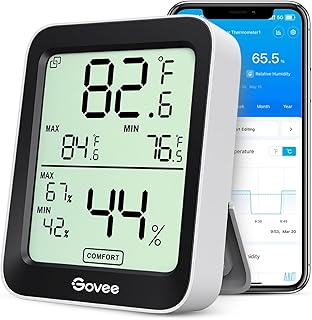
For those who want to go beyond a passive display and actually receive notifications when conditions drift outside a healthy range, the Govee Room Thermometer Hygrometer, Bluetooth Humidity Meter with APP Alert brings smartphone connectivity into the picture at an accessible price point.
Govee is a brand with a well-established track record in this category. In independent professional testing published by home and DIY review outlets, Govee’s Bluetooth hygrometer range has been consistently praised for near-perfect out-of-box calibration, a reliable app experience, and the ability to log historical readings over an extended period — useful for reviewing what happened in a monitored space over days, weeks, or months. The Govee Home app can send alerts when temperature or humidity drifts outside your chosen thresholds, which is a practical feature for monitoring a loft where you store a wooden instrument, a basement wine storage area, or a room where important documents are archived.
Worth noting: this specific UK listing carries no published buyer reviews at the time of writing, so you are relying on Govee’s broader brand reputation and the established track record of this product range rather than UK-specific buyer experience. That is a reasonable basis for confidence given Govee’s standing in this space, but it is not the same as a product backed by hundreds of verified UK purchases. Factor that in before committing.
The Bluetooth connection works within typical room-to-room distances. This is not a Wi-Fi device, so monitoring from outside the home or reliably across multiple floors will depend on your specific layout and where your phone is kept. The display is large and clear, showing both temperature and humidity simultaneously. If you want the combination of a readable on-device display plus app-based alerts and data history, and you are comfortable adopting the Govee Home app, this is the most practical connected option available in this section of the UK catalogue.
Best for Nurseries and Baby Rooms
The TempPro TP157 Digital Hygrometer, Indoor Thermometer, Baby Room Thermometer is positioned specifically for nursery monitoring — a use case where room conditions matter more than many parents initially realise.
Babies are more sensitive to temperature and humidity variation than adults in ways that affect sleep quality and respiratory comfort. UK health guidance recommends keeping a baby’s bedroom between 16–20°C, and humidity significantly outside the 40–60% range can aggravate respiratory sensitivity. A dedicated monitor on the nursery shelf gives parents an objective reference point — particularly useful during night feeds when you are assessing whether the room feels too warm or whether the humidifier needs adjusting, without relying on guesswork.
The TP157 offers a straightforward digital display designed for readability from a typical shelf position. TempPro produces several hygrometer models for the UK market, and this is their nursery-specific design. At 4.5 stars, the product rating is positive, but to be direct: this UK listing carries no published buyer reviews at the point of writing, which means that rating reflects a limited or early sample. Treat it as a newer market entry rather than a product with hundreds of verified buyers confirming its performance in real nurseries.
The device is passive — no Bluetooth, no app, no data logging. For a baby room, that often works exactly as intended: a glance at a shelf tells you the room’s conditions without needing to unlock your phone in the middle of the night. If you want app-based temperature or humidity alerts for the nursery, the Govee Bluetooth model reviewed earlier in this guide is a better fit. For a clean, dedicated display you can read at a quick glance during a night feed, the TP157 is designed with precisely that scenario in mind.
Best for Monitoring Multiple Rooms
The TempPro TP49 Digital Room Thermometer Mini Temperature Monitor, 2 Pieces solves a problem that a single hygrometer cannot: it gives you readings from two rooms at once, letting you compare conditions rather than check one space and guess about the rest.
The value of simultaneous dual-room readings is easy to underestimate until you have them. Knowing your living room sits at 52% relative humidity while the bedroom is at 68% explains directly why that bedroom window has condensation every morning. Knowing upstairs is warmer than downstairs by 4°C in winter points at how heat is moving through your home. Two sensors let you cross-reference rather than guess, and that cross-referencing is often what actually identifies the source of a problem.
Each TP49 unit is TempPro’s compact form-factor design, built for minimal footprint on a shelf or windowsill. The display shows both temperature and humidity readings simultaneously. At a 4.6-star product rating, it scores well relative to its competitors in the catalogue, though the UK listing carries no published buyer reviews yet — treat that rating as preliminary rather than the result of extensive real-world testing. If you are familiar with basic digital hygrometers and want multi-room monitoring from the outset, this pack is an efficient way to begin.
One practical note: the TP49 is compact enough that its display may feel small for users wanting to read it from across a larger room. If display size is a priority — for a shared living area where you check at a glance from a distance — the G.CATACC reviewed as the overall pick offers a more comfortable reading experience. For placing one unit on a bookshelf and another on a hallway table to compare conditions across the house, the TP49 two-pack is sensible and efficient. The same model is also available as a single unit if you prefer to start with one and expand later.
Best Single-Room Compact Option
If you want one dedicated unit with a step up in specification from the entry-level TP49 range, the TempPro TP50 Digital Thermo-Hygrometer, Room Thermometer, Humidity Meter represents a measured progression within TempPro’s own lineup.
The TP50 is a distinct model — different in display design and specification from the TP49, not simply a repackaged version of the same thing. It is built as a standalone thermo-hygrometer for any typical indoor environment: bedrooms, home offices, living rooms, or utility spaces. The simultaneous temperature and humidity display is the core function, delivered in a clean, compact package that will not look out of place on a shelf in a furnished room.
For buyers who prefer not to deal with connectivity features — no Bluetooth to configure, no app to download, no wireless chip drawing on the battery — this kind of simplicity has genuine appeal. You place it on a shelf and it tells you what is happening in the room. Nothing to configure, nothing to update, no software dependency. That is a legitimate preference for buyers who want a reliable display device without the overhead of a connected product.
The honest caveat: the UK listing carries no published buyer reviews yet, which limits the independent evidence available for real-world accuracy assessment. TempPro has multiple models in the UK marketplace with positive ratings, which provides some basis for confidence in the brand’s consistency. But if verified real-world performance is your primary concern, the G.CATACC — with its near-1000 review count — remains the safer starting point. The TP50 suits buyers who specifically prefer TempPro’s compact form factor and are comfortable adopting a newer listing.
What to Look for When Buying a Hygrometer
- Stated accuracy specification: The useful accuracy range for domestic monitoring is ±2–3% relative humidity. A device claiming ±5% accuracy is too imprecise to diagnose damp problems reliably, since that margin overlaps with the boundary of the healthy humidity zone. Look for accuracy figures stated in the product specification, not just in the listing title or marketing copy.
- Display clarity and size: Consider where the hygrometer will sit and how far away you will typically be when reading it. Small LCD screens work at arm’s length; larger displays are more comfortable to read from across a room. If the device will be used by elderly users or those with limited vision, prioritise a larger, high-contrast display over the most compact available option.
- Connectivity and data logging: A passive display shows current conditions at the moment you check it. A Bluetooth-connected model with an app stores historical data and can alert you when temperature or humidity drifts outside your set thresholds. If you are trying to understand a pattern — morning condensation, recurring mould growth in a specific corner — data logged over several days is far more informative than checking a display occasionally.
- Max/Min recording: Even without app connectivity, some hygrometers record and display the highest and lowest readings since the last reset. This feature is particularly valuable for greenhouses, unheated outbuildings, lofts, and rooms where you are not always present — you can see what the sensor registered overnight without needing a phone notification.
- Battery type: Common AA or AAA batteries are easy and inexpensive to replace anywhere in the UK. Some devices use coin cells such as CR2032 or CR2477, which tend to last longer but are less convenient to source locally and more costly per unit. Check what the device requires before buying, particularly if you plan to place it somewhere awkward to access regularly.
- Intended environment: Standard room hygrometers are designed for ambient indoor conditions within a typical domestic temperature range. Greenhouse and outdoor-use models should specify a wider operating temperature range to handle UK seasonal extremes. Avoid placing a basic room sensor in a bathroom with regular steam exposure — this degrades the sensor over time and produces increasingly inaccurate readings.
- Comfort level indicator: Some models include a simple icon or expression alongside the numerical reading to indicate whether humidity sits within a comfortable zone. This is a useful feature for anyone who does not want to interpret a percentage figure every time they check — particularly helpful in shared households where not everyone will remember what the numbers mean.
Verdict
For most UK readers, the G.CATACC Room Thermometer Indoor Hygrometer Temperature Humidity Meter is the place to start. Close to 960 verified reviews at 4.6 stars gives it the most reliable real-world backing in this guide, and the simultaneous temperature and humidity display is clear and practical without any setup or pairing required. It is a passive device — no app, no alerts — but for the majority of households trying to understand whether a specific room has a humidity problem, that simplicity is exactly what is needed.
If your primary use case is a greenhouse or unheated outbuilding, go directly to the TempPro Digital Greenhouse Thermo-Hygrometer instead. The Max/Min recording delivers something no standard room monitor can, and with 256 reviews behind it, there is a meaningful body of evidence that it performs in real garden environments.
For buyers who want smartphone alerts and historical data without visiting the device in person, the Govee Bluetooth model is the logical upgrade — a brand with a strong track record in this category, even if the specific UK listing is relatively new to the market.
Start with a reviewed product, monitor your home’s conditions over a few weeks, and then decide whether the data points you towards something more sophisticated. Most people find that a straightforward display hygrometer answers the question they were actually trying to answer.
We were not paid to feature any specific product in this guide. All opinions are independent and based on publicly available specifications, verified buyer feedback patterns, and category research.
Quick Comparison Table




FAQ
What is a healthy humidity level for a UK home?
The recommended indoor relative humidity range is 40–60%. Below 40%, air becomes uncomfortably dry and can irritate airways and cause wooden furniture to contract and crack. Above 60%, you risk condensation, mould growth, and increased dust mite activity. UK homes in autumn and winter often sit above this range without adequate ventilation or heating balance.
How accurate does a home hygrometer need to be?
For practical domestic monitoring, accuracy within ±3% relative humidity is sufficient to tell clearly whether a room sits within a healthy range. If you are monitoring for a specific application — cigar humidor, musical instrument storage, or archival document preservation — look for sensors rated at ±1–2% for more precise readings.
Can I use a hygrometer in a bathroom?
You can take occasional readings in a bathroom, but leaving a standard digital hygrometer exposed to steam regularly will degrade the humidity sensor over time. Most room-grade hygrometers are not rated for continuous high-humidity steam exposure. If you want ongoing bathroom monitoring, check the device’s maximum rated humidity and operating temperature range before placing it permanently.
Do I need a smart hygrometer or will a basic display model do?
If you want to understand patterns — humidity that builds overnight or spikes when you are out of the house — a model with Bluetooth and app-based data logging will give you far more useful information than a display you check by walking over to it. For spot-checking a room’s current conditions, a basic display is adequate and requires no setup. Most people start with a passive display and consider upgrading once they have a specific reason to.
How do I test whether my hygrometer is reading accurately?
A practical home check is the saturated salt test: place the hygrometer in a sealed container alongside a small cup of water mixed with excess table salt and leave it for six to eight hours. A functioning sensor should read approximately 75% relative humidity in this environment. If your device reads significantly higher or lower, it may need calibration or replacement.
Where should I place a hygrometer in a room for the most accurate reading?
Position the device at roughly mid-wall height in a central area of the room, away from direct sunlight, radiators, air vents, and cold exterior walls. All of these locations produce readings that do not represent average room conditions — a sensor next to a radiator will show artificially low humidity, while one near a cold exterior wall may read higher than the room average. A shelf at head height near the centre of the room is generally the most representative placement.