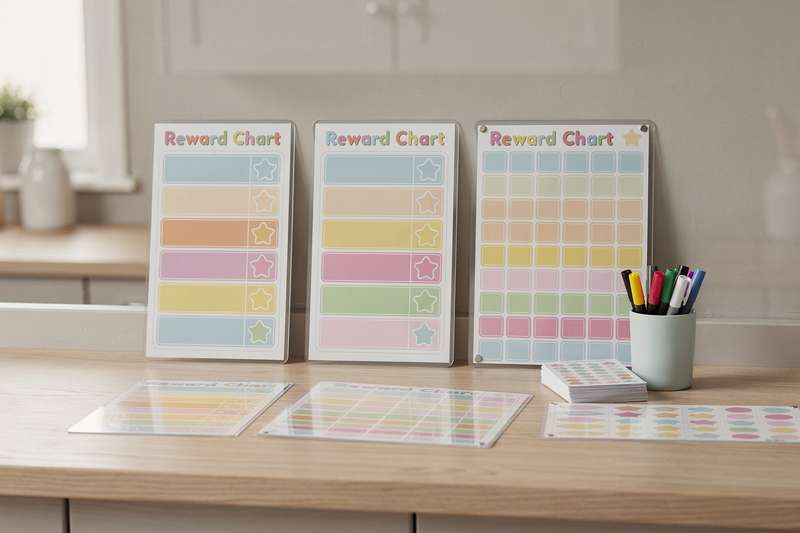
You’ve tried gentle reminders. You’ve tried the firmer voice. You’ve tried the elaborate bedtime negotiations that always end with you conceding one more story just to get five minutes of peace. If getting your child to brush their teeth, tidy their room, or get dressed without a full-scale standoff feels like a daily battle, you’re not alone. A reward chart can change that dynamic — and the psychology behind them is well-established. Children respond to visual progress, immediate recognition, and the satisfying physical act of placing a sticker or moving a star. The problem is not whether they work; it’s choosing the right one for your household.
Search “reward chart” on Amazon UK and you’re immediately faced with dozens of options: paper sticker sheets, laminated magnetic boards, novelty jars, character-themed designs. Some are built to last months; others lose their stickers by the end of the week. Some work brilliantly for a single child; others are designed specifically for siblings. Buy the wrong format and your child will lose interest within a fortnight — not because reward charts don’t work, but because the product wasn’t matched to your household. This guide covers the six best-reviewed options currently available on Amazon UK, with one honest recommendation per scenario.
How These Charts Were Evaluated
Eight reward charts currently listed on Amazon UK were considered for this guide. Two were excluded at the outset because they had no verified buyer reviews — without real-world feedback from parents, there is no reliable way to assess whether a chart holds up to daily use with actual children. The remaining six products had review samples ranging from forty to more than four hundred verified buyers, giving enough signal to identify what works and what trips households up after the first week.
Each product was assessed against five criteria: durability and reusability (does it hold up, and can you reset it without buying replacements?), ease of setup (does it work straight out of the box?), capacity (does it cover one child or multiple?), age appropriateness, and completeness (does it include everything you need, or do you have to source pens and stickers separately?). Recurring patterns in buyer feedback — both consistent praise and consistent complaints — were given significant weight alongside the product specifications.
Best for Siblings: Jaques of London Large Magnetic Reward Chart
If you have two children who both need motivation at the same time, the Jaques of London Large Magnetic Reward Chart is the most practical option in this roundup. Rated 4.6 out of 5 stars from 417 verified buyers — the highest review count here by some margin — it has been tested across enough real households to give solid confidence in how it performs day to day.
Jaques of London is a heritage UK toy and games brand, and that background shows in the quality here. The board is designed specifically to accommodate two children simultaneously, with dedicated sections for each. That structural separation matters more than it might initially seem. Nothing derails a reward system faster than one child feeling the chart belongs more to their sibling, or arguments breaking out over whose star is whose. Clearly divided sections keep things visibly fair, which is half the battle when you’re managing two children with different temperaments and different goals.
The magnetic format is well chosen for a chart you intend to use consistently over months. Sticker-based charts have their appeal — children enjoy peeling and placing — but the supply is finite. Once the stickers run out, the routine breaks. With a magnetic board, your child moves stars across the chart and you simply reset them at the start of a new week. There’s no waste, no ongoing reordering, and the physical action of placing a magnet is satisfying for children in the three-to-eight age range. The chart is positioned for children aged three and above, which aligns with the developmental stage where reward systems start working reliably.
The honest limitation is suitability for very young toddlers. If your youngest is under three, the layout may be more complex than they can meaningfully engage with — though the older sibling would still benefit fully from their dedicated section. The large format also requires a clear display location: you’ll need a reasonably prominent stretch of fridge space or a notice board, not a tucked-away corner where neither child can see it as a daily cue.
Buyer feedback is overwhelmingly positive, with parents frequently noting that the chart sustains engagement over weeks rather than fading after the initial novelty. The main note in critical reviews concerns setup instructions, which some parents found brief. In practice, magnetic reward charts are intuitive enough that detailed documentation rarely matters — but if thorough instructions are important to you, it’s worth knowing. For households with two children aged three to eight who want a system that runs reliably through the year, this is the chart to reach for first.
Best Value Two-Pack: SOL 2pk Magnetic Reward Chart
The SOL 2pk Magnetic Reward Chart takes a different approach to covering multiple children: instead of one shared board with divided sections, you get two completely separate charts — one per child — with dry-wipe pens included. Rated 4.5 stars from 130 reviews, it’s a well-regarded option for households where individual ownership of each chart matters as much as the behaviour tracking itself.
There’s a real argument for separate charts over a shared board. Some children respond noticeably better when their chart feels entirely theirs. They refer to it as their chart, take ownership of it, and track their progress without it being visually tied to what a sibling is or isn’t achieving. When one child has a bad day and doesn’t earn a star, it’s far less loaded when that result appears on their own board rather than sitting directly adjacent to their sibling’s tally. The SOL set leans into this by providing two self-contained systems, giving each child both independence and a clear sense of accountability for their own progress.
The dry-wipe pen inclusion is the detail that makes this format genuinely adaptable over time. You write your own task labels directly onto the surface, adjust them as goals change, and wipe them clean when you’re ready to move on. A chart that evolves with your child is far more valuable than one that becomes redundant because you’re still tracking a habit your child mastered three months ago. This write-on, wipe-off capability is what separates a longer-term investment from something you’ll be replacing by the following school year.
The main tradeoff is surface area. Two smaller individual charts together cover less total space than one large shared board, which means each child’s chart has fewer rows and less visual room for tracking multiple tasks at once. If your child benefits from an expansive, ambitious layout with lots of tasks across the week, a larger single board may serve them better. This two-pack is best suited to households with two children of different ages or very different goal sets, where one shared board would require too many layout compromises. At 4.5 stars across 130 reviews, the feedback suggests consistent satisfaction.
One practical note worth flagging: two separate charts need two separate mounting locations. If your kitchen fridge is already busy with drawings and school reminders, think about where the second board will actually live before you order. The flexibility is an asset in the right home, but it does require a bit of spatial planning — particularly in smaller UK kitchens where fridge space is at a premium.
Best Budget Paper Chart: Rainbow Reward Chart Children Behaviour – 10 Sheets
If you want to try reward charts without committing to the cost of a reusable magnetic board, the Rainbow Reward Chart Children Behaviour – 10 Sheets Reward Charts with 539 Star Stickers is the most accessible entry point in this roundup. Rated 4.6 stars from 41 reviews, it offers ten chart sheets and over five hundred star stickers — enough to run a structured behaviour system for several weeks without needing to reorder.
Paper sticker charts have a specific advantage that gets overlooked in the push toward reusable formats: they’re low-stakes. If you’re trying reward charts for the first time and aren’t certain your child will engage, starting with a disposable format is entirely sensible. There’s no significant upfront outlay, and the format is immediately understandable to a child aged four and upward. Place a sticker when the behaviour happens, watch the chart fill up, celebrate when it’s complete. The simplicity is the point. For children who find magnetic boards slightly abstract, the tactile specificity of peeling a sticker and pressing it to the chart is its own small, immediate reward.
The 539 stickers across ten sheets is a substantial supply. You could run a fresh chart every week for nearly three months on a single purchase, or run multiple charts simultaneously — one per child, or separate charts for separate behaviour goals — without running short. Star shapes carry the right visual weight for children in the four-to-nine age range, where sticker rewards still motivate effectively. A completed chart, stuck to the fridge as a record of achievement, is something many children take real pride in — there’s a tangibility to a fully filled paper chart that a weekly-reset magnetic board simply can’t replicate in the same way.
The limitation worth being clear about is longevity. Once a chart is full, it’s done as a tracking tool. You’ll eventually work through the supply and need to reorder, and as your child’s goals change, you’re working within a printed grid structure rather than a fully customisable write-on surface. For families who want a long-running, adaptable system that resets indefinitely, a magnetic board is the smarter investment over twelve months. But for a focused, time-limited push — building a homework habit in September, getting through the early weeks of potty training, tackling one specific bedtime behaviour — this format is fit for purpose and removes the financial barrier to getting started.
At 41 reviews the sample is smaller than some competitors in this roundup, but the 4.6-star rating is consistent with the format’s broader track record. This is a well-understood product type and the Rainbow set delivers what it promises without complication or hidden gaps in what’s included.
Best Reusable Single-Board Chart: (Rainbow) Magnetic Reward Chart with Golden Stars
For a single-child household that wants a week-in, week-out reusable system without the size and layout complexity of a purpose-built sibling board, the (Rainbow) Magnetic Reward Chart with Golden Stars is the most practical fit. Rated 4.5 stars across 174 reviews, it comes complete with magnetic golden stars and dry-wipe marker pens, so everything you need is in the box from the moment it arrives.
The golden star detail isn’t trivial. Stars carry more aspiration than plain coloured tokens — there’s a reason teachers have used gold star stickers for generations. On a magnetic board, you get that same psychological pull without the wastefulness of disposable stickers. Your child places a star when they complete a task; at the end of the week the stars return to the start. That weekly reset is a small but meaningful ritual, and the clean slate of Monday morning helps many children approach the new week with fresh motivation rather than a sense of accumulated failure. It also prevents the all-or-nothing thinking that can undermine sticker charts, where missing one day makes a child feel the whole week is already ruined.
The dry-wipe markers allow you to customise task labels on the board and change them as goals evolve. You can move from “brush teeth twice” to “read for fifteen minutes” to “practise spellings” over the course of a school year — all on the same chart, without buying anything new. That adaptability is what separates a longer-term board investment from a paper alternative that quickly becomes irrelevant when your child’s targets shift. Buyers at 174 reviews consistently highlight this flexibility as one of the chart’s strongest practical points.
Durability feedback is positive — the magnetic surface holds up well under daily handling, and the golden stars are reported to be satisfying to place and rearrange. The main limitation is scope: this is a single-child layout, and attempts to divide it between two children create the friction and territorial disputes that a dedicated sibling chart avoids. If you’re shopping for one child aged four to eight and want a system you can run for a year or more before reconsidering, this is a practical and consistently well-reviewed choice with no significant caveats.
The completeness of the package — chart, stars, and pens all included — is worth noting separately, because receiving a board without any means of marking it is a recurring frustration in the broader reward chart category. Here, you’re ready to set up and start the same evening the parcel arrives, which matters when you want to begin a behaviour system while the motivation to do so is fresh.
Best Alternative Format: JIANTA Magnetic Reward Jar for Children
The JIANTA Magnetic Reward Jar for Children is the most unconventional option in this guide and the one most worth considering if your child has already shown indifference to traditional grid-based charts. Rated 4.6 stars from 80 reviews, it uses a jar format — children earn magnetic tokens that accumulate visibly, creating a physical, growing record of their positive behaviour rather than a grid to fill.
The psychology of a jar works differently from a chart. Rather than completing a row or filling a grid toward a defined endpoint, your child watches their token collection grow over time. There’s no fixed weekly target that implies failure if it’s missed; the accumulation itself is the reward. For children who find the implied pressure of a deadline-style chart demotivating — those who shut down entirely if they’ve missed a star and feel the week is already lost — this open-ended format can be more effective than any well-designed chart. It also works well alongside a separate wall chart: some families use the jar for spontaneous recognition of bonus behaviours while the main chart handles daily structured tasks.
Because the tokens are magnetic, they adhere securely and are easy for small hands to place without losing them under the sofa. The compact footprint makes this the most portable option in the roundup — it travels to a grandparent’s house or packs for a weekend away, which matters because reward systems are most effective when applied consistently across environments. A large wall-mounted board simply can’t travel, which means the system breaks every time you leave home for more than a day. For families who move between locations regularly, that portability is a real practical advantage.
The tradeoff is structure. Without a fixed chart layout, children who thrive on clearly defined daily targets — “I have five tasks today and I’ve done three” — don’t get the same visual clarity. If your child is highly goal-oriented and responds best to seeing progress toward a specific completion point, a traditional chart will serve them better. The jar suits children who benefit from positive reinforcement but find quantified daily targets more stressful than motivating. At 4.6 stars across 80 reviews, buyers consistently mention how much children enjoy the physical handling of the tokens and how the jar becomes a natural talking point in the household rather than something that sits unnoticed on the wall.
Best for Potty Training: Potty Training Chart for Toddlers with 63 Reusable Magnetic Star Stickers (Dinosaur)
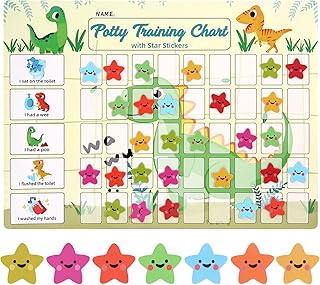
The Potty Training Chart for Toddlers with 63 Reusable Magnetic Star Stickers, Interactive Reward Chart for Toilet Training (Dinosaur) is built specifically for one of the most common reward chart use cases in the under-threes: toilet training. Rated 4.5 stars from 313 reviews — the second-highest review count in this roundup — it offers 63 reusable magnetic stars on a dinosaur-themed board designed to engage toddlers through what can be an anxious developmental phase.
The dinosaur theme is a deliberate functional choice, not merely cosmetic decoration. Toddlers are far more likely to engage with a chart that features something they’re genuinely excited about, and dinosaur enthusiasm among children aged two to four is close to universal. The visual interest of the theme means the chart doesn’t sit ignored on the bathroom wall — it becomes a focal point your child notices and wants to interact with every time they come into the room. For potty training specifically, keeping the chart in the bathroom places the reinforcement exactly where the behaviour happens, creating a direct and immediate link between the action and the reward.
The 63 magnetic stars provide a substantial and properly reusable supply. Unlike sticker-based potty charts where you eventually peel off the last sticker and the system stalls, magnetic stars return to the earning side and reset without any additional cost. This matters significantly for potty training, which can take anywhere from a few weeks to several months depending on the child. You’re not rationing stickers toward the end of a dwindling supply or breaking the routine mid-process to reorder. The system runs for as long as the child needs it, without interruption.
This chart is purpose-built for potty and toilet training rather than broader behaviour management. If you’re looking for a chart that covers multiple tasks — getting dressed, eating breakfast, tidying toys — one of the general-purpose magnetic boards above will be more appropriate. For the specific focused goal of toilet training, though, that purposefulness is a strength rather than a limitation. The layout and reward structure are calibrated for that exact milestone, and 313 verified reviews give real confidence in how it performs across a range of children and approaches. Buyers consistently mention how quickly their child engaged with the chart and how placing a star reinforced the behaviour in real time.
One small practical consideration: bathrooms are more humid than living rooms and kitchens, which can affect paper-based charts over time. The magnetic format holds up considerably better in bathroom conditions than sticker alternatives — a meaningful advantage for a chart designed to live in that room permanently throughout the training period.
What to Look for in a Reward Chart
- Reusability versus ongoing cost: Paper sticker charts are cheaper upfront but require reordering once the supply runs out. Magnetic boards cost more initially but reset indefinitely, making them a better long-term investment for year-round behaviour management. For a short-term, focused goal like potty training, disposable formats are often the more practical choice.
- Number of children: If you’re buying for siblings, look explicitly for a chart designed for two children — either a shared board with separate dedicated sections, or a twin pack. A single-child chart used by two children creates friction and territorial disputes that undermine the whole system from the start.
- Age of the child: Toddlers aged two to four need simple, themed charts with one or two behaviour targets and immediate rewards. School-age children from five upward can handle more complex grids with multiple tasks and weekly time horizons. Charts marketed for all ages tend to do none of them especially well — a dedicated toddler chart or a school-age chart will consistently outperform a generic one.
- What comes in the box: Some charts arrive complete — pens, stars, or tokens included. Others supply the board only and require you to source stickers separately. Check the listing carefully before buying, because arriving without stickers or pens is a recurring complaint in buyer reviews and disrupts the system before it even begins.
- Theme and visual appeal: For younger children especially, a themed chart — dinosaurs, space, favourite characters — substantially increases initial engagement and daily interaction. Older children and parents planning for longevity may prefer a neutral design that won’t feel babyish after six months of use.
- Mounting and display: Consider where the chart will actually live. Most magnetic boards need fridge space or a notice board with an appropriate surface. Check your available wall and fridge real estate before ordering — a chart that ends up propped on the kitchen counter or moved around constantly will not work as a consistent daily cue for your child.
- Customisability of tasks: Fixed printed task labels limit the chart’s usefulness as your child grows and their goals evolve. Boards with a write-on, wipe-clean surface let you update targets over time without buying a replacement. If you can foresee wanting to change the tasks after a few months, a customisable format is the smarter purchase.
Verdict
For most UK families with one or two children aged three to eight, the Jaques of London Large Magnetic Reward Chart is the pick to reach for first. The 417-review track record at 4.6 stars tells you this isn’t a product coasting on attractive packaging — it performs consistently across real households. The purpose-built sibling layout removes the most common source of conflict in shared reward systems, the magnetic format means no ongoing sticker costs, and the Jaques of London name carries a quality baseline that the category average doesn’t always match.
If you have a single child and want something more compact, the (Rainbow) Magnetic Reward Chart with Golden Stars covers the same reusable, write-on logic at a lower outlay. If you’re currently in the thick of potty training, the Potty Training Chart for Toddlers with 63 Reusable Magnetic Star Stickers (Dinosaur) is purpose-built for that specific phase, with over 300 reviews backing it up. And if your child has already shrugged off traditional grid-based charts, the JIANTA Magnetic Reward Jar for Children offers a distinct alternative worth trying before abandoning reward systems altogether.
The format matters more than the specific product. Get the format right for your household — magnetic versus paper, individual board versus shared, chart versus jar — and the system has a real chance of working. Get it wrong, and no amount of charming design will compensate.
We were not paid to feature any specific product in this guide. All opinions are independent and based on publicly available specifications, verified buyer feedback patterns, and category research.
Quick Comparison Table


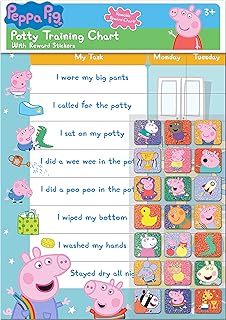

FAQ
At what age should I start using a reward chart?
Most children are developmentally ready to understand and respond to a reward chart from around two and a half to three years old. At this stage, the visual connection between completing a task and receiving a sticker or star becomes meaningful. Toddlers younger than two generally don’t yet have the sustained attention or conceptual understanding for the system to work consistently, so simpler verbal praise tends to be more effective for very young children.
How long should I run a reward chart before stopping?
Most behavioural guidance suggests running a chart for four to eight weeks on a specific goal — long enough for the behaviour to become an established habit, but not so long that the novelty fades and the chart stops motivating. Once a behaviour is consistently happening without prompting, it’s reasonable to retire that goal, either introduce a new target or phase the chart out gradually as the child’s own sense of achievement begins to take over.
Do reward charts work for all children?
They work well for most children in the three-to-ten age range, but no single approach is universal. Some children respond better to verbal praise than visual tracking; others find charts stressful if they feel they can’t keep up with the targets. The most important factor is keeping goals achievable and framing the chart as a positive tool — and never removing stars already earned as a punishment, which tends to create resentment toward the system rather than the desired change in behaviour.
Can reward charts help children with ADHD or additional needs?
Yes — reward charts are frequently recommended by occupational therapists and educational psychologists as a structured support tool for children with ADHD. The immediate visual feedback of placing a token or star is particularly well-suited to children who find delayed gratification difficult. Simpler formats work better in this context: one or two tasks maximum, with short time frames such as half-day intervals rather than full-week targets. If you’re unsure what structure will suit your child, their school’s SENCO is a helpful first point of contact.
What should the actual rewards be when a child completes their chart?
Effective rewards don’t need to be expensive or material. Small, consistent incentives — choosing the evening’s story, a favourite snack, an extra fifteen minutes of a preferred activity — outperform occasional large prizes because they maintain motivation across weeks rather than building toward a single distant event. The chart itself provides most of the drive through visible progress; the milestone reward is a celebration marker rather than the primary motivator. Involving your child in choosing the reward in advance increases its effectiveness considerably.
Should I ever remove stars as a consequence for bad behaviour?
Most child development guidance recommends against removing stars or tokens already earned. Taking away a reward your child has legitimately accumulated tends to create resentment toward the chart system rather than addressing the underlying behaviour. Instead, simply don’t add a star when the target behaviour didn’t happen — that natural, neutral consequence is clear and fair without undermining your child’s trust in the system or their sense of ownership over the progress they’ve already made.