You’ve just given the kitchen a fresh coat of paint, moved into a new flat, or finally committed to sorting out the living room ceiling that’s had a bare pendant socket since you arrived. The old fitting looked wrong from day one — too central, casting flat, undirected light over the whole room while doing nothing useful for your worktop, your reading chair, or the shelf display you’ve been building. So you decide a spotlight bar is the answer: adjustable heads, clean lines, the kind of directional control that makes a room feel properly lit rather than merely illuminated. Then you open Amazon and stare at thirty near-identical rectangular bars with slightly different names, vague specs, and no clear way to tell which one won’t wobble within six months.
The details that determine whether a spotlight bar is genuinely good are frustratingly specific — fitting type, backplate size, pivot range, finish durability — and most product pages either bury or omit exactly those details. This guide picks seven of the most relevant options currently on Amazon UK, explains what each one does well and where it falls short, and gives you enough information to make a confident decision without reading through hundreds of individual reviews yourself.
How These Picks Were Evaluated
Every fitting here was drawn from current Amazon UK spotlight and spotlight bar listings and assessed against six factors: fitting type (GU10 versus E14, and whether bulbs come in the box), the number and pivot range of spotlight heads, build quality signals from product construction (pressed steel versus plastic housing), finish durability based on verified buyer feedback patterns, ease of installation for a like-for-like ceiling rose swap, and overall review volume alongside rating distribution. Products with fewer than 20 reviews are flagged rather than treated with the same weight as well-established listings. Where the same brand offered two closely related products, the better-rated variant is featured and any alternative noted within the same section.
Best Overall: Unicozin Modern Rotatable 3 Way LED Ceiling Spotlight
For the broadest range of UK kitchens and living rooms, the Unicozin Modern Rotatable 3 Way LED Ceiling Spotlight is the most straightforward starting point. With 399 verified buyer reviews at 4.6 stars, it is the most-reviewed product in this category on Amazon UK right now — and it includes three GU10 LED bulbs in the box. That alone separates it from most competitors, where you are expected to source bulbs separately and work out compatibility yourself.
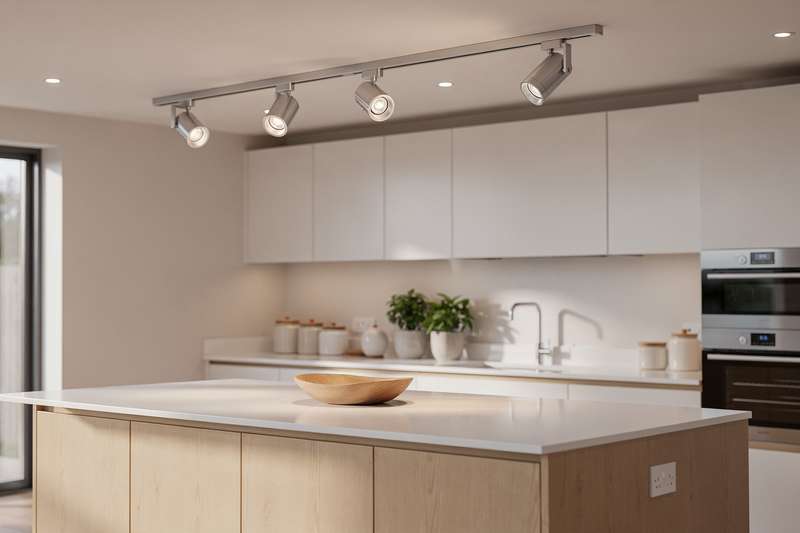
The fitting is a three-head rotatable bar in a matt nickel finish, which occupies useful middle ground between the sharper contrast of matte black and the more formal look of polished chrome. Each head swivels independently on two axes — tilt and pan — so you can angle them toward your worktop, the dining table, and the back wall simultaneously rather than having all three point straight down in a row. The included bulbs emit cool white light, which suits kitchen task lighting well but may feel too crisp for a living room where warmer tones create a more relaxed atmosphere.
Looking across the review distribution, the consistently positive notes from buyers cover three things: the backplate is large enough to cover standard UK ceiling roses cleanly, the swivelling joints move smoothly and hold their position without drooping, and the wiring process is a straightforward like-for-like swap manageable for anyone comfortable with basic ceiling connections. The matt nickel finish photographs slightly silver but reads warmer in room conditions — most buyers find it more flattering than the product image suggests.
The honest tradeoffs: three heads are sufficient for a small kitchen or hallway but may feel limiting in a wider open-plan kitchen where a four-head bar would give better coverage. The cool white bulbs are ready to go, but if you prefer warm white — the usual choice for living rooms and dining areas — you will be replacing them almost immediately, which partially negates the complete-package advantage. Matt nickel also will not suit a room where the existing hardware is committed to matte black or polished chrome; in that case, one of the finish-specific options below is a better fit.
That said, for anyone upgrading from a tired pendant or an unflattering single-bulb fitting, this is the low-risk, high-confidence choice. The review volume means you know what you are buying, and the included bulbs mean a single order completes the job. It suits rental properties, first-time spotlight bar buyers, and anyone who values knowing the ceiling result will be presentable without spending hours researching compatibility.
Best 4-Way Bar for Kitchens and Bedrooms: LVWIT 4 Way Spot Light
When you need four independently adjustable heads rather than three — for a longer kitchen run, an L-shaped room, or a bedroom where you want to direct light to four distinct zones — the LVWIT Kitchen Lights Ceiling 4 Way Spot Light is the most compelling option at this head count. Rated 4.6 stars from 35 reviews, it matches the Unicozin on rating while serving a different set of requirements: more heads, a matte black finish, and specific optimisation for kitchen and bedroom environments.
LVWIT is a lighting brand with a solid track record on Amazon UK, and the four-way bar reflects that in its proportions — the housing looks properly spaced rather than stretched to accommodate four heads awkwardly, which is a failure mode common in budget four-head fittings. Each GU10 head rotates independently, the bar mounts via a standard ceiling backplate, and the matte black finish pairs cleanly with both industrial and Scandi-influenced interiors. Matte black is also practical in kitchen environments: it does not show condensation marks or fingerprints the way a gloss or polished surface does.
The caveat here is the review count. A 4.6-star average from 35 buyers is a positive signal but a statistically shallower one than the same rating from 399 — a handful of negative experiences could shift it materially as the listing matures. The reviews that do exist are specific about build quality: buyers mention smooth-acting pivot joints, a clean backplate fit, and an installation process that presented no surprises. Crucially, there are no persistent complaints about the failure modes that tend to dominate lower-rated reviews in this category — loose heads and a backplate that is too small for the existing ceiling rose.
Practically, a four-head bar is physically longer than a three-head model, so it requires more ceiling clearance to look proportionate. In a standard UK galley kitchen with a ceiling run of 600mm or more, four heads gives you excellent worktop and counter coverage. In a compact square room or above a small dining table, the length can feel out of proportion. GU10 bulbs are not included, so factor in the cost of four quality LED bulbs as part of your total outlay.
Where this beats the Unicozin is straightforward: you need four heads and you want matte black. If your kitchen hardware — tap, handles, light switches — is already in a black or anthracite finish, matching the ceiling bar to that palette makes the room feel more considered. The same logic applies to bedrooms where black pendant lights or bedside lamps are already part of the scheme. If those specifics apply to you, this is the bar to get.
Best for Industrial Interiors: URAQT 3 Way Adjustable Industrial Ceiling Spotlights
For exposed-brick living rooms, kitchen-diners with concrete features, or any interior where the light fitting itself is meant to read as a visible design choice rather than a neutral ceiling fixture, the URAQT LED Ceiling Light Rotatable 3 Way Adjustable Industrial Ceiling Spotlights takes the standard spotlight bar concept in a deliberate industrial direction. The bar-form housing has a more utilitarian profile than the Unicozin or LVWIT, with a matte black finish that suits a converted warehouse aesthetic, a café-style kitchen, or a bedroom with open shelving and raw-material finishes.
The fitting uses three GU10 sockets across independently adjustable heads mounted on a bar-shaped housing. Early buyers — who constitute a modest 13-review sample at 4.5 stars — specifically note that the material quality feels more substantial than the price point suggests, with smooth-acting head pivots and a backplate that sits cleanly against the ceiling without gaps. These are the indicators that matter most in buyer feedback for spotlight bars, and the fact that early reviewers are volunteering positive comments on all three is a reasonable early signal.
That 13-review count needs to be acknowledged plainly: it is a thin dataset. The products discussed elsewhere in this guide have accumulated 100–399 reviews, which provides a statistically meaningful picture of performance over time. Thirteen reviews cannot tell you how the finish holds up after eighteen months in a kitchen, or whether the head pivots remain firm after frequent adjustment. You are buying on a positive early pattern rather than a proven track record — a legitimate approach for a budget fitting in a lower-stakes room, but a higher-risk call for a main kitchen or open-plan living area.
URAQT also produce a round-profile three-way GU10 fitting sold under a separate listing on Amazon UK, if the bar form factor does not align with your ceiling junction box or room shape. The round version has a lower rating but more reviews — this guide features the bar as the primary recommendation because the 4.5-star early rating is a stronger signal, and the industrial bar aesthetic is more distinctive.
The aesthetic point is worth underscoring: an industrial spotlight bar is specific by design. It looks exactly right in the right room — raw materials, minimal decoration, contemporary or loft-industrial leanings — and slightly out of place in rooms with cornicing, soft furnishings, or traditional period features. If your room fits that profile, this is a confident choice at a competitive price. If it does not, one of the other options in this guide will serve you better.
Best Single Spotlight Fitting: Knightsbridge GU10 Adjustable Spotlight, Pressed Steel, Brushed Chrome CSP1BC
Not every ceiling situation requires a bar. If you have multiple individual wiring points already in the ceiling — common in UK homes where electricians have run separate cables to several positions rather than feeding everything from one central rose — the Knightsbridge GU10 Adjustable Spotlight, Pressed Steel, Brushed Chrome CSP1BC is the individual fitting to look at. You buy one per wiring point and install them separately, giving you complete control over exactly where each light source sits without being constrained by a bar’s fixed head spacing.
Knightsbridge is a recognised UK lighting brand with a proven track record rather than a generic import rebrand. The fitting is constructed in pressed steel — a meaningful upgrade from the cast aluminium or lightweight alloy used in many budget individual spotlights — which produces a more substantial feel and a pivot mechanism that holds its position reliably without gradually loosening over time. The brushed chrome finish suits both period and contemporary interiors without committing too strongly to either direction, and resists dulling better than polished chrome in kitchen and bathroom-adjacent environments.
With 123 reviews at 4.4 stars, the Knightsbridge is one of the two most credibly reviewed fittings in this guide. Buyer feedback is consistent: the chrome plating resists dulling better than comparable products in this price range, the GU10 pivot mechanism remains firm after installation, and the backplate sits cleanly against the ceiling. The 50W rating accommodates the full range of GU10 LED equivalents currently available, including dimmable versions, without compatibility concerns.
The main limitation is inherent to the product type: this is a single-head fitting. If you have three ceiling positions, you will need three fittings and three separate installation tasks. This is actually an advantage for positioning flexibility — you place each head precisely where you need it, regardless of fixed bar spacing — but it takes more time to install and requires comfort working with multiple ceiling connections. GU10 bulbs are not included, so budget for those separately.
This fitting is particularly well-suited to rooms where individual ceiling wiring points are non-standard distances apart making a bar impractical, and to situations where you are replacing a single failed spotlight and want a direct, reliable upgrade. For a full ceiling of individual spotlight positions — rather than a single central rose — the Knightsbridge is the most credible individual unit option in this price range on Amazon UK.
Best Budget 3-Way Bar: 3-Way Black GU10 Ceiling Spotlight Bar
The 3-Way Black GU10 Ceiling Spotlight Bar is the budget-tier entry in this guide, and it comes with a transparency caveat you should read before buying: at the time of writing it has seven verified reviews at 4.4 stars. That is a positive early signal, but seven buyers is a very thin sample — not enough to draw reliable conclusions about long-term finish durability, head pivot reliability after repeated adjustment, or how consistently the backplate covers standard UK ceiling roses. You are buying on early promise rather than on proven performance.
What makes it worth considering despite that caveat is the dual mounting capability: it is designed to work on both ceilings and walls, which gives you flexibility that ceiling-only bars cannot match. Wall-mounted spotlights in a hallway, above a fireplace, or flanking a feature wall are all realistic applications that a ceiling-only bar does not serve as cleanly. The three GU10 heads each accept standard bulbs sold separately, and the matte black finish appears consistent with the product images in early buyer photos.
The seven existing reviews report no major issues: installation was described as straightforward, the heads move to different angles without excessive stiffness or looseness, and the overall build was considered acceptable for the price. What those seven reviewers cannot yet tell you is how the finish and pivot joints hold up over a year of use in a kitchen environment, where heat and steam slowly degrade inferior materials. That is information the listing does not yet have.
This is the right pick for lower-stakes locations: a landing, a utility room, a garage conversion, or any space where you want functional directional lighting at minimum outlay and where the consequences of a product not lasting perfectly are minor. It is also a reasonable option for furnished rental properties where cost control matters. For your main kitchen or a living room where you want confidence in what you are fitting, the additional investment in the Unicozin or LVWIT is better justified.
Before ordering, check the backplate dimensions against your existing ceiling rose. Most standard UK ceiling roses are in the 85–100mm diameter range, and a backplate that covers that measurement gives a clean finish without exposing old plaster marks. With only seven reviews, buyers have not yet systematically documented the backplate sizing for this specific fitting, so it is worth checking the product page Q&A or contacting the seller directly before you commit.
Best for E14 Bulb Compatibility: LED Ceiling Lights Rotatable 4 Way E14 Spotlights Fittings 240V
Every other option in this guide uses GU10 fittings, but there is a specific scenario where the LED Ceiling Lights Rotatable 4 Way E14 Spotlights Fittings 240V is the correct answer. If you already have E14 bulbs you want to reuse, if your existing ceiling wiring was installed for E14 fittings and you do not want to retrofit adapters, or if you specifically want to use decorative Edison-style filament bulbs — which are far more widely available in E14 than in GU10 — this four-head rotatable bar is the only multi-head option in this selection that accommodates them.
The E14 socket type uses a small screw-cap fitting and supports a broader range of bulb shapes than GU10 does, including globe, flame, and Edison filament styles. In a living room or dining area where the visual warmth of a visible filament bulb matters, this fitting opens up options that a GU10 bar cannot provide. With 116 verified reviews at 4.3 stars, it is one of the two most credibly reviewed fittings in this guide, and the 240V rating confirms direct compatibility with standard UK mains without adaptors. The four heads rotate independently and the bar mounts via a standard ceiling backplate.
The practical tradeoff is bulb availability. Standard E14 LED spotlight bulbs — the directional reflector type that works properly in a rotating spotlight fitting — are less common in UK retail than GU10 equivalents. You will find them, but you will have a narrower range of brands and output specifications to choose from. If you are planning to use decorative or filament-style E14 bulbs rather than directional reflectors, this largely ceases to be an issue: the E14 decorative market is well-stocked. But for the same flexibility of output choice that GU10 provides, you are working with a smaller selection.
The 4.3-star average — the lowest of the better-reviewed products in this guide — reflects a proportion of buyers who found the housing lighter than expected at the price point. For a ceiling fitting that you install once and do not handle again, material lightness is a minor consideration in actual use. Buyers specifically mention clean installs and consistent head movement as positives.
Think of this as the atmospheric or living-room option rather than the task-lighting option. GU10 LED spotlights in a kitchen give you sharp, directed task light; E14 filament globes in a living room give you a warm, ambient glow from four rotatable points. If that distinction matches what you are trying to achieve, this is the fitting that enables it.
Best 4-Way Brushed Chrome Bar: Quad GU10 Spotlight Bar in Brushed Chrome
If you specifically need a four-head GU10 bar in a brushed chrome finish — not matte black, not nickel — the Quad GU10 Spotlight Bar in Brushed Chrome is currently the most relevant option in this category. Chrome and satin-silver finishes suit traditional, transitional, and classic contemporary interiors significantly better than matte black does — particularly in rooms where the existing hardware (door handles, radiator valves, light switches) is already in a silver or brushed silver finish. Maintaining finish consistency across a room is one of those details that the overall result either rewards or quietly punishes.
The fitting accommodates four independently adjustable GU10 heads along a brushed chrome bar. Brushed chrome is a deliberately subdued choice — less reflective and more understated than polished chrome, and more durable in practice since it does not show water marks, minor surface scuffs, or condensation residue as readily. With 36 reviews at 4.0 stars, this is the joint-lowest-rated product in the guide, which warrants transparency about what the review distribution actually says.
The lower-rated reviews in that 36-review sample mostly describe two issues: a backplate that was too small to cover the existing ceiling rose cleanly, and one or two heads in a fitting being stiffer than the others straight out of the box. Neither issue is unfixable — a deeper ceiling canopy or rose cover plate can address the backplate problem, and head stiffness typically eases with a few adjustment cycles — but they are worth knowing about rather than discovering post-installation. The four and five-star reviews, which make up the majority, specifically mention a clean install and a chrome finish that looked more premium than the price point suggests.
Compared to the LVWIT four-way bar (the matte black four-head alternative in this guide), the Quad Chrome has a lower rating and a smaller review base. The LVWIT is the safer statistical pick at this head count. But the LVWIT is black, and if your interior needs chrome, there is no like-for-like alternative — the finish is the deciding factor. Against the Unicozin three-head in matt nickel, this gives you a fourth head and a distinct chrome direction, at the cost of a lower-confidence review profile.
One practical point: measure your ceiling space before ordering. A four-head bar is physically longer than a three-head model, and at a standard ceiling height the proportions need to feel right for the room size. GU10 bulbs give you full flexibility on colour temperature once installed — warm white for a dining room, cool white for a kitchen — which is an advantage over the Unicozin’s bundled cool white if warmer light is your preference.
What to Look For When Buying Ceiling Spotlights and Spotlight Bars
- Fitting type — GU10 vs E14: GU10 (two-pin twist-lock) is the UK standard for ceiling spotlight bars. Bulbs are widely available, easy to replace, and come in a wide range of colour temperatures and output levels. E14 (small screw-cap) is less common in spotlight bars but supports decorative bulb shapes including Edison filament globes — a useful choice for living rooms where ambient warmth matters more than directional task output. Check the fitting type before buying and confirm replacement bulb availability.
- Number of heads: Three heads suit small to medium rooms and give you enough directional flexibility for most kitchens and living rooms. Four heads work better for longer ceiling runs, larger kitchens, or open-plan areas. Single fittings are the right choice when you have multiple individual wiring points rather than one central ceiling rose, or when you are supplementing an existing installation at one specific position.
- Pivot and rotation range: Look for heads that rotate independently on two axes (tilt and swivel) rather than moving the whole bar as a unit. Two-axis adjustment lets you angle light precisely at a worktop, a bookshelf, or an artwork. Heads that are stiff to adjust or that gradually droop after being set are the most common complaint in lower-rated reviews — check buyer feedback specifically for comments on joint quality before buying.
- Backplate size: This is the detail most product pages skip and most buyers regret not checking. If you are replacing an existing ceiling rose, the new fitting’s backplate must be wide enough to cover the rose and any marks around it. Most standard UK ceiling roses are in the 85–100mm diameter range. If a product page does not list the backplate dimensions, check the Q&A section or contact the seller before ordering.
- Finish durability: Matte black and brushed chrome hold up better than gloss or polished finishes in kitchen and living room conditions — they do not show fingerprints, condensation, or minor surface contact as readily. Matt nickel sits in the middle ground. All finishes benefit from occasional cleaning with a dry cloth, but matte surfaces are considerably more forgiving of infrequent attention.
- Whether bulbs are included: A fitting that includes LED bulbs completes the job in a single order. Check the colour temperature of any included bulbs — expressed in Kelvin: 2700K–3000K for warm white, around 4000K for neutral, 5000K–6500K for cool white — and verify it matches the atmosphere you want in the room. Cool white is standard for kitchens; warm white is more common in living rooms and bedrooms.
- Dimmer switch compatibility: If you are fitting into a circuit with an existing dimmer switch, make sure any LED bulbs you buy are specifically marked as dimmable. Older UK leading-edge dimmers can cause flickering or buzzing with LED loads — a trailing-edge dimmer switch designed for LEDs resolves this. This is a bulb-level consideration, not a fitting-level one, but sorting it before installation saves a frustrating callback.
Verdict
For the majority of readers — upgrading from a pendant, replacing a bare ceiling socket, or fitting a new spotlight bar in a kitchen or living room — the Unicozin Modern Rotatable 3 Way LED Ceiling Spotlight is the recommendation to start with. The review volume (399 buyers at 4.6 stars) provides real confidence, the included GU10 LED bulbs mean a single order completes the installation, and the matt nickel finish sits neutrally in enough room schemes to avoid being a risky aesthetic call. Those three factors combine into a package that is hard to argue with for most ceiling situations.
Step up to the LVWIT if you specifically need four heads in matte black. Choose the Knightsbridge if you are filling individual ceiling wiring positions rather than a single rose. The E14 Rotatable Bar is the right call for living rooms where decorative bulb styles matter more than raw task output. And if your interior is genuinely industrial in character, the URAQT bar will read more naturally than any of the mainstream alternatives. For everyone else, the Unicozin gives you the most confident result with the least research required.
We were not paid to feature any specific product in this guide. All opinions are independent and based on publicly available specifications, verified buyer feedback patterns, and category research.
Quick Comparison Table


FAQ
What is the difference between a spotlight bar and individual spotlight fittings?
A spotlight bar is a single fitting that holds two or more spotlight heads on a shared bar connected to one ceiling rose and one set of wiring. Individual spotlight fittings each have their own backplate and connect to separate wiring points in the ceiling. Bars are the right choice when you have one central ceiling rose and want multiple light directions from it; individual fittings suit rooms where the electrician has run separate cables to several ceiling positions.
Do I need an electrician to fit a ceiling spotlight bar?
A like-for-like swap — removing an existing ceiling fitting and replacing it at the same position — is something most UK homeowners can handle safely by isolating the circuit at the consumer unit and connecting live, neutral, and earth wires to the new fitting’s terminal block. However, any new wiring runs, changes to the wiring position, or work in a bathroom (where Part P building regulations apply in England and Wales) should be carried out by a registered electrician.
What is a GU10 bulb and why does it matter when buying a spotlight bar?
GU10 refers to a standardised bulb fitting type with two small pins that twist and lock into the socket — the 10 describes the pin spacing in millimetres. It is the UK standard for ceiling spotlight bars because the bulbs are compact, widely available as LEDs, and straightforward to replace. When buying a bar, check the socket type (GU10 or E14) in the specification and confirm that compatible replacement bulbs are available in the colour temperature and output level you need before ordering.
How do I choose between warm white and cool white bulbs for my spotlights?
Colour temperature is measured in Kelvin (K). Warm white (2700K–3000K) produces a softer, slightly amber-tinged light that suits living rooms, dining areas, and bedrooms where a relaxed atmosphere is the goal. Cool white (5000K–6500K) gives a crisper, bluer light better suited to kitchens and home offices where task clarity matters. Neutral white (around 4000K) sits between the two and works well in spaces used for both practical tasks and relaxation.
Can I use ceiling spotlight bars with a dimmer switch?
Yes, but you need to match the components correctly. The spotlight bar fitting itself is not the limiting factor — it is the bulbs. You need LED bulbs specifically labelled as dimmable, paired with a trailing-edge dimmer switch rated for LED loads. Older leading-edge dimmers (common in UK homes built before 2000) can cause flickering or humming with LED bulbs, so check your dimmer type before buying and replace it with a compatible model if needed.
How many spotlight heads do I need for a kitchen?
A standard UK galley kitchen of around 8–10 square metres typically works well with a four-head bar at the main ceiling position, supplemented by under-cabinet lighting at the worktop. Smaller kitchens of 5–7 square metres are usually well served by a three-head bar. Open-plan kitchen-diners may benefit from two separate bars or a four-head bar combined with a pendant over the dining area, since a single bar cannot efficiently light two distinct zones at once.