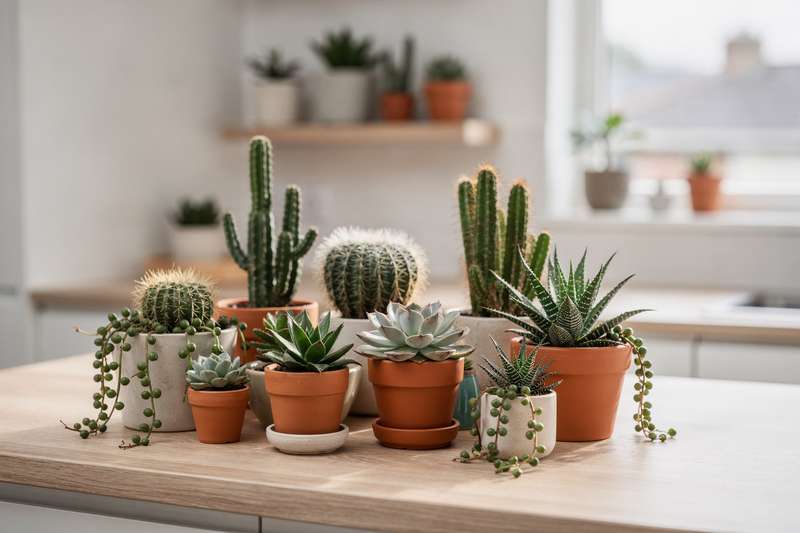
You’ve killed another succulent. It sat on the windowsill looking perfectly fine for six weeks, then one morning it was soft, translucent, and collapsing at the base. Sound familiar? You’re not alone — overwatering is by far the most common reason succulents die in UK homes, and yet the plants themselves are genuinely some of the easiest you can keep. The frustration isn’t with the plants; it’s usually a mismatch between what people buy and what they actually know how to care for.
Maybe you’re starting fresh and want a small collection of real plants for a sunny windowsill. Maybe you’ve got a north-facing flat and want something that looks like a succulent without the fuss. Or perhaps you’ve kept a few plants alive but they’ve stopped thriving and you suspect your soil or feeding routine is off. Whatever brought you here, this guide covers the full spectrum — live mini succulents, specialist feeds, proper terracotta pots, realistic artificial options, and a reference book that will genuinely teach you what you’re doing. No padding, no filler — just what’s actually worth buying on Amazon UK right now.
How We Chose These Picks
Every product in this guide was drawn from live Amazon UK search results, filtered by relevance to the actual topic: growing, displaying, and maintaining cacti and succulents in a UK context. We looked at verified buyer review patterns — not just headline star ratings, but the substance of what reviewers praised and complained about. For live plants and accessories, we factored in how UK conditions (lower light levels, indoor central heating, typical windowsill sizes) affect usability. For artificial plants, we assessed realism and value. Products with zero verified reviews were deprioritised where reviewed alternatives existed. We also considered breadth — a mix of categories (live plants, feeds, pots, fakes, reference materials) gives you a practical toolkit, not just a list of similar items.
Best All-Round Reference: The RHS Practical Cactus and Succulent Book
The RHS Practical Cactus and Succulent Book: How to Choose, Nurture, and Display more than 200 Cacti and Succulents is the single most useful purchase on this list if you’re serious about keeping these plants alive long-term. With a 4.7-star rating from 677 reviewers, it’s one of the most consistently praised cactus-specific books available in the UK, and for good reason.
This isn’t a coffee-table book full of pretty photos and vague advice. It’s a working reference — the kind of thing you come back to when a plant starts doing something unexpected. It covers over 200 species with individual care profiles, so whether you’ve got an Echeveria, a Haworthia, a Christmas cactus, or a column cactus you bought at a garden centre without knowing the name, you stand a good chance of finding it here. The RHS branding also means the advice is grounded in UK growing conditions, which matters: watering schedules and light requirements that work in Arizona don’t necessarily translate to a terraced house in Leeds.
Reviewers frequently mention using it to diagnose problems — overwatering, underwatering, root rot, etiolation (when plants stretch toward light and go leggy). That kind of diagnostic usefulness is what separates a good plant book from a generic one. The photography is genuinely helpful for identification, and the propagation chapter is particularly well regarded.
The honest tradeoff: if you only want to keep one or two undemanding succulents on a windowsill, this level of depth may be more than you need. It’s aimed at people who want to actually understand what they’re growing. But at a budget paperback price point, it’s worth having even if you only consult it a few times a year. Consider it insurance against expensive plant deaths.
Best Starter Live Plants: Carbeth Plants 3 Mixed Mini Succulents
If you want real, living plants delivered to your door, Carbeth Plants 3 Mixed Mini Succulent Plants in 5.5cm Pots is the most sensible entry point on Amazon UK. Rated 4.0 stars from 247 buyers, these arrive as a set of three distinct varieties in individual pots, which gives you immediate variety without committing to a large collection.
The 5.5cm pots are small enough to fit on a narrow windowsill or desk, and the mixed selection means you’re likely to get plants with different textures and colours — a rosette form alongside something more upright, for example. The listing describes them as easy care, low maintenance, drought tolerant, and air purifying, which is fair for the succulent family generally. What this really means in practice: water sparingly (once every two to three weeks in summer, less in winter), keep them on your brightest windowsill, and don’t leave them sitting in water.
Reviewer feedback highlights the plants arriving in good condition with healthy root systems, which is the primary concern when buying live plants online. Some reviewers note that the specific varieties in the mix can vary — you won’t necessarily get the exact plants shown in the listing photos, because availability changes with the season. That’s standard for mixed-variety plant listings and worth knowing upfront.
Where this falls short: the 5.5cm pots will need repotting within six to twelve months as the plants establish themselves, so factor in that you’ll want some suitable pots and cactus compost in due course. Also, these are best suited to indoor windowsills with reasonable light; if you’re hoping to brighten up a darker room, they will gradually stretch and weaken without supplemental lighting. For most UK flats and houses with a south- or east-facing window, though, they’re a reliable choice.
Best Specialist Feed: Westland Cacti & Succulent Feed Concentrate
Feeding is where a lot of succulent keepers go wrong — either they don’t feed at all, or they use a generic all-purpose feed that’s far too high in nitrogen and causes weak, soft growth. The Westland Cacti & Succulent Feed Concentrate 200ml solves this neatly. It’s rated 4.7 stars from 142 buyers — a strong score for a category where many products are indistinguishable from one another.
Westland is a well-established UK horticultural brand, and their cactus-specific concentrate is formulated with the right nutrient balance for succulent plants: lower nitrogen, higher potassium and phosphorus, to encourage compact, healthy growth and flowering rather than the soft, floppy stems you get from inappropriate feeds. The 200ml concentrate goes a long way because you dilute it before use — the bottle is small but represents a lot of feeds at the correct dilution rate.
Reviewers praise the improved colour and firmness of their plants after a growing season of use. A few note that instructions on the packaging are clear and that it doesn’t smell unpleasant (a genuine quality-of-life point if you’re feeding indoors). The concentrate format also means you’re not buying a lot of water, which makes it better value than pre-diluted alternatives.
The tradeoff: you only need to feed cacti and succulents during the active growing season (roughly April to September in the UK), so a single bottle will last most people through multiple seasons. Don’t feed in autumn or winter — these plants are resting, and feeding during dormancy does more harm than good. If you tend to forget this kind of seasonal rule, the RHS book mentioned above covers it well. This feed is also specifically for established plants in pots; it’s not a substitute for proper cactus compost when potting up.
Best Pots for Proper Drainage: FORAGIFT 6CM Ceramic Succulent Plant Pots
The single most impactful thing you can do to stop killing succulents is to put them in pots with drainage holes. FORAGIFT 6CM Ceramic Succulent Plant Pot, Cactus Pots for Indoor Outdoor Plants, Small Flower Pot Flowing Glaze with Drainage and Bamboo Tray delivers exactly that in an attractive package. Rated 4.2 stars from 64 reviewers, these are glazed ceramic pots in a compact 6cm size, each with a bamboo drip tray included.
The flowing glaze finish gives them a handmade aesthetic that works well on shelves and windowsills — these look considerably more considered than plain terracotta, without the premium price tag of artisan ceramics. The bamboo tray underneath catches any water that drains through, protecting your surfaces while still allowing the soil to dry out properly between waterings (which is critical for succulent health).
At 6cm, these pots are sized for small succulents and cacti — your typical Echeveria, Haworthia, Gasteria, or small cylindrical cactus. They’re not suitable for larger specimens; if you’ve got a mature Aloe or a substantial column cactus, you’ll need larger pots. But for a desktop collection or a windowsill display of young plants, the size is just right.
Reviewers note that the glaze colours can vary slightly from the listing photos, which is worth knowing if you’re trying to match a specific colour scheme. A small number of buyers mention receiving pots with minor glaze imperfections — not unusual for hand-applied glazes, and in most cases adds to the character rather than detracting from it. For gifting or for your own growing setup, these are a step up from plain plastic nursery pots without spending a lot.
Best Budget Artificial Option: QUOZUO 16pcs Fake Mini Succulents
Not every space is suitable for real plants. North-facing rooms, offices with no natural light, bathroom shelves, or homes with curious pets are all situations where realistic artificial succulents make practical sense. The QUOZUO Artificial Succulents Plants, 16pcs Fake Mini Succulents for DIY Home Floral Wall Garden Office Decoration (Unpotted) is the most affordable entry point here, with a 4.0-star rating from 77 buyers.
The key word in the listing is “unpotted” — these are stems without containers, which gives you flexibility to arrange them in your own pots, frames, wreaths, or decorative displays. If you’ve got a favourite pot you want to fill, or you’re making a floral wall panel, the unpotted format is actually an advantage. The 16-piece pack provides enough variety to create a convincing mixed display, mimicking the look of different succulent species at a small scale.
At the budget end of the artificial plant market, the realism is decent rather than exceptional — these will pass scrutiny at normal viewing distance, but up close the material texture doesn’t quite match a real leaf. For shelves, centrepieces, and office displays where people aren’t peering at them closely, they work well. Colour tends to be accurate and consistent across the set.
The tradeoff versus pricier artificial succulents is exactly what you’d expect: the leaf detail and colour gradients are less nuanced. If you need something that will hold up to close inspection — a dining table centrepiece, for example — consider stepping up to the larger sets reviewed below. For backgrounds, frames, and filler in arrangements, this budget set does the job without a second thought.
Best Large Artificial Set for Displays: Woohome 20 Pack Fake Succulents
For a more comprehensive artificial display with better realism, the NA Woohome Artificial Succulents, 20 Pack Realistic Faux Succulents Mixed Colors Fake Succulents Fake Plants for Decoration, DIY Crafting Home is the best-reviewed option in this category on Amazon UK, with 4.4 stars from an impressive 559 buyers — by far the largest review base of any artificial succulent product in this guide.
The “mixed colours” aspect is where this set distinguishes itself. Rather than uniform green, you get a range that includes purple-tipped rosettes, blue-grey tones, and reddish varieties — the kind of colour variation you’d see in a real mixed succulent arrangement. This variety makes the overall display look more natural and less obviously artificial when grouped together in a planter or decorative bowl.
With 559 reviews, there’s a meaningful signal in the feedback. Buyers consistently praise the colour accuracy, the variety of forms in the set, and the ease of arranging them. Some note that the stems are flexible enough to bend and position in foam or moss without snapping. Negative comments tend to focus on a small number of pieces in each set looking slightly less detailed than others — which is fairly standard across artificial plant ranges at this price point.
These are also unpotted stems, so you’ll need to supply your own containers or decorative media (foam, moss, sand, or gravel all work). That’s actually a versatile format for anyone who wants to create their own arrangement rather than buying a finished piece. If you want everything in one go — pot and plant — you’d need to combine this with one of the pot options in this guide, but they pair naturally with the FORAGIFT ceramics mentioned above.
Best Mid-Range Artificial Set: QUOZUO 22pcs Mini Artificial Succulents
Sitting between the budget 16-piece set and the larger Woohome pack, the QUOZUO Succulents Plants Artificial, 22PCS Mini Artificial Succulents, Fake Succulents Plant for DIY Crafting Home Garden Office Party Decor offers a slightly larger count and a 4.5-star rating from 30 reviewers. The higher star rating compared to the 16-piece set from the same brand suggests quality control may be a touch better on this version, though with fewer reviewers the sample size is smaller.
The 22-piece count in this set makes it well suited to larger arrangements — if you’re filling a long windowsill planter, creating a centrepiece for an event, or populating a decorative frame, having 22 pieces gives you enough to work with without needing to buy multiple packs. The “party decor” mention in the listing hints at another use case: temporary displays for weddings, events, or seasonal decorating where live plants would be impractical or too expensive to source at scale.
Realism is on par with others in this price bracket — convincing at normal viewing distance, with passable leaf texture and colour. The range of forms in the 22-piece set appears to include a mix of rosette types, which gives arrangements a natural, varied look. Reviewers note that they’re lightweight and easy to work with in foam-based arrangements.
The honest note here: if you’re choosing between this and the Woohome 20-pack, the Woohome has significantly more buyer feedback and a comparable rating — which makes it easier to assess quality with confidence. The QUOZUO 22-piece set is worth choosing if you specifically want a slightly larger count or prefer to stay within a brand you’ve already used. For a first artificial succulent purchase, the Woohome’s review volume makes it the safer bet.
What to Look For When Buying Cacti and Succulent Products
- Drainage holes in any pot you buy. This is non-negotiable for live succulents and cacti. Sitting water at the roots is the number one cause of rot. Any decorative pot without a drainage hole should only be used as a cachepot (with the plant kept in its nursery pot inside), not as a direct planting container.
- Cactus-specific compost for live plants. Standard multipurpose compost retains too much moisture. Look for mixes labelled specifically for cacti and succulents — or blend your own by adding 50% perlite or grit to standard compost. The right substrate makes watering frequency much less critical.
- Species suitability for your light levels. UK light levels are significantly lower than the desert environments these plants evolved in. South-facing windowsills are ideal; east-facing is workable. North-facing rooms are genuinely challenging for most cacti and succulents unless you’re using a grow light. Haworthias and Gasterias tolerate lower light better than Echeverias or most true cacti.
- Realistic review counts for live plants. Live plant listings can be harder to evaluate than product listings because quality varies by dispatch condition. Prioritise sellers with a meaningful number of reviews (100+) and look for comments specifically about how plants arrived, not just how they look in photos.
- Nutrient balance in any feed you buy. A cactus-specific feed will have a lower nitrogen ratio than general-purpose feeds. High nitrogen causes soft, vulnerable growth in succulents — fine for leafy vegetables, counterproductive for plants that are supposed to be compact and drought-adapted.
- Scale when buying artificial succulents. The stem sizes in artificial sets vary considerably. Check the listed dimensions if you have a specific pot or container in mind — a stem designed to fit a 6cm pot will look lost in a wide bowl, and vice versa. Most sets are described in terms of head diameter, so measure your container before ordering.
- Seasonal care differences. UK-bought succulents need very different care in winter versus summer. During the October-to-March dormant period, most cacti and succulents should be watered very infrequently (once a month or even less for true cacti), kept away from cold draughts, and not fed at all. Any book or resource you use should specifically address this seasonal shift.
Verdict
For most UK readers, the single most impactful purchase is the RHS Practical Cactus and Succulent Book. Understanding why your plants die — and what conditions they actually need — does more for long-term success than any pot or feed. Pair it with the Carbeth Plants Mixed Mini Succulents for a ready-to-go live collection, add the FORAGIFT ceramic pots when you’re ready to repot, and use the Westland concentrate feed through the growing season. That combination covers the four pillars of successful succulent keeping: the right knowledge, the right plants, the right containers, and the right nutrition.
If your situation rules out live plants entirely, the Woohome 20-pack artificial set is the most proven artificial option here, with genuine variety and the largest review base to support the buying decision. It won’t replace the satisfaction of a flowering Echeveria, but it will give you a credible, low-maintenance display wherever you put it.
We were not paid to feature any specific product in this guide. All opinions are independent and based on publicly available specifications, verified buyer feedback patterns, and category research.
Quick Comparison Table


FAQ
How often should I water succulents in the UK?
During the active growing season (roughly April to September), water thoroughly and then allow the compost to dry out completely before watering again — typically every two to three weeks. In winter, reduce this to once a month or even less for most species. The most reliable method is to check the soil with your finger: if it’s still damp an inch down, wait.
Can succulents survive a UK winter on a windowsill?
Most common succulents will survive a UK winter indoors without issue, provided they’re not sitting in cold draughts and are kept away from single-glazed glass that gets very cold at night. Reduce watering significantly from October onwards and don’t feed during dormancy. True desert cacti are more sensitive to cold and damp combined — the cold alone is less of a problem than cold combined with wet compost.
What’s the difference between cactus soil and regular compost?
Regular multipurpose compost retains moisture for longer than succulents need, which leads to root rot. Cactus and succulent compost is blended with grit or perlite to improve drainage and aeration, so the roots dry out much faster after watering. You can replicate this yourself by mixing roughly 50% standard compost with 50% horticultural grit or perlite.
Are artificial succulents worth buying?
They’re worth it in specific situations: rooms with very low light, environments where pets might chew real plants, temporary event decorations, or places where you simply don’t want to think about plant care. For living spaces where you’ll see them up close daily, the best artificial sets are convincing at a distance but don’t fully replace the look of a healthy real plant. For the right use case, they’re a practical and cost-effective choice.
Do succulents need feeding, and if so, how often?
Yes, but sparingly and only during the growing season. A cactus-specific liquid feed applied at half strength once a month between April and September is sufficient for most potted succulents. Avoid general-purpose feeds, which tend to be high in nitrogen and encourage soft, weak growth. Never feed in autumn or winter — it can stimulate growth at exactly the wrong time of year.
What size pot should I use for a small succulent?
Choose a pot that’s only slightly larger than the plant’s root ball — succulents don’t like excess compost around their roots because it stays wet for too long. For most small succulents you’d buy in a 5–6cm nursery pot, a 6–8cm finished pot is about right. Once the plant visibly fills the pot or roots start emerging from the drainage hole, step up one size.