Picture a Saturday afternoon in October. The pitch is soft after a week of rain, the wind is coming in off the back of the stand, and your side is one point down with three minutes left. You’ve been called up to take a penalty from 30 metres, left of centre — a kick you’ve made in training dozens of times. You mark your spot, set the tee on the turf, place the ball, and take your steps back. Then you notice it: the tee has tilted two degrees to the right. The ball is leaning at the wrong angle. The contact point you’ve been working on all month is already compromised before your run-up has started.
You adjust. Your focus shifts. The kick goes wide.
This is the specific frustration of a kicking tee that doesn’t do its job. The prong cracked during warm-up on a cold morning and you didn’t catch it. The base is too narrow for soft ground. The rubber has stiffened in the cold and no longer grips the turf the way it did in September. None of this is your technique — but all of it contributes to the miss.
In the UK, most club rugby players buy their kicking tee without much deliberation. It’s a small item, often an afterthought, sometimes picked up alongside a new gumshield. But there is real variation in design quality, material performance, and suitability for different kicking styles and contexts. The right tee for a kicker with a settled technique is different from the right tee for a school coach equipping a squad for structured sessions. This guide covers the best options currently available on Amazon UK, chosen specifically for UK conditions, UK ball types, and the situations club players and coaches actually face. Three picks made the final shortlist — that reflects the on-topic, well-reviewed products available, not padding. Three focused recommendations you can rely on are worth more than eight picks you have to sort through yourself.
How These Picks Were Chosen
Evaluating rugby kicking tees means looking past marketing copy and product images. The factors that determine performance in real match and training conditions are more specific than the generic claims most listings make.
Ground stability was the primary criterion. UK club pitches are soft, rutted, and waterlogged for a significant portion of the season, and a tee that tips over on soft ground is useless regardless of any other quality. Base footprint, prong count, and how each design distributes its load on uneven turf were all examined. Cold-weather material durability came next: rubber and polymer compounds behave very differently near freezing point, and cheap materials stiffen and crack in January conditions — precisely when matches are most tightly contested. Ball placement consistency — whether the cup holds the ball at the same angle across repeated placements — was assessed through buyer feedback, because this quality most directly affects a kicker’s ability to build repeatable technique. Ball size compatibility with both rugby league and union specifications was verified through review patterns rather than manufacturer claims. Finally, buyer review data on Amazon UK was studied closely: total review count, rating distribution, and what recurring complaints reveal about systematic design flaws versus isolated incidents. Every pick in this guide is backed by substantial verified buyer feedback.
Best Overall Rugby Kicking Tee
The DAN CARTER Supertee King Rugby League Union Kicking Tee is the pick for any club kicker who wants to stop thinking about their equipment and focus on their technique. It holds 4.7 out of 5 stars from 529 reviewers on Amazon UK, and the consistency of that rating over time — this is not a recently launched product — reflects sustained performance rather than a burst of early enthusiasm from a small initial pool of buyers.
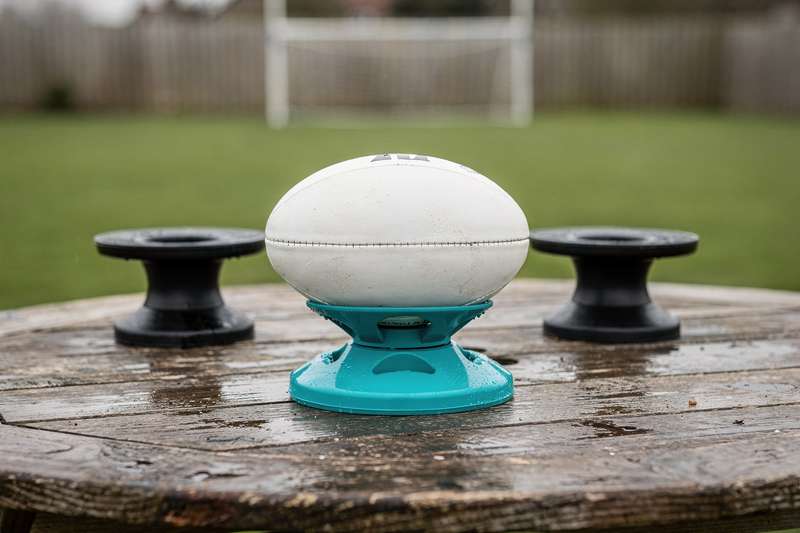
The Supertee King’s design centres on a wide, cupped ball cradle supported by a fan of angled prongs. The cup depth is well-judged: secure enough to hold the ball in position during your approach, but not so tight that retrieving the tee becomes awkward mid-match. The prongs fan out at angles that provide lateral resistance, preventing the ball from shifting sideways when placed under pressure. For any kicker whose technique depends on the ball being in exactly the same position every single time — which is to say, any kicker serious about improving — that consistency is the most valuable thing a tee can offer.
The base footprint is wider than many budget alternatives, which is the correct design priority for UK conditions. On a firm summer pitch the base matters less. On soft, waterlogged ground — which describes the majority of UK club pitches from late October through March — a narrow base tips over constantly, and that is a problem this tee avoids. The base prongs press into the turf rather than merely resting on it, which keeps the tee stable when the ball is loaded from different angles during placement. Reviewers consistently describe reliable stability on soft and waterlogged surfaces, including on pitches that would send a lighter, narrower tee sideways.
Material quality sets this tee apart from cheaper alternatives in a way that becomes clear across a full winter season. The rubber compound stays pliable in cold temperatures rather than stiffening to the point of brittleness when conditions drop close to freezing. That matters because brittle rubber cracks on impact, and in a busy training session the tee gets trodden on, kicked across the pitch, and dropped onto hard surfaces repeatedly. Multiple reviewers report using it across full winter seasons without cracking, splitting, or cup deformation. The prongs hold the right balance of flex — absorbing impact without permanently losing their shape.
The “King” designation refers to the full adult-size version, designed for size 5 balls in both league and union. Youth players using smaller balls should check whether the Supertee range includes an appropriate size for their age group rather than defaulting to this one. For adult club players, it is the correct specification. The only honest limitation: this is not the most compact tee in physical form. It takes up more bag space than a flat rubber disc. For any player prioritising performance over packing minimalism, that is a trivial tradeoff against what the tee provides on the pitch week in, week out.
Best for Club and School Kicking Sessions
The Carta Sports Prince Kicking Supertee holds the highest review count in this guide — 618 ratings at 4.7 out of 5 stars on Amazon UK. Review volume matters in a way that is easy to underestimate: a product sustaining a 4.7-star average across 600-plus purchases from a diverse range of buyers provides a far more statistically robust picture of real-world performance than a product with 50 reviews and a similar star average. This tee has been bought by club players, coaches, school sports departments, and recreational kickers across an extended period, and the consistently positive feedback across that broad pool reflects durable quality in practice.
The Prince Supertee shares design principles with the Dan Carter Supertee King — the same multi-prong cup system that stabilises the ball from multiple angles — but with prong geometry calibrated slightly differently. The cup sits at a marginally different angle, which some kickers find aligns better with their preferred ball lean. This is a subtle distinction, and plenty of buyers won’t notice a practical difference between the two Supertee designs. But for kickers who’ve tried multiple tees and have specific views about cup geometry, the Prince Supertee is worth choosing deliberately rather than as a default.
For coaches running structured kicking sessions, the Prince Supertee’s build quality is particularly relevant. A squad kicking drill might put a single tee through 150 or more ball placements in one session — far more physical stress than individual match-day use. The tee needs to survive repeated impact, mud, cold, and rough handling across an entire season without structural failure. The Prince Supertee earns consistent praise in exactly this context: multiple reviewers describe three or four seasons of regular squad use without meaningful deterioration. That longevity is the metric that matters most when you are responsible for a club’s training kit budget, where buying well once is significantly more economical than replacing cheap alternatives each season.
Ball compatibility with both league and union shapes is confirmed throughout the buyer feedback, including in settings where a mix of ball types appears in the same session. The cup handles the different profiles of league and union balls without the ball tilting laterally — the main failure mode of less well-designed cup geometries. This is particularly valuable for coaches in regions where both codes are active, or for academies working with players at different stages of development using different ball specifications.
Comparing it honestly with the Dan Carter Supertee King: the performance gap between these two products is minimal. Both hold a 4.7 rating across several hundred reviews. Both have confirmed multi-season durability and cross-code ball compatibility. The decision between them comes down to personal preference for cup geometry, which hands-on use will reveal far better than any written comparison. For a first purchase without prior Supertee experience, either is an excellent starting point. The Prince has a marginal edge in review volume: any systematic flaw in its design would be more likely to have surfaced across 618 purchases than across fewer. For a coach buying squad kit who wants the broadest possible evidence base behind their decision, that edge is worth noting.
Best Adjustable Rugby Kicking Tee
The Optimum Professional Rugby Kicking Tee with Lift-to-Adjust & Rotatable Base takes a different approach from the Supertee designs, and that difference is exactly why it belongs in this guide. With 720 verified reviews on Amazon UK — the largest review pool in this shortlist — it has been widely tested across a range of users and contexts. The 4.2-out-of-5-star rating, lower than the 4.7 the Supertees hold, reflects real buyer polarisation, and understanding why will help you judge whether it is the right tool for your situation.
The defining feature is the lift-to-adjust height mechanism. Rather than a fixed cup position, the Optimum Professional allows you to raise or lower the ball relative to the ground without swapping tees. For a kicker still developing their technique — working out where exactly they want the ball positioned for optimal contact — this is a practical advantage. For a coach who runs sessions with multiple players who each have different placement preferences, it means a single tee can serve the whole group rather than requiring a selection of different fixed-angle options. Making that adjustment quickly, without fumbling with separate equipment, has clear value in a busy training environment.
The rotatable base is the other headline feature. You can orient the base prongs to align with your run-up direction, changing how the tee resists the lateral forces generated when you load the ball from a specific approach angle. On firm, dry ground this is a modest benefit. On soft, wet ground — the standard UK winter pitch from October through March — pointing the base prongs optimally for your approach can meaningfully improve how securely the tee stays put during ball placement. For kickers who approach from a consistent angle and want every possible margin of stability, this is a thoughtful design choice.
The lower star rating reflects specific buyer experiences worth understanding clearly. The adjustment mechanism has moving parts, and moving parts wear over time under rough handling. Some reviewers report that after a season or more of regular use, the height adjustment no longer holds its set position as firmly, requiring readjustment mid-session. A solid moulded rubber tee with no moving parts does not have this failure mode. The Optimum’s adjustability comes with the maintenance consideration that any mechanical system introduces — not a flaw in the concept, but a real consequence of the design that high-volume users will encounter sooner.
The Optimum Professional is not the right choice if your technique is settled and you want a consistent, zero-maintenance option. Both Supertee designs serve that use case better. But if you are mid-development as a kicker, if you coach a diverse group with meaningfully different preferences, or if you want the ability to experiment with ball position as your approach evolves — this is the only tee in this guide that provides that flexibility. Understand the mechanical tradeoffs going in and it is a well-considered piece of kit that does something neither of the other picks can.
What to Look For in a Rugby Kicking Tee
- Cold-weather material performance: UK rugby runs through winter, and the rubber or polymer compound in your tee needs to stay pliable when temperatures approach freezing. Cheap rubber stiffens significantly below 5°C and cracks under impact when stiff. When reading reviews for any tee, prioritise buyers who describe full winter seasons of use — that is the feedback that reveals whether the material holds up in the conditions that matter most. A tee that performs fine in October but cracks in February is not fit for purpose.
- Base footprint and ground grip: The wider the base footprint relative to the tee’s overall height, the better it resists tipping on soft, uneven ground. Prong geometry at the base also matters — prongs that press into the turf rather than sitting flat on the surface hold position better when the ball is loaded from an angle during placement. This is the single most practically important specification for UK conditions, where pitches are soft for a substantial part of the season.
- Cup geometry and placement consistency: The cup determines the lean angle at which the ball is held and — more importantly — how consistently it maintains that angle across repeated placements. A well-designed cup sets the ball in the same position every time, which is what allows kicking technique to become automatic through repetition. Different cup designs favour different ball lean angles, and experienced kickers often develop strong preferences through practice. If you have a settled technique, look for a cup geometry that matches your preferred angle rather than forcing an adaptation.
- League vs union ball compatibility: Rugby league and union balls have different profiles — union balls are marginally fuller in cross-section, league balls slightly more tapered at the tips. Most quality tees handle both, but confirm this in buyer feedback before purchasing, particularly if you coach across codes or use balls from different suppliers. At grassroots level, equipment is not always consistent within a single squad, so a tee that works reliably across both ball types removes one variable from your sessions.
- Fixed vs adjustable design: A fixed-design tee made from quality rubber is simple, light, and has nothing to fail mechanically. An adjustable tee adds height and angle flexibility at the cost of mechanical complexity and long-term maintenance. If your technique is settled, a fixed design almost always serves better — fewer variables, more consistency, nothing to wear out. If you are coaching multiple players with different preferences, or developing your own approach, adjustability is a worthwhile trade-off.
- Ball size compatibility: Senior club rugby uses size 5 balls. Junior competitions typically use size 4 or 3, depending on the age group and governing body rules. A cup designed for a size 5 ball won’t hold a smaller ball securely — it will sit too low and shift sideways. If you are buying for youth players, verify through buyer feedback that the tee works reliably with the appropriate smaller ball size before committing.
- High-volume durability for squad use: An individual kicker might put a tee through 30 placements per training session. A coach running a squad kicking drill might put the same tee through 200 or more in an hour. Not all tees are built for that kind of throughput. If you are buying for a club rather than personal use, look specifically for feedback from coaches or team managers who describe the tee holding up through a full season of regular squad use — not just casual single-user experience.
Verdict
For the majority of people reading this guide — adult club rugby players who want a reliable kicking tee for training and match days in UK conditions — the DAN CARTER Supertee King Rugby League Union Kicking Tee is the clearest recommendation. The cup holds the ball consistently, the base handles soft ground reliably, and the rubber survives cold conditions across multiple seasons without cracking or deforming. The 4.7-star rating from 529 UK buyers reflects performance that has been tested across the conditions that UK club rugby actually involves.
Coaches buying kit for a squad should take a close look at the Carta Sports Prince Kicking Supertee. The review depth is the largest in this guide, the quality is closely matched to the Dan Carter version, and the track record of sustained durability under high-volume squad use is well-evidenced in the buyer feedback. The cup geometry difference between the two Supertee designs is subtle enough that buying either for squad use is a sound decision. The Prince’s slight advantage is the size of its verified buyer pool — meaningful reassurance when you are equipping a club and want maximum evidence that the product holds up through a full season.
The Optimum Professional Rugby Kicking Tee with Lift-to-Adjust & Rotatable Base is the right pick for kickers who need adjustability: those still working out their optimal technique, or coaches who want one versatile tee to serve multiple players with different ball placement preferences. It is not the right tool for a settled kicker who values simplicity and zero maintenance, but for the specific use case it addresses, nothing else in this guide provides what it offers.
In short: choose either Supertee design for consistency and simplicity. Choose the Optimum Professional when flexibility in setup is what you actually need — and go in understanding the mechanical maintenance consideration that comes with any adjustable system.
We were not paid to feature any specific product in this guide. All opinions are independent and based on publicly available specifications, verified buyer feedback patterns, and category research.
Quick Comparison Table


FAQ
What is the difference between a rugby kicking tee and a kicking holder?
In rugby, the terms “kicking tee” and “kicking holder” refer to the same piece of equipment — a moulded rubber or plastic device that holds the ball upright from the ground for placed kicks. The term “holder” originates from American football, where a player physically holds the ball for the kicker. In rugby, no human holder is used for placed kicks, so both terms describe the same inanimate support device. When searching on Amazon UK, the two terms are interchangeable in the context of rugby kicking equipment.
Which size kicking tee should I buy for junior rugby players?
Junior rugby players use smaller balls than the adult size 5: typically size 4 for players under 14 and size 3 for younger age groups, though exact specifications vary by competition rules and governing body guidance. A cup designed for a size 5 ball won’t hold a smaller ball securely — it will sit too low in the cup and shift sideways during placement. Check the manufacturer’s size guidance for any tee you consider, and confirm through buyer feedback that it works reliably with the relevant smaller ball. Some Supertee range variants exist specifically for junior ball sizes and are worth investigating for youth squad use.
How do I look after a rubber kicking tee through a cold UK season?
The biggest threat to rubber kicking tees through a UK winter is the freeze-thaw cycle, which stresses the material over repeated exposure and eventually causes cracking. Storing your tee indoors rather than leaving it in a cold boot or kit bag overnight is the single most effective maintenance habit. After muddy sessions, rinse the tee under running water to clear compacted mud from the prongs and base before it dries hard. Avoid leaving the tee compressed flat under heavy kit for extended periods, which can permanently distort the cup shape. A quality tee maintained this way should remain fully functional across multiple seasons.
Can I use the same kicking tee for rugby league and rugby union?
Yes — most quality rugby kicking tees accommodate both ball types, and all three picks in this guide are confirmed by buyer feedback to work with both rugby league and rugby union balls. The two balls differ slightly in profile: union balls are marginally fuller in cross-section, league balls slightly more tapered at the tips. Modern cup designs generally handle both shapes without the ball shifting or sitting insecurely. If you work across both codes or your squad uses balls from different suppliers, check buyer reviews for specific mentions of cross-code compatibility to confirm a given tee handles your exact ball type reliably.
What ball angle on a kicking tee produces the best results?
There is no universally correct answer — ball placement angle is a product of individual technique, kick trajectory preference, and habits built through deliberate practice. A common coaching starting point for conversions and penalties is a lean of roughly 10 to 15 degrees away from the kicker, setting up a clean contact point on the lower half of the ball. Some experienced kickers prefer a near-vertical position; others use a more pronounced lean for a higher trajectory on touchline kicks. Let your kicking coach’s guidance on your specific technique determine your preferred angle first — then select a tee whose cup geometry holds that angle consistently across every placement.
How many kicking tees does a club rugby team need?
For match days, one tee is sufficient in most situations, with a spare in the kit bag as backup against loss or damage during warm-up. For structured training sessions with multiple players working simultaneously, having three to five tees eliminates the queuing and session delays that come from rotating a single tee around a large group. Buying in small multiples also protects against a tee failing mid-season at a critical point in your training calendar. At the mid-range price point of the options in this guide, equipping a club with three quality tees is a practical investment that pays for itself quickly in uninterrupted, smooth-running sessions.