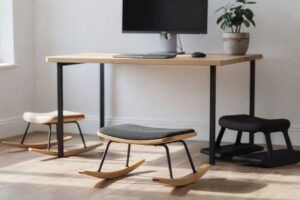
You’ve adjusted your chair three times this week and it’s still not right. Set the seat height so your feet reach the floor and the desk is suddenly at the wrong angle for your wrists; raise everything to the correct typing position and your feet dangle an inch or two above the floor. By mid-afternoon your lower back is quietly complaining and you’ve shoved a rolled-up gym bag under the desk as a makeshift foot support — until you kick it sideways during the next video call.
Travel throws up the same misery in a different seat. Six hours into a long-haul flight, your feet flat on the floor, your ankles puffing gently, your jacket balled under your knees because someone online said it helps. Meanwhile, in the next seat, someone produced a small inflatable cushion from their bag before take-off and has been comfortable for the last four hours.
The right rest — a foot rest, lumbar cushion, coccyx pad, or a proper reading pillow — is one of those purchases that seems modest right up until you use it daily, and then feels completely obvious. This guide works through what’s actually available to UK buyers right now, across five different types of rest, so you can find the right solution for your specific situation rather than buying something generic and hoping it fits.
How These Products Were Assessed
This guide covers five sub-categories within the broader rests market: under-desk foot rests, inflatable travel foot rests, lumbar support cushions, coccyx seat cushions, and bed-rest reading pillows. For each, I looked at: material quality and construction (memory foam density, inflation mechanism, fabric durability), adjustability in height and angle, non-slip performance on both hard floors and carpet, portability for travel products, and whether the cover is removable and washable — important for something pressed against your body for hours at a time.
Two products here — the Airplane Footrest and the Maliton Inflatable Foot Rest — carry meaningful verified buyer review bases (727 and 293 reviews respectively), and the patterns in that feedback directly shaped my understanding of their real-world strengths and weaknesses. The remaining five products are newer to market with no published review base at the time of writing; those are assessed on specifications and design principles alone. I say so clearly in each section, and I’d encourage you to check current review counts before committing to those picks.
Best Budget Pick for Air Travel
The Airplane Footrest is the starting point for anyone who wants to make economy class more bearable without spending much. It uses a hammock-style design: a fabric sling that attaches to the tray table and suspends your feet above the floor, reducing the pooling of blood in your lower legs over a long flight. With 727 verified buyer reviews and a 3.9/5 rating, it has enough real-world feedback to give an honest picture of both what works and what doesn’t.
The core concept is sound. When your feet hang in a sling rather than pressing flat against the floor, you remove the pressure on your calves and the backs of your thighs, and the slight elevation helps with circulation over longer journeys. The hammock design packs down to almost nothing — typically rolling up to the size of a small water bottle — so it adds no meaningful weight or bulk to a carry-on. For budget-conscious travellers who want something better than nothing, it does what it promises.
The 3.9-star rating tells a more nuanced story, though. Tray table dimensions vary across aircraft and airlines, and on some configurations the attachment strap can loosen and slip when you shift position. A portion of reviewers also report that cabin crew on certain carriers asked them to remove the device during taxi, take-off, and landing — which means fitting and removing it multiple times per flight. If you’re on a short-haul route with only an hour or so in the air, that friction can outweigh the benefit.
Height compatibility is worth considering too. This style works best for passengers of medium build. If you’re particularly tall and your knees already press the seat in front, the sling changes the leg angle but doesn’t solve the core space problem. If you’re shorter, the sling may hang too high without careful strap adjustment. Most buyers find a workable position, but expect a few minutes of fiddling on your first flight.
For casual travellers making a few long-haul trips per year, this is a reasonable, low-cost option that takes up almost no space. More frequent flyers, or anyone who finds the tray-table attachment frustrating after a first attempt, should look at the inflatable options below.
Best Inflatable Foot Rest for Long-Haul Flights
The Maliton Inflatable Foot Rest with Quick-Inflate Pump Bag approaches in-flight comfort differently: instead of a hammock, you get a firm inflatable platform that sits on the floor under the seat in front, raising your feet to a comfortable elevation without any attachment to the tray table. With 293 reviews and a 4.3/5 rating, it’s the better-received of the two travel options in this guide, and the standout feature is the pump bag — you squeeze it to inflate the rest, meaning no mouth-blowing required, which matters on a twelve-hour overnight flight.
Three inflation levels let you adjust the height to your seat configuration and leg length. At the lowest setting you get a gentle angle useful for shorter flights; at the highest, proper elevation that takes meaningful pressure off your ankles and lower legs over the long haul. The surface is firm enough to support your weight reliably rather than deflating under foot pressure — the most common failure point with cheaper inflatable rests. Reviewers consistently note it holds its inflation throughout a flight, which is the baseline expectation but not always guaranteed in this category.
The pump bag mechanism is clever but worth understanding before you fly. You squeeze the bag repeatedly to inflate, then seal it; deflation reverses the process. Once you’ve done it once, inflation takes under a minute. On the first attempt without reading the instructions, though, it can be confusing. Look at the product description or a short video before travel day — you don’t want to be puzzling this out in a cramped seat at 2am while the person beside you is trying to sleep.
Compared to the hammock-style option, this provides a considerably more stable platform. Your feet rest on something solid rather than swinging in a sling, which most people find more comfortable over longer durations. The tradeoff is pack size: when deflated, this takes up more space in a bag than the hammock alternative, though it still fits comfortably in a standard carry-on. Airlines generally raise no objection to inflatable floor rests; tray-table attachments occasionally attract crew attention.
If you travel long-haul regularly — anything above four hours — this is the stronger pick. The pump-bag design removes the main practical barrier to owning an inflatable rest, the higher review score reflects better overall execution, and the three-level height adjustment works across a wider range of seat configurations and passenger builds than a fixed-height alternative.
Best Under-Desk Foot Rest with Massage Function
The HUANUO Foot Rest does two things at once for desk workers: it raises your feet to a comfortable position and provides a textured massage surface to keep circulation moving during long sitting sessions. It offers three height positions and an adjustable tilt angle, so you can adapt it as your desk setup changes or as your preferred posture shifts across the day. A non-slip base is designed to hold it in place on both hard floors and carpet.
The design reasoning is solid. The combination of height adjustability and massage surface addresses two distinct complaints — feet that don’t quite reach the floor, and the stiffness that comes from sitting completely statically for hours on end. Adjustable tilt lets you experiment with a slightly forward-angled position (which encourages active posture) versus a flat surface (more relaxed during calls or deep-focus work). HUANUO has an established presence in ergonomic office accessories, which gives some confidence to the underlying design choices here.
Being direct: at the time of writing, this product has no verified buyer reviews on Amazon UK. I cannot tell you from real-world data whether the massage texture is useful in practice or merely a surface feature, whether the height positions hold firm under sustained foot pressure, or how the rest performs on carpet compared to hard floors. For a product where daily usability depends on those details, that’s a meaningful gap. Check the current listing for updated reviews before buying, and factor in that you’re taking more of a calculated risk than with the reviewed options in this guide.
The massage surface on rests of this type typically consists of raised nodules or a textured top layer. The benefit is subtle — encouraging small foot movements rather than anything close to an actual massage — but it can help with circulation over a full working day. Whether you find the texture pleasant or irritating is entirely personal: some users find the tactile feedback helpful, others prefer a smooth, neutral surface and find the nodules distracting. If you’re uncertain, treat the massage function as a potential bonus rather than the primary reason to buy.
This suits someone who specifically wants adjustability and a massage function, and who is comfortable purchasing before the review base builds. If you’d rather have a product with an established real-world track record, the Everlasting Comfort Foot Rest below is the more cautious choice in this sub-category.
Best Memory Foam Foot Rest for Desk Workers
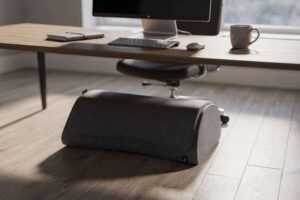
The Everlasting Comfort Foot Rest takes a more straightforward approach: a solid memory foam wedge that sits under your desk and provides a consistent, cushioned platform for your feet throughout the working day. It’s positioned for both office use and gaming desks, which reflects the reality that anyone spending extended hours in a chair — whatever the screen is showing — faces the same problem of feet that don’t quite reach the floor at the optimal chair height.
Memory foam is a sensible material choice for a foot rest. It conforms to the shape and weight distribution of your feet over time, distributes pressure evenly, and stays quiet while you shift position — no rattling adjustment mechanisms to fiddle with during calls. The simplicity is also a practical advantage: you place it under the desk and it does its job without further thought. The trade-off is that a foam wedge offers one fixed height, and if that height doesn’t match your specific desk-to-floor gap, you can’t adjust it without placing additional material underneath.
Transparency: this product has no buyer reviews on Amazon UK at the time of writing. That matters because memory foam density varies significantly between products, even at similar price points. High-density foam holds its shape through months of daily use; lower-density foam compresses flat relatively quickly and stops providing meaningful support. Without reviewer feedback, there’s no way to know where this specific product sits on that spectrum. Checking the current listing for updated reviews is advisable before committing.
The leg elevation benefit extends beyond foot comfort. Raising your feet even a small amount reduces compression on the backs of your thighs against the seat edge — a common cause of the pins-and-needles sensation that builds during long seated stretches. This is particularly useful if you’re working on a chair that isn’t height-adjustable, such as a dining chair pressed into service as a home office seat.
If you want a no-fuss foot rest without adjustment mechanisms to maintain, this is the right approach. Before buying, measure the gap between your naturally hanging feet (when seated at the correct desk height) and the floor, then confirm the product dimensions cover that gap. A foam wedge that’s too low provides minimal benefit; one that’s too high forces an uncomfortable upward leg angle that creates its own problems.
Best Lumbar Support Cushion for Office and Car Use
The Travel Ease Ergonomic Lumbar Support Cushion addresses the back end of the sitting problem — literally. While foot rests deal with what happens below the desk, a lumbar cushion deals with what happens at your lower back, where most prolonged sitting discomfort actually originates. This is a memory foam cushion with a skin-friendly cover, designed to sit between you and the backrest of an office chair or car seat to fill the gap that most chair backs leave in the lumbar region.
Most chairs — even well-made ones — are compromised in their lumbar support because they’re built to accommodate a range of body sizes. The built-in lumbar curve may hit at the wrong point for your spine, providing pressure where you don’t need it and leaving a gap where you do. A separate cushion lets you position support exactly where your lower back needs it. Memory foam is the appropriate material here: it moulds to your shape rather than pushing back with a rigid, fixed curve.
There are no buyer reviews for this product at the time of writing. For a lumbar support specifically, that’s a significant information gap. Practical effectiveness depends on details that specifications alone don’t confirm: whether the cushion slides down the chair under body weight, whether the attachment strap is long enough for different chair widths, and how the foam density holds up after months of daily use. A lumbar cushion that migrates out of position within an hour is worse than no cushion, because you end up adjusting it constantly. I’d check current review counts before buying.
The skin-friendly cover description suggests breathable fabric, which matters for something pressed against your back all day. Key things to verify in the full listing: does it include an adjustable-length attachment strap? Is the cover removable for washing? What is the foam density rating? These aren’t always listed clearly but they substantially determine how the product performs over time.
A lumbar cushion is the right category of solution if your discomfort starts roughly at the beltline and worsens through the afternoon. If the pain is higher — mid-back or shoulder level — a lumbar cushion won’t address it; monitor height and keyboard positioning are more relevant there. For the classic lower-back desk worker complaint, this type of support consistently makes a real difference when the execution is right.
Best Seat Cushion for Tailbone and Hip Comfort
The ProtoArc Ergonomic Coccyx Seat Cushion targets one specific problem: pressure on the coccyx (tailbone) and hip bones during prolonged sitting. The split design — a cut-out channel through the rear of the cushion — removes direct contact between the seat surface and your tailbone, which can become significantly painful during long working days, after minor injury, or simply due to individual anatomy. It’s designed to work across office chairs, car seats, and home chairs, giving it a practical versatility for people who move between contexts throughout the day.
That multi-surface flexibility is a real advantage. If you spend the morning at a desk, drive to a meeting, and sit through an afternoon of back-to-back calls, the cushion travels with you rather than staying fixed to one chair. The pressure redistribution the split design provides works by shifting seated weight towards the ischial tuberosities (sitting bones) rather than concentrating it on the tailbone — which is the mechanism behind the burning or aching sensation that builds in chairs without this accommodation.
There are no buyer reviews for this product at the time of writing, and for a coccyx cushion that gap is particularly relevant. The effectiveness of the cut-out design depends heavily on its actual dimensions: the channel needs to be wide enough and deep enough to actually keep the tailbone clear of the seat surface, rather than being a shallow cosmetic feature. Without reviewer feedback confirming this, you’re relying on the brand’s design intent alone. Check the current listing, and if there are still no reviews, consider comparing it against a well-reviewed alternative in this sub-category before deciding.
ProtoArc positions this for standard office desk chairs, so dimensions should suit typical office seating. If you’re planning to use it in a car with a heavily contoured bucket seat, check the cushion dimensions carefully — an additional cushion can raise your seated position on some vehicles and affect your reach to the pedals and steering wheel. For a standard flat office chair seat, that concern doesn’t apply.
If coccyx or hip pain is your primary complaint, this category of solution is the right one. If your pain is more in the lower back than the tailbone, the lumbar cushion above is the more appropriate fix. Some people find they benefit from both at the same time — a seat cushion and lumbar support address different aspects of seated posture and work together rather than conflicting.
Best Reading Pillow for Bed Rest and Sofa Use
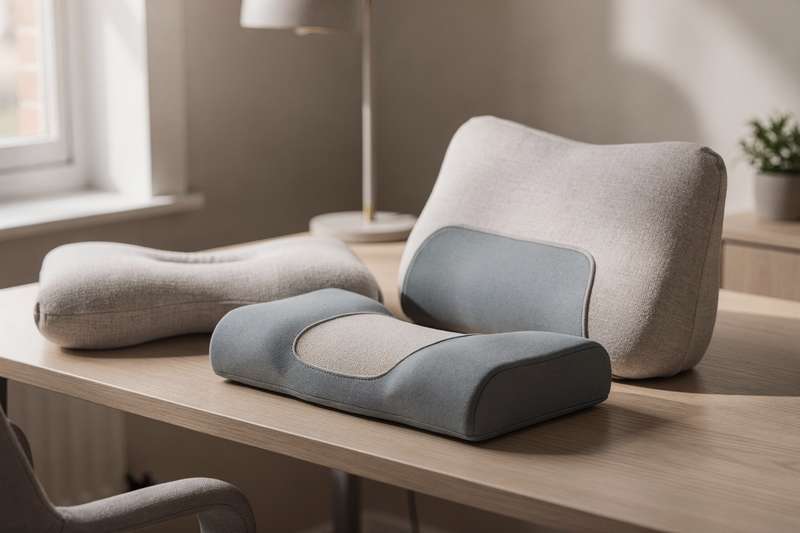
The SLIGUY Reading Pillow solves a different kind of rest problem: not desk-based sitting, but the hours spent reading, watching a tablet, or browsing your phone while leaning against a headboard or sofa back. Without proper support in this position, you end up hunching forward, craning your neck, or propping yourself on one arm until it goes numb. A reading pillow gives you a shaped backrest that leans against the headboard and wraps around to support your arms as well as your back.
The arm supports are the feature that most distinguishes a reading pillow from a stack of regular pillows. Having a surface to rest your forearms on means you’re not holding a book or tablet at arm’s length for extended periods, which fatigues your shoulders more quickly than most people expect during longer sessions. The pockets are a secondary practical improvement — having somewhere to put your phone, glasses, or TV remote without reaching over the side of the bed is a small but constant quality-of-life gain during an otherwise relaxed evening.
No buyer reviews at the time of writing, which makes it harder to assess the specifics that matter most: how the filling holds its shape after months of use, whether the arm support height works across different body sizes, and whether the backrest provides enough firmness to support your lumbar region when pressed against a soft headboard. Reading pillows vary from very firm (better lumbar support but harder on the arms) to quite soft (comfortable initially, but less supportive over an hour). Without reviews, I can’t tell you where this model sits on that spectrum — that’s a limitation worth factoring into your decision.
The dual positioning as both a bed chair and sofa back pillow is practically useful if you move between rooms throughout the day. Check the dimensions against both your headboard and your sofa back — some reading pillows are sized for single beds and feel narrow on a wider sofa. Confirm whether the cover is removable for washing: with something pressed against your back and arms regularly, cleanability is basic maintenance rather than an optional extra.
A dedicated reading pillow is worth buying if you spend more than thirty minutes at a time reading or using a device in a semi-reclined position. The arm support and shaped backrest are functional improvements that a rearranged pile of regular pillows can approximate but never quite match. Once this product builds a review base, buyer feedback will be the best guide to whether the SLIGUY holds up in daily use as well as the design suggests.
What to Look For When Buying a Rest
With five different product types covered in this guide, the important buying criteria shift depending on which kind of rest you need. Here are the key factors across all categories:
- Material and foam density: Memory foam is standard for desk and seat cushions. Higher-density foam holds its shape longer and provides firmer, more consistent support — it may feel harder initially but outlasts lower-density alternatives significantly. Inflatable travel rests let you adjust firmness by changing the inflation level, which is a genuine advantage for anyone not sure what firmness works best for them before committing to a fixed-density product.
- Height adjustability: A fixed-height foot rest is only useful if that height matches your specific chair and desk setup. Measure the gap between your naturally hanging feet (when seated at the correct desk height) and the floor before buying. Adjustable rests with two or three height positions give you flexibility to fine-tune, and tilt adjustment lets you experiment with the angle rather than committing to one position indefinitely.
- Non-slip performance: Any floor-based rest needs a reliable non-slip underside. Rubber and silicone grips work well on hard floors, but performance on carpet varies by product. If your workspace is carpeted, look specifically for reviews or product descriptions addressing carpet performance before purchasing — some non-slip materials that grip hard floors slide freely on soft surfaces.
- Portability and pack size: For travel rests, deflated pack size and weight are the primary constraints. Hammock-style rests pack smallest but provide less structural support. Inflatable platform rests are bulkier when packed but more stable in use. Neither should add meaningful weight to a carry-on. For desk rests that stay in one place, portability is irrelevant — prioritise material quality and adjustability instead.
- Lumbar cushion attachment: A lumbar support that slides down the chair backrest within an hour is worse than useless. Look for an adjustable strap that fits your specific chair width and a robust buckle mechanism. If the listing doesn’t mention strap adjustability, assume it’s a basic fixed strap and check whether the dimensions suit your chair before buying.
- Coccyx cushion cut-out depth: The effectiveness of a coccyx cushion depends on the cut-out channel being wide and deep enough to genuinely keep the tailbone clear of the seat surface. Shallow cut-outs provide minimal relief. Where possible, find products that specify cut-out dimensions, or seek out reviewer feedback that specifically addresses whether tailbone clearance works in daily use.
- Washable covers: Anything pressed against your feet, back, or arms regularly should have a removable, machine-washable cover. This is basic maintenance, not a bonus feature. If a listing doesn’t specify a removable cover, contact the seller before buying or assume it doesn’t have one.
The Bottom Line
Of the products with a meaningful real-world review base, the Maliton Inflatable Foot Rest with Quick-Inflate Pump Bag is the strongest overall recommendation for anyone whose primary problem is travel discomfort. A 4.3/5 rating from 293 reviewers is the best combination of score and review volume in this selection, and the pump-bag inflation mechanism removes the main practical barrier to owning an inflatable travel rest. If you’re a regular long-haul traveller and only buying one product from this guide, this is the one to start with.
For desk workers, the most useful thing this guide can do is help you match product to problem. Feet dangling above the floor? A foot rest — the HUANUO with its adjustable settings if you want flexibility, the Everlasting Comfort if you want simplicity. Lower back aching by afternoon? The Travel Ease lumbar cushion addresses that directly. Tailbone soreness from a long day in a hard chair? The ProtoArc coccyx cushion is the targeted fix. Evenings on the sofa leaving your shoulders stiff and your neck craned forward? The SLIGUY reading pillow is a more specific solution than any rearrangement of regular cushions. Identify the pain point first — the right rest follows from there.
We were not paid to feature any specific product in this guide. All opinions are independent and based on publicly available specifications, verified buyer feedback patterns, and category research.
Quick Comparison Table


FAQ
Do foot rests actually help with back pain?
Yes, though indirectly. When your feet are unsupported and your legs dangle, your pelvis tends to rotate backwards, flattening the natural lumbar curve and loading the lower back muscles. A foot rest that brings the floor up to meet your feet helps restore a more neutral pelvic position, which reduces spinal strain over a long working day. For significant back pain, a foot rest is one component of a broader ergonomic setup — monitor height, chair adjustment, and lumbar support all contribute as well.
Are inflatable foot rests allowed on planes?
Generally yes, though rules vary by airline and are not always written down explicitly. Floor-based inflatable rests are rarely challenged by cabin crew during the cruise portion of a flight. You will almost certainly be asked to deflate and stow any foot rest during take-off, landing, and turbulence for safety reasons, regardless of type. Tray-table hammock rests attract more crew attention on some carriers. Check your specific airline’s policy if in doubt, and be prepared to remove it when asked.
What height should a foot rest be?
The ideal height allows your thighs to be roughly parallel to the floor — or very slightly angled downwards at the knee — when seated at your correctly adjusted desk and chair height. Measure the gap between where your feet hang naturally in your chair and the floor; that measurement tells you the rest height you need. Most under-desk foot rests offer between seven and fifteen centimetres of height, and adjustable models give you more room to dial in the exact position for your setup.
Can I use a coccyx cushion every day long-term?
Yes, and for many people it becomes a permanent fixture in their desk setup. The main long-term consideration is foam degradation — most foam cushions compress over months of daily use and gradually provide less relief than when new. High-density foam lasts considerably longer than budget alternatives. Some users replace their cushion every twelve to eighteen months; a well-constructed high-density option can last several years before losing meaningful support.
Is a reading pillow worth buying if I already have regular pillows?
The value is in the arm supports and the shaped backrest, which a stack of regular pillows can’t reliably replicate. Regular pillows compress and slide apart over the course of an evening; a reading pillow holds its position and provides your forearms with somewhere to rest, which reduces shoulder fatigue substantially during longer reading or tablet sessions. If you spend more than thirty minutes at a time reading in bed or on the sofa, it’s a practical upgrade over improvised pillow arrangements.
What is the difference between a lumbar support cushion and a coccyx cushion?
A lumbar cushion sits behind your lower back, between your spine and the chair backrest, filling the gap that most chair backs leave in the lumbar region. A coccyx cushion sits on the seat itself and redistributes pressure away from the tailbone and hip bones. They address different pain points: lumbar cushions for lower back ache, coccyx cushions for tailbone or hip soreness. Many people who sit for extended periods find they benefit from both simultaneously — they address different aspects of seated posture and work together rather than conflicting.