You found a gorgeous mosaic serving tray on Instagram, saved forty-odd similar projects, and eventually decided it was time to have a go yourself. The first kit you ordered looked the part in the listing photos — neat rows of colourful tiles, a finished product that actually resembled the preview image — but when it turned up, there was no grout, no adhesive, and instructions that amounted to three blurry diagrams. You managed something resembling a coaster, but the grout crumbled at the edges and the tiles looked patchy. Or perhaps you’re shopping for a different reason entirely: you want a craft activity for a half-term afternoon, and you’d like something that won’t put glass fragments anywhere near small fingers. Either way, the mosaic kit category on Amazon UK is all over the map — glass tile coaster sets designed for adults, peel-and-stick foam art packs aimed at toddlers, decorative sea glass kits for beach lovers, loose acrylic tile assortments for free-form work, and professional-grade tool sets for anyone ready to cut their own tiles. The difference between a satisfying finished project and a box of regret comes down to matching the right kit to what you actually want to make, and who’s going to be making it.
How These Picks Were Chosen
Each product in this guide was assessed against five practical criteria: kit completeness — does it include everything you need, or are adhesive and grout sold separately? Material and safety — is the tile type appropriate for the intended user’s age and experience level? Project format — is the finished object something worth keeping or giving? Verified buyer feedback patterns — not just the star average, but how many people left it and what they consistently highlighted. And listing accuracy — because a kit that arrives with half the items shown in the product images is no bargain regardless of its rating. Where review counts are low, that has been flagged clearly. A 5-star rating from two buyers is a different weight of evidence to one from five hundred, and you deserve to know which situation you’re looking at before spending your money.
Best Mosaic Coaster Kit for Adults
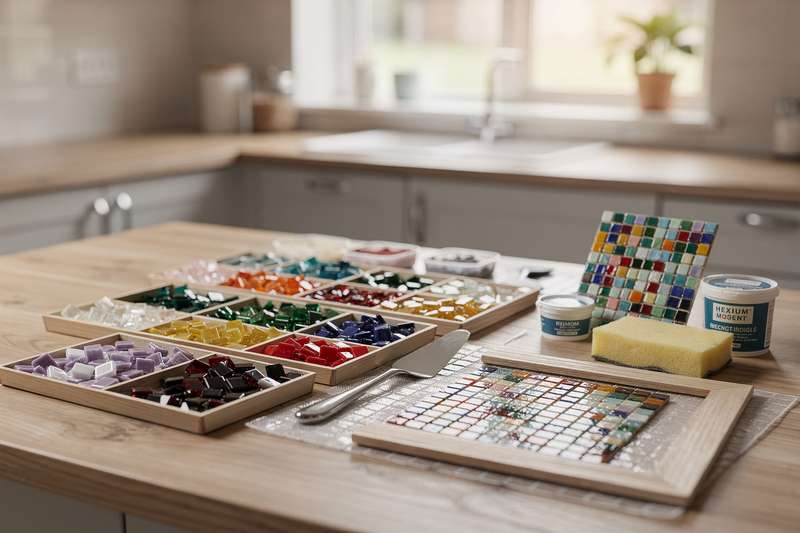
The 10 Sets DIY Mosaic Coaster Kit, Glass Tile Coaster Craft Kit for Adults is the most practical choice for adult beginners who want a hands-on project with a tangible, gift-worthy result. Ten complete coaster sets in a single package sets it apart from single-project alternatives: you get enough material to experiment on the first couple of sets, refine your technique on the next few, and still have plenty left over to make gifts. At the time of evaluation it holds a clean 5.0-star rating from ten verified buyers — a positive early record, even if the review base is still modest.
Glass mosaic tiles have a meaningful advantage over foam and acrylic when it comes to finished quality. They produce a piece that looks handmade in the artisan sense — not the school-project sense — and once properly grouted and sealed, they’re easy to wipe clean and will last for years. For coasters specifically, that durability matters: you’re making something that will sit on a coffee table and take a hot mug every morning, not a decorative piece that lives untouched on a shelf.
The volume in this kit is both its strength and its main logistical consideration. Ten sets means ten bases, ten tile assortments, and ten separate grouting stages. Working alone, you’ll want adequate table space and a willingness to pace yourself — this isn’t a single-session project from start to finish. But if you’re organising a craft evening, a hen party activity, or a Christmas gift-making session, the format is ideal: everyone gets their own coaster set, and the materials are already divided out for you.
One thing to check before ordering any glass tile kit: verify whether adhesive and grout are included with the tiles and base, or whether you’ll need to source them separately. Grout colour is a bigger creative decision than most beginners expect — white grout against colourful tiles looks fresh and bright, while dark grey or black grout gives a more graphic, bold result. If you’re new to mosaic work, a pre-mixed tile adhesive or strong PVA is forgiving for positioning tiles before they set, and unsanded grout in a neutral shade is a sensible starting point. Existing reviewers note that the tile quantity per set is generous — you’re unlikely to run short partway through a coaster, which matters for beginners who inevitably break a few pieces during placement.
The main limitation is that glass tiles require basic handling care. They have sharp edges, and breaking them — which you’ll do deliberately to fill awkward gaps in a design — produces fragments that need tidying carefully. This isn’t a kit to hand to a child without supervision. For adults comfortable with that, the glass tile format produces results that justify the extra care, and ten coaster sets in one package represents significant value for a group activity or an ongoing personal project.
Best Mosaic Kit for Young Children
The Dubydu Mosaic Sticker Art Kit for Kids Age 3+, 8 Pack Ocean & Animal Crafts, Foam Mosaic Kits for Children, Peel and Stick DIY Art Set takes a fundamentally different approach to mosaic craft — and that’s entirely the point. Where glass tile kits are designed for adults happy to work with adhesive, grout, and sharp-edged materials, this kit uses pre-cut foam stickers that children peel and press onto a printed template. No scissors, no glue, no grout, no sharp edges. For children aged three and upward, that’s the correct format.
The pack includes eight separate activity sheets covering ocean and animal themes — fish, turtles, crabs, and similar designs that appeal to younger children rather than the geometric or floral patterns that dominate adult kits. Each sheet has a pre-printed design with colour-coded sections, so children match foam pieces to the corresponding areas without needing significant fine-motor precision. The peel-and-stick format means the activity is genuinely self-contained: children can get started without waiting for glue to dry or needing adult help for the detailed bits.
With a 4.3-star rating from twelve verified UK buyers, this has a small but consistent feedback base. Reviewers note that the foam pieces are easy for small fingers to handle and that the activity holds children’s attention for a meaningful stretch of time — not just ten minutes before they want to do something else. Eight activity sheets give reasonable longevity, whether you’re spreading them across several days at home or using them for a group activity at a birthday party or school holiday club.
The honest limitation is that foam sticker mosaics are activity pieces, not lasting display objects in the way glass tile mosaics are. The foam doesn’t have the same finish or durability as grouted glass, and the completed sheets are better understood as an enjoyable creative process than a keepsake. For a three-year-old or a six-year-old, that’s perfectly fine — the act of making it is the point, and the ocean and animal themes give the activity a clear sense of purpose rather than being abstract shape-matching.
If you want to introduce older children (eight to twelve) to mosaic craft with a slightly more structured project and a more durable result, a supervised glass tile kit may be worth considering. But for children under eight, or for any situation where you need a craft activity that doesn’t require hovering over participants, this format is the clear choice. It travels well (the sheets and stickers pack flat), requires no prep and minimal cleanup, and the eight-pack format gives you enough material to last through half-term without running out on day two.
Best Sea Glass Mosaic Kit
The DIY Sea Glass Mosaic Kit, Sea Glass Art Kit, Sea Turtle Craft, Beach Art occupies a distinctive niche in this category. Rather than manufactured ceramic or glass tiles, it uses tumbled sea glass pieces — the frosted, beach-worn fragments that carry an organic, coastal aesthetic no precision-cut tile can replicate. The sea turtle design suits the material well: irregular shapes and frosted texture complement a nature-themed subject in a way that uniform square tiles simply wouldn’t achieve.
Sea glass behaves differently to cut tiles. The pieces are naturally irregular in shape and size, so the fitting process is less about straight grout lines and geometric precision and more about finding pieces that complement each other organically. For some crafters, this is liberating — you’re working with the material rather than against it, and small gaps or overlaps contribute to the handmade aesthetic rather than detracting from it. For crafters who prefer neat, symmetrical results, it may feel less controlled than tile kits, and that’s worth knowing before you commit.
This kit currently holds a 5.0-star rating from two verified reviewers, which is a very small sample. Two five-star reviews tell you the kit doesn’t have catastrophic flaws, but they can’t tell you how it performs across a range of users or over time. If you’re cautious about thin review bases, that’s a fair position. If you’re drawn to the sea glass aesthetic and comfortable working with an organic, less predictable material, the format is genuinely different to anything else in this roundup, and that distinctiveness has real value.
The sea turtle theme in this listing is one of two designs currently available from the same product line — the seahorse version (DIY Sea Glass Mosaic Kit, Sea Glass Art Kit, Seahorse Craft Kit, Beach Art) carries the same format and rating at the time of writing. If turtles aren’t your preference, the alternative is available and equally reviewed.
Sea glass mosaic projects work particularly well as a slow, mindful craft rather than a quick afternoon activity. The process of sorting through pieces, finding shapes that fit naturally, and gradually building up the design is absorbing in a way that’s more about patience than speed. That makes it a solid fit for adults who approach craft as a way to switch off from screens and structured tasks, and who want a finished display piece with genuine visual character. Once sealed, the frosted, layered quality of sea glass catches the light differently at different angles — that quality simply can’t be replicated with manufactured tiles.
One practical note: as with any mosaic using natural or irregular materials, adhesive application matters. Press pieces firmly and allow adequate drying time before grouting, as the varied thickness of sea glass means some pieces may sit slightly higher than others. Patience during the drying phase pays off in a cleaner, more professional-looking grout application.
Best Acrylic Tile Set for Free-Form Projects
The Acrylic Mosaic Tiles for Crafts, 400+ Mixed Shapes Acrylic Pieces sits in a different category to the project-specific kits above. Rather than giving you a defined base and a design to follow, this is a loose tile assortment — 400+ pieces in mixed shapes — that you bring to your own projects. If you already have a mosaic base, a terracotta pot, a picture frame, or any other surface you want to tile, this gives you the raw material to work freely without the constraint of a printed template.
Acrylic tiles have practical advantages over glass in certain situations. They’re lighter, less likely to shatter if dropped, and marginally more forgiving on curved surfaces — they flex slightly where glass won’t. The mixed shapes in this assortment mean you can create more organic designs without needing to cut tiles to fit unusual spaces. For crafters who haven’t yet invested in tile nippers or cutters, that’s a meaningful benefit: varied compositions are achievable without specialist tooling.
The limitation is straightforward: this is a component, not a complete kit. You’ll need adhesive, a base, and grout to produce a finished project — none of which are included. If you’re a complete beginner expecting to open the box and start work immediately, this isn’t the right entry point. It’s best suited to crafters who already have mosaic supplies and want to extend their tile palette, or those who specifically want to design their own project from scratch.
This listing has a single verified review at 5.0 stars — which means the feedback basis for evaluation is minimal. It’s included here because the format fills a real gap in this guide (loose tiles for free-form work) and because acrylic as a material has practical advantages in the right context. That said, if you prefer buying products with an established review record before committing, treat this as a supplementary purchase rather than a standalone starting point. Adding it alongside one of the established kits above is the more cautious approach for first-time buyers.
400+ pieces is a meaningful quantity — enough to cover several small projects or one larger decorative piece — and the mixed shapes add useful variety across different project types. Acrylic tiles also deliver reliably vivid colours without the natural variation you get with sea glass or stone. The trade-off is that acrylic lacks the light-catching depth of glass and the organic texture of natural materials: it’s the right choice when bold, graphic colour is the priority rather than fine surface quality or a handcrafted feel.
Best Mosaic Tools Set for Advancing Crafters
The Glarks 9Pcs Mosaic Tools Set, 2Pcs Heavy Duty Wheeled Glass Mosaic Nippers and Tile Cutter Pliers with 7Pcs Mosaic Tile Tools is a different kind of recommendation to the kits above — it doesn’t include tiles, a base, or a design template. What it provides is the tooling to break free from pre-cut tiles entirely and start working with glass, ceramic, or stone sheets cut to any shape you want. With a 4.5-star rating from 513 verified buyers, it’s comfortably the most widely reviewed product in this roundup, and the feedback is consistent: reviewers rate the nippers as sturdy, reliable, and suited to both hobby and semi-professional use.
The set includes two wheeled glass mosaic nippers and tile cutter pliers, plus seven additional mosaic tile tools. Wheeled nippers work by rolling a hardened wheel along the tile surface to score it before breaking, which gives more consistent results than lever-type cutters when making curved and irregular cuts. For anyone who’s tried to follow a curved design template using only square pre-cut tiles and found the result blocky and disappointing, nippers are what makes fluid, design-led mosaic work possible. They’re not difficult to learn, but they do require a little practice before your cuts become consistent.
This tools set is for crafters who already know they’re serious about mosaics, or who have quickly outgrown the constraints of beginner kits. If you’ve completed a couple of coaster projects and find yourself wanting to make larger wall panels, garden art, or custom mirror frames — work where you need to cut tiles to specific shapes — this is the logical next purchase. It’s also a sensible investment if you plan to buy tiles in sheets, which is significantly more economical for larger projects than paying for pre-cut assortments piece by piece.
The 513-reviewer feedback base means you’re drawing on a wide range of buyer experiences rather than a handful of early impressions. Most highlight the build quality of the nippers as stronger than the price point might suggest, with the hardened wheels holding their edge through extended use rather than dulling quickly. A smaller proportion of reviewers note that the seven additional tools in the set vary in usefulness — some are handy for specific finishing tasks, others less so — but the core nippers and cutter pliers are consistently praised as the heart of the set, and worth the purchase on their own merits.
One practical note: working with glass-cutting tools requires care. Sharp edges, glass fragments, and significant cutting force are all part of the process. Eye protection is strongly recommended — small glass chips can travel further than expected during cuts — and working on a wipeable surface makes cleanup straightforward. This is firmly adult territory, but for anyone ready to move beyond pre-packaged kits and start working with raw tile material, this set is what opens up the full scope of what mosaic work can produce.
What to Look for When Buying a Mosaic Kit
Once you’ve identified the type of project you want to make and who’s going to be making it, these are the specifics that determine whether a kit delivers or disappoints:
- Kit completeness. The single most important thing to check before buying. Does the kit include a base or substrate, tiles, adhesive, grout, and grout sealer — or just the tiles? Some listings show all of these in the product images but only include tiles in the box. Read the “what’s included” section carefully, and if something isn’t listed explicitly, assume it’s not there. Sourcing grout and adhesive separately for a small project adds both cost and a trip to a craft shop.
- Tile material. Glass produces the most polished results but has sharp edges and requires careful handling — not appropriate for unsupervised children. Ceramic tiles are heavier and more robust. Acrylic is lightweight, less sharp, and better for curved surfaces. Foam sticker pieces are the appropriate option for children under eight without adult supervision — no adhesive, no sharp edges, no grout. Sea glass is organic and distinctive but less predictable than manufactured tiles.
- Base type and intended use. Coasters, picture frames, trays, and garden stepping stones all require slightly different approaches to adhesive and sealant. An MDF base suits indoor display pieces but won’t survive outdoor exposure without heavy-duty sealing. Terracotta and concrete are far better choices for garden projects. Make sure the kit’s base matches where you plan to display or use the finished piece.
- Project size and session length. A small coaster can be tiled in an hour; a large tray or stepping stone may require multiple sittings spread across several days. If you’re crafting with children or fitting sessions around other commitments, smaller formats are more realistic to complete. Larger projects produce more impressive results but demand more space, more materials, and patience through the grouting and drying stages.
- Age and skill suitability. Age guidance on mosaic kits reflects real material differences, not just marketing convention. Glass tiles and nippers are adult tools. Simple tile kits with larger, more rounded pieces suit older children under supervision. Foam sticker kits are appropriate for young children working independently. Be honest about the user’s age and attention span when choosing — an overly complex kit for a young child is a waste for everyone.
- Instructions quality. Look for listings that specifically mention instructions in English, and check review comments for any mention of unclear or missing guidance. A kit with good materials and vague instructions is a frustrating experience — particularly for first-timers who have no existing reference point to fill in the gaps themselves.
- Tile quantity and breakage margin. For tile kits, check whether the stated piece count is enough to cover the base with some spare for breakage and mistakes. A first project with exactly the right number of tiles — no margin for error — is a recipe for a stressful finish. Generous tile counts are a practical indicator of a kit designed by someone who has actually used mosaic tiles rather than simply packaged them.
Our Verdict
For most adults approaching mosaic craft for the first time, the 10 Sets DIY Mosaic Coaster Kit, Glass Tile Coaster Craft Kit for Adults is the strongest starting point in this roundup. The ten-set volume gives you room to learn and make mistakes without running out of material, the glass tile format produces finished pieces polished enough to give as gifts, and the coaster format is a manageable size for a first project that actually gets completed rather than abandoned halfway through.
If you’re buying for children under eight, the Dubydu Mosaic Sticker Art Kit for Kids Age 3+, 8 Pack Ocean & Animal Crafts is the clear choice — safe, engaging, and self-contained. For crafters who’ve worked through a few beginner projects and want to move into more complex, design-led work, the Glarks 9Pcs Mosaic Tools Set is the purchase that changes what’s possible. The sea glass kit and the acrylic tile assortment are solid picks for specific tastes — one for coastal-aesthetic decorative pieces, one for free-form experimentation with existing supplies. But for the majority of readers who are new to mosaic craft and want a satisfying result from their first attempt, the glass tile coaster kit is where to begin.
We were not paid to feature any specific product in this guide. All opinions are independent and based on publicly available specifications, verified buyer feedback patterns, and category research.
Quick Comparison Table


FAQ
Are mosaic kits suitable for complete beginners with no craft experience?
Yes — most beginner mosaic kits are designed to require no prior experience. Kits that include a pre-printed base, pre-cut tiles, adhesive, and grout provide a guided step-by-step process to follow. The main learning curve is managing adhesive drying time and grout application, both of which improve quickly with a little practice. Starting with a small format like a coaster is sensible before attempting something larger.
What is the difference between glass tiles and acrylic tiles in mosaic kits?
Glass tiles produce a more polished, reflective finished result and are the traditional mosaic material — durable, easy to clean, and long-lasting once sealed. Acrylic tiles are lighter, less likely to shatter if dropped, and have softer edges, making them more forgiving for beginners and safer in situations where sharp edges are a concern. Glass is the better choice for quality display or functional pieces; acrylic suits casual projects or crafters working on curved surfaces.
Do I need to buy grout separately for most mosaic kits?
It depends on the specific kit. Some complete kits include grout and adhesive; others include only tiles and a base, expecting you to source the finishing materials yourself. Always read the “what’s included” section of the product listing carefully before buying, and check buyer reviews for any mention of missing components. If grout isn’t explicitly listed as included, assume you’ll need to purchase it separately — unsanded grout works for narrow gaps between small tiles, and sanded grout suits wider joints.
At what age can children safely use glass tile mosaic kits?
Glass tile mosaic kits are generally recommended for ages twelve and above, with close adult supervision due to sharp tile edges. For children aged eight to twelve, simple kits with smaller tiles can work with careful adult oversight. For children under eight, foam sticker mosaic kits — which use no adhesive, no grout, and no sharp materials — are the appropriate alternative, and children can use them independently without safety concerns.
How long does a typical mosaic coaster project take to complete?
Tiling a standard mosaic coaster typically takes one to two hours depending on tile size and design complexity. After the tiles are placed, the adhesive usually needs several hours — often overnight — to cure fully before grout can be applied. Grouting itself takes around thirty minutes, followed by a further setting period before the piece can be sealed and put into use. Allow a full day or two from start to a finished, usable coaster.
Can I use mosaic kits for outdoor garden projects?
Some mosaic kits are suitable for outdoor use, but this depends heavily on the base material and the sealant applied. MDF bases are not weatherproof and will deteriorate quickly outside. Terracotta, stone, and concrete bases are much better suited to garden projects. If you want to make an outdoor stepping stone or garden ornament, look specifically for kits designed for outdoor use, and always finish the piece with a high-quality waterproof sealant once the grout has fully cured.