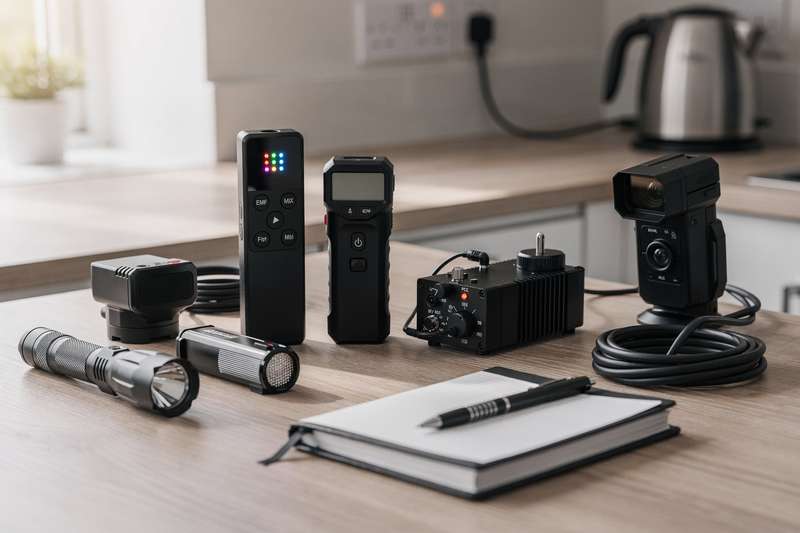
You’ve sorted access to a reputedly active location — a draughty Victorian gatehouse, a converted mill with a documented history, or the cellar of a coaching inn that locals avoid after dark. You arrive with enthusiasm and a phone torch, and spend four hours in the cold with nothing to show for it except slightly damp feet. Meanwhile, the group in the adjacent wing have pods lighting up, meters registering sudden spikes, and a setup that generates actual data worth reviewing afterwards. The difference between those two experiences is not luck or belief — it’s equipment. Choosing the right paranormal field investigation gear means understanding what each device genuinely measures, which ones give you reliable environmental data, and which ones produce more noise than signal. This guide cuts through the confusion and gives you a clear view of the best options available on Amazon.co.uk right now, so you arrive at your next location prepared rather than hopeful.
How These Picks Were Evaluated
Each device in this guide was assessed against the following criteria: the type of field it detects (magnetic, radio frequency, static electricity, or REM disruption), the sensitivity range specified by the manufacturer, the clarity of the feedback mechanism for use in low-light conditions, portability and ease of deployment in real-world field environments, battery requirements for extended overnight sessions, and — critically — the pattern of verified buyer feedback on Amazon.co.uk. Products with substantial review counts received priority weighting, and where buyer comments highlighted specific failure modes such as false positives, fragile construction, or battery drain, those tradeoffs are noted honestly in each section. One product in this guide has limited review data at time of writing; this is flagged clearly so you can factor it into your purchasing decision.
Best Overall: VERY SENSITIVE Rem Pod Spirit Pod Kii EMF Meter Ghost Hunting Equipment Detector
The VERY SENSITIVE Rem Pod Spirit Pod Kii EMF Meter Ghost Hunting Equipment Detector tops this guide through sheer volume of real-world validation: 245 verified buyer ratings averaging 4.0 out of 5 on Amazon.co.uk. That feedback depth tells you this device is actually being taken into active locations by investigators who then return to write about the experience, rather than gathering dust after one disappointing outing.
The core technology combines REM (Radiating Electro-Magnetic) pod functionality with KII-style EMF detection in a single unit. Understanding the distinction between these two detection types matters. A conventional passive EMF meter reads the ambient magnetic field strength generated by existing electrical sources — wiring, appliances, power transformers. A REM pod, by contrast, generates its own small electromagnetic field around an external antenna and then monitors that field for disturbances. When something enters or disrupts the generated field — a conductive mass moving nearby, a significant change in ambient electromagnetic energy, or something the device cannot otherwise account for — it triggers an alert. That means a REM pod will respond in an empty room with no conventional electrical sources present, making it significantly more useful for controlled field conditions than a passive meter alone.
The “VERY SENSITIVE” descriptor is substantiated by buyer feedback rather than marketing copy alone. Reviewers consistently note that it registers environmental changes that cheaper, less sensitive devices miss. That sensitivity cuts both ways: you will capture more potentially meaningful readings, but you will also need to be disciplined about establishing a baseline when you first enter a location. Mobile phones in pockets, Wi-Fi signals from adjacent rooms, radio transmissions from other investigators’ equipment — all of these can trigger a high-sensitivity REM pod. Good field practice means silencing devices, noting the baseline reading before the session begins, and understanding which readings are clearly above that baseline before drawing any conclusions.
Build quality, according to reviewer reports, is solid for the price tier. It runs on standard, widely available batteries — a more significant practical point than it sounds, since proprietary rechargeable cells that die at 2am in a remote location leave you stranded with no options. The visual and auditory alert system is clear enough for use in complete darkness, which keeps you present in the investigation rather than squinting at a dim screen. Several reviewers note the auditory alert is distinct enough to hear across a room without being loud enough to disrupt the atmosphere of the session.
The tradeoff to acknowledge honestly: a proportion of reviewers report occasional triggering that appears to have no identifiable environmental cause, which may be high sensitivity creating false-positive noise rather than anomalous readings. This is a category-wide challenge rather than a specific product flaw, but it is worth knowing before you buy. If the device triggers repeatedly after careful environmental control, move it further from any remaining electrical infrastructure before concluding the readings are meaningful. For the majority of investigators — particularly those assembling their first serious kit — this is the strongest all-round starting point currently available on Amazon.co.uk.
Best for RF Spectrum Detection: Pro EMF Reader Ghost Hunting Meter, 5MHz-3500MHz Paranormal Equipment
The Pro EMF Reader Ghost Hunting Meter, 5MHz-3500MHz Paranormal Equipment fills a specific gap that standard EMF meters leave entirely open: radio frequency spectrum detection across a broad range of frequencies.
Standard passive EMF meters — including many popular ghost hunting devices — focus on the extremely low frequency magnetic field component. They detect changes caused by electrical wiring, motors, and power infrastructure, but they do not capture the radio frequency spectrum: the bands used by mobile networks, Wi-Fi routers, baby monitors, and cordless phones. With its stated detection range of 5MHz to 3,500MHz, this reader operates in that territory, and the practical distinction matters for investigative methodology.
The most immediately useful application is cross-referencing your other sensor readings. If your REM pod or passive EMF meter registers activity and you want to rule out wireless device interference as the cause, checking the RF reader simultaneously gives you a rapid answer. If the RF reader is also spiking, there is an identifiable wireless signal present and your other reading probably has a mundane explanation. If the RF reader shows nothing while your EMF meter remains active, that is a more interesting data point — the field change has no obvious wireless source. Used this way, the RF reader makes your entire investigation more evidence-based and reduces the risk of misattributing interference signals to unexplained causes.
With 32 reviews averaging 4.1 stars, the feedback base is more modest than the top pick in this guide — but the pattern within those reviews is consistently positive, with particular mention of detection sensitivity and the breadth of what the device picks up. Critical feedback tends to focus on the learning curve: this is not a beginner’s one-button device. Making meaningful sense of RF readings requires some background understanding of which frequency bands correspond to which common sources. If you are entirely new to field investigation, you may initially find it generates more raw data than you can interpret. That is not a reason to avoid it — it is a reason to pair it with some reading on RF frequencies before your first session with it.
Physically, it is compact enough for a kit bag without adding significant weight. Battery operation keeps it usable at remote locations without mains access. If you already own a solid REM pod or passive EMF meter and want to add a different detection dimension rather than duplicating existing coverage, this is a logical complement. It is particularly valuable for investigators who prioritise methodological rigour and want to rule out conventional RF sources from their data, rather than collecting unexplained spikes without any context for what generated them.
Best Multi-Function Pod: Spiritpod X1S – Rem Static Detector, Ghost Hunting Equipment, Detector Pod, K2, EMF Meter, Paranormal Equipment
The Spiritpod X1S – Rem Static Detector, Ghost Hunting Equipment, Detector Pod, K2, EMF Meter, Paranormal Equipment packages three detection modalities — REM field disruption, static electricity sensing, and K2-style EMF measurement — into a single pod-format unit, making it one of the more practical standalone devices for placement in a stationary position during an investigation.
The multi-sensor approach deserves unpacking. The REM component operates as described for the top pick: it generates a field and alerts to disruptions. The static detection element adds a capability that dedicated EMF meters do not cover — changes in electrostatic charge in the immediate environment. This is particularly relevant in older stone buildings, where atmospheric moisture levels, air movement through historic masonry, and temperature differentials can all create electrostatic variation that a static detector registers while a standard EMF meter shows nothing. The K2 element brings the multi-LED EMF display that investigators have used for years — it is a trusted and immediately readable format, even if it is not a recent innovation.
With 152 reviews averaging 3.8 out of 5, the X1S is one of the more thoroughly road-tested options in this guide, and the pattern within the feedback is instructive. Positive reviews consistently highlight the convenience of multi-mode detection in a single device — particularly valuable for solo investigators or small teams who need to cover multiple locations simultaneously without a specialist device for each position. The constructive feedback is equally consistent: the multi-sensor design means none of the individual functions is quite as sensitive as a dedicated single-purpose device. Side-by-side with a specialist high-sensitivity REM pod, the X1S may miss weaker signals that the specialist device catches. That is an honest tradeoff rather than a product fault.
The physical design works well for field placement. The pod format sits stably on uneven surfaces — flagstones, bare floorboards, old stonework — without needing a perfectly level position. Visual and auditory alerts are clearly differentiated so you can tell at a glance which detection mode is triggering. The X1S is the updated version of the Spiritpod X1 (covered separately in this guide), with refinements to sensitivity calibration and alert response time that justify the step up for investigators past the very early stages of the hobby.
If you are running a solo investigation or a two-person team and want a single pod covering multiple detection types in one placement, the X1S is a strong fit. If you are running a larger team with dedicated positions for multiple devices, you might prefer pairing specialist sensors — but that is a considerably higher total outlay. For most investigators at the intermediate stage, the X1S strikes a workable balance between coverage and cost.
Best Entry-Level Pod: Spiritpod X1 – Rem Static Detector, Ghost Hunting Equipment, Detector Pod, K2, EMF Meter, Paranormal Equipment
The Spiritpod X1 – Rem Static Detector, Ghost Hunting Equipment, Detector Pod, K2, EMF Meter, Paranormal Equipment is the base model in the Spiritpod range, and it fills a useful and distinct position in a multi-device kit — especially when building coverage across several rooms without spending premium amounts on every pod.
The core functionality mirrors the X1S: REM detection, static electricity sensing, and K2-style EMF display. The fundamental detection capability is the same. Where the X1S represents a more refined and sensitive iteration, the X1 provides essentially the same detection profile with a slightly less tuned sensitivity threshold. The rating data illustrates an interesting pattern: 78 reviews averaging 3.9 stars puts the X1 marginally ahead of the X1S on per-reviewer satisfaction, despite being the simpler model. The most likely explanation is expectation calibration — buyers who choose the entry-level model rate it against entry-level expectations, while some X1S purchasers arrive with higher hopes and mark it down when specialist devices outperform it in direct comparisons.
The practical use case for the X1 is secondary coverage. If your primary detection station is running the VERY SENSITIVE Rem Pod from the top pick in this guide, or the X1S from the section above, placing an X1 in an adjacent room, corridor, or separate area gives you additional coverage at a cost that does not exhaust your investigation budget. You are not relying on the X1 to catch subtle signals at the margins of detection — you are using it to ensure that obviously active areas do not go unmonitored while your attention is focused elsewhere.
A pattern worth noting from across the review data: investigators report better performance from pod-format devices when positioned centrally in a room rather than against walls. Walls in older buildings often contain hidden wiring, damp masonry that conducts stray electromagnetic energy, or ferrous materials such as iron pipework that create ambient field noise. Central placement reduces exposure to those confounding factors and gives you cleaner baseline readings to work from. This applies across the category, not specifically to Spiritpod products.
Build quality is comparable to the X1S — the pod format is physically robust for the environments it is designed for. The alert system is clear in low-light conditions. Battery requirements are standard and replaceable. For investigators newer to the hobby who are not yet ready to invest in a full multi-device specialist setup, the X1 is a lower-commitment route to experiencing multi-mode detection before deciding whether to step up. For more established investigators, it is a cost-effective, deployable secondary coverage device that extends your detection footprint without duplicating your primary sensor.
Best Simple Visual Indicator: EMF Meter, 5 LED Magnetic Field Detector, Ghost Hunting Equipment Tester for Home, Office & Outdoor Inspections
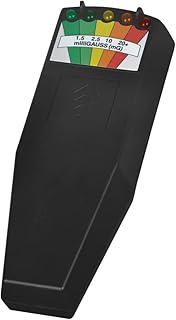
The EMF Meter, 5 LED Magnetic Field Detector, Ghost Hunting Equipment Tester for Home, Office & Outdoor Inspections takes a more focused approach than the multi-function pods elsewhere in this guide, concentrating specifically on magnetic field detection with a clear, graduated five-LED visual display.
A transparency note before the full assessment: this product carries a 4.4-star rating in the listing but shows no text reviews in our data at time of writing. That limits what can be said about real-world field performance from buyer experience, and you should factor that uncertainty into your decision. The specification and design approach are coherent with the category, and the five-LED display format is well-established in electromagnetic detection — but treat this as a specification-informed recommendation rather than one underpinned by substantial buyer feedback.
The design rationale for a five-LED bar display is its immediate readability. Multi-function pods with multiple alert modes require some familiarity to interpret quickly in the middle of an active session — you need to know which sound corresponds to which detection type and what calibration means in context. An LED bar removes that cognitive step entirely. One LED indicates low-level field presence; all five glowing indicates a strong reading. In a dark room during an active session, that visual escalation is readable at a glance without any analysis. This makes the format particularly useful for investigators earlier in their experience, before they have developed the pattern-recognition that comes from extended time with more complex equipment.
Magnetic field detection — what this device specifically measures — responds to the same environmental factors as a KII meter: mains electrical wiring, motors, appliances, and certain natural geological features such as iron-bearing rock formations. The five-LED display gives you a graduated readout of field strength rather than a numeric or graph-based output. That simplicity is genuinely useful in low-light conditions where squinting at a small digital screen is not practical. The listing explicitly mentions outdoor use, which is worth noting: an LED display does not require any screen brightness adjustment, and it does not create the white-light bleed that destroys night-adapted vision — a real advantage for outdoor field investigations in total darkness.
The absence of text review data means this device carries more uncertainty than any other pick in this guide. If you are assembling a kit and want one uncomplicated visual detector to sit alongside your REM pod and RF reader — where this device’s job is simply to display field strength in a format anyone in the room can read at a glance — it is a logical supporting addition in principle. If you are making it your sole device for a solo investigation, the lack of community-validated performance data makes it a higher-risk sole choice. Think of it as a supporting player rather than the cornerstone of your kit.
What to Look For When Buying Paranormal Field Investigation Equipment
- Detection modality: Understand what each device actually measures before buying. Passive EMF meters detect changes in existing low-frequency electromagnetic fields. REM pods generate their own field and detect disruptions to it. RF detectors measure radio frequencies from wireless devices. Static detectors sense changes in electrostatic charge. Multi-function devices combine two or more of these. None is categorically superior — they serve different investigative purposes, and a kit covering multiple modalities gives you more to work with than several duplicates of the same sensor type.
- Sensitivity level and baseline calibration: Higher sensitivity is not always an advantage in isolation. A highly sensitive device in an electrically noisy environment will trigger constantly, generating data that is difficult to interpret meaningfully. Look for devices that allow you to establish a clear environmental baseline before the session begins, and be cautious of any device that triggers so frequently it provides no quiet reference point to compare anomalous readings against.
- Alert type and low-light usability: Paranormal investigations typically happen in reduced or zero light. LED-based alerts — whether single indicators or multi-LED bar displays — are immediately visible without a torch and do not create the screen glow that ruins dark adaptation. Auditory alerts confirm readings without requiring you to look at the device. Check that the alert system works clearly in complete darkness before committing to any device for serious overnight field sessions.
- Battery type and longevity: Standard, widely available battery formats (AA, AAA) are significantly preferable to proprietary rechargeable cells for overnight field use. If a built-in rechargeable battery dies at 2am in a remote location, your investigation is over. Standard batteries can be swapped from a kit bag in seconds, keeping the session running without interruption. Where possible, check the typical battery life for the investigation durations you plan.
- Single-function versus multi-function: Dedicated single-purpose devices are typically more sensitive at their specific detection type than multi-function alternatives. Multi-function pods are more convenient when you are covering multiple locations with limited equipment. Your decision should reflect whether you are running a solo or small-team investigation — where multi-function coverage is more practical — or a coordinated team setup where specialist sensors can be dedicated to each position.
- False positive susceptibility: All electromagnetic detection devices respond to some conventional sources — Wi-Fi signals, mobile network transmissions, radio communications, electrical wiring. Understanding which sources your device is sensitive to, and systematically eliminating them from your investigation environment, is as important as choosing the right device in the first place. Buyer reviews that discuss specific false-positive scenarios are often the most practically useful feedback available.
- Build quality for field conditions: Field investigations happen in old buildings, damp cellars, and outdoor environments. Check whether the device’s physical format is stable on uneven surfaces such as flagstones or bare floorboards, whether it tolerates low temperatures for winter investigations, and whether the construction feels robust enough for regular transport and deployment. Pod-format devices that sit stably without a tripod are noticeably more practical than those requiring careful level placement every time.
Verdict
For most readers building their first or second serious investigation kit and wanting a well-tested, reliable all-round device that covers the core detection modality used in the field, the VERY SENSITIVE Rem Pod Spirit Pod Kii EMF Meter Ghost Hunting Equipment Detector is the strongest starting point. The combination of REM field generation and KII-style EMF detection in a single unit gives you active and passive magnetic sensing simultaneously, and 245 buyer reviews at a 4.0 average confirms it performs in genuine field conditions rather than just in demonstrations.
If your kit is already established and you want to add methodological depth, the Pro EMF Reader Ghost Hunting Meter, 5MHz-3500MHz Paranormal Equipment adds a genuinely different dimension — RF spectrum detection that no other device in this guide covers. Used alongside your primary sensor, it helps you distinguish wireless interference from readings that have no conventional wireless explanation, which raises the overall quality of your investigation data.
For investigators building multi-room coverage on a measured budget, pairing the top pick with one or two Spiritpod devices provides broad coverage across different detection types without excessive duplication. Start with the VERY SENSITIVE Rem Pod as your primary sensor, add secondary pods as budget allows, and consider the RF reader once you have enough field experience to make meaningful use of the data it generates.
We were not paid to feature any specific product in this guide. All opinions are independent and based on publicly available specifications, verified buyer feedback patterns, and category research.
Quick Comparison Table


FAQ
What is the difference between a REM pod and a standard EMF meter?
A standard passive EMF meter measures changes in existing electromagnetic fields generated by electrical sources such as wiring, appliances, and transformers. A REM pod generates its own small electromagnetic field around an antenna and monitors that field for disturbances. This means a REM pod can register events in an electrically quiet environment where a passive meter would show nothing — making it a more flexible tool for controlled field conditions where eliminating conventional electrical sources is possible.
How do I avoid false positives when using ghost hunting equipment?
Establish a clear environmental baseline before the investigation begins. Switch off or remove mobile phones, disable Wi-Fi from any unused devices, position sensors away from known electrical wiring and appliances, and note the normal reading level for the specific location. Any readings recorded during the session should be evaluated against that baseline rather than in isolation. Cross-checking with a second device — such as an RF reader alongside an EMF meter — helps identify whether a spike has a conventional wireless explanation before you treat it as anomalous.
Do I need more than one device for a field investigation?
A single well-chosen device can deliver a productive investigation, but multiple devices covering different detection modalities provide significantly more data to work with. At a minimum, combining a REM pod with a passive EMF meter covers both active and passive magnetic sensing. Adding an RF detector lets you rule out wireless interference from your readings. A single quality device always beats multiple poor-quality ones generating more noise than signal, but building up coverage over time gives you more context for interpreting what you find.
What is the difference between the Spiritpod X1 and the Spiritpod X1S?
Both the Spiritpod X1 and X1S combine REM field detection, static electricity sensing, and K2-style EMF measurement. The X1S is the updated version with refinements to sensitivity calibration and alert response time, meaning it should detect weaker signals more reliably than the base X1. In highly active locations both devices will trigger clearly; the difference is more apparent in quieter environments where marginal signal strength matters. The X1 suits secondary coverage or a first pod purchase; the X1S is worth the step up if it will serve as your primary standalone sensor.
Can ghost hunting EMF meters be used to check home appliances for electromagnetic output?
Yes — passive EMF meters used in paranormal investigation also detect electromagnetic output from household appliances, wiring, and electrical infrastructure. For this purpose, a passive magnetic field meter is adequate and straightforward to use. REM pods are less suited to appliance testing, since their readings reflect disruptions to their own generated field rather than direct measurement of ambient EMF from external sources — making them primarily a field investigation tool rather than a general-purpose EMF measurement device.
What batteries do paranormal investigation devices typically use?
Most pod-format investigation devices use standard AA or AAA batteries, which is a significant practical advantage for overnight field investigations where immediate replacement power needs to be available. Check the specific battery requirement for any device before buying, since some models consume power faster depending on their sensitivity level and alert frequency during an active session. Avoid devices with proprietary rechargeable cells if you plan to use them in extended or remote locations without reliable access to charging points.