When the Floor Feels Miles Away
Picture this: you’re in your first yoga class, the instructor cues a forward fold, and everyone around you seems to melt effortlessly toward the mat. Your hands stop somewhere around your knees. You feel stiff, frustrated, and quietly convinced that yoga just isn’t built for your body. Maybe you’ve already tried borrowing a block from the studio — one of those battered, slightly squashed foam rectangles that compresses the moment you put any real weight on it — and it didn’t help much either.
If you’re a beginner, especially one with a larger frame or limited flexibility, the wrong yoga block doesn’t just fail to help — it can actively make poses feel more awkward and less stable. The right block set, on the other hand, genuinely changes what your body can do on the mat. It closes the gap between where you are now and where the pose is supposed to be, without judgment and without risk.
This guide is written specifically for UK buyers who are newer to yoga and want blocks that will hold firm under real body weight, offer enough height to actually bridge the gap, and won’t turn into a crumbled wedge of foam within six months. You’ll find honest picks across materials and price points, plus a clear breakdown of what to look for before you buy.
How We Evaluated These Picks
These recommendations are based on an analysis of verified buyer feedback patterns across hundreds of UK Amazon reviews, cross-referenced with instructor recommendations from yoga equipment specialists and physio-informed yoga communities. Evaluation criteria included: density and compressibility under load (particularly relevant for plus size practitioners who need blocks that don’t sink), block dimensions and height options, surface grip in both dry and slightly damp conditions, edge firmness for restorative support, material durability over months of regular use, whether the set includes a strap or additional accessories, and overall value relative to longevity. Price bands reflect typical UK Amazon pricing at time of research. Where a single block or a two-pack represented the better value, that’s what’s recommended.
Best Overall Beginner Set: High-Density EVA Foam 2-Pack with Strap
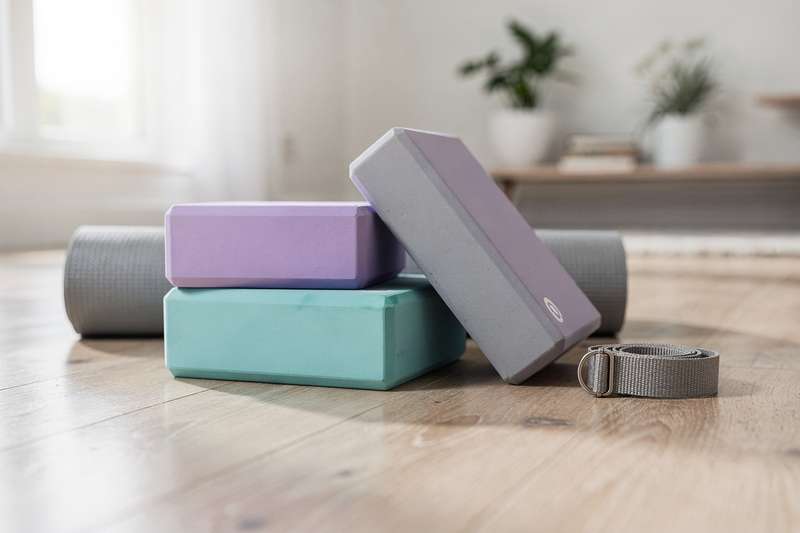
If you’re just starting out and want one set that covers most of what you’ll encounter in a beginner yoga class, a high-density EVA foam 2-pack bundled with a yoga strap is the most practical starting point. The two-block format matters more than it might seem: many poses — supported bridge, restorative fish, even simple seated forward folds — benefit from having a block under each hand or at different heights simultaneously. Buying two from the start saves you the frustration of realising mid-class that one block isn’t enough.
What you’re looking for in this category is a block that measures approximately 9×6×3 inches, made from EVA foam with a density of at least 200g per block (lighter blocks tend to compress). The surface should have a slight texture — either a micro-patterned grip or a bevelled edge — rather than a completely smooth finish, which can be slippery when your palms are warm. For plus size practitioners specifically, density is the most important specification: a block that compresses even slightly under hand or sit-bone pressure undermines the stability it’s meant to provide.
The included yoga strap in a good bundled set should be at least 5.5 feet long, with a simple D-ring or buckle closure. Straps help with hamstring stretches, shoulder openers, and ankle-to-knee poses where your hands simply can’t reach yet. It’s the kind of accessory that feels unnecessary until the first session where you actually use it, at which point it becomes indispensable.
The tradeoff with standard-density EVA foam sets is longevity: at the very budget end, these blocks can start to show compression marks after six to twelve months of daily use. If you’re practising three or more times a week, it’s worth spending a few pounds more on a set with a higher-density rating. Avoid any set that doesn’t specify the foam density, as vague descriptions like “firm foam” are often a sign the manufacturer doesn’t want to commit to a number.
Best Cork Block for Stability and Firmness
Cork is, without question, the better material choice if your primary concern is stability under load. Unlike EVA foam, natural cork does not compress — it maintains its dimensions whether you’re resting the weight of one hand on it or sitting your full body weight down for a supported pose. For plus size beginners, this is a meaningful difference. A foam block that sinks even five millimetres changes your alignment and removes the proprioceptive feedback that helps you understand where your body is in space.
When shopping for a cork yoga block, look for one made from compressed natural cork rather than cork-covered foam (a cheaper construction that combines the downsides of both materials). The size to prioritise is 9×6×4 inches — that extra inch of height compared to a standard 3-inch foam block makes a significant difference if you have limited hamstring or hip flexibility. A 4-inch block at its tallest orientation gives your hands a real platform in standing forward folds, while the 3-inch orientation works well under the lower back in supported poses.
The surface texture of cork is naturally grippy, and it becomes slightly more so as your hands warm up — the opposite of smooth foam, which tends to become more slippery with heat. This makes cork particularly good for dynamic flows where you’re transitioning in and out of contact with the block quickly. Cork is also odourless and easy to wipe clean with a damp cloth, which matters if you’re sweating in your practice.
The honest downside: cork blocks are heavier than foam — typically 400–600g per block versus 200–300g for EVA foam. If you’re carrying your kit to a studio, two cork blocks plus a mat can feel genuinely cumbersome. They’re also slightly more expensive per block. For home practice, these tradeoffs are minor; for commuting yogis, worth considering. Cork blocks also have sharper corners than bevelled foam, so if you’re using them in restorative poses under the sacrum or between shoulder blades, look for one with lightly rounded edges.
Best Budget Foam 2-Pack (Under £15)
Not everyone wants to spend £30 or more before they’ve decided whether yoga is going to stick. A budget EVA foam 2-pack under £15 is a perfectly reasonable way to start, provided you know what you’re accepting in the tradeoff. The key difference between a £10 foam block set and a £22 one usually comes down to foam density and edge finishing — the cheaper set will feel slightly softer underfoot and may show compression marks sooner, but for a beginner practising two or three times a week, it will last at least a year of regular use before showing meaningful wear.
In this price band, look for blocks that are at least 9×6×3 inches — anything smaller is harder to balance on and provides less surface area for weight distribution. The foam should be described as “high density” or “non-compressible”; if the listing simply says “foam,” treat that as a yellow flag. Many budget sets in this range are perfectly serviceable and represent the same basic construction as more expensive options — the difference is in quality control consistency rather than fundamental design.
Where budget blocks tend to fall short for plus size practitioners is under direct body weight — sitting on them, for example, or placing them under the sacrum in supported bridge. If any of these poses are in your regular practice, it’s worth stepping up to a higher-density option. For purely hand-to-floor support in standing poses, however, a budget foam block works well and the lower price makes it easy to replace when needed.
One practical tip: if a budget listing includes a yoga strap, check whether the strap is made from cotton or synthetic material. Cotton straps are softer on the wrists and hands; synthetic straps (usually nylon) are more durable and easier to wipe clean. Either works, but it’s useful to know before you buy.
Best Extra-Large Foam Block for Plus Size Support
Standard 9×6×3-inch blocks are fine for most practitioners, but if you have a larger frame, wider hips, or simply want more surface area under your hands and a wider base underfoot, an oversized yoga block is worth the small premium. Look for dimensions closer to 9×6×4 inches or, better yet, blocks marketed specifically as “large” or “XL” with a density rating above standard EVA foam.
The principle here is simple: a wider, taller block is more forgiving. If your hand placement is slightly off-centre, a larger block is less likely to tip. If you’re transitioning between the 3-inch and 4-inch orientations, a taller block gives you a more meaningful height difference. For poses like half-moon or triangle where the block takes a significant percentage of your upper body weight, the extra few centimetres of platform width can make the difference between a pose that feels supported and one that feels precarious.
High-density options in this format typically weigh around 300–400g per block — slightly heavier than standard foam, but still comfortable to carry. The foam should be latex-free (important for anyone with latex sensitivity, and good practice regardless). Look for a block with a bevelled or rounded edge rather than a sharp 90-degree corner; this is more comfortable against the forearm or shin in poses like supported warrior or reclined positions.
The tradeoff for oversized blocks: they take up more space in a bag and can feel slightly unwieldy for smaller-handed practitioners. If you have smaller hands and are choosing between a standard and large block, the standard 9×6×3 may actually give you better purchase and control. But for a larger frame where the goal is maximum stability and confidence, the extra size is worth it.
Best Cork 2-Pack for Restorative Yoga
Restorative yoga — the slow, held, supported practice that’s especially good for stress recovery, joint mobility, and building a sustainable foundation — relies heavily on blocks. You’ll often need two simultaneously: one under the sacrum, one supporting the thoracic spine, or a pair stacked to create a bolster-like prop for supported inversions. Having two matched cork blocks makes this far easier and more stable than mismatching cork and foam or using two different-height blocks.
When buying a cork 2-pack, consistency between the two blocks matters. Both should be from the same batch of compressed natural cork so their density, height, and surface texture are matched. Slight variation between blocks in a pair — even a few millimetres — becomes noticeable in restorative poses held for five minutes or more. Read reviews specifically for comments about consistency; this is where cheaper cork sets sometimes disappoint.
For restorative use, a slightly softer cork (if such a thing exists — some manufacturers offer a “soft cork” or cork-and-foam composite) can be more comfortable under bony prominences like the sacrum or skull. However, if you’re a plus size practitioner, prioritise density over softness. A composite block that’s comfortable for a lighter person may still compress under more weight, losing the structural support that makes restorative poses therapeutic.
Expect to pay more for a matched cork 2-pack than for two individual cork blocks bought separately — manufacturers price the matching and quality-control premium into the set. In the UK, a good paired cork set typically costs £25–£40. This is a long-term investment: well-maintained cork blocks last five years or more, making the per-session cost negligible over time.
Best Mid-Range Foam Block with Bevelled Edges
If you want something between budget foam and premium cork — a block that’s light to carry, comfortable to grip, and properly firm without the cost of cork — the sweet spot is a mid-range high-density EVA foam block with bevelled (chamfered) edges. This is the format used in most professional yoga studios because it’s genuinely good: firm enough to hold shape under load, light enough to adjust quickly, and soft enough on the skin not to leave impressions on forearms or shins.
Look for blocks in this category that specify their foam density in grams per litre or describe the construction as “closed-cell” foam — closed-cell EVA resists moisture absorption and doesn’t harbour bacteria the way open-cell foam can. The bevelled edge is a genuine functional improvement over a sharp corner: it’s more comfortable in forward folds where the block rests against the shin, more stable in lateral poses, and less likely to dig into the wrist if the block tips slightly.
In this mid-range, you’ll also find blocks that come in a range of colours — useful if you want to easily identify yours in a shared studio space or simply prefer something more cheerful than grey. Functionally this makes no difference, but it’s worth knowing the option exists.
The main limitation of EVA foam at any price point is that it remains a foam product: it will eventually show compression marks with heavy use, and it doesn’t have the inherent grip of cork. If your hands sweat heavily during practice, you may find a foam block requires occasional wiping down mid-session. For most beginners practising at home, this is a minor inconvenience rather than a real problem.
Best for Travel and Studio Use: Lightweight Compact Foam Block
If you’re heading to a studio regularly and don’t want to rely on the studio’s often-depleted or hygienically questionable block supply, a lightweight travel foam block is worth keeping in your kit bag. These are typically single blocks rather than pairs, made from a slightly lower-density EVA foam to reduce weight, and designed to slot into a standard yoga bag alongside a mat.
The compromise here is explicit: a travel block prioritises portability over maximum firmness. For beginners who are still finding their range of motion, a slightly softer block can feel reassuringly gentle — less like hitting a hard surface, more like meeting a firm support. However, if you need genuine structural support (for example, you’re sitting your body weight on the block or using it in supported inversions), a travel-weight block may not deliver.
Look for something that weighs under 200g, measures around 9×6×3 inches (same footprint as standard, just lighter construction), and ideally comes with a carry strap or loop for easy attachment to a mat bag. Some travel blocks fold or compress, but these tend to be less stable once unfolded — stick to a solid one-piece construction for reliability.
For home-based beginners, a travel block is probably not your first purchase. It makes most sense as a second or third block — something you can throw in a bag without worrying about the weight while keeping your better-quality blocks at home.
What to Look For When Buying a Yoga Block Set
- Density and compressibility: This is the most important criterion for plus size practitioners. A block that compresses under your weight defeats its purpose. High-density EVA foam should be described with a density specification (look for 200g+ per block) or labelled “closed-cell” or “non-compressible.” Cork does not compress meaningfully at any body weight.
- Dimensions: Standard is 9×6×3 inches, which gives three usable height orientations (3″, 4″, 6″). A 4-inch block (often marketed as “large” or “thick”) provides more useful height for people with limited flexibility. Oversized or XL blocks (sometimes 9×6×4 or larger) offer a wider base for additional stability.
- Material: EVA foam is lightweight, affordable, and widely available. Natural cork is firmer, more durable, naturally grippy, and better for sweatier practices. Cork-and-foam composites exist but vary in quality — check that the cork layer is substantial rather than a thin veneer. Wood blocks exist but are uncommon in beginner sets and less forgiving on joints.
- Edge profile: Bevelled or rounded edges are more comfortable in prolonged contact with skin (forearms, shins, the sacrum). Sharp 90-degree corners are fine for hand support but can be uncomfortable in restorative poses.
- Surface grip: Look for a non-slip surface treatment or natural cork texture. Smooth foam becomes slippery when warm. Some blocks have a raised dot or line pattern for additional traction.
- Set composition: Two blocks is the minimum useful set for most practices. A set that includes a strap adds genuine value for hamstring and shoulder work. Sets that include a bag or mat are typically priced as bundles — only useful if you actually need the additional item.
- Weight capacity claims: Some listings specify a maximum weight capacity (often 250–300kg for quality blocks). Take these with a degree of scepticism for foam blocks — the real variable is density, not a single headline figure. Cork blocks, by nature of the material, tend to be more reliably load-bearing.
Verdict: Which Block Set Should You Actually Buy?
For the majority of readers coming to this guide — beginners with a larger frame who want blocks that will genuinely support their practice rather than squash underfoot — the recommendation is a high-density EVA foam 2-pack with a yoga strap, ideally from a brand that specifies the foam density in their listing. This format gives you two blocks immediately (which you will need), the versatility to use them at three different heights, and a strap that opens up a whole category of stretches your body may not otherwise be able to access in the early weeks of practice.
If budget isn’t a constraint and you’re confident yoga is becoming a regular part of your routine, move to a natural cork 2-pack instead. You’ll feel the difference in stability immediately, and well-maintained cork blocks will last years longer than foam. For anyone doing primarily restorative or yin yoga where blocks spend long periods under bony areas of the body, cork is the more comfortable long-term choice.
Avoid the temptation to buy the cheapest possible foam set if you’re a plus size practitioner — the few pounds saved will be lost in the frustration of a block that wobbles or compresses. Invest in density. Everything else is secondary.
Editorial note: We were not paid to feature any specific product in this guide. All opinions are independent and based on publicly available specifications, verified buyer feedback patterns, and category research. Prices shown were accurate at time of writing and may change.
Quick Comparison Table


FAQ
What weight can yoga blocks actually support?
High-quality high-density EVA foam and natural cork blocks are structurally capable of supporting well over 150kg under normal yoga use. The real question isn’t structural failure — it’s whether a block will compress or deform under your weight, which affects your stability. Natural cork doesn’t compress meaningfully at any body weight. For foam blocks, look for a density specification (200g+ per block) or a “non-compressible” label to ensure the block holds its shape under load.
Should I buy one yoga block or two?
Two blocks is the practical minimum for a useful practice. Many beginner poses — supported bridge, seated forward folds, lateral standing poses — benefit from having a block under each hand or at different heights simultaneously. Starting with a pair means you won’t find yourself mid-class wishing you had a second one. If budget is a constraint, one high-quality cork block is better than two cheap foam ones, but a matched pair is the long-term goal.
Is cork or foam better for plus size beginners?
Cork is generally better for plus size practitioners because it doesn’t compress under load, providing consistent height and stability regardless of body weight. Foam blocks can compress slightly under heavier use, which reduces their effectiveness as a prop. That said, high-density closed-cell EVA foam is a good middle ground if you prefer a lighter block or are managing the cost of starting out — just make sure the density rating is specified rather than vague.
What size yoga block is best for beginners?
The standard 9×6×3-inch block works for most beginners and gives you three height options: 3 inches (lying flat), 4 inches (on its side), and 6 inches (standing upright). If you have limited flexibility in the hamstrings or hips — common for beginners — a 4-inch or “large” block that starts at 4 inches in its flattest orientation gives you a more useful range of heights. Avoid anything smaller than 9×6×3 inches as the reduced surface area makes balancing less stable.
Can I use yoga blocks for restorative poses if I’m plus size?
Yes, and yoga blocks are especially useful in restorative yoga for plus size practitioners, who often benefit from more props rather than fewer. The key is choosing blocks that don’t compress under your body weight — natural cork blocks or high-density foam are both appropriate. For poses where the block sits under the sacrum or thoracic spine, a rounded or bevelled edge is more comfortable than a sharp corner. Starting with two matched cork blocks gives you the most flexibility for supported restorative positions.
How do I clean and maintain yoga blocks?
EVA foam blocks can be wiped down with a damp cloth and mild soap after each session, then left to air-dry fully before storage — don’t leave them in a sealed bag while still damp as this can cause odour. Cork blocks are naturally antimicrobial and can be wiped with a damp cloth; avoid soaking them in water as prolonged moisture can cause the cork to swell or crack over time. Store all blocks away from direct sunlight, which can cause foam to degrade and cork to dry out prematurely.