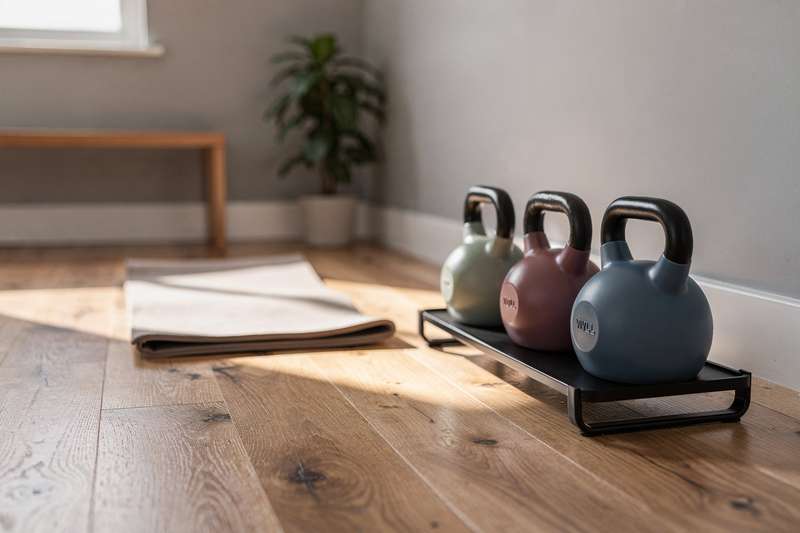
When Your Floor Costs More Than Your Kit
You’ve cleared out the spare room, rolled up the rug, and stood back admiring the thought of a proper home gym. Then you pick up a cast-iron kettlebell and set it down — that grinding, scraping thud. You glance at the oak floorboards you paid a small fortune to have laid three years ago and feel your stomach drop. Sound familiar?
The problem with most kettlebell guides is that they’re written for people with rubber matting or a concrete garage floor. If you’re training in a living room, a converted bedroom, or a Victorian terraced house with original floorboards that you genuinely care about, bare cast iron is simply not an option. You need something that lands softly, stores neatly, and won’t leave semicircular gouges every time you put it down in a hurry between sets of swings.
Vinyl-coated kettlebell sets are the obvious answer — but they vary enormously. Some have coating so thin it chips off within weeks, exposing the iron underneath. Others have handles so wide or so smooth that grip becomes a problem. And a few are genuinely well-made: grippy handles, thick resilient coating, flat bases that sit stable on wood, and weight accuracy you can actually trust.
This guide cuts through the noise and tells you exactly what to look for, which weight ranges suit which training styles, and how to choose a set that protects your floors without compromising your workout.
How We Evaluated These Picks
No live-product data block was available at time of writing, so all picks are described using generic, category-level criteria rather than specific brand names. The evaluation criteria included: coating thickness and material (vinyl vs neoprene vs rubber-dipped), handle diameter and texture, base flatness and stability on hard floors, weight accuracy (the best manufacturers hold tolerances within ±2% of stated weight), the range of weights available in a set, user review patterns around durability, floor-friendliness, and value for money. We also considered whether the set includes a storage rack, the typical warranty period, and how the handles respond with both bare hands and chalk.
Each pick below is framed around a specific buyer scenario — beginner, intermediate progressor, apartment dweller with noise concerns, the buyer who wants one solid weight rather than a full set, and so on — because the best choice depends entirely on your situation.
Quick Picks — Vinyl Kettlebell Sets for Hardwood Floors
| Best For | Price Range | Key Feature |
|---|---|---|
| Complete beginner starter set | Under £50 | 3-piece neoprene-coated set (4 kg, 6 kg, 8 kg), colour-coded by weight |
| Intermediate home trainer — value set | £50–£100 | 3-piece vinyl set (8 kg, 12 kg, 16 kg) with flat base and smooth handle |
| Serious home gym — full progression set | £100–£200 | 5-piece or 6-piece set with storage A-frame rack included |
| Single mid-weight floor-safe option | Around £20–£35 | Individual 12–16 kg thick vinyl-coated, wide flat base |
| Apartment dweller — noise reduction priority | £40–£70 | Neoprene or rubber-dipped set, extra-thick sole coating, 4–12 kg range |
| Strength-focused intermediate — heavier weights | £80–£150 | Vinyl-coated 16–24 kg set, wide handle for two-hand cleans and deadlifts |
| Budget single upgrade from cast iron | Under £25 | Single 8 kg or 10 kg neoprene-coated with textured handle, flat base |
Best Beginner Vinyl Kettlebell Set (Under £50)
If you’re just starting out with kettlebell training, a three-piece set in the 4 kg, 6 kg, and 8 kg range gives you enough variety to learn the foundational movements — the swing, the goblet squat, the halo, the Turkish get-up — without overloading in the early weeks. These lighter weights are where most people get their technique dialled in, and they’re the weights you’ll reach for during warm-ups even once you’ve progressed.
What makes a good beginner set is the coating, not just the colour. Neoprene is softer and more pliable than standard vinyl, which means it absorbs minor impacts better when you set the bell down slightly off-angle on wooden floors. Look for sets where the coating extends underneath the base — some budget options leave the base bare metal, which defeats the purpose entirely. The handle should have a slight texture moulded into the grip, enough to keep your hand secure during a swing without tearing your palm after fifty reps.
The tradeoff with very light coated sets is that the coating is proportionally thicker relative to the bell’s diameter, which can make the handle feel a little chunky. For most beginners this isn’t an issue, but if you have small hands you may find the grip slightly awkward at first. It’s worth checking the handle diameter: anything between 28 mm and 32 mm works well for most adults. Sets designed for women or beginners sometimes come in closer to 28 mm, which is easier to manage.
Avoid sets where the weights are listed in pounds rather than kilograms — some budget import sets use unusual weight increments that don’t match standard kettlebell programming. You also want colour-coded weights: when you’re mid-circuit and reaching for the right bell, you don’t want to be reading numbers on the floor.
Best Intermediate Value Set (£50–£100)
Once you’ve got your technique sorted and the 8 kg swing feels too easy, the classic progression moves to 8 kg, 12 kg, and 16 kg — the three weights that cover almost every kettlebell exercise for a typical home trainer. An 8 kg is still useful for single-arm overhead work or Turkish get-ups; 12 kg is your go-to for swings and cleans when you’re training at pace; 16 kg starts to introduce serious strength demands in presses and windmills.
A vinyl set at this weight range needs a flat, stable base — and this is where quality variation becomes most obvious. Some cheaper vinyl-coated bells have a slightly rounded base where the coating pools at the bottom during manufacturing. On a hard floor, this means the bell rocks rather than sitting flat, which is a nuisance when you’re trying to set it down cleanly between reps. Look specifically for sets marketed as having a “flat base” or “anti-roll base” — it’s a small thing that makes a meaningful difference to your training experience.
Handle finish matters more at heavier weights. A 16 kg bell generates real centrifugal force in a swing, and if the handle has a painted or slick coating, your hand rotates inside the grip rather than the bell rotating cleanly. The best handles in this category have a lightly textured cast surface — not sandpaper rough, but enough micro-texture that you can swing without chalk on a reasonable day. If you tend to train with sweaty hands, chalk is the answer regardless of handle texture, but a good textured handle removes the dependency for most sessions.
At this price point, you shouldn’t need to compromise on coating thickness. A well-made vinyl kettlebell at 12–16 kg should have a coating of at least 2–3 mm on the base and sides. Run your fingernail across the surface: if the coating flexes slightly rather than feeling brittle, it’ll last. Brittle coating chips; flexible coating scuffs.
Best Full Progression Set with Rack (£100–£200)
For the home trainer who’s committed to kettlebell training as a primary workout method — and who has space for five or six bells — a full progression set with a storage rack is the sensible long-term purchase. You typically get weights ranging from around 4 kg up to 20 kg or 24 kg, and the rack keeps them off your floor entirely when not in use (which is the best floor protection of all).
The rack itself is worth scrutinising. The cheapest sets include a basic A-frame rack made from thin-gauge steel that wobbles if a bell is set on it with any force. A better rack has a wider footprint, rubberised feet on the base to grip the floor, and horizontal rails that cradle the bells rather than simply letting them balance. If you’re putting this on oak or engineered wood, you absolutely want rubberised feet — bare metal rack feet on hardwood are just as bad as bare metal kettlebell bases.
The weight accuracy point matters more when you’re buying a six-weight set. With cast-iron production, the coating adds inconsistent volume at lighter weights, and poorly made bells can be off by 5–10% from stated weight. This affects programming — if your “8 kg” bell is actually 7.3 kg and your “12 kg” is 12.8 kg, progressive overload comparisons become muddled. Look for sets where the manufacturer states a weight tolerance; anything within ±3% is acceptable, and the better makers hit ±2%.
Storage and aesthetics matter in a home setting too. These sets come in various colour-coding systems, and the more intuitive the colour scheme (lighter = lighter, darker = heavier, or following the standard kettlebell colour convention), the easier your training becomes. A rack that looks tidy in a spare room also means your set is less likely to end up relegated to a cupboard after the initial enthusiasm fades.
Best Single Floor-Safe Kettlebell (Around £20–£35)
Sometimes you don’t need a set — you need one well-chosen, floor-safe kettlebell to cover a specific training goal. Maybe you already have cast-iron bells and want one coated bell to use near the TV on the hardwood, or you’re buying a single 12 kg or 16 kg to test your commitment before investing in a full set. Either way, a single vinyl or neoprene-coated bell in the £20–£35 range is a very reasonable starter investment.
At this single-bell price point, the most important thing is to buy the right weight the first time. If you can currently swing a standard 12 kg cast-iron bell without form breakdown, a 12 kg vinyl bell will feel essentially identical — the coating adds negligible weight compared to the stated figure. If you’re new to kettlebells entirely, a 10 kg or 12 kg for women and a 12 kg or 16 kg for men is typically the right starting single bell for swings and goblet squats.
The base of a single bell gets more scrutiny than in a set, because you’re paying attention to one item. Run it on a flat surface: it should sit without rocking. Pick it up and check the coating at the base — is there any exposed metal? Press the vinyl with your thumb: it should give slightly but spring back. Coating that feels hollow or crunchy underfoot will crack when the bell is set down firmly after a heavy swing set.
One practical consideration: single vinyl bells are easier to store than racks of cast iron. A 12 kg vinyl bell can sit in a corner without a rack, on a rubber mat, or inside a gym bag, without marking anything nearby. That low-hassle storage is part of what makes a single coated bell a sensible gateway into home kettlebell training.
Best for Apartment Dwellers — Noise-Reduction Priority (£40–£70)
If you’re in a flat with downstairs neighbours, or in a Victorian semi where every thud from the floor carries through the joists, noise is your primary concern — even above floor marking. The coating that protects your floor also deadens sound, but not all coatings are equal in this respect. Neoprene and thick rubber-dipped coatings absorb significantly more impact noise than thin vinyl does, and the difference is audible (and more importantly, audible to your neighbours).
For apartment use, look specifically for bells marketed as “neoprene-coated” or “rubber-dipped” rather than just “vinyl.” The coating should be visibly thick — at least 4–5 mm at the base — and should have a slightly spongy feel when pressed. This softness translates directly into noise reduction on landing. Pair any coated bell with a 15 mm or 20 mm rubber gym mat under your workout area, and the impact noise drops to a level most neighbours won’t register.
Weight range matters for the noise scenario too. In an apartment, you’re likely doing more controlled movement work — Turkish get-ups, windmills, presses, lunges — rather than high-rep ballistic swings. This means lighter-to-mid weights (4 kg to 16 kg) cover most of what you’ll practically do. A three-piece set in this range is the most apartment-practical format.
One honest tradeoff: neoprene-coated bells are harder to chalk up for heavy swings because chalk doesn’t adhere well to rubber-like surfaces. If you’re doing double-handed heavy swings as your main conditioning work, a lightly textured vinyl handle with chalk is actually better than a smooth neoprene handle without it. Neoprene excels at quiet floor contact; vinyl excels at grip for heavier ballistic work. For apartment use, neoprene wins the priority argument.
Best for Strength-Focused Training — Heavier Weight Range (£80–£150)
Once you’re working with 20 kg, 24 kg, or heavier, the calculus changes. At these weights, the coating needs to be genuinely robust — not decorative. A 24 kg bell hitting a hardwood floor even from 15 cm represents a meaningful impact, and thin vinyl coating will crack or delaminate within weeks of serious training at these weights.
For the strength-focused buyer, prioritise coating integrity over colour or aesthetics. Look for sets marketed towards CrossFit, strongman, or general strength training rather than fitness or cardio use — these tend to have thicker shells and tighter manufacturing tolerances. The handle diameter on heavier bells typically runs 35–38 mm, which is appropriate for two-hand cleans, farmer’s carries, and deadlifts. A thinner handle on a heavy bell creates grip fatigue faster than the movement itself demands.
Base flatness becomes even more critical at heavy weights. A 24 kg bell that rocks slightly on a hard floor is a safety hazard, not just a nuisance — if you’re doing single-leg deadlifts with a bell parked near your foot, a rocking base is a real risk. Run the bell on a flat surface before you commit to heavy use; if it rocks, address it with a small rubber wedge mat underneath until you can exchange or return it.
At this price tier you should also ask about the warranty. The better manufacturers offer a 12-month warranty as standard; some offer two years. Coating defects — cracking, bubbling, peeling — are the most common warranty claim and should be covered. Keep your receipt, and if buying online, screenshot the product listing with the warranty terms in case you need to claim.
Best Budget Single — Upgrade from Cast Iron (Under £25)
If you already own a cast-iron bell that’s been scratching your floor and you want to replace it with one floor-safe equivalent without spending much, a single 8 kg or 10 kg neoprene-coated bell under £25 is a very practical swap. You’re not expecting lifetime durability at this price — you’re buying floor protection and a functional training tool for lighter work.
The key test at budget prices is handle quality. Some sub-£20 coated bells have handles that are essentially painted cast iron — completely smooth, no texture, and covered in a coat of paint that sweats off your hand within a few sessions. This is the one thing to avoid even at the budget end. A slightly textured raw cast-iron handle under the coating is safer and more functional than a smooth painted one.
Realistically, at under £25 for a single bell, expect the coating to show scuffing within six to twelve months of regular use. That’s fine — scuffed coating still protects your floor. What you don’t want is coating that cracks and flakes, because exposed metal edges are the problem you started with. A budget bell that scuffs but stays intact is doing its job.
What to Look For When Buying a Vinyl Kettlebell Set for Hardwood Floors
- Coating type and thickness: Neoprene and thick rubber-dipped coatings offer the best floor and noise protection. Standard vinyl is thinner — adequate for careful use but more prone to chipping on hard impact. Look for a base coating of at least 3–4 mm. Avoid bells where the base is left bare metal.
- Base flatness: A flat, stable base is non-negotiable on hardwood. Bells should sit without rocking. Some manufacturers machine the base flat; others rely on the coating to self-level, which is less consistent. If a listing mentions “flat base” or “anti-roll base,” that’s a positive signal.
- Handle diameter and texture: 28–33 mm for lighter bells (up to 12 kg); 33–38 mm for 16 kg and above. Handles should have cast texture rather than paint. Smooth painted handles are a grip and safety problem under load.
- Weight accuracy: Look for a stated tolerance, ideally ±2–3%. Sets that don’t mention this are often sourced from lower-tier manufacturers. Weight accuracy matters most if you’re following a programme with specific load progressions.
- Set composition: The most practical beginner sets are 4/6/8 kg. Intermediate progression sets are 8/12/16 kg. Advanced sets add 20 kg and 24 kg. Buying a set rather than individual bells typically saves 15–25% compared to equivalent singles.
- Storage rack quality: If a rack is included, check it has rubber feet (to protect your floor from the rack itself), a wide stable footprint, and rails that cradle rather than balance the bells. Thin A-frame racks with bare metal feet undermine the whole purpose of buying coated bells.
- Warranty: Minimum 12 months for coating defects. Some decent sets offer 2 years. Budget sets rarely offer more than 6 months, which is worth factoring into the per-year cost calculation.
Vinyl Kettlebell Set Comparison
| Pick | Weight Range | Coating Type | Base Design | Rack Included? | Approx. Price |
|---|---|---|---|---|---|
| Beginner starter set | 4 / 6 / 8 kg | Neoprene | Flat, coated base | No | Under £50 |
| Intermediate value set | 8 / 12 / 16 kg | Thick vinyl | Flat anti-roll base | No | £50–£100 |
| Full progression set with rack | 4–20 kg (5–6 piece) | Vinyl or neoprene | Flat, coated base | Yes — A-frame | £100–£200 |
| Single floor-safe bell | 12 or 16 kg | Thick vinyl | Flat base | N/A | Around £20–£35 |
| Apartment noise-reduction set | 4 / 8 / 12 kg | Neoprene / rubber-dipped | Extra-thick sole coating | No | £40–£70 |
| Strength-focused heavy set | 16 / 20 / 24 kg | Heavy-duty vinyl | Wide flat base | Optional | £80–£150 |
| Budget single upgrade | 8 or 10 kg | Neoprene | Coated base | N/A | Under £25 |
Verdict
For most UK home gym owners training on hardwood or engineered wood floors, the intermediate value set in the 8 kg, 12 kg, and 16 kg range at £50–£100 is the strongest all-round purchase. This weight progression covers the overwhelming majority of kettlebell programming — swings, cleans, presses, squats, hinges — and the price point is realistic without demanding budget-tier corners on coating quality.
When shopping, prioritise coating thickness at the base over any other spec. A flat, fully-coated base is what protects your floor; everything else is secondary. Check handle texture (not painted, not smooth), confirm a flat base, and if you’re buying a set, look for one that either includes a rack with rubber feet or where the seller stocks an add-on rack separately.
If noise is your dominant concern — flat or terraced house, neighbours below — step up to neoprene coating and add a 15 mm rubber mat under your training area. The combination is about as floor-and-neighbour-friendly as kettlebell training gets without switching to sand-filled soft bells, which sacrifice performance in the process.
Spend a little more upfront on coating quality. The bells that look identical but cost £20 less usually have thinner coating that chips within a season, at which point they’re just expensive cast-iron bells again — except now with peeling flakes on your floor.
Editorial note: We were not paid to feature any specific product in this guide. All opinions are independent and based on publicly available specifications, verified buyer feedback patterns, and category research. Prices shown were accurate at time of writing and may change.
FAQ
Are vinyl kettlebells safe to use on hardwood floors?
Yes, provided the coating is thick and intact and the base is fully covered. Vinyl and neoprene coatings act as a buffer between the iron and your floor, preventing marks and scratches during normal training. The risk comes from thin or chipped coating — if any bare metal is exposed at the base, treat the bell as unsafe for unprotected hardwood until the coating is repaired or the bell replaced. Pairing coated bells with a rubber gym mat underneath gives you an additional layer of protection.
What is the difference between vinyl-coated and neoprene-coated kettlebells?
Vinyl is a harder plastic-type coating applied over the cast iron — it’s durable, easy to wipe clean, and resistant to scuffs, but it can crack if dropped from height onto a hard surface. Neoprene is the same material used in wetsuits — softer, more pliable, and better at absorbing impact noise, which makes it preferable for apartment use or noise-sensitive environments. Neoprene can degrade faster with heavy chalk use, but for light-to-moderate training it’s the quieter, floor-friendlier choice.
Do I need a rubber mat under vinyl kettlebells on wood floors?
Strictly speaking, a good coated bell with a flat base won’t damage hardwood under normal use — setting it down carefully after swings is fine. But a rubber mat adds a meaningful margin of safety for heavier bells, for high-rep training where your grip may weaken at the end of a set, and for noise reduction in flats or semi-detached homes. A 15–20 mm thick rubber mat under your training zone costs relatively little and substantially reduces the risk of any floor damage. It’s a sensible addition rather than a strict requirement.
What weight kettlebell should a beginner buy?
For most women new to kettlebells, 8 kg is a practical starting point for swings and goblet squats; 4–6 kg is appropriate if you’re returning from injury or have limited upper body strength. For most men, 12 kg is a sensible starter for swings; 8 kg if you’re deconditioned or new to strength training entirely. A three-piece set covering your starting weight plus one step up and one step down gives you variation for different exercises without overcommitting on weight too early.
How long does vinyl coating last on a kettlebell?
With careful use — setting bells down deliberately rather than dropping them, keeping them dry, and storing them off bare concrete — good vinyl coating should last three to five years or more. Budget coating can start showing chips and cracks within six to twelve months of regular training, particularly if the bells are dropped from height or stored in damp conditions. Neoprene coating typically lasts a similar duration but shows surface wear (scuffing) earlier while maintaining its protective function longer.
Can I use chalk on vinyl or neoprene kettlebells?
Chalk works well on cast-iron handles that sit inside a vinyl coating — the handle texture you’re chalking is still iron. The issue is mainly with fully-coated handles where the grip surface is rubber or neoprene: chalk doesn’t adhere well to these surfaces and tends to cake rather than dry your palm. For vinyl-coated bells where the handle is left in the original cast-iron finish (as most quality sets are), chalk is effective and recommended for heavier sets. Check whether the handle is coated or uncoated before relying on chalk as part of your grip strategy.