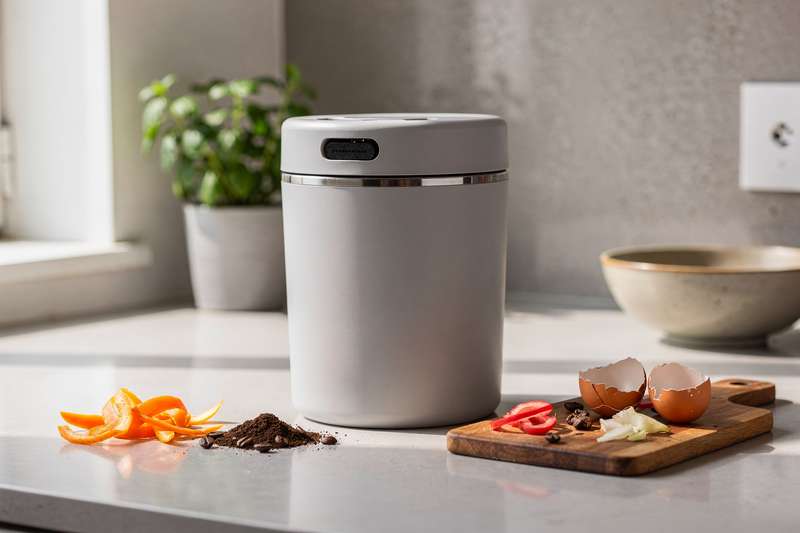
You live in a flat. The kitchen worktop is roughly the size of a large chopping board once your kettle, toaster, and fruit bowl have claimed their territory. You started composting with good intentions — a bag tucked under the sink, maybe a ceramic bowl with no lid — and within three days you had fruit flies orbiting a soggy pile of banana peel, and a smell that greeted you every time you walked into the kitchen. Your flatmates weren’t impressed. You chucked the whole thing in the general waste and felt guilty about it for a week.
Sound familiar? You’re not alone. Countertop composting in a small flat is a genuinely tricky problem: you need something compact enough not to monopolise precious worktop space, sealed well enough to contain the kind of odour that builds up fast in a warm kitchen, and simple enough to actually use every day rather than becoming another guilt-inducing object you ignore. The wrong bin turns composting into a chore you abandon; the right one disappears into your routine so smoothly you barely notice it’s there.
This guide cuts through the noise and gives you five concrete, well-matched picks drawn from products actually available on Amazon UK right now — so you can stop guessing and start composting without the stink.
How These Picks Were Evaluated
To put together these recommendations, the evaluation focused on a handful of criteria that matter most in a small-flat context. Odour control was the primary filter — specifically whether the lid design (press-button, locking, or filter-assisted) actually contains smells between collections rather than relying on you to empty it the same day. Capacity got weighted carefully: too small means you’re emptying daily (annoying), too large and you’re storing week-old food waste on your worktop (worse).
Footprint and height mattered — a bin that’s 30cm tall works in a utility room but not under a kitchen cupboard. Ease of cleaning was tested against real-world use: bins with lots of nooks, removable inner buckets, and dishwasher-safe components score higher. Verified reviewer patterns on Amazon were cross-referenced for recurring complaints (lid breakage, staining, seal failure) and consistent praise. Warranty and brand reputation were factored in where relevant. Price tier was noted but not used as a tiebreaker — value for money matters across all budgets.
Best Overall Pick: YourCasa 5L Compost Bin
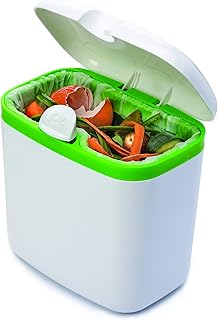
The YourCasa compost bin 5L kitchen food waste caddy is the pick that most reliably solves the smell problem without making the bin itself awkward to use daily. With 852 reviews and a 4.6/5 rating, this is a product that has been genuinely tested by a wide community of UK buyers — the review count alone puts it head and shoulders above many alternatives in terms of pattern confidence.
The lid opens with a push button, which sounds like a minor detail but matters enormously in practice: when your hands are covered in vegetable peelings, you don’t want to wrestle with a screw-top or a flip that requires two hands. One tap with an elbow or a knuckle and it’s open. The lid seals firmly when closed, which is the primary reason smells stay contained. Reviewers consistently note that even after a few days of summer use, the bin doesn’t broadcast its contents to the rest of the kitchen.
At 5 litres, it sits in a sweet spot for a one- or two-person flat: enough capacity to last three to four days before needing emptying, but not so large that you’re storing a substantial volume of decomposing food at room temperature. The footprint is compact, and the countertop profile is tidy enough not to dominate a small worktop. The inner surfaces are smooth, which makes rinsing between liners easy — a point several reviewers specifically call out as a reason they’ve stuck with this bin long-term.
The main limitation is that this is a plastic bin with no active filtration layer — it relies on the mechanical seal of the lid rather than an activated carbon filter. If you forget to empty it for five or six days in a warm kitchen, the seal will work hard but odours may eventually start to escape. Keep to a two- to four-day emptying rhythm and you’ll have no issues. It’s also worth noting the bin is designed for use with compostable liner bags rather than direct placement of food waste, which keeps the interior clean and cuts down on residue buildup. Overall, for straightforward daily countertop composting in a flat, this is the most dependable choice in the current UK Amazon range.
Best Budget Pick: Joie Kitchen Countertop Compost Bin
If you want to get started with countertop composting without committing much money upfront, the Joie Kitchen Countertop Compost Bin offers a 2.7-litre BPA-free plastic container with a locking lid and odour control at a genuinely accessible price point. It’s the smallest-capacity bin in this guide, which is actually a feature rather than a drawback for solo dwellers: a smaller volume means you’re more likely to empty it before smells develop, and the bin takes up minimal worktop real estate.
The locking lid is the key odour-control mechanism here. It clips down firmly rather than just resting on top, which creates a more reliable seal than a loose-fitting lid — a common failure point on cheap bins. The BPA-free construction is worth noting if you’re composting with an eye on environmental responsibility, and the dishwasher-safe design means cleaning is straightforward. For budget bins, the ability to run it through the dishwasher properly (rather than just wiping it down) is a genuine hygiene advantage.
Where does it fall short? At 2.7 litres, a household that cooks regularly — roasting vegetables, making stock, prepping fruit — will fill this bin in a day or two. If you cook enthusiastically or share with a partner, you’ll find yourself emptying it more frequently than feels convenient. The 74-review count means the reliability pattern is less established than some other picks in this guide; there are positive signals, but the sample is smaller. The 4.3/5 rating is decent without being exceptional.
It’s also worth being realistic about what “odour control” means at this price tier: there’s no activated carbon filter, no double-walled design, no gasket seal. The locking lid does a reasonable job, but it’s a mechanical seal on a lightweight plastic bin. For a single person emptying every one to two days, it performs well. For anyone hoping to leave it unattended for a week, it will let you down. Used within its intended parameters — small volume, frequent emptying, liner bags — this is a practical, no-faff starting point that won’t deter you from composting by being complicated or expensive.
Best for Odour Filtration: Joseph Joseph Stack 4 Kitchen Compost Caddy
The Joseph Joseph Intelligent Waste Stack 4 Kitchen Food Waste Compost Caddy is the pick that takes odour control most seriously at a design level. Joseph Joseph built their reputation in the UK on kitchen accessories that solve a specific problem with genuine engineering attention, and the Stack 4 caddy exemplifies this: it ships with a dedicated odour filter built into the lid, which actively absorbs gases rather than relying purely on a physical seal.
The activated carbon filter in the lid is the standout feature. Carbon filters work by adsorbing the volatile organic compounds that give food waste its characteristic smell — the same principle used in refrigerator deodoriser pads but applied specifically to a compost bin lid. The result is a bin you can leave on the worktop even in a warm kitchen with noticeably less odour than unfiltered alternatives. Replacement filters are available separately, which is worth factoring in as a small ongoing cost, but for odour-sensitive households or anyone who simply can’t empty the bin every two days, this is the most reliable approach.
At 4 litres, capacity is sensible for a one- to two-person household. The graphite colour is neutral and fits most kitchen aesthetics without looking clinical or industrial. Joseph Joseph’s quality control track record is strong, and the design has clearly been thought through: the lid fits snugly, the bin is easy to lift and rinse, and the overall footprint is modest.
The tradeoff is that this is a mid-range priced bin, and the filter does need replacing periodically — typically every two to three months with regular use. If you consistently empty every two days, you may find a simpler sealed bin performs adequately without the filter cost. But for anyone who has tried cheaper options and found that smells still crept out, the Joseph Joseph’s active filtration makes a tangible difference. The absence of verified review count data for this listing on Amazon means you’re relying more on Joseph Joseph’s wider brand reputation here, which is well-established in the UK kitchen accessories market, and the 4.7/5 rating — even without a large visible review count — is a strong signal.
Best for Everyday Durability: Tydi 4.5L Food Waste Bin
The Tydi 4.5L Food Waste Bin with Press-Button Lid is the most reviewed pick in this guide at 719 ratings, sitting at 4.6/5 — which means you’re looking at a product with a robust, statistically reliable feedback base. When a product accumulates this many reviews at that rating, recurring issues tend to surface clearly; the absence of significant complaint patterns around lid failure, seal deterioration, or odour leakage is reassuring.
The press-button lid mechanism is smooth and practical. Unlike some budget bins where the button feels flimsy after a few months of daily use, reviewer feedback on the Tydi consistently references the button as remaining reliable over extended use. The anti-slip base is a small but genuinely useful feature in a kitchen environment — a bin that slides around when you open it one-handed gets irritating quickly, and on tiled or laminate worktops this is a real issue with lighter plastic bins. The secure lid design creates a tight seal that contains odours effectively for a typical two- to four-day collection cycle.
At 4.5 litres, this bin is right in the middle of the practical range for a small flat: enough capacity for a couple over three to four days of regular cooking, not so large it becomes a waste-storage repository. The indoor kitchen compost caddy design is clean and functional — it doesn’t look out of place on a worktop, and the form factor is narrow enough to fit alongside other worktop items without being intrusive.
Where the Tydi asks you to manage expectations is in the odour filtration: like the YourCasa, it relies on the mechanical seal of the lid rather than an active carbon filter. The seal is good — better than many cheaper alternatives — but it is not an absolute barrier to odour, particularly in warmer months with aromatic food waste like fish scraps or fermented fruit. Use compostable liner bags (they help enormously with smell and cleaning), empty on a regular schedule, and you’ll find this bin performs consistently well. It is also worth noting that the same ASIN appears in slightly different colourway/variant configurations in the Amazon listing (the B0G395HYQ4 ASIN is the same product in a different variant), so check the listing carefully when ordering to confirm the colour you want.
Best for Aesthetics: Harbour Housewares Vintage Kitchen Compost Bin
Not everyone wants a plastic bin on their worktop. If your kitchen leans towards a classic, country, or Scandi aesthetic — or if you simply find most plastic food waste caddies an eyesore — the Harbour Housewares Vintage Kitchen Compost Bin in Cream Steel is the pick that squares the circle between practicality and appearance.
The 3.2-litre steel construction is the main differentiator here. Steel is naturally more resistant to absorbing food odours than plastic — it doesn’t become stained or carry residual smells in the same way a plastic inner surface can after months of use. The cream finish with decorative handles gives it a character that fits naturally into a traditional or neutral kitchen without looking like a utility item. If you’re the kind of person who thinks about how their worktop looks (not a small consideration when you live in a compact flat where the kitchen is often visible from the living space), this matters.
The 3.2-litre capacity is on the smaller side, sitting between the Joie’s 2.7L and the 4-4.5L of the other picks. For a single person or a couple who cook moderately, this works well for a two- to three-day cycle. The handles are a practical detail that makes carrying to the outside collection bin easier — a minor convenience that adds up over repeated daily use. The replaceable filter in the lid keeps odours managed between empties, which is a valuable addition on a steel bin where you can’t rely purely on gasket seals.
The honest tradeoffs: steel bins are typically heavier and slightly harder to rinse quickly than plastic. The cream finish, while attractive, shows marks and requires occasional wiping to stay looking its best. There are no verified review counts visible for this listing, so you’re weighing the specification and brand reputation (Harbour Housewares is a well-regarded UK kitchen accessories brand) more heavily than crowd-sourced feedback. For anyone who has rejected other bins purely on aesthetic grounds, this is the pick that resolves that friction without compromising on core function.
Best Easy-Clean Pick: EKO Food Waste Compost Bin 4L
The EKO Food Waste Compost Bin in Grey is the pick for anyone who finds themselves avoiding composting because cleaning the bin is unpleasant. With 516 reviews at 4.6/5, this is a well-validated product, and the consistent theme across positive reviews is how straightforward it is to keep clean — a factor that matters more than it sounds when you’re deciding whether to stick with a composting habit long-term.
EKO as a brand is known in the UK for stainless steel and kitchen waste bins, and this 4-litre compost caddy reflects that background: the lid fits cleanly and securely, the interior surfaces are smooth, and the overall construction feels considered rather than cheaply assembled. At 4 litres, capacity is well-suited to a one- to two-person flat on a two- to three-day emptying schedule. The grey colour is a neutral that works in most kitchen palettes without drawing attention to itself.
What sets this bin apart in the easy-clean category is the combination of a smooth inner bucket, a well-fitting lid with no excessive crevices to trap food residue, and a design that rinses quickly under the tap. Some compost bins develop a persistent smell in the interior over time — particularly around lid joins, filter housings, and textured surfaces where organic residue builds up. The EKO’s cleaner internal geometry resists this accumulation more effectively than designs with more complex mouldings.
The limitations are honest ones: like most bins in this tier, odour control relies on the lid seal rather than active filtration. The grey plastic, while tidy, doesn’t have the visual character of the Harbour Housewares steel option. And while 516 reviews at 4.6/5 is a solid pattern, it’s worth reading a cross-section of recent reviews to ensure current production batches maintain the quality that earlier buyers experienced. Used with compostable liner bags — which dramatically reduce the cleaning burden — this bin is one of the lowest-effort options in the guide, which makes it particularly well-suited to people who want composting to be genuinely low-maintenance rather than an ongoing project.
Best Simple & Affordable: Addis Everyday Kitchen Food Waste Compost Caddy
The Addis 518251 Everyday Kitchen Food Waste Compost Caddy Bin in Metallic Silver comes from one of the most established names in UK kitchen and household bins — a brand that has been supplying British kitchens for decades. This 4.5-litre caddy is a no-frills, functional approach to countertop food waste collection, and it does exactly what it says on the listing without unnecessary complexity.
The metallic silver finish is clean and unobtrusive, fitting easily into modern or neutral kitchen schemes. At 4.5 litres, capacity matches the Tydi and sits comfortably for regular use in a small flat. The design is simple: a fitted lid, a straightforward opening mechanism, and a construction that prioritises easy cleaning and straightforward use over aesthetic flourishes or advanced odour-control features. For someone who wants a reliable, brand-trusted caddy from a company they recognise, the Addis offers exactly that reassurance.
The honest assessment is that this is a workhorse rather than a specialist: it doesn’t have a carbon filter, an anti-slip base, or a press-button mechanism. It does the basics well and comes with the implicit quality assurance of a major UK household brand. The absence of a visible verified review count on the Amazon listing means pattern-matching from buyer feedback is limited, so brand trust carries more weight here than data-driven confidence. If you already own Addis bins elsewhere in your home and trust the brand, extending that to a compost caddy is a low-risk choice. If you’re undecided between this and a more feature-rich option, the YourCasa or Tydi would likely serve you better — but for straightforward, brand-confident, everyday use, the Addis is a solid choice that rarely features in “I wish I’d bought something else” conversations.
What to Look For in a No-Smell Countertop Compost Bin
- Lid seal quality: This is the single most important factor. A tight-fitting lid — whether press-button, locking, or weighted — is what stands between your kitchen smelling neutral and smelling like a compost heap. Look for bins where reviewers specifically mention the lid seal holding up over months of daily use, not just on first use. Avoid bins where the lid just rests loosely on top; they look similar in product photos but perform very differently in practice.
- Active vs passive odour control: Some bins rely purely on the mechanical lid seal (passive), while others include an activated carbon filter in the lid (active). Active filtration is meaningfully better for odour-sensitive households or anyone who can’t empty every two days. Factor in the cost of replacement filters (typically every two to three months) when comparing mid-range options with filters against cheaper seal-only designs.
- Capacity relative to your household: A 2.7-3L bin is right for a solo dweller who cooks moderately; a 4-5L bin suits a couple or a single person who cooks enthusiastically. Going larger than 5L on a countertop in a small flat creates more problems than it solves — you end up storing substantial volumes of ageing food waste at room temperature.
- Ease of cleaning: Smooth interior surfaces, removable inner buckets, and dishwasher-safe components all reduce the effort of maintaining a clean bin. Bins with complex moulding, textured interiors, or recessed lid channels accumulate residue and become harder to clean over time. This matters for long-term odour control as much as the lid seal does.
- Liner bag compatibility: Most countertop compost bins are designed to be used with compostable liner bags, and this is strongly recommended regardless of bin type. Bags prevent food waste from contacting the inner surface directly, dramatically reduce cleaning frequency, and make emptying cleaner and faster. Check that your chosen bin’s dimensions are compatible with standard liner bag sizes (most UK bags are designed for 5-7L caddies, so a well-fitting 4-5L bin will work fine).
- Footprint and height: Measure the space you have before buying. Many countertop bins are taller than they look in product photos — 20-25cm is typical, which can conflict with under-cupboard clearance in compact kitchens. Width matters too if your available worktop strip is narrow.
- Material durability: Steel bins resist odour absorption over time better than plastic, but they’re heavier and can rust if the coating is compromised. Quality plastic bins (BPA-free, smooth-moulded) are lighter and easier to rinse but may show staining with prolonged use. Neither material is definitively superior — match the choice to your priorities around aesthetics, weight, and maintenance.
Verdict
For the majority of readers — someone in a one- or two-person flat, cooking regularly, wanting a compost bin that controls smells reliably without demanding daily attention — the YourCasa 5L compost bin is the clearest recommendation. It has the strongest review base of the picks in this guide, consistent odour-control feedback, a practical press-button lid, smooth easy-clean interior, and a capacity that suits realistic flat-dwelling cooking patterns without being oversized.
If active odour filtration is your priority — you have a warm kitchen, you can’t commit to emptying every two to three days, or you’re particularly odour-sensitive — the Joseph Joseph Stack 4 caddy is worth the step up in price for the carbon filter advantage. And if you cook solo in a studio flat and want to spend as little as possible while still getting started, the Joie 2.7L bin will serve you well with a frequent-emptying habit and a liner bag.
The right bin is the one you’ll actually use. Any of these picks, used with compostable liner bags and emptied on a two- to four-day schedule, will keep your kitchen smelling normal and your food waste out of landfill.
We were not paid to feature any specific product in this guide. All opinions are independent and based on publicly available specifications, verified buyer feedback patterns, and category research.
Quick Comparison Table




FAQ
Do countertop compost bins really stop smells, or is it a marketing claim?
A well-designed countertop compost bin with a tight-fitting lid will control odours effectively for a two- to four-day collection cycle under normal conditions. Bins with activated carbon filters do this more reliably than those relying on a mechanical seal alone. The key variable is emptying frequency — no bin, at any price, will contain a week’s worth of warm-weather food waste indefinitely. Used on a realistic schedule with compostable liner bags, the good picks in this guide won’t make your kitchen smell.
How often should I empty a countertop compost bin in a flat?
Every two to three days is the practical sweet spot for most households. In summer, when kitchen temperatures are higher, err towards every two days — warmth accelerates decomposition and odour production. In winter, you can stretch to three to four days comfortably. The size of your bin should match your household’s food waste volume so you’re emptying based on the schedule, not because the bin is overflowing.
Are compostable liner bags necessary, or can I put food waste directly in the bin?
You can put food waste directly in the bin, but liner bags are strongly recommended for practical reasons. They prevent food residue from building up on the inner surfaces (which causes persistent odour over time), make emptying faster and less messy, and extend the time between thorough cleans. In the UK, compostable liner bags are available at most supermarkets and are compatible with council food waste collections. The small ongoing cost is well worth the convenience and hygiene benefit.
Can I put cooked food and meat scraps in a countertop compost bin?
This depends on where you’re sending the contents. Most UK council food waste collections accept all food including cooked food, meat, fish, and dairy. Home garden compost bins typically shouldn’t receive these items as they attract pests. If your food waste goes to a council collection, a countertop caddy is ideal for all food types. If it goes to a home compost bin, stick to fruit, vegetables, coffee grounds, and eggshells. Check your local council’s guidelines if you’re unsure — most publish clear lists of accepted items.
What is an activated carbon filter and does it really help with odour?
An activated carbon filter is a layer of treated carbon material, usually fitted inside the bin lid, that adsorbs volatile organic compounds (the gases that cause food waste odour) as air passes through it. It doesn’t eliminate odour entirely but meaningfully reduces what escapes into your kitchen air compared to a mechanical seal alone. Filters need replacing every two to three months with regular use — most bins that include them also sell compatible replacement filters separately. For odour-sensitive households or kitchens that run warm, the filter makes a real difference.
What size countertop compost bin is best for a one-bedroom flat?
A 4 to 5-litre bin is the practical sweet spot for one to two people in a flat. It’s large enough to last three to four days between empties for a household that cooks regularly, but small enough to sit unobtrusively on a worktop without dominating the space. Bins under 3 litres work for solo dwellers with moderate cooking habits but require more frequent emptying. Anything over 6 litres is better suited to a family kitchen than a compact flat worktop.