Picture this: it’s a Sunday afternoon, the TV remote has gone flat, the kids’ toys have died simultaneously, and somewhere in a kitchen drawer there’s a battery charger — but you’re not sure whether it still works, whether it charges AAA as well as AA, or whether plugging it in will just result in warm batteries and no actual charge. You’ve been through the cheap-and-cheerful chargers that take 16 hours and cook the cells in the process. You’ve also bought batteries in bulk from the supermarket only to watch the costs add up week after week. What you actually want is a reliable, straightforward household battery charger that gets the job done quickly, safely, and without requiring a degree in electronics to operate.
The good news is that the market for household battery chargers under £30 has improved dramatically in the last few years. Smart charging circuits, individual slot management, Type-C inputs, and LCD displays have trickled down from enthusiast territory into everyday, affordable products. The challenge is sorting the genuinely useful from the disappointingly basic — and that’s exactly what this guide does for you.
How We Evaluated These Chargers
Each pick in this guide was assessed against a consistent set of criteria relevant to typical UK household use. Charging speed matters, but so does safety — overcharge protection, temperature monitoring, and auto-cutoff are not optional extras. The number of charging slots and whether those slots manage batteries individually (rather than in pairs) makes a real difference to flexibility. Compatibility with both AA and AAA at minimum was a baseline requirement, with C, D, and 9V support treated as a bonus. Input options — whether the charger uses a UK mains plug or a USB/Type-C connection — affect where and how you can use it. We also looked at real buyer review patterns across verified purchases, paying particular attention to complaints about heat, reliability over time, and accuracy of charge indicators. Finally, value for money was weighed: you want a charger that will last two or three years without drama, not one that dies six months in.
Best Overall Budget Pick
The Amazon Basics Battery Charger for Rechargeable AA and AAA NiMh Batteries – UK Plug, 4-Bay, Black sits at the top of the budget pile for a straightforward reason: it does exactly what most households need without any fuss. This is a four-bay NiMH charger with a UK mains plug already attached — no adapter hunting, no USB power brick to source separately. You plug it in, drop in your batteries, and charging begins. LED indicators tell you at a glance which slots are active and which have finished.
The 4-Bay layout suits the majority of typical home users well. Most people are rotating four to eight batteries across remotes, clocks, toys, and torches — and having four slots means you’re rarely waiting around for a previous batch to finish before you can start the next. The charger handles both AA and AAA NiMH cells, which covers the two most common household formats. It won’t charge C, D, or 9V cells, so if you need those you’ll want to look at one of the wider-compatibility options further down this list.
Where this charger earns its keep is in its reliability over time. The Amazon Basics line has been available long enough that there’s a substantial body of real-world feedback to draw on, and the consistent message from buyers is that it keeps working without drama. It doesn’t charge at the absolute fastest rate available in this category, so if you’re topping up batteries the night before a camping trip it’s worth starting early rather than expecting a two-hour turnaround. That said, a gentler charge rate is actually better for battery longevity — aggressive fast-charging degrades NiMH cells faster.
The main limitation is the lack of individual slot monitoring. Some cheaper chargers charge in pairs, meaning a mismatched pair of cells will pull each other’s performance down. This model’s implementation is straightforward but functional — fine for a home setting where you’re typically charging matched batteries from the same pack. It’s not the right tool for battery hobbyists who want detailed diagnostics, but for the average kitchen drawer, it’s a solid, dependable choice that won’t let you down.
Best Starter Bundle (Charger + Batteries Included)
If you’re starting from scratch — no charger, no rechargeable batteries — the Amazon Basics Rechargeable Batteries NiMH, AAA 800mAh 4-Pack + AA 2000mAh 4 Pack with 4 Bay Battery Charger, UK Plug, Black is the most sensible entry point available. You get eight batteries across both key formats — four AA at 2000mAh and four AAA at 800mAh — plus the charger itself, all in a single purchase. For anyone who’s been putting off switching to rechargeables because the initial outlay felt uncertain, this takes all the guesswork out of compatibility.
The AA cells at 2000mAh are a reasonable capacity for everyday use: TV remotes, wireless keyboards, and wall clocks will run for months on a full charge. The AAA cells at 800mAh are similarly practical for smaller devices like slim remotes and some torches. Neither capacity figure is exceptional — you can find higher-capacity cells if you shop separately — but the combination of adequate capacity, trusted brand quality control, and the convenience of having everything arrive together makes this bundle particularly sensible as a household starting kit.
The charger included in the bundle uses a UK mains plug and handles four slots. It’s the same platform as the standalone 4-bay model, which means you’re getting a proven, reliable base rather than a mystery unit bundled with batteries to shift stock. Bear in mind that the charger charges the AA and AAA slots without individual cell monitoring, so it’s best to charge matched pairs or sets when possible. This isn’t a hardship in practice — most households run batteries in matched sets from the same device anyway.
One thing to flag: the charger in this bundle does not include a USB port, so you can’t use it to top up a phone or tablet while your batteries charge. If USB passthrough matters to you, look at the 8-bay model below. But as a complete first step into rechargeable household batteries — with everything you need out of the box — this bundle is hard to beat at this price tier.
Best for Large Households or High Battery Turnover
The Amazon Basics Rechargeable AA NiMh Batteries with 8-Bay Battery Charger, USB-C Port, No AC Power Adapter, 8 Count (Pack of 1) steps up to eight charging slots — which genuinely changes how you manage batteries in a busy household. If you’ve got multiple children’s toys, a ring doorbell running on AAs, a wireless gaming controller, a kitchen timer, and a TV remote all competing for charged batteries, four slots becomes a bottleneck. Eight slots means you can cycle through a full set of eight AAs in one go.
There’s an important practical note upfront: this charger uses a USB-C input rather than a direct UK mains plug. The listing states no AC power adapter is included, so you’ll need to supply your own USB-C power source capable of delivering adequate wattage. Most modern phone chargers and USB-C hubs will do the job, but if you’re expecting a plug-and-go solution straight out of the box, factor in that you’ll need a suitable USB-C brick. The upside of this approach is flexibility — you can run it from a power bank when camping, from a USB-C port on a monitor at your desk, or from any standard charger you already own.
The USB-C port also means this charger functions partly as a USB hub passthrough in some configurations, though its primary function is battery charging. The eight included AA batteries at 2000mAh give you a ready-made rotation stock to start with. The 8-bay layout handles both AA and AAA cells. Review patterns for this model are consistent with the broader Amazon Basics family — buyers report straightforward, reliable operation without overheating issues, which matters a lot when you’re running eight cells at once.
The tradeoff versus the 4-bay models is footprint: an 8-bay charger takes up more worktop or drawer space. If your kitchen is tight on counter space, the larger dock might feel cumbersome. But for families who go through batteries at pace, the time saved by doing one big charging session rather than two smaller ones is a genuine quality-of-life improvement. This is the one to choose if battery management is a recurring household chore rather than an occasional task.
Best for Fast Charging (Branded Reliability)
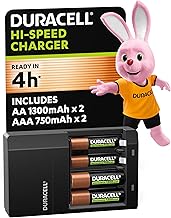
The DURACELL Hi-Speed Battery Charger, 4 hours, Compatible with AA and AAA NiMh Batteries, 2x AA 1300mAh and 2x AAA 750 mAh, Rechargeable Batter takes a different approach from the Amazon Basics family: it prioritises charging speed. A four-hour charge time for NiMH AAs is meaningfully faster than many standard chargers in this category, which can take eight to sixteen hours on a slow overnight cycle. If you’ve ever needed charged batteries the same afternoon rather than the next morning, the speed advantage here is real.
Duracell has been making batteries and battery management products long enough that quality control is generally dependable, and this charger’s 4.6-star rating reflects a product that buyers actually trust in practice. It comes with two AA and two AAA NiMH cells included — not a huge battery set, but enough to get you started with the most common sizes immediately. The charger itself handles four slots across AA and AAA configurations.
The smart charging circuit includes overcharge protection and monitors cell temperature to prevent heat damage — important when you’re pushing charge rates higher to achieve faster turnaround. Cheaper fast chargers skip this protection and end up damaging battery longevity in the process, so the presence of thermal monitoring here is worth noting. Over time, batteries charged on well-managed circuits retain their capacity better than those repeatedly pushed through unmonitored fast-charge cycles.
Where this charger is slightly less versatile than some alternatives is in its format range: it handles AA and AAA only, with no provision for C, D, or 9V cells. The included batteries are also at the lower end of capacity (1300mAh for AA compared to 2000mAh alternatives), which means you may want to invest in higher-capacity cells alongside the charger if your use case involves high-drain devices like digital cameras or gaming controllers. But as a fast, reliable four-slot charger from a brand with a proven track record, this earns its place in any household that values speed.
Best for Individual Slot Control and Heavy Rotation
The Granicell 8 slot AA AAA Battery Charger, USB Smart Battery Charger, Type-C Connector with LED Display, Individual Slots for Ni-MH/Ni-CD Rech is the pick for anyone who wants more than basic plug-and-charge functionality without stepping outside the budget range. Eight individual slots — each managed independently by the charger’s internal circuit — means you can mix AA and AAA cells in any combination across the bay without the charger treating mismatched cells as a problem. Each slot reads its own battery’s state and charges accordingly, rather than treating paired slots as a single unit.
The LED display provides real-time status for each of the eight slots, so you can see at a glance which cells are charging, which are full, and whether any slot has flagged a problematic cell. This is particularly useful when you’re charging a mix of batteries with different ages and charge histories. Older cells will show as full sooner than newer ones; the Granicell lets you see this rather than guessing. Its 4.6-star rating, backed by over a thousand buyer reviews, suggests the display is accurate rather than optimistic.
The Type-C input makes it USB-powered, just like the Amazon Basics 8-bay — so again, you’ll need a USB-C power source. The input specification is 5V 2A, which is modest enough that most standard phone chargers will work without issue. Charging speed per slot is reasonable rather than record-breaking, but with eight slots running simultaneously and individual management keeping each cell on the optimal charge curve, you end up with better-conditioned batteries at the end of the cycle than you’d get from a faster but less intelligent charger.
The main consideration for UK buyers is that this is a smaller brand than Amazon Basics or Duracell. The review base is substantial and positive, but if brand heritage matters to you — or if you’re buying as a gift for someone who values recognised names — the familiarity factor isn’t there in the same way. From a pure functionality standpoint, though, the Granicell’s individual slot management puts it ahead of similarly priced four-bay alternatives. It’s the sensible choice for users who want a smarter charger without moving into premium territory.
Best All-in-One with Fast Charging and Status Display
The Energizer Recharge Pro – Battery Charger for AA & AAA Batteries – 4x AA Rechargeable NiMH Batteries Included – Fast Charging with Charge Sta occupies an interesting position: it’s a mid-range product from a major battery brand that includes a visual charge status display (charge indicator), a set of four AA NiMH batteries, and a fast charging circuit — all combined in a single package. Energizer is one of the most recognised names in batteries globally, and the Recharge Pro charger is their answer to users who want more than a basic trickle charger but don’t want to research the enthusiast end of the market.
The charge status indicator is a practical feature that gets undervalued until you’ve owned a charger without one. Being able to see that your batteries are at 75% after an hour — rather than just watching a solid red LED with no progress information — lets you plan around your charging cycle rather than working around it. The four included AA NiMH cells are Energizer’s own rechargeable line, which means they’re tested to work optimally with this charger’s charge rate and circuit management. Buying a charger and batteries from the same manufacturer in one kit removes a variable that can sometimes affect how well a charger performs.
Fast charging here means meaningfully quicker turnaround than a standard overnight charger, though the exact speed will vary depending on the capacity of the cells being charged. The charger’s safety protections include overcharge prevention and temperature monitoring — standard for a product in this category from a major brand, but worth confirming because not all budget options include both. At 4.6 stars, buyer satisfaction is high, and the Energizer name carries a manufacturer warranty that smaller brands sometimes can’t match.
The limitation is format: four AA/AAA slots, no support for C, D, or 9V. If your household uses a variety of battery sizes and you want one charger to cover all of them, you’ll need a different solution. But for the vast majority of UK homes where AA and AAA dominate, the Energizer Recharge Pro’s combination of brand confidence, status display, included batteries, and fast charging makes it a well-rounded, complete package at this price tier.
Best for 1.5V Lithium Rechargeable AA Batteries
The POWEROWL Rechargeable Lithium AA Batteries 8 Pack with Charger, 1.5V Stable Output 3600mWh Battery with Lithium/NiMH Charger Storage Box for is a different category of product — and it’s worth understanding why before you buy. Standard NiMH rechargeable AAs output around 1.2V, which most devices tolerate fine but which some older or more sensitive electronics flag as “low battery” earlier than necessary. Lithium rechargeable AAs output a stable 1.5V throughout their discharge cycle, matching the voltage of alkaline disposables exactly.
The practical result is that devices which previously “died” earlier on NiMH rechargeables — certain digital cameras, some LED torches, and older game controllers — perform for their full expected runtime on these lithium cells. The 3600mWh capacity rating is a lithium-appropriate figure (lithium cells are rated in mWh rather than mAh because the stable voltage makes direct mAh comparison misleading); in practice, this translates to longer runtimes in high-drain devices compared to mid-capacity NiMH AAs.
The included charger is designed specifically for these lithium cells but also handles NiMH, giving you some flexibility if you’re running a mixed battery household. The storage box is a genuinely useful practical touch — keeping charged and discharged lithium AAs separated and identifiable is easier with purpose-made storage, and it protects the batteries during transport for travel or camping use. With 65 reviews and a 4.1-star rating, this is a newer product with a smaller feedback base than some picks here, which means you’re taking a slightly higher risk on long-term reliability — but the early indicators are positive.
The tradeoff with lithium rechargeables is cost per cycle compared to NiMH. Lithium rechargeable AAs are more expensive upfront and charge more slowly than NiMH cells on a comparable charger. They earn their value in high-drain applications and in devices where voltage stability matters. If you’re mainly powering low-drain items like wall clocks and TV remotes, NiMH is more economical. But if you have a digital camera or a high-powered torch that’s always draining batteries faster than expected, this POWEROWL bundle is worth the premium.
Best Budget Lithium AA Option for Trying the Format
The Rechargeable AA Batteries Lithium with Charger,10 Pack 1.5V 3000mWh Double A Battery Rechargeable,Long Lasting Pilas Recargables Lithium ion gives you ten 1.5V lithium rechargeable AA batteries with a charger — a larger cell count than most competing options — at a budget-friendly price point. If you want to trial lithium rechargeable AAs across several devices simultaneously without a large upfront commitment, the ten-pack format makes more sense than buying four or eight.
The 3000mWh capacity per cell is slightly lower than the POWEROWL alternative, but still comfortably ahead of standard mid-capacity NiMH AAs in terms of effective runtime in high-drain applications. The 1.5V stable output applies the same advantage: devices that underperform on NiMH will typically run properly on these. The charger included handles the lithium cells and is compact enough not to dominate a kitchen worktop.
With 29 reviews at 4.2 stars, this is one of the newer products in the guide, and the review base is smaller than ideal for complete confidence in long-term durability. Real-world feedback is broadly positive at this stage, with buyers noting the stable voltage performance and the value of getting ten cells in one purchase. The main caution is that with any newer listing, it’s worth checking recent reviews at the time of purchase to confirm quality consistency has held up — smaller brands occasionally have batch-to-batch variation that only shows up in later reviews.
This pick is best suited to buyers who are curious about lithium rechargeables but want to minimise financial risk while testing the format. The ten-cell count means you can replace all the AAs in two or three devices at once and get a genuine comparison against whatever you were using before, rather than testing in isolation. It’s not the most battle-tested option in this guide, but the value-per-cell ratio at the budget end of lithium rechargeables is genuinely attractive.
What to Look For in a Household Battery Charger
- Individual slot management vs paired slots: Chargers with individually managed slots charge each cell based on its own state, which is better for battery longevity and more flexible when mixing batteries of different ages. Paired-slot chargers charge two cells together — cheaper to make, but less efficient if your cells aren’t evenly matched. If you can stretch to individual slot management, it’s worth it for a charger you’ll use for years.
- Overcharge protection and temperature monitoring: These are safety features, not luxury additions. Overcharging NiMH cells damages their capacity over time and, in extreme cases, causes overheating. A good charger cuts off power when a cell reaches full charge (delta-V or -dV/dt detection) and monitors temperature as a secondary safety check. Don’t buy a charger that doesn’t mention either of these protections.
- Charging speed and charge rate: Measured in milliamps (mA), the charge rate determines how quickly a battery fills. Slow chargers (100–200mA) take 8–16 hours but are gentle on cells. Fast chargers (500–1000mA) can fill a standard AA in 2–4 hours but rely more heavily on overcharge protection to avoid damage. For most households, a mid-speed charger (around 300–500mA) balances convenience and longevity well.
- Battery format compatibility: Most household chargers cover AA and AAA. Some also handle C, D, and 9V cells — genuinely useful if you have torches, baby monitors, or smoke alarms on those formats. Check the product listing explicitly; don’t assume wider compatibility from a product photo.
- Power input (mains plug vs USB/Type-C): UK mains plug chargers work immediately out of the box, which is the simpler option for home use. USB and Type-C input chargers are more versatile for travel and can be powered from a laptop or power bank, but require you to supply an appropriate power source. If you’re buying as a gift or for general home use, a mains plug version avoids confusion.
- Number of slots: Four slots suits most one- or two-person households comfortably. Families with multiple battery-hungry devices — toys, remotes, controllers, cameras — will find an 8-slot charger worth the extra footprint, saving multiple charging cycles per week.
- Display type (LED indicators vs LCD screen): LED indicators tell you whether a slot is charging or full — binary, simple, adequate. LCD screens show charge percentage, voltage, or error codes — more information for users who want to track their batteries’ condition over time. For casual household use, LEDs are sufficient; if you want to monitor battery health, an LCD is a meaningful upgrade.
Verdict
For the modal UK household — a couple or a family with standard AA and AAA battery needs across remotes, toys, and kitchen gadgets — the Amazon Basics Rechargeable Batteries NiMH bundle with 4 Bay Charger is the most practical starting point. You get batteries and a charger together, both from a reliable source, with a UK mains plug and no compatibility puzzles to solve. It’s not the fastest charger in this guide, and it won’t impress with advanced displays or individual slot diagnostics — but it works, it keeps working, and it covers the two most common battery sizes immediately out of the box.
If you already have rechargeable batteries and just need a better charger, the Granicell 8-slot charger is the smartest upgrade within the budget range — eight individually managed slots with LED display feedback, at a price that won’t hurt. And if you’ve been frustrated by devices running flat faster than expected on standard NiMH cells, the POWEROWL lithium AA bundle is worth trying — the stable 1.5V output makes a noticeable real-world difference in high-drain devices. Start with the bundle if you’re new to rechargeables, step up to the Granicell if you want smarter charging, and investigate lithium AAs if your current setup keeps leaving you disappointed.
We were not paid to feature any specific product in this guide. All opinions are independent and based on publicly available specifications, verified buyer feedback patterns, and category research.
Quick Comparison Table



FAQ
How long do rechargeable AA batteries take to charge?
It depends on the charger’s output rate and the battery’s capacity. A standard overnight charger (100–200mA) will take 10–16 hours to fully charge a 2000mAh AA cell. A fast charger running at 500–1000mA can complete the same charge in 2–4 hours. Most mid-range chargers fall somewhere between these extremes. Always check the charger’s rated current and match it against the battery capacity for an accurate estimate.
Can I mix AA and AAA batteries in the same charger at the same time?
Yes, provided the charger supports both formats — and the vast majority of household chargers do. On chargers with individual slot management, each slot handles its own cell independently, so mixing AA and AAA in the same session is no problem. On paired-slot chargers, it’s best to keep the same format in the paired slots to avoid uneven charging.
Are rechargeable batteries worth it for low-drain devices like remote controls?
Absolutely. Low-drain devices like TV remotes, wall clocks, and wireless keyboards actually highlight one of the best properties of NiMH batteries — they hold their charge well over long periods in low-draw applications. A single charge can last months in a remote control, meaning you barely need to think about topping them up. The break-even point versus disposables is reached quickly once you account for how rarely you’ll need to recharge.
What’s the difference between NiMH and lithium rechargeable AA batteries?
Standard NiMH AAs output around 1.2V and are well-suited to most household devices. Lithium rechargeable AAs output a stable 1.5V — matching alkaline disposables — which benefits high-drain devices like digital cameras and powerful LED torches that can underperform on 1.2V NiMH. Lithium rechargeables cost more upfront and require a compatible charger, but deliver noticeably better runtime in demanding applications. For everyday low-drain use, NiMH is more cost-effective.
Do I need a charger with a UK mains plug, or will a USB charger work?
Either works, but the choice depends on your setup. A UK mains plug charger is simpler — plug it in and go, no adapter required. USB and Type-C input chargers are more flexible, especially for travel or desktop use, but require you to supply a compatible power source (phone charger, USB hub, or power bank). If you’re buying for a standard home setup or as a gift, a mains plug version removes any uncertainty. For camping or travel, USB input is more versatile.
How do I know when my rechargeable batteries need replacing?
NiMH batteries typically last 500–1000 charge cycles before capacity drops noticeably. Practically, you’ll notice the signs before any technical measurement: devices run flat more quickly than they used to on a full charge, or the charger shows the battery as “full” after an unusually short time. If batteries that used to last a week in a remote are now failing after two days, it’s time to replace them. Chargers with individual slot displays can help by showing the actual voltage — cells sitting consistently below 1.2V fully charged are nearing the end of their useful life.