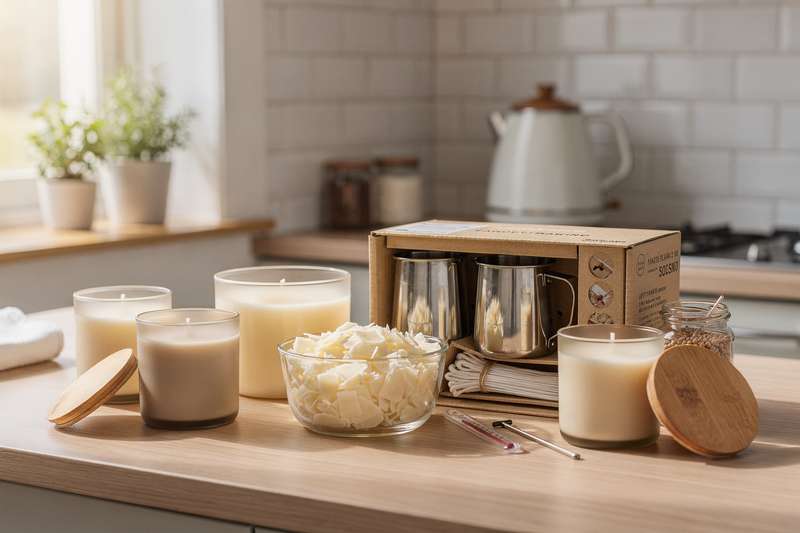
You watched a few YouTube videos, bought a bag of soy wax flakes and a pack of generic wicks, and set up a double boiler on your hob. An hour later you had a lopsided candle with a wick that drowned in the wax, a kitchen that smelled vaguely of burnt saucepan, and a very real question: is this supposed to be relaxing? It’s the same frustration thousands of UK crafters run into when they first try candle making — the hobby looks effortless online but the reality involves inconsistent melting temperatures, wick sizing confusion, and fragrance throw that disappears by the second burn.
The good news is that the right starter kit or the right individual supply solves most of those problems before they even start. Whether you want a full all-in-one kit so you can pour your first candle tonight, a dedicated wax melter to ditch the double boiler for good, or a reliable set of pre-waxed wicks so you stop guessing at sizing — there’s something in this guide for you. These are concrete, real-product recommendations you can order from Amazon UK right now, with honest notes on where each one shines and where it falls short.
How We Evaluated These Picks
Choosing candle making supplies isn’t just about picking whatever has the most stars on Amazon. For this guide, we looked at several specific criteria. First, completeness — does a kit genuinely include everything a beginner needs, or does it quietly omit the thermometer or pouring container? Second, capacity and yield — how many finished candles can you realistically make before you need to restock? Third, ease of use, particularly for those who have never worked with hot wax: is the melting method forgiving enough for a first attempt? Fourth, build quality of any hardware (melting pots, thermometers, wick holders). Fifth, reviewer feedback patterns — we looked at what real buyers consistently praised or flagged across multiple reviews, not just the headline star rating. Finally, value relative to tier: budget picks are assessed against other budget picks, not against premium options.
Best All-in-One Starter Kit for Beeswax Candles
The Candle Making Kit with Beeswax, Wicks, Candle Tins and More is the pick for anyone who wants to open a box and start making candles within the hour, without sourcing individual components separately. It’s aimed squarely at beginners, and it delivers on that promise by bundling beeswax, pre-tabbed wicks, candle tins and supporting supplies together in a single package.
The inclusion of beeswax rather than paraffin is a meaningful choice for a starter kit. Beeswax burns cleaner, has a naturally warm honey scent even without added fragrance oils, and is considerably more forgiving when it comes to setting temperature — you’re less likely to get sink holes or cracking if you pour it slightly off the ideal temperature. For a first-time candlemaker, that forgiveness matters. Soy wax can be gorgeous but it’s more sensitive to temperature swings, and paraffin brings its own debates around air quality. Beeswax sidesteps a lot of that drama.
With 94 verified reviews and a 4.5/5 star rating, the pattern in feedback is positive overall. Buyers repeatedly mention that the tins are a decent quality, the wicks are correctly sized for the containers included, and the instructions are clear enough to follow without supplementary videos. That last point is often where cheaper kits fall apart — vague instructions that leave beginners guessing about pour temperature or cure time.
Where it has limitations: beeswax doesn’t hold fragrance oils as readily as soy or coconut-soy blends, so if your goal is heavily scented candles, you may find the scent throw underwhelming once you start adding your own fragrance oils. It also makes fewer candles than some kits at a similar price point, so if you want to produce candles in quantity — for gifts or a small market stall — you’ll need to buy wax in bulk separately fairly quickly. Think of this as a genuine introduction to the craft rather than a long-term production kit.
This is particularly well-suited to parents buying for teenagers, anyone who wants to try the hobby before investing further, or crafters who appreciate natural materials and want their first candles to use something more sustainable than paraffin. It also works well as a gift — the packaging is tidy enough that it reads as a considered present rather than an afterthought.
Best Electric Wax Melter for Beginners (Mid-Capacity)
The venpow Candle Wax Melter with Pour Spout and Candle Making Kit for Adult Beginners addresses one of the most common pain points new candlemakers hit almost immediately: the double boiler is fiddly, slow, and introduces moisture risk if water splashes into the wax. An electric melting pot removes all of that faff.
This version from venpow has earned a 4.4/5 star rating from 105 reviewers, which for a relatively new candle-making product represents a meaningful dataset. The pour spout is the feature that earns its place in this guide — a well-designed spout means you can transfer molten wax into jars without dribbling it across your worktop, which is both safer and tidier. The kit format (rather than just a bare melting pot) means it also includes some supporting supplies, making it a practical step up from buying a melter alone.
The capacity is sufficient for small-to-medium batches — enough to fill several standard candle jars in a single melt. That makes it appropriate for home hobbyists making candles for personal use or occasional gifting, though if you’re thinking about producing candles commercially you’d likely want something with a larger reservoir. The heat control on electric melters like this also gives you much better precision than a hob-based double boiler, which is genuinely important: soy wax poured too hot will develop wet spots against the glass, and fragrance oils added at too high a temperature will simply evaporate off before the wax sets.
One honest caveat: at the budget-to-mid price point, the temperature dial on electric melters is rarely as precise as a dedicated professional unit. You’ll still want a separate thermometer (see the dedicated pick below) to confirm your wax temperature rather than relying solely on the dial. That’s a minor inconvenience rather than a dealbreaker, and the overall package represents strong value for someone transitioning away from double-boiler methods.
If you’ve already tried candle making with basic equipment and the process felt frustrating and inconsistent, this melter is likely the single upgrade that will make the biggest difference to your results.
Best Compact Electric Melter for Smaller Batches
The venpow Candle Wax Melter with Pour Spout, 1.5L Large Capacity for Making Candles and Soaps is the higher-rated sibling in the venpow range, sitting at 4.6/5 from 46 reviews, and it’s the pick for crafters who want a slightly more refined experience with the same core electric-melting convenience.
The 1.5-litre capacity is the practical sweet spot for most home crafters. It’s large enough to melt wax for three to five medium candles in one session — which is the typical hobbyist batch size — without being so large that it feels unwieldy on a kitchen worktop. The pour spout design is the same core feature as its sibling, and the dual compatibility with soap making as well as candles is a genuine bonus if you’re the type of crafter who enjoys trying related crafts. Soap making uses a similar hot-pour process, and having a dedicated melting vessel for both avoids the issue of fragrance or dye contamination between projects.
Compared to the B0FJ8FDBTT version, this one has fewer overall reviews but a slightly higher average rating — suggesting that those who have used it are highly satisfied, though the sample size is smaller. The feedback pattern indicates buyers particularly appreciate the ease of cleaning, which is worth flagging because cleaning solidified wax out of a regular saucepan is genuinely one of the most annoying parts of candle making. A purpose-built melting pot with a smooth interior and pour spout is dramatically easier to wipe clean.
This is the better choice if your priority is neatness and precision over maximum batch volume. It’s also a good fit if you’re making candles alongside soap or other wax-based crafts and want one vessel that handles both. If you purely want maximum capacity and have a specific larger project in mind, the B0FJ8FDBTT is the slightly more practical option. But for the typical weekend craft session, this 1.5L model is the cleaner, better-reviewed choice.
Best Complete Beginner Kit with Built-In Temperature Control
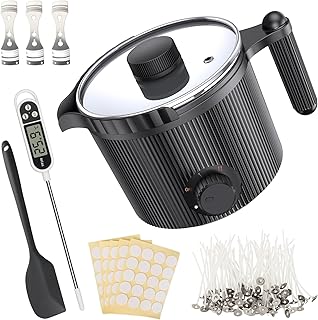
The RAOYAN 1.5L Candle Wax Melter with Pour Spout, Complete Kit for Beginners and Adults with Thermometer and Wicks is the premium option in this guide, and its 4.8/5 star rating from 15 early reviewers suggests it’s earned that positioning — though with a small review count, treat it as a strong early indicator rather than a fully established track record.
What sets this apart from the other melting pot options is the fact that it arrives as a genuinely complete kit: the melter, a thermometer, and wicks are included together. For a beginner, that bundling is meaningful because it removes one of the most common rookie mistakes — pouring wax without monitoring temperature. Many first-time candlemakers skip the thermometer step entirely because they don’t own one, and then wonder why their candles have frosting, sinkholes, or weak scent throw. Having the thermometer in the box from day one builds good habits from the start.
The 1.5L capacity keeps it practical for home use, and the pour spout — consistent with the broader trend in this category — makes the transfer from melting pot to jar controlled and clean. The kit format also means this works well as a gift for someone who has expressed interest in candle making but doesn’t know where to start: you’re not gifting a single component that requires them to buy five other things to use it.
The honest tradeoff at this tier is that you’re paying more, and with a smaller review base there’s slightly more uncertainty about long-term durability compared to the venpow options which have more real-world testing behind them. If you’re comfortable being an early adopter of a well-rated product and the all-in-one convenience appeals to you, this is the most polished beginner package in the roundup. If you’d rather buy a melter and thermometer separately to keep your options open, the combination of the venpow B0FJ87GF9D and the dedicated thermometer pick below achieves a similar result.
Best Candle Making Thermometer
The Candle Making Thermometer — 300mm Probe with Clip, Easy to Read Supplies for Melting Soy and Paraffin Wax is an essential addition to any candle making setup, and if you’re using a kit or melter that doesn’t include one, this is the specific accessory to buy first.
Temperature is the single variable that controls the most in candle making. Soy wax is typically poured between around 50–60°C, fragrance oils are added at specific temperatures to bind properly, and if you add dye or fragrance when the wax is too hot you’ll lose a significant proportion of the scent before the candle even sets. A thermometer that clips onto the side of your melting pot, with a 300mm probe long enough to reach into a deep vessel without you having to hold it manually, is far more practical than a floating dairy thermometer or a cooking probe that keeps sliding around.
With a 4.5/5 star rating, this thermometer is well-regarded by the candle making community even if the formal review count on this listing is low — it’s the sort of product that gets recommended in craft forums and Facebook groups before it accumulates large numbers of Amazon reviews. The easy-to-read dial format is preferable for candle making to digital probes that require batteries and can lag slightly on temperature readings.
The realistic limitation is that it’s a dedicated analogue thermometer — it won’t do anything clever, won’t alarm you when you’ve hit a target temperature, and won’t connect to an app. But for candle making, that simplicity is a feature. There are no batteries to run out mid-session, no screen to read through steam, and no calibration faff. If you already own a digital kitchen thermometer, check whether it reads accurately below 100°C before assuming it’s suitable — many food probes are calibrated for higher-temperature cooking and lose accuracy in the 50–80°C range relevant to wax work.
Best Pre-Waxed Wick Set with Holders
The Candle Wicks for Making Candles, 50 Pcs 10cm/20cm Cotton Pre Waxed Candle Wicks with 4 Pcs Candle Wick Holders and 60 Dot Stickers is the wick set to buy if you’re building your own supply kit or expanding beyond what came in a starter set.
Pre-waxed wicks with metal tabs are the standard for container candles, and this set covers both 10cm and 20cm lengths — useful because the correct wick length depends on the depth of your container. The inclusion of four wick holders (the bars or frames that sit across the top of your jar to keep the wick centred while the wax cools) is genuinely helpful: keeping a wick perfectly centred while hot wax contracts is the step beginners most often skip, and an off-centre wick leads to uneven burning. The 60 adhesive dot stickers to fix the wick tab to the bottom of the jar round out a thoughtfully assembled pack.
The 4.5/5 rating reflects broadly positive feedback on wick quality — cotton wicks that are pre-waxed hold their shape during pouring, don’t absorb moisture before use, and produce less smoke on burning than bare cotton wicks. Fifty wicks gives you a meaningful quantity to experiment with before you commit to buying in bulk, and buying a mixed length set at this stage makes sense because you’ll likely try different container sizes as you develop your style.
The limitation worth noting: this set doesn’t specify wick diameter or burn rate in the listing, which means you’ll need to do a small amount of your own testing to match wick size to your specific wax type and container diameter. That’s a standard part of candle making development and not unique to this product — no wick pack will be perfect for every application — but it’s worth being aware that some burning tests may be needed before you settle on the right wick for a specific candle design.
Best Budget Entry-Level Candle Making Set
The Candle Making Set Including Stainless Steel Melting Pot, Candle Wicks, Single Hole Wooden Bracket and White Background Stickers is the lowest-cost entry point in this guide, and with a perfect 5.0/5 star rating — albeit from just one reviewer — it’s intriguing rather than proven.
The stainless steel melting pot is the core of the value proposition here. Stainless steel is more durable and easier to clean than cheap aluminium alternatives, and it holds heat more evenly during the melting process. The bundle format — pot, wicks, wooden wick holder and stickers — gives you the essential hardware to start making container candles without buying anything else, provided you source your own wax and fragrance oil separately.
This is the pick for the genuinely cost-conscious buyer who wants to dip a toe into candle making with minimal financial risk. The practical reality is that you won’t know whether you’ll enjoy the hobby until you’ve actually done it a few times, and spending a significant amount upfront on premium equipment before that point isn’t always sensible. A basic steel pot that does the job competently, combined with wicks and a holder, gives you the core kit to make your first candles and find out whether you want to invest further.
The honest caveat here is that with only one review, there’s very limited real-world feedback on build quality, heat consistency, or longevity. If you’re buying at this budget tier, go in with appropriate expectations: the equipment will likely work well enough to get you started, but it may not have the same finish or longevity as mid-range options. Treat it as a starting point rather than a long-term tool. If you make ten candles and find yourself hooked, an upgrade to one of the venpow melters will feel like a natural next step.
Best Value Wick Pack for High-Volume Candle Making
The Candle Wicks for Making Candles, 50 Pcs 10cm Long Pre-Waxed Wicks with Metal Tabs and 3-Hole Wick Holder is the practical choice if you’ve moved past the beginner stage and are making candles in consistent batches with a fixed container size.
Whereas the B0F17YLVQJ wick set covers two lengths to give you flexibility, this pack focuses specifically on the 10cm length — which is the standard for most medium container candles — and pairs the wicks with a 3-hole wick holder, a different format to the bar-style holder in the mixed set. The 3-hole holder allows you to centre wicks in containers of varying diameters more precisely, which matters when you’re using a range of jar sizes. The pre-waxed cotton construction and metal tabs are consistent with the other wick pack, and the low-smoke claim in the product title aligns with what pre-waxed cotton wicks generally deliver when correctly sized to the container.
With a 4.5/5 rating, this pack sits in the same quality bracket as its sibling but with a slightly different operational focus. If you’ve already established which container size you prefer and you know 10cm wicks work for your setup, buying this pack over the mixed-length option is the more efficient choice — you get a consistent supply without the slight variation in sticker dot quantity and holder style that comes with the mixed pack.
The limitation is the same as any wick set: you’ll still need to test burn to confirm the wick is right for your specific wax, fragrance load, and container diameter. If you’re making candles in multiple container sizes simultaneously, the mixed-length pack is more versatile. If you’ve landed on your preferred format and want a reliable, consistent supply, this is the better value proposition.
What to Look For When Buying Candle Making Supplies
- Wax type compatibility: Different wax types — soy, beeswax, paraffin, coconut-soy blends — have different melting points, fragrance load capacities, and cooling behaviours. Soy wax is popular for its clean burn and renewable sourcing but is more sensitive to temperature variations. Beeswax is forgiving for beginners. Make sure any kit or melter you buy is compatible with the wax type you intend to use, and check that the temperature range of any thermometer covers the relevant working temperatures.
- Melting method: Electric melting pots are significantly more controllable and consistent than double boilers on a hob. If you’re serious about the hobby, an electric melter with a pour spout is worth the investment from the outset. Microwave methods exist but are difficult to temperature-control and are better suited to very small batches.
- Wick sizing: Wick diameter relative to container diameter is one of the most consequential variables in candle performance. A wick that’s too thin will create tunnelling (a hole down the centre of the candle, leaving wax on the sides unmelted). A wick that’s too thick will produce a large, sooty flame. Most beginner kits pre-match wicks to their included containers — when buying wicks separately, check the manufacturer’s guidance on which diameter suits your container size.
- Fragrance load and oil type: Not all fragrance oils are suitable for all wax types. The fragrance load — typically expressed as a percentage of the wax weight — varies by wax and by the specific oil. Soy wax typically accepts 6–10% fragrance load; exceeding this doesn’t make the candle smell stronger, it just creates oily spots or fire safety issues. If a kit includes fragrance oil, check whether it’s designed for the wax included.
- Container quality: Glass jars and metal tins perform differently. Glass shows off the candle aesthetically but can crack if poured too hot or if the wax-to-glass temperature differential is too large. Metal tins are more forgiving and easier to store and gift. For your first candles, metal tins with a lid are the most practical choice.
- Kit completeness: Before buying a kit, list what it actually includes versus what you’ll need to add. Many kits omit a thermometer, a pouring pitcher or container, or a wick holder. An apparently affordable kit that requires three separate accessory purchases to be usable isn’t as good value as it appears.
- Cure time and patience: No amount of good equipment substitutes for the need to let candles cure properly after pouring — typically 24–48 hours before burning. Products that promise you can burn a candle within a few hours of making it will often disappoint on scent throw. Build cure time into your craft planning, especially if you’re making candles as gifts with a deadline.
Verdict
If you’re choosing just one product from this guide, the beeswax candle making kit with tins and wicks is the best starting point for most UK readers. It gives you real materials to work with in a genuinely complete format, uses beeswax that’s forgiving for first-time makers, and the 4.5/5 rating from nearly 100 reviewers provides solid confidence that it delivers on its promises.
If you’ve already tried candle making and your frustration is specifically with inconsistent results from a double boiler, upgrade to the venpow 1.5L electric wax melter — it’s the single piece of equipment most likely to improve your candles immediately and meaningfully. Pair it with the candle making thermometer if you don’t already own one, and you have a core setup that will serve you through hundreds of batches.
For those who want everything in one box and are happy to invest slightly more for the convenience, the RAOYAN complete kit with melter, thermometer and wicks is the most polished all-in-one option currently available.
We were not paid to feature any specific product in this guide. All opinions are independent and based on publicly available specifications, verified buyer feedback patterns, and category research.
Quick Comparison Table


FAQ
What type of wax is best for beginners in candle making?
Beeswax is the most forgiving option for absolute beginners because it has a relatively wide pour temperature range and a naturally warm scent, meaning your first candles will smell pleasant even without added fragrance oils. Soy wax is the most popular choice for hobbyists because it’s renewable, clean-burning, and holds fragrance well, but it’s more sensitive to temperature and can develop surface imperfections if poured at the wrong temperature. Avoid paraffin as a first wax — it performs well commercially but brings its own handling and air quality considerations that add complexity for a beginner.
Do I need a thermometer for candle making?
Yes — a thermometer is one of the most important tools in candle making and is frequently omitted from budget kits. Wax poured too hot develops sinkholes, discolouration, and poor fragrance throw; wax poured too cool can cause separation issues. A basic clip-on candle thermometer costs very little and removes all of that guesswork, making it one of the highest-value additions to any beginner setup.
What’s the difference between a wick holder and a wick bar?
Both serve the same purpose — keeping the wick centred in the jar while the wax cools and sets — but they differ in design. A wick bar (or wooden bracket) typically has one hole or notch and sits across the top of a single jar. A 3-hole wick holder allows you to centre wicks in jars of different diameters more precisely. For most home candle making with standard jars, either format works well; the 3-hole version offers slightly more flexibility if you use a range of container sizes.
Can I use a regular kitchen thermometer for candle making?
Possibly, but not always reliably. Many kitchen thermometers are calibrated for higher cooking temperatures (above 100°C) and lose accuracy in the 50–80°C range relevant to wax work. A thermometer specifically designed for candle or chocolate work, with a clip to hold it on the side of the melting pot, will give you more accurate and convenient readings than a general-purpose food probe. If you’re using a digital thermometer, check its stated accuracy range before relying on it for candle making.
How long do homemade candles need to cure before burning?
The standard recommendation is at least 24 hours for paraffin and beeswax candles, and 48 hours or more for soy wax candles. Soy wax benefits from a longer cure because it continues to bind fragrance oil molecules as it fully crystallises, which improves the eventual scent throw when the candle is lit. Burning a soy candle too soon after pouring often results in disappointing scent — the candle performs much better after a full cure. If you’re making candles as gifts, factor this cure time into your timeline.
Is an electric wax melter worth buying instead of a double boiler?
For most hobbyists who make candles more than occasionally, yes — an electric melter is worth the investment. Double boilers on a hob require constant attention to prevent the water from boiling dry or splashing into the wax, are slower to reach target temperatures, and can vary significantly in heat depending on your hob settings. An electric melter with temperature control is more consistent, safer, and considerably easier to clean. The main argument for a double boiler is cost if you’re only making one or two candles to see whether you enjoy the hobby — at that stage, a repurposed heatproof jug over a saucepan of hot water is fine as a trial run.