You’ve been eyeing those layered beaded necklaces and stacked bracelets everywhere — on the high street, on runways, on your Instagram feed. Maybe you’ve even bought a few pieces, only to find the quality doesn’t justify the price tag or the style isn’t quite what you envisioned. So you decided to make your own. Sensible move. But then you stood in front of a craft shop or scrolled through Amazon and felt completely overwhelmed: rolls of wire, packets of findings, pliers in five different shapes, and books promising everything from beginner basics to Celtic wirework. You picked up a random kit, got home, and found the instructions confusing, the wire too stiff, or the beads too small to thread without magnifying glasses and a quiet place to sit. Meanwhile, the beaded jewellery trend is only accelerating — from Chanel’s draped necklaces to Polo Ralph Lauren’s wrist-stacked bracelets, handcrafted bead pieces feel more current than ever.
The good news: beading and jewellery-making is genuinely approachable once you have the right starting point. The bad news: not every kit or book is created equal, and buying the wrong one wastes both money and enthusiasm. This guide cuts through that confusion. Whether you want to whip up a summer bracelet stack in an afternoon or master Celtic wirework over a winter, there is a specific pick below that matches where you are right now.
How We Evaluated These Picks
Every product in this guide was assessed against a consistent set of criteria drawn from real buyer feedback patterns, product specifications, and the practical demands of different skill levels. For kits, we looked at completeness (does it include everything you need to make a finished piece on day one?), tool quality (are the pliers functional or just decorative?), variety of materials (beads, wire gauges, findings), and whether the instructions are clear enough for someone who has never crimped a wire in their life. For instructional books, we considered the step-by-step clarity of photographs or illustrations, the range of techniques covered, the difficulty progression, and whether the finished designs are genuinely wearable rather than dated or overly complex. We also examined review patterns closely — a product with a handful of glowing reviews deserves more scrutiny than one with hundreds of consistent, detailed responses. Ratings alone don’t tell the whole story; the substance of feedback does.
Best All-Round Starter Kit for Adults
The shynek Jewelry Making Kit for Adults is one of the most comprehensively assembled starter sets available on UK Amazon right now, and it earns its position as the top recommendation for anyone approaching beading and jewellery-making for the first time — or for someone returning to the craft after a long break. It carries a 4.7-star rating from nearly 500 reviewers, which is a genuinely strong signal at that volume.
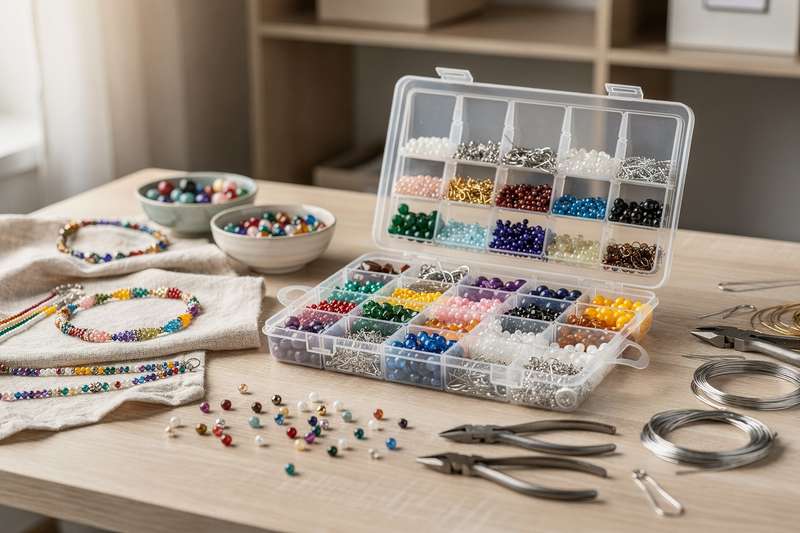
The kit includes pliers, beading wire in multiple gauges, a solid selection of findings (clasps, jump rings, crimp beads, head pins, eye pins), and an assortment of decorative charms and beads. This matters enormously for beginners because not having to source components separately removes a significant barrier to getting started. You can open the box, follow the included project guide, and have a finished bracelet or necklace within an hour. That kind of immediate reward is what keeps people engaged long enough to develop real skill.
The pliers included are functional for beginner use — round-nose and flat-nose variants suitable for opening jump rings, forming loops, and crimping. They won’t replace professional-grade tools if you progress seriously into wirework, but for learning the fundamentals they do the job without frustrating you. The wire included is typically flexible enough to thread through most standard beads, though if you want to work with very small seed beads you may eventually want to supplement with finer wire or beading thread separately.
Where this kit is less ideal: experienced crafters who already own pliers and wire will find the component assortment modest rather than exciting, and the charm and bead selection, while varied, is fairly generic. Think of it as a learning platform rather than a material treasury. For anyone who wants to test whether jewellery-making is genuinely their thing before investing further, this is the most sensible entry point at a budget-friendly price point.
Best Book for Complete Beginners
Bead Jewelry Making for Beginners: Step-by-Step Instructions for Beautiful Designs is the instructional guide that does exactly what the title promises, which is rarer than you’d think in craft publishing. If you’ve bought a kit and want a proper foundation in technique rather than relying on a small insert card, this book fills that gap efficiently.
The step-by-step format is genuinely beginner-friendly — photographs walk you through each stage clearly, including the fiddly bits that most guides gloss over, such as how to properly close a crimp bead so it doesn’t slip, how to make a neat wrapped loop, and how to plan a colour scheme that actually works rather than just grabbing whatever beads are nearest. The designs lean toward wearable, contemporary pieces: bracelets, necklaces, and earrings that a modern adult would actually want to make and wear, rather than projects that feel lifted from a 1990s craft class.
The book’s strength is its pacing. It doesn’t assume you know anything, and the difficulty increases gradually through the projects so you’re building on each skill before the next one is introduced. By the end, you’ll have a solid grounding in stringing, basic wirework, and working with findings — enough to confidently follow more advanced books or YouTube tutorials without feeling lost. The 4.5-star rating reflects consistent praise for its clarity, though reviewers note it’s firmly pitched at beginners; if you already know how to make a wrapped loop you’ll outgrow it quickly.
One honest caveat: the book doesn’t include materials, so you’ll need beads, wire, and findings separately (or alongside the shynek kit above). That’s entirely normal for instructional books in this category, but worth stating clearly so there’s no disappointment at the letterbox.
Best Kit for Budget-Conscious Crafters
The Kuuqa Jewelry Making Kit is a compact, budget-tier option that includes 15 pieces of findings hardware across multiple types alongside four reels of beading wire in different gauges. It carries a 4.4-star rating, making it a creditable option if you want to dip a toe into the craft without committing to a larger outlay.
The value proposition here is wire variety. Having four different gauges included is genuinely useful even beyond the beginner stage — finer gauges work better for delicate stringing projects and seed beads, while heavier gauges are better suited to wirework and structural pieces. For the price, getting a usable selection of gauges alongside a mixed packet of clasps, crimp beads, and jump rings is reasonable value.
The tradeoffs are real, though. The kit description notes it is non-foldable (meaning the wire reels are fixed rather than portable) and the findings assortment is smaller than in the shynek kit. There are no decorative beads or charms included, so you’ll need to source those separately. Effectively, this is more of a hardware and wire starter pack than a complete jewellery-making experience — ideal if you already have a collection of beads or are picking up a specific project and just need the infrastructure components without paying for a larger bundle.
For a first-time buyer who wants to make finished pieces from day one, the shynek kit above is the more rounded choice. But if you’re supplementing an existing collection, buying a second kit for a friend, or simply want a cost-effective way to restock wire and findings, the Kuuqa delivers solid basics at a genuinely low price point.
Best for Paper Bead Enthusiasts
Paper Bead Jewelry: Step-by-step instructions for 40+ designs is a niche pick that earns its place here by being genuinely excellent at what it does. With a 4.7-star rating from nearly 250 reviewers, this book has built a loyal following among crafters who want to make jewellery from recycled paper — magazines, wrapping paper, scrapbook sheets — rather than buying beads.
Paper beading is surprisingly compelling once you try it. The technique involves cutting strips of paper at precise angles, rolling them tightly around a skewer or mandrel, sealing them with varnish or PVA glue, and stringing the finished beads into bracelets, necklaces, and earrings. The results can be remarkably colourful and individual — no two paper beads come out exactly alike, which means every piece is genuinely one-of-a-kind. It’s also one of the most sustainable approaches to jewellery-making, using materials most households already have.
The book covers over 40 designs at varying difficulty levels, with clear photographs and templates for cutting the paper strips at the correct taper for different bead shapes. Reviewers consistently highlight that the instructions are detailed enough to produce good results even without prior experience of paper crafts. The finished designs range from chunky statement pieces to delicate layered styles — exactly the kind of colourful, handcrafted aesthetic that’s trending strongly in 2026 jewellery.
This pick is less suited to someone who wants to work with glass, crystal, or metal beads — the techniques here are entirely paper-focused. But as a standalone creative discipline or a complement to conventional beading, it’s an unusually rewarding and cost-effective option. You’ll need a few basic tools (a skewer or mandrel, scissors, glue, and varnish) but these are typically inexpensive to source separately.
Best for Celtic and Wirework Styles
Wire and Bead Celtic Jewelry: 35 quick & stylish projects is the pick for anyone who has moved beyond stringing and wants to explore structural wirework with a distinctly Celtic aesthetic. It holds a 4.4-star rating from 140 reviewers — a solid endorsement for a fairly specialised title.
Celtic wirework involves weaving, coiling, and forming wire into knotwork patterns, often combined with beads to add colour and texture. The results look considerably more complex than they actually are, which makes this a particularly satisfying area of jewellery-making: relatively modest skill produces impressive-looking finished pieces. The book includes 35 projects described as quick, which is accurate — many can be completed in under an hour once you’ve practised the core techniques.
The photography is clear and the project range covers necklaces, earrings, bracelets, and brooches, so you won’t exhaust the content quickly. What sets this apart from generic wirework guides is the consistent aesthetic — if you like the Celtic knotwork style, the projects here are genuinely cohesive rather than a scattered grab-bag of unrelated techniques. Several reviewers note it’s accessible even without prior wirework experience, provided you take the introductory technique pages seriously before jumping to projects.
The honest limitation: if Celtic aesthetics aren’t your thing, you’ll find the design range narrow. This isn’t a general-purpose wirework manual — it’s a focused collection with a strong visual identity. It also requires wire and beads separately; round-nose pliers, flat-nose pliers, and wire cutters are essential tools that aren’t included. If you pair this book with a dedicated wirework tool set, you’ll have a very capable intermediate craft setup.
Best Comprehensive Technical Reference
The Encyclopedia of Wire Jewellery Techniques is the reference book that serious jewellery-makers reach for when they want to understand not just how to follow a project, but why each technique works and how to adapt it. With a 4.7-star rating from 363 reviewers, this is one of the most consistently praised books in the entire wire jewellery category on UK Amazon.
Encyclopaedia-format craft books can sometimes feel dry or hard to navigate, but this one avoids those pitfalls. It’s organised logically by technique — from basic wire manipulation through to complex weaving, coiling, and finishing methods — with high-quality step-by-step photography for each. The coverage is genuinely comprehensive: you’ll find techniques for working with round wire, half-round wire, and twisted wire; methods for creating clasps, bail structures, and cabochon settings; and approaches to combining wire with beads, stones, and other materials.
What makes this particularly valuable is its longevity as a reference. Unlike project-based books, which you work through and then set aside, this encyclopaedia stays useful as your skills grow. When you encounter a new technique in a YouTube tutorial or a magazine feature, you can look it up here for a detailed, reliable explanation. Multiple reviewers note they’ve owned their copy for years and still return to it regularly. For anyone committed to wire jewellery as a long-term craft, this is the single most useful book investment you can make.
It’s not the right starting point for an absolute beginner — you’ll benefit more from a project-led book first to build basic confidence. But once you’ve made a few pieces and want to understand the craft more deeply, this encyclopaedia becomes indispensable. It covers wire jewellery specifically rather than beading or stringing, so if your interest is in bead-heavy work without wire structure, the beginner’s guide or paper bead book may be more directly useful.
Best Budget Earring-Making Kit
The LOMYLM Earring Making Kit is the most focused option in this guide: a compact set specifically assembled for making earrings, finished in gold tone, and priced at the very accessible end of the market. It includes pliers, beading wire, and a selection of jewellery beads aimed at adults and beginners.
The appeal here is specificity. Rather than a general jewellery kit that spreads its components across multiple jewellery types, this kit concentrates on earring-making — which means the hardware, wire, and beads included are chosen with earrings in mind. If earrings are your primary interest (mismatched beaded earrings are one of the stronger jewellery trends of the moment), buying a kit designed for that purpose makes more sense than adapting a general kit.
The 3.7-star rating from 43 reviewers is the lowest in this guide, and that deserves honest acknowledgement. Feedback patterns suggest the pliers are on the lightweight side and may feel flimsy compared to purpose-built craft tools. The bead selection is described as limited in terms of variety. For occasional or casual use — making a few pairs of earrings for personal use or as gifts — it’s a perfectly serviceable starting point. For anyone planning to make earrings regularly or in volume, you’d quickly feel constrained by the toolkit and want to upgrade individual components.
This is best positioned as a low-commitment trial purchase: if you want to explore earring-making before spending more, it lets you find out whether you enjoy the process without significant financial risk. If the craft clicks, your next step would be investing in better-quality pliers and a broader bead collection. Pair it with the beginner’s book above for a low-cost entry setup that covers both instruction and hardware.
Best Broad Reference for Bead Craft Diversity
Best Book of Beading: Jewelry, Bottles, Purses & Accessories takes a wider view of what bead craft can produce — not just wearable jewellery, but decorative objects and accessories. It covers bottles, purses, and various embellished accessories alongside jewellery projects, making it a genuinely broad introduction to beadwork as a craft form rather than purely as jewellery-making.
For someone whose interest in beads extends beyond necklaces and bracelets — perhaps into home décor, bag embellishment, or textile-adjacent work — this is the most varied book in this guide. The project range means you’re unlikely to exhaust the content quickly, and the cross-category scope can spark ideas that a narrower jewellery-only book wouldn’t prompt.
The 3.8-star rating from 18 reviewers is the most modest in this selection, and the honest read on that is mixed feedback on the book’s age and some of the design aesthetics, which a minority of reviewers find dated. It’s worth noting that the core beading techniques covered remain entirely valid regardless of when the book was published — methods for peyote stitch, brick stitch, fringing, and bead weaving don’t go out of date — but if you’re hoping for designs that feel current and runway-adjacent, this may not be the best match. It suits someone who wants to learn the full breadth of what beadwork can do, and who is comfortable adapting project aesthetics to their own taste.
For a reader who already knows they want to focus primarily on jewellery, one of the more specialised books above will serve them better. But for the genuinely curious crafter who sees beads as a versatile material rather than just a jewellery input, it’s a useful broad-spectrum reference that covers ground none of the other picks in this guide address.
What to Look For When Buying Beading and Jewellery-Making Supplies
- Complete vs partial kits: Some kits include beads, wire, findings, and tools; others include only wire and findings hardware with no beads. Check the product listing carefully — if beads and charms are what you want to make pieces from immediately, confirm they’re included before buying.
- Tool quality matters more than quantity: A kit with two genuinely functional pliers is more useful than one with six cheap ones that bend or slip. Look for pliers described as having comfortable grip handles and properly aligned jaws. Round-nose and flat-nose pliers are the two you cannot do without for most jewellery-making tasks.
- Wire gauge selection: Different gauges suit different projects. Finer gauges (higher numbers, such as 28 or 30 gauge) are better for threading seed beads and delicate weaving; heavier gauges (20 or 22 gauge) are better for structural wirework, making clasps, and projects that need to hold their shape. A kit or purchase that gives you multiple gauges gives you more creative range.
- Findings variety: Findings are the functional hardware components — clasps, jump rings, crimp beads, head pins, eye pins, and ear hooks. A broad findings selection gives you flexibility to finish pieces in different ways. Check whether the findings are plated (gold or silver tone) or plain metal, as this affects the finished look of your jewellery.
- Skill level match for books: A beginner’s book that assumes you know nothing is frustrating for an intermediate crafter, and a technical encyclopaedia is daunting for someone on day one. Be honest about where you are: if you’ve never made a wrapped loop, start with a project-led beginners guide. If you’ve made several pieces and want to understand technique more deeply, a reference encyclopaedia is the better investment.
- Photography and instruction clarity: In craft books, step-by-step photography is far more useful than illustrations for most learners. Look for books where reviewers specifically mention that the photos are clear and the instructions are easy to follow at the bench — praise for general content quality is less useful than praise for usability in practice.
- Your primary jewellery type: Earring-focused kits differ from bracelet or necklace kits in terms of the hardware included (ear hooks vs clasps, for example). Match the kit’s focus to what you most want to make, rather than assuming a general kit will optimally serve a specific ambition.
Verdict
For most UK readers arriving at this guide — curious about beading, perhaps inspired by the handcrafted jewellery trend, and wanting to make their own pieces without spending a lot upfront — the combination of the shynek Jewelry Making Kit for Adults and the Bead Jewelry Making for Beginners book is the most sensible starting point. The kit gives you everything you need to make finished pieces from day one; the book gives you the technique foundation to understand what you’re doing and progress beyond following a single insert card.
If you already have some materials and want to move into wirework, The Encyclopedia of Wire Jewellery Techniques is the single best long-term investment in this guide — it will remain useful for years as your skills develop. And if paper beading catches your interest as a sustainable, low-cost creative outlet, the Paper Bead Jewelry book is a genuinely enjoyable and well-reviewed route into making colourful, individual pieces from materials you already have at home.
We were not paid to feature any specific product in this guide. All opinions are independent and based on publicly available specifications, verified buyer feedback patterns, and category research.
Quick Comparison Table


FAQ
What tools do I need to start making beaded jewellery?
At minimum, you need round-nose pliers (for forming loops and curves in wire), flat-nose pliers (for gripping, opening jump rings, and crimping), wire cutters, and beading wire or thread. A set of crimp beads and a clasp or two will let you finish a piece properly. Most beginners’ kits include all of these, which is why a complete kit is usually more cost-effective than buying tools individually to begin with.
Is beading and jewellery-making suitable for absolute beginners with no craft experience?
Yes — basic stringing and bracelet-making are among the most accessible crafts for adults with no prior experience. You can produce a wearable finished piece within an hour using a good starter kit and clear instructions. The learning curve steepens as you move into wirework, knotting, and bead weaving, but the entry point is genuinely low. Starting with a beginner-focused kit and a project-led book makes a significant difference to early success.
What’s the difference between beading wire and beading thread?
Beading wire (often sold as tiger tail or coated steel wire) is a twisted or braided steel cable with a plastic coating — it’s strong, holds its shape, and is ideal for stringing heavier beads, stones, and charms. Beading thread (such as nylon or silk thread) is more flexible and drapes softly, making it better for seed bead weaving (peyote stitch, brick stitch) and knotted jewellery like pearl necklaces. Many kits include wire; thread is usually purchased separately if needed for weaving projects.
Can I make professional-looking jewellery at home, or will handmade pieces look obviously amateur?
With practice, handmade beaded jewellery is entirely comparable in appearance to bought pieces — and often more distinctive. The key differences that separate polished from amateurish results are neat loop closures, consistent crimp finishing, and thoughtful colour and bead selection. A good beginner’s book that covers technique detail (not just inspiration) makes a real difference here. Many crafters find their work is indistinguishable from boutique pieces after just a few projects.
Which beading book is best for someone who already knows the basics and wants to improve?
If you can already string a bracelet and make a basic loop, the most useful next step depends on your direction of interest. For wirework and structural jewellery, The Encyclopedia of Wire Jewellery Techniques is the most comprehensive reference available at this level. For Celtic-inspired wire and bead combinations, Wire and Bead Celtic Jewelry offers 35 achievable projects that build on basic skills without feeling repetitive.
Are beaded jewellery kits good value, or is it cheaper to buy components separately?
For beginners, kits are almost always better value than buying components separately — the convenience of having wire, findings, beads, and tools in one purchase at a single price point saves both money and the frustrating experience of realising mid-project that you’re missing something. As your skills grow and you develop more specific material preferences, buying individual components in bulk from specialist suppliers becomes more cost-effective. Think of a starter kit as the platform for learning; once you know what you like and use most, you can optimise your purchasing accordingly.