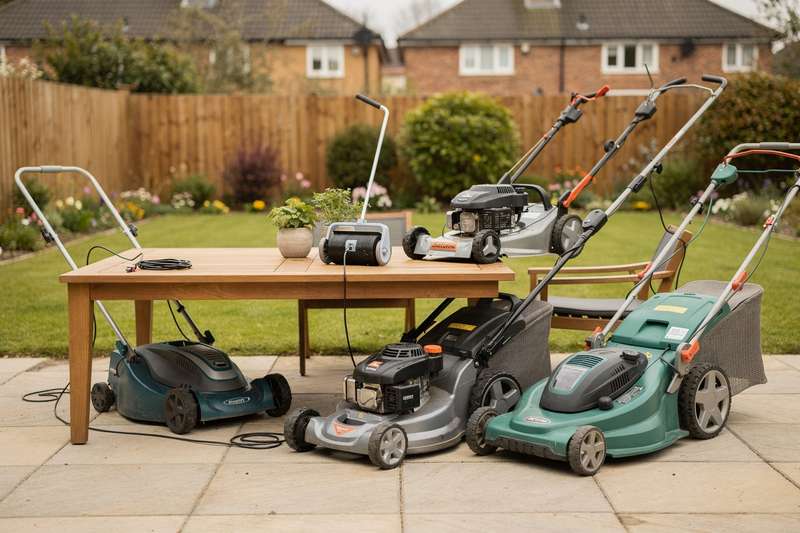
You’ve been putting off mowing for a week — again. The back lawn is looking more like a meadow than a garden, the grass clippings from last time are still stuck in the wheels of your old push mower, and every time you drag it out of the shed you’re reminded how much effort a supposedly simple job actually takes. Maybe your current mower is too heavy for the slope near the fence, or the collection bag never seems to stay clipped on properly, or you simply bought whatever was cheapest three summers ago and have regretted it every weekend since. You’re not after a ride-on tractor with a 54-inch deck — you’re just someone with a reasonably sized UK garden who wants to mow it without dreading the process. This guide is written for exactly that reader. Whether your patch is a compact courtyard-sized strip or a sprawling half-acre with a tricky slope, the right mower exists on Amazon right now — you just need to know which one is actually worth buying and which ones sound good on paper but frustrate you in practice.
How We Chose These Picks
Selecting a lawn mower comes down to matching the machine to your specific garden, not just picking whichever model has the most stars. For this guide, we assessed each product in the live Amazon UK catalogue against five criteria: cutting width relative to garden size, power source and motor rating, build quality indicators (materials, brand reputation, included accessories), real-world usability factors (cable length, weight, roller provision, grass box volume), and verified buyer feedback where sufficient review samples existed.
Two products in this shortlist carry substantial review samples — over 300 and over 800 verified buyers respectively — giving a statistically meaningful picture of real-world satisfaction and failure patterns. The remaining three come from well-established brands with documented specifications and clear design intent; where buyer reviews were absent or very thin, we relied on published specs and category knowledge to assess fit for purpose. We also filtered out products from the live catalogue that are accessories (mower covers, seat pads) rather than mowers themselves, keeping the guide focused on tools that actually cut grass.
Best Self-Propelled Petrol Pick: Mountfield SP41
The Mountfield SP41 Petrol Lawnmower is the standout performer in this shortlist, and the one most likely to satisfy gardeners with a medium to large lawn who are tired of fighting a corded electric model around the plot. With 832 verified reviews averaging 4.3 out of 5 stars, it has a track record that the other picks in this guide simply cannot match yet.
The SP41 is self-propelled, which means you’re guiding rather than pushing — a significant quality-of-life difference if your lawn has any incline at all. Its 39cm cutting width covers ground efficiently without being so wide that manoeuvrability suffers around borders and garden furniture. The 123cc ST120 Autochoke engine starts reliably without the warm-up fussing you sometimes get with cheaper petrol units — Mountfield’s autochoke system is one of the genuinely useful features here, particularly for occasional users who don’t want to fiddle with choke positions each time. The 40-litre grass collector is large enough for a full session on most medium gardens without stopping to empty, and the machine handles up to 250m² per tank, which comfortably covers the average UK garden with room to spare.
The tradeoff compared to electric models is obvious: you need to store and handle petrol, the engine requires basic annual servicing (air filter, spark plug, blade sharpening), and it is louder than anything corded. It is also heavier than hover or lightweight wheeled electric mowers, so getting it in and out of a tight shed takes a little effort. That said, for anyone whose garden has a slope, uneven patches, or simply exceeds what a 1400W corded mower can handle comfortably, the SP41 earns this top spot by a clear margin. Reviewers repeatedly highlight ease of starting and the quality of the cut finish — two things that matter more than almost any spec sheet number.
What to watch: a small but consistent thread in the reviews mentions the drive cable can need adjustment after a season’s use. This is a routine maintenance task, but worth knowing in advance so you’re not surprised. Overall, for a petrol self-propelled mower at this price tier, the SP41 is a well-supported, dependable choice from a brand with proper UK dealer and parts networks.
Best Corded Electric Pick for Medium Gardens: LawnMaster 1600W
The LawnMaster 1600W Electric Lawn Mower is the electric counterpart to the Mountfield — a proper corded wheeled mower with 333 reviews at 4.3 stars, making it the second-best-reviewed product in this guide and a solid choice for anyone whose garden falls in the medium-sized bracket and who wants to avoid petrol entirely.
The 37cm cutting width sits in a practical sweet spot: wide enough to reduce the number of passes you need to make, but narrow enough to navigate around flower beds without constantly colliding with borders. The rear roller is a feature many buyers don’t realise they care about until they see the difference it makes — it produces those classic striped lawn bands that elevate a simple mow into something visually satisfying. Six adjustable cutting heights give you flexibility from a close early-season cut to a longer summer setting that protects the lawn in dry spells.
At 1600W, this is a properly powered corded mower — not a toy. It handles thick or slightly overgrown grass without bogging down noticeably, which is a real advantage over the lighter 1200W hover models lower in this list. Reviewers with medium-sized lawns (roughly 100–200m²) describe it as easy to push and effective on the first pass, which is exactly what you want from a plug-in mower.
The obvious limitation is the cable. You are tethered to a socket, so you’ll need an outdoor-rated extension lead for any garden over about 30 metres from a plug point. Managing the cable around a complex garden layout adds a small but real cognitive load to each mowing session. The LawnMaster also lacks the self-propelled drive of the Mountfield, so on slopes it asks more of you physically. For a flat or gently sloping medium garden where you want electric simplicity, low running costs, and the ability to create smart lawn stripes, this is an excellent pick with a meaningful review base behind it.
Best for Small Lawns and Awkward Spaces: Flymo Speedi-Mo 360C
The Flymo Speedi-Mo 360C Electric Wheeled Lawn Mower carries a 4.6-star rating — the highest of any product in this guide — and represents Flymo’s established reputation for reliable, user-friendly electric mowers built for UK garden conditions. While the review count is not large enough to draw statistical conclusions, a 4.6 score from the reviews that do exist is a strong early signal.
The Speedi-Mo 360C is a wheeled mower (not a hover), which gives it more predictable handling on slightly uneven lawns compared to pure hover models. The 36cm cutting width and 1500W motor make it well-matched to lawns up to around 150–200m² where you want a proper cut with some grass collection. This is fundamentally a different product from the hover models below — it has wheels, it cuts closer, and it handles irregular terrain more confidently than a hover design that relies on cushioning itself on flat ground.
Where it differs from the LawnMaster is in the cutting width (36cm vs 37cm — essentially identical) and in build approach. Flymo is a brand with decades of UK market presence and widely available spare parts, which matters for long-term ownership. If something breaks on a lesser-known brand’s mower two years from now, you may find yourself without support; with Flymo, service parts and local dealers are straightforward to find.
The tradeoff: no rear roller means no lawn stripes. If a striped finish is important to you, the LawnMaster is the better choice. The Speedi-Mo is the pick for someone who wants a reliable, uncomplicated wheeled electric mower from a trusted brand, who doesn’t need stripes, and whose garden is small to medium in scale. It is also notably easy to store, with a compact footprint that suits smaller sheds.
Best Hover Mower for Slopes and Edges: Flymo Hover Vac 250
The Flymo Hover Vac 250 Electric Hover Collect Lawn Mower solves a specific problem that wheeled mowers handle poorly: steep banks, awkward slopes, and tight edges where you need to swing the mower sideways. The hover design lifts the machine on a cushion of air, which means virtually no rolling resistance — you can sweep it in any direction, including across a slope, without it fighting you.
With a 1400W motor and 25cm cutting width, this is clearly a tool for compact or awkwardly shaped spaces rather than large open lawns. The 15-litre grass box is correspondingly modest, so you’ll be emptying it more frequently than with a larger wheeled mower. The ambidextrous handle design is a small but thoughtful detail that makes it easier to switch sides when working along a border. The unit folds flat, which makes storage in a cramped shed or utility room straightforward.
Hover mowers do have real limitations worth acknowledging. Because they float, they are less effective on very uneven or bumpy ground — they can skip over high spots and miss patches. They also give you no roller stripe effect, and the narrow 25cm deck means more passes on larger areas, which becomes tedious quickly. On a long, flat lawn, a wheeled mower will always finish the job faster. But for the person with a challenging bank or a border-heavy garden where a conventional mower is simply awkward to manoeuvre, the Hover Vac 250 does something that wheeled alternatives genuinely cannot match as well.
The Flymo brand’s after-sales support applies here too — parts and accessories are available, and the product design is well-established rather than experimental. This is a focused tool: buy it if hover mowing solves a real problem in your garden layout, not as a general-purpose mower.
Best Budget Compact Pick: BLACK+DECKER BEMWH551-GB
The BLACK+DECKER Electric Hover Mower BEMWH551-GB is the most budget-accessible option in this shortlist, and it has a clear use case: very small gardens, patios with a grass strip, or anyone who simply needs a functional hover mower without spending more than necessary. At 1200W with a 30cm deck, it sits below every other mower in this guide in terms of raw power and cutting width.
What it does well is keep things simple and light. This mower is genuinely compact and easy to carry — if your garden is more of a lawn feature than an actual lawn, and the idea of storing a full-size wheeled mower feels excessive, the BEMWH551-GB fits the brief. BLACK+DECKER is a recognised brand with broad retail presence, and the hover design means zero wheel maintenance and easy sideways sweeping around beds and borders.
The limitations are clear, however. At 1200W and 30cm wide, this mower will struggle with thick or long grass and will take considerably more passes than any of the wider models above to cover the same area. There is no grass collection on this model — it is a mulching hover mower, so clippings are distributed back onto the lawn surface. For some gardeners this is perfectly acceptable (mulching returns nutrients to the soil), but if you prefer a clean, collected finish, you need to look at the Flymo Hover Vac 250 or either of the wheeled electric options instead.
There are currently no verified buyer reviews on Amazon UK for this listing, so the 4.2-star rating should be treated with caution rather than as a settled consensus. BLACK+DECKER’s broader mower range has a reasonable reputation, and the product design is straightforward enough that the risk of nasty surprises is low — but if a proven track record matters to you, the LawnMaster or Mountfield SP41 give you a much larger evidence base to draw confidence from. Buy the BEMWH551-GB if you have a very small patch, a tight budget, and no need for grass collection.
What to Look For When Buying a Lawn Mower
- Cutting width matched to garden size: A 25–30cm deck suits tiny strips and awkward spaces; 36–39cm covers small to medium gardens efficiently; anything over 40cm is for larger lawns where fewer passes saves meaningful time. Choosing too wide a deck makes manoeuvrability around borders a constant battle.
- Power source — petrol, corded electric, or battery: Corded electric is the lowest-hassle option for gardens up to around 200m² with reasonable socket access. Petrol gives you freedom from cables and stronger performance on slopes or thick grass. Battery cordless models (none in this guide’s catalogue) offer cordless convenience but at a premium cost and with a runtime ceiling per charge.
- Self-propelled vs push: On flat ground, push mowers are fine. On any meaningful incline, self-propelled drive transforms the experience — you guide rather than haul. If your garden has a slope, this should be a priority feature rather than a luxury.
- Rear roller provision: If you want classic lawn stripes, you need a rear roller. Not every mower has one. Check the spec sheet explicitly rather than assuming — a mower without a roller will never produce bands regardless of technique.
- Grass collection vs mulching: A grass box collects clippings for disposal or composting; a mulching function chops clippings finely and returns them to the lawn. Some mowers offer both. If you have a compost bin or prefer a clean finish, prioritise a reasonably sized collection box (40 litres or above for medium gardens).
- Weight and storage footprint: Electric hover mowers are the lightest and most compact. Petrol wheeled mowers are heavier and need a larger storage space. If your shed is tight or you have limited upper-body strength, factor in the mower’s weight and whether it folds flat.
- Brand support and parts availability: A mower is a long-term purchase. Brands with established UK dealer networks — Flymo, Mountfield, Hyundai — make spare parts, blades, and service far easier to arrange two or three seasons from now than lesser-known names whose parts may simply not be available when you need them.
Verdict
For the majority of UK gardeners — someone with a medium-sized lawn, a modest slope or two, and an appetite for a clean finish without excessive maintenance — the Mountfield SP41 is the most compelling all-round choice. Its self-propelled drive, autochoke starting, and 40-litre collection bag remove the main friction points that make mowing feel like a chore. The 832-review track record gives real confidence that this is a product that delivers on its promises in ordinary UK garden conditions — not just in lab settings.
If you want to avoid petrol entirely and your garden is flat and medium-sized, the LawnMaster 1600W is the electric alternative with the evidence base to back it up — 333 reviews, a rear roller for stripes, and enough power to handle real grass. For very small gardens on a tight budget where hover mowing makes sense, the BLACK+DECKER BEMWH551-GB covers the basics, with the caveat that you should set expectations accordingly on coverage and grass collection.
We were not paid to feature any specific product in this guide. All opinions are independent and based on publicly available specifications, verified buyer feedback patterns, and category research.
Quick Comparison Table


FAQ
What size lawn mower do I need for an average UK garden?
Most UK gardens fall in the 50–200m² range. A mower with a 36–39cm cutting width handles this comfortably without too many passes. If your garden is under 50m², a 25–30cm hover mower is sufficient and easier to store. For anything over 200m², look at wider wheeled or self-propelled petrol models to save time.
Is a petrol or electric lawn mower better for a UK garden?
Electric corded mowers are lower maintenance, quieter, and produce no emissions — a good fit for most small to medium UK gardens with socket access. Petrol mowers offer more power and freedom from cables, making them better suited to larger lawns, slopes, or thick grass. Battery-powered cordless models split the difference but cost more and have runtime limits per charge.
Can I use a hover mower on a bumpy or uneven lawn?
Hover mowers work on slopes and awkward angles better than wheeled mowers, but they are less suited to genuinely bumpy or rutted ground — they can skip over raised patches and leave uncut areas. For very uneven surfaces, a wheeled mower with larger rear wheels gives more consistent ground contact and a more even cut.
Do I need a rear roller to get stripes on my lawn?
Yes. Lawn stripes are created by bending the grass blades in alternating directions as you mow, which only a rear roller can do reliably. If you want stripes, check the specification of any mower you’re considering explicitly — not all wheeled electric mowers include a rear roller. Of the picks in this guide, the LawnMaster 1600W specifically includes one.
How often should I sharpen my lawn mower blade?
For most home gardeners mowing a typical UK lawn, sharpening once a season — ideally at the start of spring — keeps the cut quality high and reduces strain on the motor or engine. A dull blade tears grass rather than cutting it cleanly, leaving brown tips and making the lawn more vulnerable to disease. If you mow very frequently or hit grit and stones regularly, check the blade condition mid-season too.
What does self-propelled mean on a lawn mower, and do I need it?
A self-propelled mower drives its own wheels forward using a transmission linked to the engine or motor — you guide and steer it rather than pushing it. On flat gardens, the difference is modest. On any incline, self-propelled drive makes a noticeable practical difference, especially over a long mowing session. If your garden has any meaningful slope, it is worth prioritising as a feature.