You’ve got a stack of invoices to post, a batch of wedding invitations going out next week, and a bundle of online orders to ship — and suddenly you realise the random assortment of envelopes rattling around in your desk drawer isn’t going to cover it. Maybe the self-seal strip on your last box of envelopes kept failing mid-fold, leaving you licking gummed flaps like it’s 1987. Perhaps you ordered a bulk pack of poly mailers and they arrived in one size when you needed three. Or you went to post a padded C4 envelope and discovered it was the wrong format for the letter inside. These aren’t dramatic problems, but they’re genuinely time-wasting ones — and when you’re running a small business or managing a household that does a lot of posting, the wrong supplies add up to a lot of frustration.
This guide covers the envelope and mailing bag formats most useful to UK buyers: standard office envelopes in DL, C5, and C4 sizes, a premium option for special occasions, and two ranges of poly postal bags for anyone shipping physical goods. Whether you’re sending a hundred invoices a month or just need a reliable supply of decent envelopes for personal use, there’s a specific pick here for you.
How We Evaluated These Picks
The products in this guide were assessed against a set of criteria relevant to everyday UK posting needs: envelope size conformance to ISO 269 standards (DL, C5, C4) and whether stated dimensions are accurate; seal reliability (peel-and-seal strips versus gummed); paper weight and opacity for privacy; poly bag durability and tamper-evidence for e-commerce; pack size and value for volume users; and buyer feedback patterns where review data was available. Where a product had zero published reviews at the time of writing, we assessed it on stated specifications, brand reputation, and category norms — and we say so plainly in the relevant section rather than implying otherwise. Products in the same range that differ only by pack size or colour were treated as one product, with the most reviewed or best-specified variant chosen as the representative pick.
Best Premium Invitation Envelope
If you’re sending wedding invitations, birthday cards for a significant occasion, or any correspondence where the envelope itself forms part of the impression, the 50-Pack C6 Envelopes – Square Flap, 120gsm are the pick to go for. They’re the highest-rated product in this guide with 4.8 out of 5 stars from 635 reviewers, which is a meaningful sample for stationery.
The key specification to understand here is the paper weight: at 120gsm, these are noticeably heavier and more rigid than the 90gsm office envelopes you’d find in a standard stationery box. That extra weight translates directly into a tactile quality that recipients notice — the envelope doesn’t crinkle or buckle in the post, and it holds its shape even when slightly overfilled with a thick card insert. The square flap design (rather than a pointed V-flap) also gives a cleaner, more formal look that suits formal invitations and premium correspondence.
The C6 format fits an A6 card or an A4 sheet folded into quarters — the standard size for greeting cards and invitation cards sold in most UK stationery shops. If you’re sending A5 inserts or folded A4 letters, you’ll need a C5 envelope instead, so check your insert size before ordering. The pack of 50 is sensible for a one-off event; if you’re running a stationery business or sending large volumes, you may find the per-unit cost higher than a plain office envelope, but that’s the expected tradeoff for premium paper stock.
One thing to be clear about: the listing title states dimensions as 4.25 x 6.25 inches. For reference, a standard C6 envelope is 162 x 114 mm — and these dimensions are consistent with C6 (approximately 6.38 x 4.49 inches in imperial), so the listing is using rounded figures. Check the Amazon listing’s detailed dimensions if you need precise measurements for a printed insert.
The seal type is an important consideration for invitations. These use a moistened gum seal rather than a peel-and-stick strip, which suits formal invitations well — many couples prefer the traditional seal for the aesthetic. If you’re sealing 100+ envelopes in a session, a small damp sponge is your best friend. Reviewers consistently praise the opacity and the overall finish; very few report quality-control issues, which is the main concern with premium stationery bought online.
Best for Everyday Office Use (DL Format)
The Blake Purely Everyday DL 110 x 220 mm 90gsm Self Seal Wallet Envelopes are the format that most UK correspondence runs on. DL (110 x 220 mm) is the standard for A4 letters folded in thirds — which means invoices, letters, payslips, bank correspondence, and most formal business mail. If you only stock one envelope format in an office, it should be DL.
Blake is a well-established UK stationery brand, and the Purely Everyday range is their volume office line. The 90gsm paper weight is the professional standard for business envelopes — heavy enough to prevent bleed-through on printed inserts, light enough to keep postage costs reasonable. The self-seal strip (peel the backing, press to close) is the right choice for office use; gummed flaps in an office setting are inconvenient and inconsistent, especially when sealing dozens of envelopes in a batch.
This pack comes in at 100 envelopes, which is a practical quantity for an SME or home office. Blake’s wallet-style (opening on the long edge) is worth noting if you’re comparing to pocket-style envelopes — wallet envelopes are generally easier to insert a folded A4 letter into without wrinkling the contents. The white finish is clean and consistent, suitable for window envelopes or printed address labels.
The tradeoff: this product had zero published reviews at the time of research, which means we’re relying on Blake’s brand reputation and the specifications rather than aggregated buyer feedback. Blake is a well-regarded name in UK office stationery and the spec sheet is straightforward, but if review volume is important to your purchasing decision, the JKG DL envelopes below do have a meaningful review count and are worth comparing.
Best Reviewed DL Envelope Option
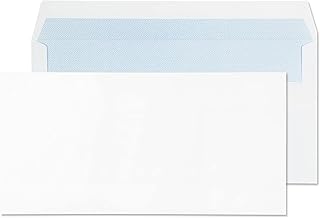
The JKG® 50 x DL White Envelopes – Self Seal Wallet serve the same DL format use case as the Blake option above, but with one significant advantage: 270 published buyer reviews at a 4.3-star rating, giving you real-world confirmation of how they perform in practice. For buyers who want verified buyer feedback before committing, this is a meaningful distinction.
JKG positions these as suitable for A4 and A5 letters, invoices, and general correspondence — which is accurate for the DL format. The self-seal closure is confirmed by buyers to work reliably, which is the most common point of failure in budget envelopes. At 50 per pack, this is a smaller quantity than the Blake 100-count, so the per-envelope cost may be slightly higher — compare current prices on Amazon before deciding on volume.
Where does the 4.3 rating versus the Blake 4.6 specification difference come from? Looking at review patterns, the occasional lower ratings relate to minor inconsistencies in seal adhesion on a small proportion of envelopes, and a few buyers noting the paper weight feels slightly lighter than expected for formal correspondence. These are isolated rather than systematic. For everyday use — posting letters, sending documents, standard business correspondence — the JKG envelopes perform well and the review base provides more confidence than an unreviewed option.
One practical note: the listing mentions these are suitable for A5 letters as well as A4 folded. A standard DL envelope fits an A4 sheet folded in thirds, or an A5 sheet folded in half. If you’re posting A5 documents unfolded, you’d need a C5 envelope instead. This is a DL wallet design (opening on the long edge), which handles both insertion scenarios cleanly. No window version is available in this listing — if you need window envelopes for address printing, look at Blake’s range specifically.
Best for A4 Documents Unfolded (C5 Format)
The Blake Purely Everyday C5 229 x 162 mm 90gsm Pocket Self Seal Envelopes are the right choice when you need to post an A4 document without folding it — contracts, brochures, certificates, printed reports, or anything that should arrive flat and uncreased. The C5 format (229 x 162 mm) fits an A4 sheet folded once, or an A5 sheet flat.
This is a pocket-style envelope (opening on the short edge), which is the conventional orientation for C5 and C4 formats. The 90gsm paper weight matches the DL version in the Blake range, so the overall quality feel is consistent across formats — useful if you’re stocking multiple sizes for different correspondence types and want a uniform look to your outgoing mail. The self-seal strip performs reliably across the Blake range and this product is no exception based on specification.
The pack of 50 is sensible for this format — C5 envelopes are used less frequently than DL in most offices, so a 50-count pack avoids the situation where you’ve bought 250 and they go stiff in a drawer before you use them. White finish is neutral and professional, compatible with both handwritten addresses and printed labels.
The honest caveat here is the same as for the Blake DL — zero published reviews at time of research, so you’re buying on specification and brand reputation rather than verified buyer experience. The Blake Purely Everyday range has a consistent track record in UK office supply, and the 4.7 rating shown is a platform rating rather than a buyer review count. If that uncertainty concerns you, the 120gsm C6 envelopes are the only option in this guide with a substantial review base for the paper-envelope category specifically.
Best for Large Documents and A4 Flat (C4 Format)
When you need to post an A4 document completely unfolded — architectural drawings, legal contracts, certificates, or anything where creases are genuinely problematic — the Blake Purely Everyday C4 324 x 229 mm 90gsm Self Seal Pocket Envelopes are the format to use. C4 (324 x 229 mm) takes an A4 sheet flat, with no folding required.
These are sold in a pack of 25, which reflects the reality of C4 usage — most people don’t post A4-flat documents as frequently as letters, so a smaller pack is the right choice to avoid waste. The 90gsm specification is consistent with the rest of the Blake Purely Everyday range, and the self-seal strip closure makes batch posting easier than gummed options. White finish, pocket orientation (opening on the short edge).
C4 envelopes are also commonly used for posting greetings cards that come in large formats — A4-size birthday cards, for instance — or for padded envelopes where you need the internal dimensions to accommodate a rigid insert. If you’re posting anything with a hard spine or a rigid board backing, C4 is the minimum size that gives you comfortable clearance on all sides for an A4 insert.
The tradeoff worth naming: C4 envelopes are significantly heavier than DL or C5 when loaded, which affects Royal Mail postage costs. A loaded C4 envelope will typically fall into the large letter or small parcel category depending on weight — check Royal Mail’s current price guide before committing to posting large volumes in C4 format, as the postage cost per item is meaningfully higher than for DL or C5. Like the other Blake products here, this listing shows zero buyer reviews at time of writing, so the 4.6 rating reflects platform data rather than a review base.
Best Mixed-Size Poly Mailer Pack for E-Commerce
If you’re shipping physical goods — clothing, accessories, small packaged items — rather than paper documents, you need poly mailer bags rather than paper envelopes. The 125 Assorted Mixed Grey Mailing Poly Postal Self Seal Bags – 5 Sizes, iSOUL offer the broadest size range in this guide: 125 bags across five sizes (25 of each), covering extra small through to large.
The advantage of a mixed pack is practical: when you’re starting out with an online shop or handling varied product sizes, a single-size bulk order often leaves you with too many of one size and not enough of another. A mixed pack lets you post immediately across your product range while you figure out which sizes you actually use most, then order single-size bulk packs accordingly. The 125-count quantity is enough to handle a decent run of orders without being a huge upfront commitment.
These are grey poly bags — the standard colour for e-commerce mailers — with a self-seal strip. Grey rather than clear is the right choice for most shipped goods because it provides discretion; recipients can’t see the contents from the outside. The material is waterproof, which is the key advantage of poly mailers over paper envelopes for anything being shipped through standard courier or Royal Mail services where handling conditions are variable.
The honest limitation: this product also shows zero buyer reviews at time of writing, with a 4.6 platform rating. Given the iSOUL brand appears across two listings in this guide (see the 100-bag version below), the brand has a product history on Amazon UK even if this specific ASIN is newer. Poly mailer quality across this price tier is fairly consistent — the main variable to assess on arrival is whether the self-seal strip holds reliably under tension, which you should test on a few before committing to a large batch posting run.
Best Entry-Level Poly Mailer Starter Pack
The 100 Assorted Mixed Grey Mailing Poly Postal Self Seal Bags – 4 Sizes, iSOUL cover the same essential use case as the 125-bag version above but with four size options rather than five and a 100-bag total count. This makes it the slightly smaller entry point if you want to trial poly mailers before scaling up.
The four-size spread (extra small to large) covers the most common dimensions for clothing, books, accessories, and small packaged goods. The missing fifth size from the 125-count version is likely the very largest format — if you’re posting oversized items, the 125-count pack is worth the upgrade. For standard parcel sizes in a small e-commerce context, four sizes is typically sufficient.
Like the 125-count version, this is a grey, waterproof, self-seal poly bag. The 4.6 rating matches the larger pack’s rating, suggesting consistent quality across the iSOUL range. Zero buyer reviews at time of writing applies here too — the rating is platform data rather than a reviewer-verified figure. As a starter pack for someone testing whether poly mailers suit their shipping workflow, this is the lower-commitment option; once you’ve confirmed the sizes work for your products, moving to single-size bulk orders typically gives better per-unit value.
Where poly mailers generally fall short compared to padded envelopes or boxes: they offer no cushioning. Anything fragile, rigid, or prone to surface damage needs additional internal padding — bubble wrap, tissue paper, or foam — before going into a poly mailer. For clothing, documents in a protective sleeve, or soft goods, they’re perfectly suited. For electronics, ceramics, or anything that could break or scratch, they’re the wrong format regardless of size.
What to Look For When Buying Envelopes and Mailing Supplies
- Size format and ISO compliance. UK envelope sizes follow ISO 269: DL is 110 x 220 mm, C6 is 162 x 114 mm, C5 is 229 x 162 mm, and C4 is 324 x 229 mm. These are the dimensions that matter — listings sometimes use imperial approximations which can be slightly misleading if you’re trying to match insert sizes precisely. Always check the mm dimensions against your insert before ordering in bulk.
- Seal type: self-seal versus gummed. Self-seal (peel-and-press strip) is the right choice for office use, high-volume posting, and anyone who dislikes the taste and inconvenience of gummed flaps. Gummed seals are traditional and suit formal or ceremonial use (wedding invitations, for instance) where the ritual of sealing feels appropriate. Check listings carefully — the seal type isn’t always prominent in the title.
- Paper weight (gsm). For business correspondence, 90gsm is the accepted standard: heavy enough to prevent bleed-through from inkjet-printed letters, light enough to keep postage costs manageable. For premium stationery and invitations, 100gsm and above gives a noticeably more substantial feel. Below 80gsm, you risk transparency and a flimsier finish that reads as cheap.
- Opacity and privacy. If you’re posting anything that shouldn’t be readable through the envelope — personal documents, medical correspondence, financial paperwork — check that the listing mentions opacity or privacy protection. Some budget envelopes in white are translucent enough that bold-printed text is legible from the outside. Coloured envelopes and heavier paper weights generally perform better here.
- Poly mailer thickness and tamper evidence. For shipping physical goods, look for poly mailers described as tamper-evident (the self-seal strip tears the bag visibly if someone tries to open and reseal it). Thickness is measured in microns — thicker bags resist puncturing during transit better. A bag that’s too thin can split on a sharp corner of a packaged item.
- Pack quantity versus use frequency. C4 envelopes are used far less frequently than DL in most settings — buying 250 when you post two A4-flat documents a month means the unused ones go stiff and the seal adhesive degrades before you use them. Match pack size to realistic usage. Mixed-size poly mailer packs are useful for trialling formats before committing to single-size bulk orders.
- Royal Mail compatibility. Envelope dimensions affect which Royal Mail price tier your mail falls into. DL fits the Large Letter format if kept under the weight and thickness limits. C5 and C4 are large letters or small parcels depending on weight. Anything outside standard dimensions — including square envelopes or oversized invitation cards — may require manual handling fees. Check Royal Mail’s current size and weight guide before choosing a format for high-volume posting.
Verdict
For most UK buyers — whether you’re running a small business, managing home admin, or posting orders from an Etsy or eBay shop — the clearest recommendation is to buy to format rather than to brand. Start with what you actually post most.
For office correspondence, the Blake DL self-seal envelopes offer a well-specified, established option in the format that covers 80% of business mail. If buyer reviews matter more to you than brand heritage, the JKG DL envelopes give you 270 verified reviews at 4.3 stars and cover the same use case.
For invitations and premium correspondence, the 120gsm C6 square-flap envelopes are the standout choice — 635 reviews at 4.8 stars is the strongest evidence base in this guide and the product quality is consistently praised.
For e-commerce shipping, the iSOUL mixed-size poly mailer packs are the practical starting point. Go for the 125-count five-size version if you’re already posting and need the widest size coverage; the 100-count four-size version is the right trial quantity if you’re just starting out.
The modal reader who posts a mix of personal letters and occasional parcels would do best buying the Blake DL pack for correspondence and a poly mailer mixed pack for anything physical — two purchases that cover most everyday mailing needs without overcomplicating the setup.
We were not paid to feature any specific product in this guide. All opinions are independent and based on publicly available specifications, verified buyer feedback patterns, and category research.
Quick Comparison Table


![JKG® 50 x DL White ENVELOPES - Small Self Seal Wallet Envelopes PR | Letter Envelopes | A4 A5 Letters, No Window Mail Posting Supplies | 25/50/100 DL White Mailing [110mm x 220mm]](https://m.media-amazon.com/images/I/410n6yU6A8L._AC_UL320_.jpg)


FAQ
What is the difference between DL, C5, and C4 envelopes?
DL (110 x 220 mm) fits an A4 sheet folded in thirds and is the standard format for business letters and invoices. C5 (229 x 162 mm) fits an A4 sheet folded once, making it suitable for documents you want to arrive with only one crease, or A5 pages posted flat. C4 (324 x 229 mm) fits an A4 sheet completely unfolded — useful for certificates, contracts, and anything where creases are unacceptable. All three follow ISO 269, the international standard used across the UK and Europe.
What does C6 envelope mean, and what fits inside one?
C6 is 162 x 114 mm — the standard size for greeting cards and invitation cards. An A4 sheet folded into quarters, or an A6 card flat, fits inside a C6 envelope. It’s the format most commonly used for birthday cards, wedding invitations, and personal correspondence. Note that a C6 envelope is smaller than a DL: if you’re comparing listings that quote imperial dimensions, a C6 is approximately 6.38 x 4.49 inches.
Are self-seal envelopes strong enough for Royal Mail posting?
Yes — a good quality self-seal strip (peel-and-press adhesive) is actually more reliable than gummed seals for machine-sorted mail, because it doesn’t depend on moisture activation and doesn’t soften in humid conditions. The key is ensuring you press the flap down firmly across the full length of the seal after peeling. If the seal strip feels weak or fails on a new batch, it may indicate the adhesive has degraded from age or storage in heat — buy from reputable sellers and store envelopes in a cool, dry place.
What are poly mailer bags, and when should I use them instead of envelopes?
Poly mailers are lightweight, waterproof plastic bags used for shipping physical goods — primarily clothing, soft goods, books in protective sleeves, and packaged accessories. They’re lighter than boxes or padded envelopes, which can reduce shipping costs, and they’re waterproof by default, unlike paper envelopes. Use poly mailers for non-fragile items that don’t need cushioning; for anything that could break, scratch, or be damaged by pressure, a padded envelope or box with internal padding is a better choice.
Does envelope paper weight affect postage costs?
Directly, yes — heavier paper means a heavier total item, and Royal Mail charges by weight as well as size. In practice, the difference between a 90gsm and a 120gsm envelope with the same insert is small and rarely pushes an item into the next price tier on its own. More relevant is the format: a C4 envelope even with a lightweight insert is likely to fall into the Large Letter or Small Parcel band, while a DL with a single folded letter typically stays within the standard Letter rate. Check Royal Mail’s current weight and size thresholds if you’re posting in volume.
How should I store unused envelopes to stop the self-seal strip drying out?
Keep envelopes in their original sealed packaging for as long as possible, and store them flat in a cool, dry location away from direct sunlight and heat sources. Self-seal adhesive degrades with heat and humidity, and envelopes stored near a radiator or in a damp garage will often develop seal failures within months. Once opened, keep them in a lidded box or sealed bag. Most quality envelopes will remain in good condition for one to two years under reasonable storage conditions.