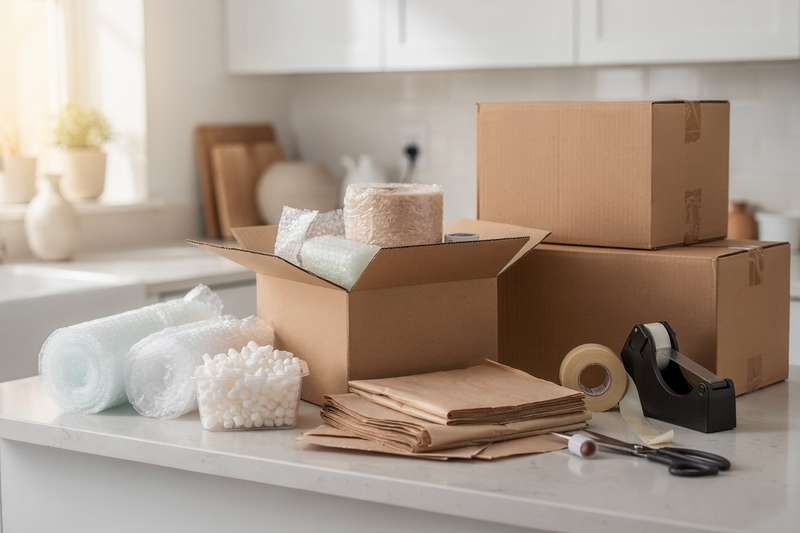
You’ve got three weeks until moving day, a stack of flat-pack boxes from the supermarket, and absolutely no idea whether to use bubble wrap, crinkle paper, or just stuff everything in with old jumpers and hope for the best. Sound familiar? The problem isn’t effort — you’re clearly putting in the work. The problem is that most people buy the wrong type of packing material for what they’re actually wrapping, or they use too little of it and leave gaps that let items knock together in transit. The result: you arrive at your new place, open the box that definitely said “FRAGILE” in red marker, and find your grandmother’s teapot in four pieces.
Moving is stressful enough without the added gut-punch of broken belongings. Whether you’re packing a full kitchen, a home office, or just a handful of precious objects going into storage, the right packing material makes the difference between a box that survives a bumpy van ride and one that doesn’t. This guide cuts through the noise — no gimmicks, no unnecessary spending — and tells you exactly which materials to reach for, and when.
How We Evaluated These Picks
To build this guide, we assessed a range of packing materials available on amazon.co.uk, focusing specifically on products that serve genuine protective or void-filling functions during house moves, storage, or shipping of fragile goods. Our evaluation looked at several core criteria: cushioning performance for delicate items, ease of use (can you tear it, fold it, or dispense it quickly?), ecological footprint (is it recyclable or biodegradable?), pack size relative to value, and verified buyer feedback patterns drawn from real reviewer comments. We paid close attention to how products performed for heavy, awkward, and fragile items — not just standard parcel shipping. Products with zero reviews were included only where they rounded out a genuine gap in the category and where the specifications were clearly stated by the listing. We cross-referenced patterns across hundreds of reviews to surface common complaints and consistent praise, rather than relying on individual ratings alone.
Best All-Round Packing Paper for Fragile Items
The Packing Paper for Moving Wrapping 100 Sheets Newspaper Offcuts is the sort of no-fuss workhorse that earns its keep across almost every box you pack. With 545 verified reviews and a solid 4.3-star rating, this is clearly a product that real people are buying in volume for actual house moves — not just the odd parcel.
The 100-sheet count is generous enough to get through a kitchen or a living room’s worth of glassware and ornaments without running out halfway through. Each sheet is unprinted, which matters more than you’d think: unlike newspaper, you won’t end up with grey ink smudges across your white crockery or on your hands. The paper itself is substantial enough to wrap around a mug or a plate with a few folds and still feel secure, though it’s not so thick that it eats up all your box space when used in quantity.
For fragile items, the best approach is to lay a sheet flat, place the item in the centre, and fold the corners inward before rolling. For plates, stack them upright — never flat — with a sheet between each one. For mugs, tuck the handle in the paper first. Where this material really shines is as a void filler: scrunch sheets loosely into balls and pack them around items to stop shifting during transit. That combination of wrapping and gap-filling from a single material makes it practical.
The honest limitation here is that packing paper on its own won’t absorb a hard knock the way foam or honeycomb paper will. If you’re moving genuinely delicate antiques or electronics, layer this alongside something with more cushioning. For everyday crockery, glassware, and kitchen equipment though, 100 sheets of quality unprinted packing paper is one of the most cost-effective protective materials you can buy. Buyers in the reviews frequently mention using the full pack across a kitchen move with sheets to spare.
Best Eco-Friendly Bubble Wrap Alternative
If you’d rather not deal with plastic waste after your move, the Honeycomb Packaging Paper Roll – 30M x 30cm Packing Paper Cushioning Wrap for Shipping, Moving, and Breakables is the standout choice in this guide, backed by 419 reviews and the highest rating of any product here at 4.7 stars.
Honeycomb paper works on a clever principle: the die-cut kraft paper expands as you pull it, creating a three-dimensional hexagonal structure that wraps snugly around objects and provides genuine cushioning. Unlike flat packing paper, the honeycomb structure grips items as you wrap, which means you often don’t need tape to keep it in place. The 30-metre length is substantial — you can wrap dozens of items from a single roll without constantly reaching for a new one.
The 30cm width is well-suited to everything from wine glasses to small picture frames to kitchen appliances. For narrower items like pens or cutlery, you’ll tear or fold the width in half. For larger items, you can overlap two lengths. Where honeycomb paper has a clear edge over traditional bubble wrap is environmental: the paper is fully recyclable, and it biodegrades rather than sitting in landfill for decades. Many buyers mention using it for both house moves and ongoing e-commerce packaging for small businesses — the 30-metre roll handles both.
The tradeoff compared to bubble wrap is that honeycomb paper is slightly less forgiving with irregular shapes. A baroque-style vase with lots of protrusions, for instance, is harder to wrap neatly in honeycomb paper than in bubble wrap, which moulds more easily. But for standard household fragiles, this roll is genuinely impressive — reviewers repeatedly note that items arrived safely even after drops during courier transit. If you’re choosing one roll of protective wrap for a house move, this is the one to prioritise.
Best Budget Packing Paper for Box Filling
The 100 Sheets Newspaper Offcuts Packing Paper for Moving Box Filling covers similar territory to the all-round pick above, but at a lower price point and with a slightly lower review count of 127 at 4.2 stars. It’s worth a mention for anyone who needs a large volume of filler paper and wants to spend as little as possible.
The “newspaper offcuts” description refers to the paper’s origin — it’s produced from offcuts of newsprint stock, giving it a slightly grey, unbleached appearance. Crucially, it’s unprinted, so there’s no ink transfer risk. The sheets are comparable in size and weight to the premium packing paper pick, and they serve exactly the same purposes: wrapping fragile items and crumpling into box-filler balls to eliminate dead space inside your moving boxes.
Where this product sits slightly below the all-round pick is consistency. Some buyers in the reviews mention minor variation in sheet quality within a pack, and the slightly lower rating reflects occasional concerns about sheet thickness. For items you’d class as moderately fragile — non-precious crockery, books, kitchenware, soft furnishings — this level of packing paper is entirely adequate. For your most valuable or breakable items, pair it with foam sheets or honeycomb wrap for extra security.
The 100-sheet count gives you enough material to fill several large boxes, and because this is genuinely the budget end of the category, you can afford to use it generously — which is exactly the right approach with packing paper. The main rule applies here as much as anywhere: never leave void space in a box. Fill it, pad it, and seal it. This paper does that job reliably at a low cost per sheet, making it a practical buy when you’re packing an entire house and want to stock up without overspending.
Best Foam Sheets for Plates and Glassware
The ASelected 50-Count Packing Foam Sheets, 12″ x 12″ Cushion Foam Sheets addresses a real gap that paper-based materials can’t fill: direct impact protection for hard, heavy fragile items like plates, glasses, and ceramic dishes. With 322 reviews at 4.3 stars, this product has a meaningful feedback base that validates its usefulness for exactly this purpose.
Each 12″ x 12″ foam sheet is made from a low-density polyethylene foam — the same soft, slightly waxy material you’ll recognise from the packing that comes around new plates or cookware. It’s not as compressible as bubble wrap, but it’s better at absorbing consistent friction and sustained pressure, which is precisely the stress that occurs when plates are stacked on top of each other in a moving box. The foam conforms slightly to the surface of each item, reducing movement and vibration rather than just providing a surface layer.
The 12-inch square size works well for standard dinner plates and side plates. For larger serving platters or pasta bowls, overlap two sheets. For glasses, wrap a sheet around the body and tuck one end inside the glass to protect the base — the stem on wine glasses is the most vulnerable point and foam provides more controlled protection there than paper. Fifty sheets is enough to handle a full dining set with sheets to spare for stacking layers inside the box.
The honest downside of foam sheets is environmental: polyethylene foam isn’t curbside recyclable in most UK councils, and it takes considerable time to break down. If sustainability is a priority, honeycomb paper does a comparable job for many items. But if you have a large set of delicate plates, heirloom china, or crystal glasses that you genuinely cannot afford to break, foam sheets offer a margin of protection that paper alone doesn’t match. Several reviewers specifically mention using them for moving fragile crockery successfully after previous moves that resulted in breakages using paper only.
Best Compact Roll for Small Spaces and Light Parcels
The Roll of Paper Bubble Wrap for Packing Cushioning Wrap Papers, 30cm x 10M Brown Honeycomb Packing Paper for Moving House Shipping Breakables is the shorter-roll option in the honeycomb paper category, coming in at 10 metres rather than 30. With 9 reviews and a 4.6-star rating, the feedback base is limited but positive — worth considering if you don’t need a full 30-metre roll and want to spend less upfront.
The 10-metre length makes this a practical choice for smaller moves, single-room packs, or ongoing use for sending occasional fragile parcels. If you’re moving a studio flat, helping a friend shift a few boxes, or packing up a home office rather than an entire house, 10 metres of honeycomb cushioning wrap is a more calibrated buy than committing to 30 metres of material you might not use. The 30cm width is identical to the longer roll, so the wrapping experience is the same.
Because this is the same honeycomb paper format — expandable kraft paper that forms a three-dimensional cushioning structure when pulled — the protective properties are equivalent to the longer roll per metre. It wraps snugly, holds without tape on most items, and is fully recyclable. The brown kraft aesthetic also works well if you’re posting gifts or products and want the packaging to look considered rather than purely functional.
The caveat is the limited review count. Nine reviews is not enough to draw firm conclusions about long-term reliability or consistency across batches. If you’re packing high-value items, the longer-roll product with its much larger review base gives you more confidence. But for light, occasional use — a few parcels a month, a small move, or topping up your supply partway through a larger move — this compact roll hits a useful middle ground between the budget paper sheets and the full 30-metre honeycomb roll.
What to Look For When Buying Packing Materials
- Match the material to the item type: Heavy, hard fragile items (plates, ceramics, glass) need foam sheets or honeycomb paper that absorb sustained pressure. Lighter fragiles (ornaments, picture frames) do well with packing paper or honeycomb wrap. Void filling — stopping items from shifting — works best with crumpled packing paper, foam noodles, or screwed-up paper.
- Never leave dead space in a box: The most common cause of breakage isn’t the packing material itself — it’s insufficient fill. A box that has room for items to knock together will have broken items by the time it arrives. Whatever material you use, fill every gap. A box should feel solid when you close it.
- Consider roll width and sheet size relative to your items: A 30cm-wide honeycomb roll is ideal for most crockery and small-to-medium items, but won’t wrap large vases or picture frames in a single pass. Foam sheets at 12″ x 12″ suit standard dinner plates well, but you’ll need to overlap for larger pieces. Match the dimensions to your most common item size.
- Eco credentials matter beyond the marketing: “Recyclable” and “biodegradable” are not the same thing, and neither guarantees a product is genuinely low-impact. Kraft paper honeycomb wrap is recyclable in most UK kerbside collections and biodegrades readily. Polyethylene foam is generally not kerbside recyclable. If sustainability is important to you, prioritise paper-based options.
- Volume vs. cost per use: A 100-sheet pack of packing paper looks affordable, but if you’re packing a three-bedroom house you may need two or three packs. Work out roughly how many items you’re packing and buy generously — running out halfway through and resorting to newspaper is a false economy. Most paper-based packing materials keep indefinitely, so surplus is not wasted.
- Tape compatibility: Packing paper stays where you put it only if you use tape to secure it. Standard brown packing tape works well. Honeycomb paper often grips without tape, but tape is still advisable for anything you’re posting. Always have a tape dispenser to hand when packing.
- Storage format: Rolls are generally easier to store and dispense than loose sheets, especially when you’re mid-pack and don’t want paper flying everywhere. If you’re buying packing materials for ongoing use (a small business, regular eBay selling, etc.) a roll format keeps things tidy between uses.
Verdict
For most people doing a standard house move in the UK, the single best purchase is the Honeycomb Packaging Paper Roll – 30M x 30cm. Its 4.7-star rating across 419 reviews is the strongest signal of consistent real-world performance in this category, and the 30-metre length gives you enough material to handle a substantial move without running out. It wraps, it cushions, it fills voids, and it goes in your recycling bin when you’re done — unlike plastic bubble wrap, which creates disposal headaches.
Pair it with a pack of the Packing Paper for Moving Wrapping 100 Sheets for box filling and lighter wrapping duties, and if you have a full china cabinet or fragile crockery set, add a pack of the ASelected Packing Foam Sheets for the most breakable items. Those three products together cover almost every packing scenario in a typical house move, and none of them require a big outlay. Buy generously, fill every box completely, and seal everything with quality tape — that combination will get your belongings to the other end in one piece.
We were not paid to feature any specific product in this guide. All opinions are independent and based on publicly available specifications, verified buyer feedback patterns, and category research.
Quick Comparison Table


FAQ
What is the best packing material for fragile items when moving house?
For most fragile items, a combination of honeycomb kraft paper for wrapping and unprinted packing paper for void filling works well. For very heavy fragiles like full dinner sets or crystal glasses, foam sheets add an extra layer of sustained-pressure protection that paper alone doesn’t provide. The key principle is always the same: wrap each item individually, then fill every remaining gap in the box so nothing can shift in transit.
Is honeycomb packing paper as good as bubble wrap?
For most standard household moves, yes — and in some respects it performs better. Honeycomb paper grips the item as it wraps, provides three-dimensional cushioning, and is fully recyclable, unlike plastic bubble wrap. Where bubble wrap still has an edge is with highly irregular shapes, since the plastic film moulds more easily around complex contours. For flat-sided items, dishes, glasses, and most household fragiles, honeycomb paper is a genuinely effective alternative.
How much packing paper do I need for a house move?
As a rough guide, a one-bedroom flat typically requires around 80–150 sheets of packing paper alongside a roll of cushioning wrap. A three-bedroom house might need 300–500 sheets in total, spread across multiple packs, plus two or more rolls of honeycomb or foam protection for the kitchen. It’s almost always worth buying slightly more than you think you need — unused packing paper stores flat and can always be reused for future parcels.
Can I use newspaper instead of packing paper?
Newspaper works in a pinch for void filling, but it has two real disadvantages: the ink transfers onto whatever you’re wrapping, which is particularly problematic for white crockery, light-coloured fabrics, or anything with a surface finish. It’s also thinner than proper packing paper, offering less cushioning per layer. Unprinted packing paper or honeycomb wrap is a meaningfully better option for anything you care about.
Are foam packing sheets recyclable?
Polyethylene foam sheets are not accepted in most UK kerbside recycling collections. Some specialist foam recycling drop-off points exist, but they’re not widely available. If recycling matters to you, kraft paper honeycomb wrap and unprinted packing paper are both accepted in standard paper and card recycling. For the most environmentally conscious move, stick to paper-based cushioning materials where your items allow.
Do I need both bubble wrap and packing paper, or will one do the job?
For most moves, a good honeycomb cushioning wrap (which replaces plastic bubble wrap) combined with packing paper for void filling covers the majority of packing needs. You don’t generally need both traditional bubble wrap and paper. Where foam sheets add value is for the heaviest fragile items — plates, stoneware, cast ceramics — where sustained pressure protection matters more than cushioning against knocks. Build your kit based on what you’re packing, not on buying every material available.