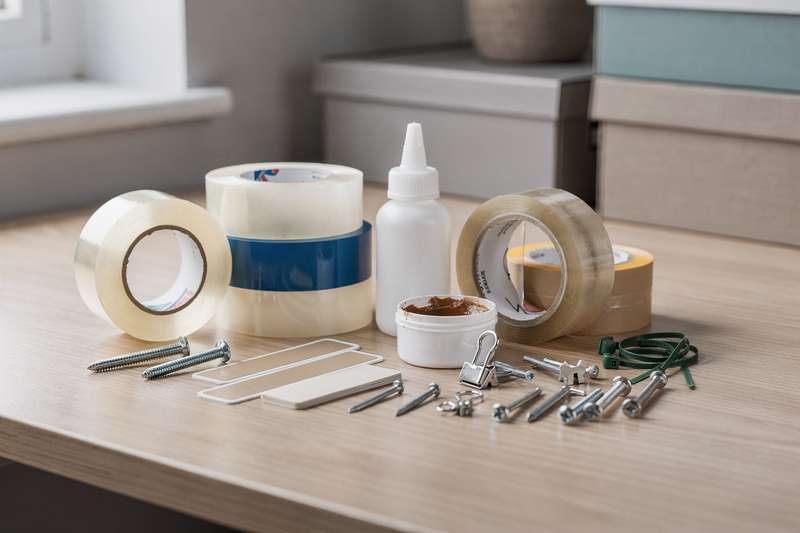
You know the scenario. You’ve just moved into a new flat, or your landlord has made it abundantly clear that drilling holes means losing your deposit. You’re staring at a stack of photo frames, a cable management problem under your desk, and a roll of sticky tape that clearly isn’t up to the job. The packaging tape you grabbed from the kitchen drawer keeps peeling off the wall after 48 hours. Your freshly mounted shelf bracket has left a gouge in the plaster. You’ve tried blu-tack, you’ve tried standard double-sided tape, and nothing seems to hold reliably without either falling off or taking the paint with it when you remove it.
The frustration is real. Tape, adhesives, and fasteners sound like the most mundane product category imaginable — until you need the right one and keep reaching for the wrong one. Whether you’re hanging artwork without drilling, organising cables at your desk, routing remote-control sensors to a cabinet door, or reinforcing a package that needs to survive the postal system, the product you choose makes an enormous difference to the result. This guide cuts through the noise and gives you five solid, well-chosen picks that cover the most common UK domestic and office use cases.
How We Evaluated These Picks
Selecting adhesives and fasteners isn’t as simple as grabbing whatever has the highest star rating. For this guide, the evaluation focused on five practical criteria: holding strength relative to claimed use case, surface compatibility (especially with painted plaster walls, wood, and MDF), ease of removal without damage, reusability where relevant, and the quality of the manufacturer’s own application guidance. Products were assessed using buyer review patterns on Amazon UK, cross-referenced against category knowledge about adhesive chemistry and fastener mechanics. Only products available directly on amazon.co.uk were included. The live product block used for this guide contained several VELCRO Brand and Unibond listings with zero published reviews on the UK marketplace — where that’s the case, it is noted in the relevant section, and advice is based on the brand’s wider track record and product specifications rather than aggregated UK buyer feedback.
Best for Heavy-Duty Indoor Mounting
If you need an adhesive solution that grips hard and stays gripped, the GORILLA mounting tape earns attention as the go-to for serious indoor bonding tasks. Gorilla’s foam-core double-sided mounting tape is widely recognised in the adhesive category for punching above its weight — it’s commonly used to fix bath panels, mount hook rails, secure cable trays to desks, and even fix lightweight shelving brackets to tiled surfaces where drilling would mean calling a plumber.
The foam core is what makes this tape distinct from ordinary double-sided office tape. The foam conforms slightly to surface irregularities, maximising contact area and therefore grip. On smooth surfaces like painted MDF, glass, ceramic, or metal, this matters a great deal. You’ll get a far more reliable bond than you would with a flat film tape, because micro-gaps between the adhesive and an imperfectly smooth surface are partially absorbed by the foam layer. This is particularly useful in UK homes where plaster walls are rarely perfectly flat.
The key limitation here is permanence. Gorilla mounting tape is designed to be a long-term fix, not a removable one. If you mount something with it and later change your mind, removal can be genuinely difficult — you risk pulling paint off walls or leaving residue on surfaces. It is not the right tool for temporary hanging or anything you expect to reposition. The adhesive is also sensitive to temperature during initial application: surfaces and tape should ideally be at room temperature for the bond to set properly, so don’t try to apply it in a cold garage in January and expect full strength immediately.
For buyers who need a permanent or semi-permanent indoor mounting solution without drilling — think cable management trays under desks, towel hook rails on tiled bathroom walls, or fixing an LED strip to the underside of a shelf — this is a very capable option. Just be deliberate about placement before you press it down, because you won’t easily get a second chance.
Best for Reusable Hook-and-Loop Fastening
The VELCRO® Brand Stick On Tape is the hook-and-loop self-adhesive tape that most households should have in a drawer at all times. Available in cut-to-length rolls, it covers an impressive range of everyday organising and mounting tasks: keeping remote controls from sliding off shelves, securing lightweight picture frames, organising cables, fixing door stops, and holding lightweight decorations to walls for events.
What distinguishes the VELCRO® Brand product from generic hook-and-loop alternatives is the quality of both the fabric fastener mechanism and the pressure-sensitive adhesive backing. The brand’s own material uses precisely engineered hook density, which matters when you’re fastening and unfastening repeatedly. Cheaper alternatives lose their grip relatively quickly after repeated use — the hooks deform and no longer engage the loop side properly. The genuine VELCRO® Brand tape is rated for a substantially higher number of open-and-close cycles, making it genuinely reusable in a way that no-name versions aren’t.
This listing has no published UK buyer reviews in the current dataset, so the recommendation here is based on VELCRO® Brand’s established track record in the UK market and general category knowledge rather than aggregated UK-specific feedback. If you want community validation before buying, searching for other VELCRO® Brand listings on Amazon UK will surface older verified reviews that speak to the same underlying product quality.
One honest tradeoff: the self-adhesive backing is strong enough for smooth, clean surfaces but can struggle on textured or slightly porous walls — the kind of rough-plastered or stipple-painted surface common in older UK terraced houses. On those surfaces, you may find the adhesive backing peels away from the wall before the hook-and-loop joint gives way. For smooth, clean surfaces — painted wood, laminate, smooth plasterboard, glass — the hold is reliable. Cut it to length, press firmly for 30 seconds, and allow 24 hours before loading it.
Best for Lightweight Damage-Free Hanging
The Command damage-free picture-hanging strips are the product of choice when you absolutely cannot risk marking walls — whether you’re renting, living in student accommodation, or simply don’t want to commit to a fixed position for a piece of art. Command strips use a patented interlocking adhesive strip system: two strips lock together, one adheres to the wall, one to the frame, and when you want to remove them, you pull a tab that stretches the adhesive cleanly away from the surface.
This is a fundamentally different mechanism from standard double-sided tape or foam mounting tape. The stretch-release adhesive is engineered to fail cleanly rather than cohesively — meaning when you pull the tab, the adhesive stretches and breaks its bond with the wall rather than peeling the paint off. In practice, this works very well on modern emulsion-painted plasterboard walls, which are the standard in UK new-builds and most post-1980 properties. On older lime plaster, bare brick, or heavily textured surfaces, results are less predictable — occasionally the surface itself comes away rather than the adhesive, which is a property of the wall rather than a failure of the product design.
The size and weight rating you choose matters considerably. A pair of small Command strips is designed for lightweight frames; larger pairs are rated for heavier loads. Overloading strips is the most common reason people experience failures — a frame that gradually slides down the wall overnight is almost always a case of using strips rated below the frame’s actual weight. Always weigh your frame before buying and select strips rated comfortably above that weight. This listing has no published UK reviews in the current dataset, but Command strips have an extensive global review history and are widely stocked in UK retailers, which makes them a low-risk choice.
For renters, students, and anyone who redecorates frequently, Command strips are a category essential. They won’t hold heavy mirrors or oversized canvases, but for standard photo frames, lightweight decorative items, and small organisation accessories, they’re the most reliable damage-free option available.
Best Reusable Interlocking Fastener
The Removable Interlocking Fastener Adhesives — rated 4.2 out of 5 from 496 reviewers on Amazon UK — represent the most versatile option in this guide for anyone who needs a repeatedly reattachable fastening solution. Unlike foam mounting tapes, which bond permanently, or hook-and-loop strips, which require two separate components, these interlocking fasteners use a mushroom-headed stem design that engages with a complementary surface or with itself, creating a firm but releasable connection.
The 496 real buyer reviews give this product genuine credibility in a category where many listings have thin UK feedback. Reviewers consistently highlight two use cases: first, keeping items like remote controls, routers, and cable boxes neatly positioned on shelves or entertainment units without cable ties; second, organising lightweight items in home offices — think labelling systems, desk accessories, and cable routing. The self-adhesive backing holds well on smooth plastics and wood, and the fastening joint itself can be opened and closed many times without significant degradation.
The tradeoff is load capacity. These fasteners are optimised for lightweight, repeated-use scenarios rather than structural mounting. If you’re thinking about mounting a large picture frame or a hook rail that will take real weight, the foam mounting tape option or Command strips are better suited. Where these interlocking fasteners genuinely shine is in office and home organisation: keeping a cable management box attached to the underside of a desk and easily removable for maintenance, securing a smart home hub to a shelf, or keeping a frequently-accessed binder attached to a filing cabinet. The reusability is the headline feature — you can peel these away from their partner surface, reposition, and reattach without the adhesive failing or leaving significant residue.
Application tip: clean both surfaces with isopropyl alcohol before applying the self-adhesive pad, and allow 24 hours of cure time before loading. The adhesive backing performs significantly better on clean surfaces than on surfaces with any dust, grease, or residue from previous adhesives.
Best Hook-and-Loop for Office Cable and Accessory Management
The VELCRO Brand tape in this format is the version to consider when your priority is bundling and routing cables rather than wall mounting. This listing focuses on the hook-and-loop tape in a configuration well-suited to office use — wrapping around cable bundles, securing loose wiring behind desks, and keeping charging cables from tangling in bags or drawers. Like the VELCRO® Stick On Tape listed above, the build quality of the genuine brand is measurably better than generic alternatives, particularly for repeated open-and-close cycles that cable management demands.
The practical advantage in an office context is that hook-and-loop cable ties allow you to add or remove a cable from a bundle without cutting anything, unlike reusable zip ties which require unfastening the whole bundle. For a home office where you’re regularly adding or swapping peripherals — monitors, USB hubs, laptop docking stations — this flexibility is a genuine everyday quality-of-life improvement. You can also cut the tape to exactly the length needed, which means a roll goes a long way.
This listing carries no published UK buyer reviews in the current dataset, which is worth flagging. The product recommendation here is based on VELCRO® Brand’s category reputation and the established performance of hook-and-loop tape in cable management applications. If you want community-vetted feedback specifically, look for VELCRO® Brand cable tie listings with verified purchases before buying. That said, the brand’s reputation in this space is well established and the risk of disappointment is low for straightforward cable organising tasks.
One consideration: hook-and-loop tape picks up fluff and debris over time, which can reduce the grip of the hook side in particular. In a high-traffic office environment where the tape is opened and closed daily, give the hook side an occasional pass with a stiff brush or a bit of tape to lift out trapped fibres. It sounds fiddly but takes ten seconds and extends the useful life of the tape considerably.
What to Look For When Buying Tape, Adhesives & Fasteners
- Surface compatibility: Match the product to your surface type. Foam mounting tapes perform well on smooth, non-porous surfaces (painted MDF, glass, ceramic, metal). On rough plaster, stipple paint, or bare brick, adhesive backing can pull away from the surface itself. Always check the manufacturer’s surface guidance before buying.
- Permanence vs. removability: This is the single most important decision. If you rent, or expect to reposition items, choose damage-free strips or hook-and-loop products explicitly marketed as removable. Permanent foam mounting tapes are difficult to remove without surface damage once fully cured.
- Load capacity: Every adhesive and fastener product has a weight rating. Take it seriously. Most failures in this category happen because users exceed the rated load — either by choosing too small a product or by using fewer strips than the weight requires. Weigh your item before buying.
- Reusability: Hook-and-loop (VELCRO-style) products are designed for repeated fastening. Command-style stretch-release strips are one-use — once removed, they need replacing. Foam mounting tape is permanent. Know which behaviour you need before choosing.
- Temperature and humidity: Most adhesives require application in normal room conditions (roughly 15–30°C). In cold garages, sheds, or during UK winters with unheated rooms, adhesives can fail to bond properly or become brittle. Some products are explicitly rated for outdoor or temperature-variable use — check this if your application is outside or in an unheated space.
- Residue: Even “damage-free” products can leave adhesive residue on some surfaces, especially if left for a long time before removal. If residue is a concern — on wallpaper, on painted surfaces in rented properties — test a small area first and check the manufacturer’s guidance on maximum installation duration.
- Cut-to-length vs. pre-cut: Rolls offer flexibility and economy for varied tasks; pre-cut strips are more convenient for specific hanging applications where consistency matters. For general household use, rolls are more versatile; for picture hanging specifically, pre-cut paired strips are easier to apply correctly.
Verdict
For most UK readers — renters, home office workers, or anyone who needs reliable fastening without drilling — the Removable Interlocking Fastener Adhesives make the most versatile starting point. They’re the only pick in this guide with a substantial body of real UK buyer reviews confirming real-world performance, and the repeated-use, reattachable design covers a wide range of everyday scenarios without committing to a permanent bond.
If your primary need is hanging art or décor without drilling, the Command damage-free strips are the most targeted solution, with a stretch-release mechanism that genuinely protects painted walls when used within their rated weight limit. For anything heavier that still doesn’t warrant drilling, the GORILLA mounting tape provides the strongest bond in the group — just be certain of your placement before pressing it down.
Cable and accessory organisation in a home office is best served by the VELCRO® Brand cut-to-length options: reusable, adjustable, and the genuine article outperforms generic alternatives over repeated use cycles.
We were not paid to feature any specific product in this guide. All opinions are independent and based on publicly available specifications, verified buyer feedback patterns, and category research.
Quick Comparison Table


FAQ
Can I use foam mounting tape on painted plaster walls without damaging them?
It depends on the paint adhesion and the quality of the plaster beneath it. On well-prepared, modern emulsion over plasterboard, foam mounting tape usually bonds to the paint rather than pulling it off — but removal is still risky because the foam tape adhesive is permanent and very strong. For painted walls where damage matters, use Command-style stretch-release strips instead, which are specifically engineered to release cleanly from painted surfaces.
What’s the difference between VELCRO® Brand and generic hook-and-loop tape?
The main differences are hook density, material durability, and adhesive backing quality. Genuine VELCRO® Brand tape is engineered for a higher number of engagement cycles before the hooks deform and lose grip. Generic alternatives are often cheaper but lose holding performance noticeably faster with repeated use. For occasional use the difference is minor; for daily cable management or frequent repositioning, the genuine brand is worth the extra cost.
How do I remove foam mounting tape without damaging my surface?
Start by warming the tape with a hairdryer on a low heat setting for 20–30 seconds — this softens the adhesive and makes it easier to peel without tearing. Use dental floss or a thin plastic card worked behind the tape to cut through the bond rather than pulling directly. Any remaining residue can usually be removed with an adhesive remover or a small amount of cooking oil worked in gently, followed by a clean wipe-down.
Are Command strips suitable for heavy picture frames?
Command strips are available in multiple weight ratings, and the key is choosing the right size for your specific frame weight — always weigh the frame first. Using strips rated below the frame’s weight is the most common cause of failure. Command strips work well for standard photo frames and lightweight canvases, but for large, heavy mirrors or oversized frames above around 15 lbs, dedicated picture hooks or wall anchors are more appropriate.
Can hook-and-loop tape be used outdoors in the UK climate?
Some hook-and-loop tapes are rated for outdoor use, but you need to check the specific product. UK outdoor conditions — rain, humidity, temperature swings — degrade standard self-adhesive backings relatively quickly. Look for products explicitly stating outdoor or weatherproof adhesive backing. For purely indoor applications in typical UK conditions, standard hook-and-loop tape performs reliably without any special treatment.
How long should I wait after applying adhesive tape before loading it?
Most pressure-sensitive adhesive tapes, including foam mounting tapes and hook-and-loop backing, need at least 24 hours to reach full bond strength after application. Some manufacturers recommend up to 72 hours before applying the maximum rated load. Applying weight immediately after pressing the tape down almost always results in weaker bonding. When temperature is below about 15°C, cure time can be longer — this is especially worth bearing in mind during UK winters.