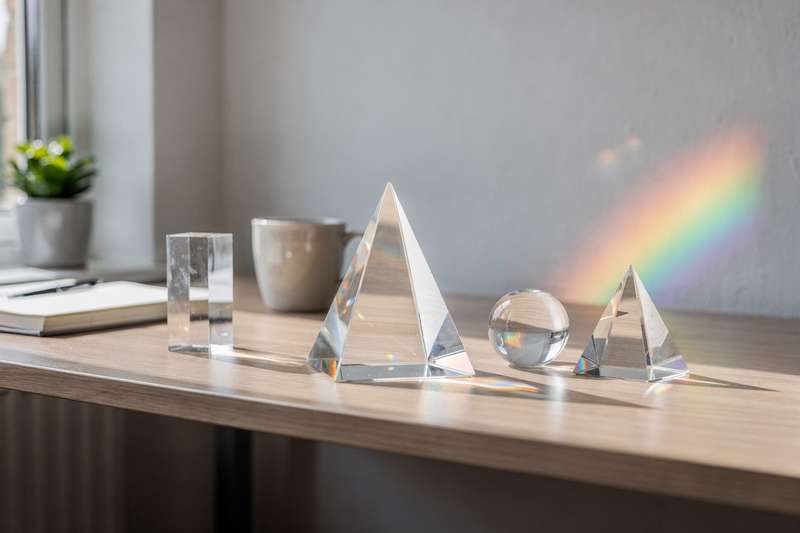
You’ve seen those photographs — a landscape or portrait shot through a glass prism, splitting the light into a clean spectrum that bleeds across the frame in a way no editing preset can replicate. Or perhaps you’re a physics teacher who’s spent too long explaining refraction from a textbook diagram when you know a physical demonstration would make the concept click in seconds. Maybe you just want to hang something from a south-facing window that turns dull winter sunlight into colour across your kitchen wall. Whatever the reason, you’ve started searching for prisms and immediately run into a wall of vague listings, confusing sizing, and no clear indication of which piece of glass is worth your money and which will arrive looking cloudy and scratched.
The problem is that “prism” covers an enormous range of products. A triangular optical-glass prism for a photography shoot has completely different requirements from a hanging suncatcher pendant for your conservatory window. If you buy a suncatcher when you need an optical prism, you’ll get distorted, washed-out results through your camera. Buy a dense optical prism for a chandelier display and you’ll have a beautiful — but absurdly heavy — decoration that probably won’t hang properly. This guide cuts through that confusion, matching specific products to specific use cases so you spend your money on the right piece of glass the first time.
How We Evaluated These Picks
Selecting the right prisms for this guide came down to five core criteria. First, glass quality: K9 optical crystal is the standard benchmark for clarity and consistent refraction — it transmits light cleanly without the bubbles, striations, or greenish tint you get with cheaper glass. Second, surface finish: hand-polishing and flat, scratch-free faces matter enormously for photography use, where any imperfection shows up in the image. Third, size and weight relative to intended use, since a prism that’s too small produces faint spectra and one that’s too bulky is impractical on location. Fourth, real buyer review patterns — the number of reviews and the consistency of feedback across verified purchases, paying particular attention to complaints about clarity, sizing accuracy, and packaging damage. Fifth, topic fit: suncatcher pendants and chandelier drops were evaluated on their hanging mechanism, crystal cut quality, and how effectively they scatter rainbow light rather than on optics specifications designed for camera work. Where two listings turned out to be colour or size variants of the same product line, only the most-reviewed variant was selected.
Best All-Round Photography Prism — Compact Size
The Adwikoso Crystal Optical Glass Triangular Photography Prism (2.5 inch) is the pick that most photographers and hobbyists should reach for first. It sits in the sweet spot of size — compact enough to hold comfortably in front of a lens with one hand while you shoot with the other, but large enough to cover a standard prime lens field of view when held close. At 2.5 inches, the faces are sufficiently wide to produce a clean, visible spectrum rather than the hairline rainbow you’d get from a tiny novelty prism.
The K9 optical crystal construction is what makes this one genuinely usable rather than decorative. K9 glass has a refractive index close to that of optical borosilicate glass, which means it bends light efficiently and consistently. In practice, when you hold it at roughly 45 degrees to a light source and position it at the edge of your lens, the colour separation is crisp — you get distinct bands of red, orange, yellow, green, blue, and violet rather than a muddy smear. The cleaning pouch included in the box is a practical touch; fingerprints kill the effect faster than anything else, and having a dedicated cloth means you’re not wiping the faces on your T-shirt between shots.
With 397 verified reviews and a 4.1-star rating, there’s a solid body of real-world feedback here. The consistent positives are clarity out of the box and the accurate sizing — buyers report the 2.5-inch measurement corresponds to the actual face length. The main criticisms worth noting: a small number of buyers received units with minor chips to one corner, which suggests packaging could be better, so inspect it carefully when it arrives. Also, 2.5 inches is great for 35mm to 85mm focal lengths but feels limiting if you’re shooting wide — a wider lens captures more of the frame and you may want the larger option instead (see the 6-inch version below). This prism is great for portrait and product photography on location but struggles as a demonstration tool for a full classroom because the spectrum projection isn’t bright enough to read from a distance without a powerful light source.
For a solo photographer or a parent setting up a home science project, though, this is genuinely the most practical starting point in the category. The K9 glass quality at this price tier is hard to fault, and the compact form factor means it travels easily in a camera bag without adding meaningful bulk.
Best Large-Format Prism for Demonstrations
If the 2.5-inch prism is the portable workhorse, the Adwikoso Crystal Optical Glass Triangular Photography Prism (6 inch) is the statement piece. Six inches of K9 optical crystal gives you substantially more surface area, which translates directly into a brighter, more spread-out spectrum — the kind that can project visibly onto a wall several metres away when combined with a bright torch or directed sunlight through a window gap.
This is the version that makes sense for physics teachers, science communicators, or anyone setting up a deliberate light-dispersion display. When you’re demonstrating the visible spectrum to a group of people, you need the rainbow to be big enough that everyone in the room can see it clearly — a 2.5-inch prism simply won’t achieve that without a very powerful collimated light source. The 6-inch faces produce a much wider beam spread, and when angled correctly, the separated wavelengths land clearly on a white surface with readable colour bands.
The same 397 combined reviews as the 2.5-inch model (this is the larger variant of the same Adwikoso line) give you confidence in the brand’s consistency. Buyers confirm the faces arrive flat and clear, and the cleaning pouch is again included. The obvious tradeoffs are weight and portability — this is not a prism you’ll comfortably hold in front of a camera for twenty minutes during a photoshoot. It’s also awkward to store without a dedicated case. For creative photography, the 6-inch format actually works well for specific techniques: setting it on a table, projecting light through it onto a textured surface, and photographing the resulting spectrum as an abstract study. But hand-holding it for lens-edge bokeh effects is physically tiring and less controlled than the compact version.
The 6-inch model is also excellent for product flat-lay photography when you want to incorporate a physical spectrum element into the shot itself — the prism becomes a prop as much as a tool. If your use case involves either teaching groups or creating deliberate, composed photographic scenes rather than impromptu location work, the larger format earns its place comfortably. Just know what you’re getting into size-wise before ordering.
Best Budget Entry-Level Prism
The Photography Prism Rainbow Spectrum Experiments Glass with Gift Box is the most accessible starting point in this category — rated 4.6 stars from 15 reviews, it arrives in a gift box, which makes it a sensible choice if you’re buying for a curious child or as an introduction to optics for someone who isn’t yet certain they want to invest in premium glass.
The gift box presentation is genuinely useful here rather than just marketing. If you’re getting this for a young person — the listing notes age 2+ but the physics teaching angle makes it most relevant for primary-school age upward — the boxed format makes it feel like a considered present rather than an Amazon impulse. The glass itself is clear enough to produce recognisable rainbow effects when held in direct sunlight or near a bright lamp, and for introductory physics teaching on light spectrum and refraction, it does the job. You won’t get the sharp, crisp colour separation of K9 optical crystal, but for a first experiment demonstrating that white light contains all colours, the effect is convincing.
Where this pick falls short relative to the Adwikoso options is precision. The glass quality and face flatness are less consistent, and if you attempt to use it for photography — holding it in front of a lens to create bokeh or spectrum flares — the results will be noticeably softer and less defined. The spectrum tends to bleed together at the edges rather than separating cleanly. That’s not a reason to dismiss it; it simply means managing your expectations. As a science demonstration tool or a thoughtful gift for someone curious about optics, it performs well above its price bracket. As a photography tool for anyone serious about the technique, you’d quickly outgrow it and want to step up.
The 15 reviews are too few to draw strong conclusions about long-term durability, but the current feedback is positive and consistent. Handle with care — as with all glass prisms at this end of the market, the faces can chip if dropped — and keep it in the box when not in use to protect the surfaces.
Best Suncatcher Pendant Set for Window Decor
The Hanging Crystal Prism Suncatcher Ornament Window Garden Decor Colorful Faceted Crystal Glass Drop Rainbow Maker Pendant approaches the prism category from a completely different angle. This isn’t an optical tool for photography or scientific demonstration — it’s a decorative hanging that uses faceted crystal glass to scatter sunlight into rainbow patches across walls, ceilings, and floors. With 379 reviews at 4.6 stars, it’s one of the most consistently praised picks in this guide.
The faceted drop design is key to how it works. Unlike a flat-faced triangular prism that produces a directed spectrum beam, a faceted crystal pendant scatters light in multiple directions simultaneously, creating several overlapping rainbow patches rather than a single clean band. The effect is warmer and more ambient — think of the light-play you see in a chandelier rather than a focused physics demonstration. For a conservatory, a sunny kitchen window, or a child’s bedroom, this creates a genuinely lovely display that changes throughout the day as the sun moves.
Installation is simple: the pendant comes with a hanging loop and is designed to suspend from a curtain rail, a small hook on a window frame, or even a plant hanger. No tools required. The faceted glass is clear and well-cut, and reviewers consistently note that the rainbow effect is noticeably stronger than cheaper plastic alternatives — plastic suncatchers tend to produce faint, washed-out colour rather than the vivid red-orange-yellow-green-blue-violet arcs you get from proper glass.
The main limitation is that this type of suncatcher only works well with direct or near-direct sunlight. A north-facing room in the UK — where bright, direct winter sun is a luxury rather than a given — will produce disappointing results most of the year. South or west-facing windows are ideal. Also worth noting: the rainbow patches move constantly with slight air currents, which is part of the charm but can be distracting if you’re trying to photograph them for social media content. For pure decorative enjoyment though, this is one of the easiest and most satisfying prism purchases you can make.
Best Crystal Ball Suncatcher for Rainbow Making
The Crystal Ball Prism Clear Suncatcher Glass Chandelier Lamp Lighting Drops Pendants Hanging Sun Catchers Rainbow Maker for Window Home Deco takes the suncatcher concept in a slightly different direction, using a spherical or drop-shaped crystal ball form rather than a faceted pendant. Rated 4.7 stars from 54 reviews, this is the highest-rated pick in the guide by average score, and the feedback is notably consistent about one thing: the rainbow intensity is stronger than expected.
A crystal ball disperses light differently from a faceted drop. The curved surface refracts and reflects light across a wider solid angle, meaning the rainbow patches it creates tend to cover more of a room and shift more dramatically as the sun moves. Reviewers describe waking up to rainbow patches on their bedroom ceiling or watching the spectrum move slowly across a wall during a sunny afternoon — the kind of ambient light display that feels genuinely magical rather than contrived. The glass quality appears solid for this category: clear, without obvious bubbles or distortion, and the hanging mechanism is secure.
Where this differs from the faceted pendant option above is in the character of the light display. The faceted pendant creates sharper, more defined rainbow arcs. The crystal ball creates broader, softer washes of colour that blend together more. Neither is objectively better — it depends on the aesthetic you’re after. The ball format also means it hangs with a slight rotation, which causes the rainbow patches to slowly sweep across surfaces over the course of a sunny day. Many buyers specifically mention this effect as a highlight.
If you’re buying for a child’s room, this spherical style tends to generate the most delight — the moving, room-filling colour display is more immediately impressive than a narrow spectrum beam from a triangular prism. It’s also a strong candidate for a gift. The limitation, as with any suncatcher, is sunlight dependency. In a UK climate, plan for this to be a seasonal treat during bright weather rather than an all-year-round feature unless your room gets reliable direct light.
Best Single-Prism Upgrade for Serious Photography
The SEIWEI K9 Crystal Optical Glass Triangular Prism is the pick aimed at photographers who have tried a budget triangular prism and want a step up in glass quality and finish. Rated 4.5 stars from 18 reviews, the sample size is modest but the feedback is specific and credible: reviewers describe noticeably cleaner face polishing and sharper colour separation compared to cheaper alternatives they’d previously owned.
The SEIWEI prism is a clear K9 optical glass triangular prism designed for both photography effects and physics teaching. The key specification to look for in any premium triangular prism is the face flatness and the polish quality at the edges and corners — chips or rough edges indicate a lower-quality finishing process that will show up as artefacts when you’re using the prism in front of a camera lens. The SEIWEI listing specifically calls out its optics kit credentials, suggesting it’s targeted at users who understand what they’re looking for rather than casual buyers. At 18 reviews it’s not as battle-tested as the Adwikoso models, but the pattern of feedback is positive.
In practical photography terms, this prism works best for lens-edge effects — positioning it at the periphery of your lens while shooting portraits or landscapes to introduce a streak of prismatic colour into the composition. The technique requires patience and some experimentation with angle and distance from the lens, but when it works the result is a subtle, elegant optical effect that integrates naturally with the image rather than looking like a post-processing overlay. The K9 glass clarity is important here: any cloudiness or inconsistency in the glass will reduce contrast and introduce colour casts that are difficult to correct in editing.
The tradeoff with the SEIWEI relative to the Adwikoso 2.5-inch is that the review base is much smaller, so you’re taking on slightly more uncertainty. If you want the safest bet for a compact photography prism, the Adwikoso remains the more proven choice. But if you’re specifically looking to upgrade from a basic prism and want a K9 option with a focus on finish quality, the SEIWEI is worth considering — particularly if the Adwikoso 2.5-inch feels limiting for your current work.
What to Look For When Buying a Prism
- Glass type — K9 optical crystal vs standard glass: K9 crystal is the benchmark for clarity and consistent refraction in this category. It transmits light without the greenish tint or internal striations that cheaper glass produces. For photography and precise demonstration work, K9 should be your minimum standard. For decorative suncatchers, high-quality clear glass (whether or not it’s technically K9) is adequate, but avoid opaque or lightly frosted glass — it won’t scatter rainbow light effectively.
- Face flatness and polish quality: For triangular prisms used in photography, the flatness of each face is critical. Even minor surface imperfections create distortion that shows up in camera. The easiest way to check this from a listing is to look for specific mentions of hand polishing, scratch-free finish, or optics-grade surface quality in the product description. If a listing says nothing specific about surface quality, that’s often a warning sign.
- Size relative to use case: Compact prisms (around 2–2.5 inches) are ideal for hand-held photography work. Larger prisms (6 inches+) project brighter, wider spectra suitable for classroom demonstration. Suncatcher pendants work on a different logic entirely — faceted surface area determines the spread and intensity of the rainbow, not length.
- Single prism vs multi-shape set: A single high-quality triangular prism will outperform a set of five mixed shapes in terms of optical purity. Multi-shape sets offer creative variety — balls, cubes, pyramids — and are better suited to experimentation and education than to producing predictable photographic results. If you know you want a triangular prism specifically, buy a single good one rather than a cheaper set.
- Sunlight requirements for suncatchers: Hanging crystal pendants and ball suncatchers are almost entirely sunlight-dependent. In the UK, this matters seasonally. South and west-facing windows with unobstructed light are ideal. If your room doesn’t get direct sunlight, a decorative suncatcher will be largely non-functional. Triangular optical prisms, by contrast, work with any strong directional light source — a bright LED torch or studio light works just as well as the sun.
- Cleaning and maintenance: Glass prisms attract fingerprints, dust, and moisture. A prism that comes with a dedicated cleaning cloth or pouch is worth the marginal extra cost. Fingerprints on a prism face dramatically reduce the quality of any optical effect — plan to clean the faces before every photography session. For suncatchers, periodic dusting keeps the glass clear and the rainbow effects strong.
- Packaging and fragility: Glass prisms ship badly when packaging is inadequate. Look for listings that mention protective packaging or padded cases — corner chips are one of the most common complaints in this category and are almost always a shipping or handling issue rather than a quality-control fault. If a prism arrives chipped, raise it immediately with the seller; all reputable Amazon listings should offer a replacement or refund for damage in transit.
Verdict
For most UK buyers reading this guide, the Adwikoso Crystal Optical Glass Triangular Photography Prism (2.5 inch) is the pick we’d recommend as a starting point. It has the largest body of verified buyer feedback in this category, the K9 glass quality delivers genuinely clean refraction, and the 2.5-inch size is practical for both photography work and home physics experiments. The included cleaning pouch shows the manufacturer understands how these prisms are actually used. If you outgrow it and need more projection power for classroom use, the 6-inch version of the same model is the logical next step. If your interest is purely decorative — rainbow light patterns across your walls — the Crystal Ball Prism Suncatcher at 4.7 stars is the most enthusiastically reviewed option in the guide and produces a visually striking effect for minimal effort. Match the product to the use case, and any of these picks will reward you.
We were not paid to feature any specific product in this guide. All opinions are independent and based on publicly available specifications, verified buyer feedback patterns, and category research.
Quick Comparison Table


FAQ
What is the difference between a K9 crystal prism and a standard glass prism?
K9 optical crystal is a specific type of barium crown glass with a high refractive index, excellent clarity, and very low levels of internal distortion. Standard glass prisms can contain bubbles, striations, or a slight green tint that reduces the sharpness and vibrancy of the spectrum they produce. For photography and precision demonstrations, K9 is noticeably better. For casual decorative use, the difference is less critical, but K9 glass suncatchers will still produce more vivid rainbows than budget alternatives.
What size prism do I need for photography?
For hand-held photography work — holding the prism at the edge of your lens during a shoot — a 2 to 2.5-inch triangular prism is the most practical size. It covers the lens field of view adequately for focal lengths from 35mm to 85mm and is light enough to hold comfortably for extended periods. If you want to project the spectrum onto a surface or use the prism as a prop in a flat-lay composition, a 6-inch prism produces a much more visible and photogenic result.
Do prism suncatchers work in the UK climate?
Yes, but they work best with direct sunlight, which is naturally more limited in the UK — particularly in autumn and winter. South or west-facing windows that receive several hours of unobstructed direct sun will produce strong rainbow displays from a good-quality glass suncatcher. North-facing rooms or windows with partial obstruction will see much weaker results. If you want reliable year-round prism effects, an optical triangular prism used with a bright directional lamp or torch is the more dependable option.
Can I use a decorative crystal ball suncatcher for photography experiments?
Not effectively, no. Decorative suncatchers are designed to scatter light in multiple directions simultaneously, which creates ambient rainbow patches rather than a clean directional spectrum. Photography prism techniques rely on a defined, controlled beam of separated colours — for that, you need a flat-faced triangular prism in optical-grade glass. A suncatcher held in front of a camera lens will produce a blurry, soft scattering effect rather than the precise spectral streak used in prism photography.
How do I clean a glass prism without scratching it?
Use a microfibre cloth — the same type used for camera lenses or glasses — and avoid paper towels or rough fabrics that can leave fine scratches on polished glass. For fingerprints, a single drop of lens cleaning solution on the cloth works well. Never use abrasive cleaners or anything containing alcohol above about 70% concentration. Store prisms in their pouch or box when not in use to prevent dust and accidental contact damage. Clean the faces before each photography session, as even a light fingerprint noticeably reduces the sharpness of the spectrum.
Is a prism set or a single prism better for beginners?
For a complete beginner who is curious about prisms and wants to explore different optical effects, a set offers more variety and creative experimentation for the same budget. For someone who knows they specifically want to try prism photography or classroom light spectrum demonstrations, a single high-quality triangular prism in K9 glass will give better results than a set of mixed shapes in lower-quality glass. Buy for the specific purpose, not for the number of pieces.