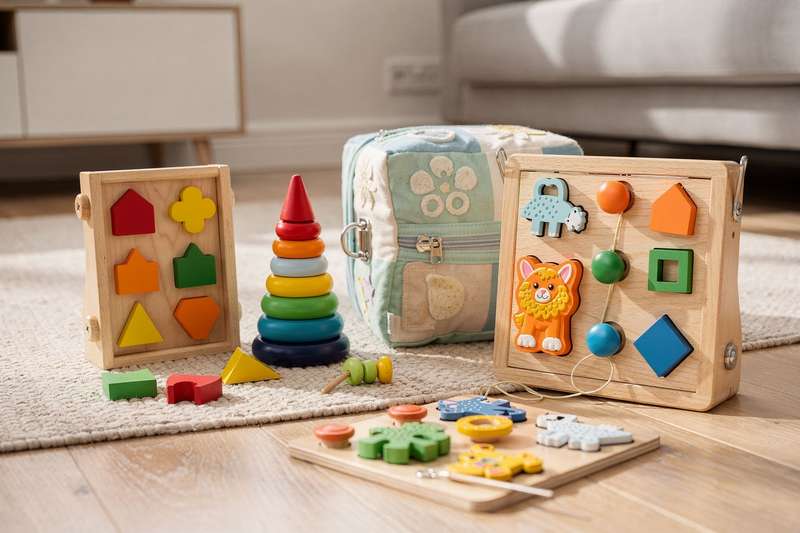
You’re standing in your living room surrounded by plastic tat that cost a small fortune and now lives under the sofa collecting fluff. Your one-year-old has absolutely zero interest in the elaborate play gym you assembled at midnight, but is thoroughly entertained by the TV remote and a yoghurt lid. Sound familiar? The early development toy market is genuinely bewildering — shelves and search results packed with brightly coloured products that all claim to be Montessori-inspired, educational, and essential for your child’s cognitive growth. Most of them are mediocre. A fair few are outright disappointing. And the ones that actually hold a toddler’s attention for longer than four minutes? Those take some finding.
What you actually need are toys that build real skills — fine motor control, colour and shape recognition, cause-and-effect understanding, early literacy — without requiring a PhD to set up or a crowbar to clean. This guide cuts through the noise and points you toward the picks that genuinely deliver, whether you’re buying for a six-month-old just starting to bat at things, a curious two-year-old obsessed with posting objects into holes, or a three-to-four-year-old ready for early writing and matching challenges.
How We Evaluated These Picks
Selecting the right early development toys isn’t just about star ratings. For this guide, the evaluation focused on five core criteria: developmental appropriateness (does the toy actually match the cognitive and physical stage it claims to target?), durability and material safety (wooden and fabric toys were scrutinised for finish quality and splinter risk; plastic for BPA-free credentials and sturdiness), engagement longevity (how long does it hold a child’s interest across multiple play sessions, not just the first unwrapping?), ease of adult involvement (the best picks allow independent play but also reward shared play), and verified buyer feedback patterns — particularly repeat mentions of durability issues, misleading sizing, or unexpected complexity.
Products with zero verified reviews in the live catalogue were assessed on specifications, brand reputation, and category context only — this is noted transparently in those sections. Where strong buyer feedback existed, patterns across hundreds of reviews were weighed to surface the honest picture, not just the headline star score.
Best for Vocabulary and Early Literacy: Talking Flash Cards for Toddlers
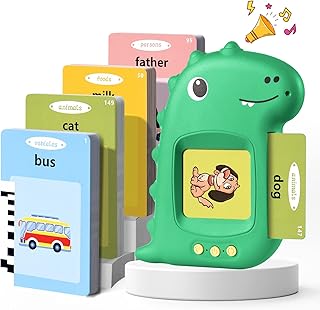
The Talking Flash Cards for Toddler Toys sit at a genuine sweet spot in the early development category — interactive enough to hold attention, educational enough to justify the purchase, and simple enough that a two-year-old can operate them without meltdown. Rated 4.5 out of 5 stars from over 600 verified buyers, this is one of the strongest-reviewed picks in the live catalogue.
The concept is straightforward: cards slot into a reader device that speaks the word, letter, or number aloud, reinforcing the visual with an auditory cue. This dual-channel approach (seeing the card and hearing the word simultaneously) is well-supported by early childhood research as an effective method for vocabulary acquisition. For children aged two to five, this maps neatly onto a stage where receptive language is outpacing expressive language — they’re absorbing far more than they can say, and hearing consistent spoken words alongside images accelerates that connection.
Buyer feedback patterns highlight a few recurring positives: children return to it independently (a strong sign of genuine engagement rather than novelty), the audio is clear enough to be understood without adult interpretation, and it works well for children with sensory processing differences or autism, where predictable, repeatable stimuli are particularly valuable. On the tradeoff side, some reviewers note the volume could be higher in noisy environments, and the card reader requires batteries — worth checking what’s included before wrapping it for a birthday. The age range listed (2–6 years) is optimistic on the upper end; most children will move on by four or five, but for the core window of two to four years, this is a genuinely useful tool.
This works particularly well as a pre-school literacy primer — use it to introduce alphabet letters before moving on to phonics workbooks. It’s also a solid travel toy: compact, self-contained, and engaging enough for a car journey without requiring an adult to facilitate every moment of play.
Best Reusable Activity Workbook: Preschool Learning Activities Busy Book
The Preschool Learning Activities 54 Reusable Pages Tracing Books for Kids Ages 3-5 takes a different approach to early development: pen-and-paper style activity, but with wipe-clean pages that can be used repeatedly. Rated 4.6 out of 5 stars from nearly 200 verified buyers, it’s a newer entry but already building a solid reputation.
The format is a busy book with reusable writing and tracing pages — covering handwriting practice, pattern tracing, number formation, and early drawing activities. At 54 pages, there’s enough variety to keep a three-to-five-year-old occupied across multiple sessions without hitting the same page every time. The wipe-clean surface is the key selling point: rather than burning through single-use activity pads, a child can complete a page, you wipe it down, and it’s ready again. For parents who resent disposable stationery products that run out in a fortnight, this is a practical alternative.
From a developmental standpoint, tracing and early handwriting activities directly support the fine motor control needed for school writing. The pincer grip required to hold a dry-erase pen is excellent preparation for pencil use, and tracing letters and numbers reinforces the muscle memory for forming shapes correctly — something that, if left until formal schooling, can take considerably longer to correct. Buyer feedback frequently praises the page variety and the quality of the wipe-clean surface, which holds up to repeated use without ghosting or surface degradation.
The main caveat: this is firmly a 3–5 year activity rather than something suitable for younger toddlers. Below three, the fine motor control required for meaningful tracing simply isn’t there for most children, and forcing it can be frustrating rather than developmental. If your child is closer to two, the shape sorter or stacking toy picks in this guide will be better matched. For a nursery-age child approaching school readiness, though, this is one of the more useful and honest purchases in the category.
Best Shape Sorter for Fine Motor Development: KmmiFF Wooden Shape Sorter
The KmmiFF Wooden Shape Sorter Montessori Toy for 1-3 Year Old Boys Girls is a solid contender in the wooden toy segment, rated 4.6 out of 5 stars from over 400 verified buyers — a meaningful sample for a category where cheap imports often inflate ratings quickly and then fade.
Shape sorting is one of the foundational early development activities for a reason. It requires a child to recognise shape properties, rotate and manipulate objects (spatial reasoning), and persist when a first attempt doesn’t work (problem-solving and frustration tolerance). A wooden construction over plastic gives the pieces a satisfying weight and texture that toddlers generally find more engaging to handle, and the KmmiFF’s finish quality is consistently praised in buyer reviews for being smooth rather than rough — a real concern with budget wooden toys where splintering is a genuine safety risk.
The toy targets the one-to-three age range, which is accurate for the core shape-sorting mechanic. A 12-to-18-month-old will engage with it at a basic level, posting shapes with some adult guidance; an 18-month to two-and-a-half-year-old will typically master it independently and derive real satisfaction from the completion loop. By three, most children will have outgrown the challenge of the sorting mechanism itself, though they may continue using the pieces in imaginative play. Multiple reviewers highlight that the wood quality feels genuinely solid rather than lightweight and cheap — an important distinction when these toys get dropped, thrown, and chewed.
One honest tradeoff: wooden shape sorters aren’t suited to being left in a car or outdoor play area — temperature and moisture will eventually affect the wood and fit of the pieces. Keep it as an indoor toy and it should last well through the target age range and potentially serve a second child. For parents wanting to move away from plastic toys, this is a dependable starting point.
Best Classic Stacking Toy: Fisher-Price Rock-a-Stack Baby Toy
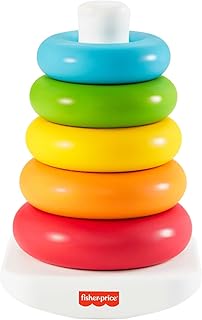
The Fisher-Price Rock-a-Stack Baby Toy is one of those products with a near-perfect claim to classic status in early development toys. Rated 4.8 out of 5 stars — and notably, this particular variant is made from plant-based materials, which will matter to parents thinking about sustainability. While the live catalogue shows zero verified reviews for this specific listing, the Rock-a-Stack name has decades of documented buyer feedback across multiple retail channels; the product design itself is one of the most studied and validated in infant toy research.
The premise is beautifully simple: graduated coloured rings stack onto a wobbly base, and the base rocks when pushed rather than toppling. This solves an early toddler frustration point — conventional stacking towers fall over easily, which can discourage a younger baby still developing the fine motor precision to place rings carefully. The roly-poly base allows successful play even with imprecise placement, which is developmentally appropriate for six-to-twelve-month-olds who are in the early stages of intentional object manipulation.
The graduated ring sizes introduce early size discrimination — a precursor to later sorting and sequencing tasks. The bright colours support colour naming as an adult plays alongside. And the rocking action introduces cause-and-effect play at the most basic level: push it, it moves; let go, it returns. For very young infants, this is genuinely meaningful developmental input rather than just distraction.
Because this listing has no reviews yet in the live catalogue, it’s worth noting the main risk with any newly listed variant of an established product: check that the product dimensions match your expectations and that the plant-based material update hasn’t introduced any durability changes. The Fisher-Price brand and Rock-a-Stack heritage are well-established, but a new production run can occasionally produce batches with tighter or looser ring fits. Overall, for infants from around six months through to about 18 months, this remains one of the most developmentally sound toy purchases available at a budget price point.
Best Wooden Multi-Skill Starter Set: Montessori Wooden Toys for 1-2 Year Olds
The Montessori Wooden Toys for 1-2 Year Olds is pitched as a gift set and multi-skill starter pack, rated 4.5 out of 5 stars from 48 verified buyers — a smaller sample than ideal, but sufficient to establish a credible pattern. This pick suits parents who want a single purchase that introduces several developmental skills at once rather than buying individual toys.
The set is aimed squarely at the one-to-three year window and appears to combine multiple wooden activity components into one package — stacking, sorting, and preschool learning activities. The appeal is clear: rather than assembling a developmental toy library piecemeal, you get a coordinated set designed to grow with a child through the toddler years. For grandparents or relatives buying a first birthday present, this kind of set often lands better than a single specialised toy, because there’s almost always one element that becomes a favourite.
Buyer feedback at this volume is sufficient to flag any major quality problems — and the absence of negative patterns around finish quality or missing pieces is a positive indicator. The 4.5 rating with 48 reviews is honest rather than inflated, suggesting a product that delivers on its promise without being exceptional in any single dimension. The tradeoff with multi-component wooden sets is that some pieces will engage a particular child more than others; you’re unlikely to get the maximum developmental value from every item in the box, but the overall investment is typically strong given the breadth of activities covered.
This is a sensible pick for gift-givers uncertain about a child’s specific developmental stage or preferences, and equally useful for parents who want to introduce Montessori-style wooden toys without committing to an expensive specialist retailer. As the child’s interests clarify around 18 months to two years, you can supplement with more targeted toys like the shape sorter or flash cards covered elsewhere in this guide.
Best Memory and Matching Game: Orchard Toys Farmyard Heads and Tails Game
The Orchard Toys Farmyard Heads and Tails Game represents a different mode of early development play: structured card-based games that require attention, memory, and turn-taking. Rated 4.7 out of 5 stars, and while this specific listing shows zero verified reviews in the live catalogue, Orchard Toys is one of the most respected UK educational game brands with a long track record across independent toy reviews and school buyer lists.
The game works by matching animal head and tail cards — a simple mechanic that introduces memory recall, visual discrimination, and the concept of a matching rule. For children aged 18 months and upward, this kind of guided game also introduces something that purely solitary development toys can’t: shared play rules, waiting for a turn, and the social experience of playing alongside another person. These are genuine early social-emotional skills, not just nice extras.
Orchard Toys consistently produces cards on robust, chunky card stock that survives the handling of small hands better than standard card games. The farmyard theme is familiar and appealing to most toddlers without being overstimulating. The game can be played at varying levels of complexity — younger children can simply match heads and tails without formal game structure, while older toddlers and preschoolers can play a proper memory-card style game with turns and a winner.
The honest caveat: because the live catalogue shows zero reviews for this listing, verify stock availability and check whether the UK listing is current before purchasing. The game itself is a known quantity from a reputable publisher, but a listing with no activity may indicate low stock or a recently relisted product. This is a particularly good pick for parents of children approaching two-and-a-half to three years who want to introduce cooperative play alongside individual development activities.
What to Look For When Buying Early Development and Activity Toys
- Age appropriateness — and honesty about it: Many toys claim ranges of 1–5 years, which is rarely accurate for a single product. Look for toys with a genuine developmental sweet spot — typically an 18-month window — and match the toy to your child’s current stage rather than where you’d like them to be. A toy that’s too advanced creates frustration; one that’s too simple gets ignored within days.
- Material quality and safety: For wooden toys, look for smooth, splinter-free finishes and non-toxic paint or stain — many UK-sold wooden toys carry EN71 certification, which is the European toy safety standard. For plastic, check for BPA-free labelling, particularly for toys likely to end up in a mouth. Fabric toys should be washable; if they can’t be cleaned, assume they’ll need replacing rather than refreshing.
- Skill specificity: The best developmental toys target a specific skill clearly — fine motor control, colour matching, early literacy, shape recognition. Toys that claim to develop everything simultaneously often do nothing particularly well. Identify which developmental area you want to support and choose accordingly.
- Engagement longevity: A toy that’s engaging on day one but ignored by day three hasn’t delivered real developmental value. Look for reviews that mention a child returning to a toy repeatedly over weeks or months. Open-ended toys (blocks, shape sorters, tracing books with wipe-clean pages) typically outlast single-mechanic novelty toys.
- Ease of independent play: The best early development toys allow a child to self-direct once the basic concept is understood. Toys requiring constant adult facilitation to work are less useful in practice, however well-designed they are in theory — because the developmental benefit of problem-solving comes from the child working through the challenge, not being walked through it.
- Durability for real use: Toddlers are not gentle. Joints, hinges, cards, and battery compartments need to withstand dropping, throwing, and liberal application of small-child determination. Check reviewer comments for mentions of pieces breaking within weeks — this is a reliable early-failure indicator that star ratings alone often mask.
- Storage and tidiness: A toy that loses pieces within a week becomes useless quickly. Sets with dedicated storage (a box, bag, or integrated container) stay intact and useable significantly longer than loose-piece sets. Worth prioritising if you’re buying for a younger sibling in the household.
Verdict
For most UK parents buying a first or second meaningful development toy for a child in the one-to-three year window, the KmmiFF Wooden Shape Sorter is the pick that delivers the best combination of developmental value, durability, and honest buyer validation. Shape sorting is a foundational skill for this age range, the wooden construction is built to last, and the 400-plus verified reviews give you real confidence that the quality matches the description. It targets fine motor control, spatial reasoning, and problem-solving in a single toy that a child will return to across many months.
If your child is closer to three or four and approaching school readiness, the Talking Flash Cards are the upgrade — over 600 verified reviews and a strong track record for vocabulary development make them the standout for the pre-school literacy phase. And for a genuinely versatile birthday gift that covers multiple skills in one purchase, the Montessori Wooden Toys starter set is a sound choice when you’re not certain of a child’s exact developmental stage.
We were not paid to feature any specific product in this guide. All opinions are independent and based on publicly available specifications, verified buyer feedback patterns, and category research.
Quick Comparison Table




FAQ
What age should you start using early development toys?
Most early development toys are suitable from around six months, when babies begin reaching, grasping, and batting at objects intentionally. Simpler cause-and-effect toys and stacking rings work well from six months; shape sorters and matching games typically become engaging from around 12 to 18 months. Always check the specific age recommendation on the packaging and trust your own observation of your child’s readiness over a printed age range.
Are wooden toys better than plastic ones for toddler development?
Neither material is universally superior — the developmental value comes from the toy’s design, not the material. Wooden toys tend to be more durable, have a satisfying weight and texture that many children prefer, and are more sustainable. Plastic toys can offer audio, light, and electronic features that wooden equivalents can’t replicate. A balanced toy collection often includes both; the priority should always be material safety (EN71 certification, BPA-free labelling) over material type.
What’s the difference between Montessori toys and standard educational toys?
Montessori-aligned toys are typically made from natural materials, designed for open-ended independent play, and focused on a single skill or concept — the idea being that a child learns more effectively by self-directing through a challenge than by being guided step-by-step. Standard educational toys vary widely but often include more electronic elements, structured rules, and adult-led play. Many toys on the market use the Montessori label loosely; look for open-ended design and natural materials as practical indicators rather than relying on the label alone.
How do I know if a toy is genuinely educational or just marketed as such?
Look for a specific skill the toy develops and ask yourself how the toy’s mechanics actually build that skill. A shape sorter builds spatial reasoning and fine motor control through a clear cause-and-effect mechanism. A toy claiming to develop creativity, intelligence, and social skills simultaneously is usually making broad marketing claims with little backing. Specific, verifiable developmental mechanics are the mark of a genuinely educational toy.
How many early development toys does a toddler actually need?
Research into children’s play consistently finds that fewer, higher-quality toys lead to deeper engagement and longer-lasting developmental benefit than a large quantity of options. A good working set for a toddler might include one stacking or sorting toy, one early literacy or language tool, one open-ended creative activity, and one social-play game. Rotating toys every few weeks rather than having everything available at once also extends engagement and reduces overstimulation.
Do talking and electronic learning toys genuinely help with language development?
Electronic talking toys, including flash card readers, can support vocabulary acquisition when they present clear audio-visual pairings and are used alongside adult interaction. Research suggests they work best not as a replacement for conversation, but as a supplement — a child hearing a word spoken by a toy and then discussing it with an adult absorbs the word more effectively than either stimulus alone. Avoid electronic toys with overly complex audio or rapid sound sequences, which can overstimulate rather than teach.