You’ve carved your block, your design is clean, and everything is ready — except the ink is fighting you. It’s either too thick and dragging across fine detail, or it’s drying faster than you can re-roll the brayer, leaving patchy coverage that shows up the moment you lift the block. You’ve tried a few tubes from craft shops, maybe even a set that came bundled with lino and cutters, but the results never quite match what you see other printmakers producing online. Sound familiar?
This guide is for you: the hobbyist or semi-professional working at a kitchen table or small studio, printing short runs of greetings cards, art prints, or fabric pieces, who wants reliable, water-washable ink that doesn’t require specialist ventilation or industrial clean-up. Water-based linocut ink sits at a specific crossroads — it needs to be safe enough for a domestic setting, consistent enough for repeatable results, and forgiving enough that you can actually enjoy the process rather than fight the materials.
How We Evaluated These Picks
To put together these recommendations, we assessed each product across a consistent set of criteria: ink consistency and workability on both soft-cut rubber and traditional grey lino, coverage opacity, open time (how long it stays workable on the inking plate before skinning over), ease of clean-up with water alone, compatibility with paper and fabric substrates, and the pattern of feedback from verified buyers with measurable review counts. We specifically prioritised inks that are realistically available to UK buyers via Amazon, and which carry meaningful review volumes — because twenty reviews rarely tells you much about long-term behaviour. Where a product stood out for a particular use case (fabric, fine detail, bulk printing, or beginners), we’ve noted it. We’ve been honest about tradeoffs throughout.
Best All-Round Starter Ink for Beginners
The Essdee Premium Quality Block Printing Ink (Blue 100 ml) is, for most people picking up linocut for the first time, the most sensible starting point on the UK market. With 750 verified reviews and a 4.5-star rating, it carries the kind of sustained feedback that tells you it’s not a fluke — consistently well-rated over years and across a wide range of user skill levels.
The ink has a smooth, slightly gel-like consistency that rolls out well on an acrylic inking plate or a piece of glass. It doesn’t dry instantly, which gives you a usable working window of several minutes — enough to roll, press, and re-ink without panicking. For beginners who are still getting their press pressure consistent, that forgiving open time is genuinely useful. Coverage on cartridge paper, printmaking paper, and light card stock is solid: you’ll get good opacity without needing to double-roll obsessively.
The 100ml size is well-suited to small runs — greetings cards, gift wrap, art prints up to A4. If you’re printing larger formats or doing longer runs, you’ll find 100ml disappears faster than you’d expect, but for learning and occasional use it’s practical. Clean-up genuinely is just warm water and a cloth, which matters if you’re working at a kitchen table.
Where it falls slightly short: very fine detail work (thin parallel lines or intricate texture) can occasionally fill in slightly if you’re not careful with ink quantity on the brayer. The blue is a slightly muted mid-blue rather than a vivid cyan, so if you’re mixing colours or expecting a bright primary palette, check swatch reviews first. But as a workhorse ink for learning the craft? This earns its place firmly at the top of the beginner shortlist.
Best for Fine Detail Work: Essdee Yellow
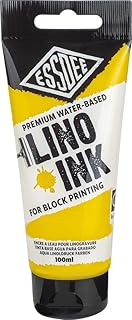
If you’ve already got your process dialled in and want to start working with colour — particularly lighter, more transparent colours where ink body really matters — the Essdee Block Printing Ink, Water, Yellow, 100ml is worth picking up alongside your primary colours. It shares the same 4.5-star rating and 750-review foundation as the rest of the Essdee range, giving you confidence in consistency across the colour line.
Yellow is notoriously tricky in relief printing. Thin pigment loads mean poor opacity, and insufficient coverage on white paper leaves a washed-out result that looks weak in reduction prints or two-colour compositions. Essdee’s yellow handles this better than many budget alternatives — it has enough body to hold its own on the block without becoming too stiff to roll evenly.
The consistency matches the blue well, which is important if you’re printing registration-accurate multi-colour work: you don’t want one colour drying significantly faster than another while you’re lining up the second block. Using inks from within the same range reduces that variable considerably.
For detail-heavy designs, the key is keeping the ink layer thin and even on the block. Yellow tends to fill fine cuts more visibly than dark inks simply because the contrast is lower and any ink creep into shadow areas shows. Use the minimum quantity of ink on your brayer, build up pressure gradually, and you’ll get clean results. This ink is great for floral motifs, botanical prints, and layered colour work — it’s less suited to very bold, heavy coverage areas where you’d want a more opaque pigment base. That’s just the nature of yellow pigments, not a product flaw.
Best for Printing in Red: Essdee Red
The Essdee Premium Quality Block Printing Ink (Red 100 ml) rounds out the Essdee primary colour set and performs exactly as you’d expect from the range — reliably, consistently, and without surprises. Again, it shares the 4.5-star, 750-review backing that makes this a trustworthy choice rather than a speculative one.
Red is a colour where opacity and vibrancy both matter: too transparent and it looks pink on white paper; too heavy-bodied and it becomes difficult to spread cleanly. Essdee’s red lands in a good middle position. It prints with genuine warmth on white cartridge and Somerset Velvet, and it layers reasonably well if you’re doing reduction print work where red appears as an underlayer to black or navy.
One thing worth knowing: red inks in any water-based formula tend to have slightly longer dry times than black equivalents, because red pigments often require a larger pigment load to achieve opacity. Give each print a few extra minutes before stacking. That said, on a typical home drying rack or when prints are laid flat, you won’t encounter problems.
If you’re building a colour printing kit and already have the blue and yellow, adding this red completes a functional primary set. These three colours, combined with Essdee’s black in a larger size (covered below), give you the foundations of a proper small studio ink selection without needing to invest in specialist mixing systems or professional screen printing supplies. The consistency match across the range is the real selling point here — not just the individual colour.
Best for High-Volume or Larger Format Work: Essdee Black 300ml Twin Pack
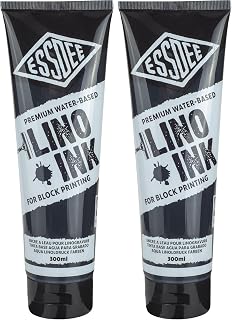
Once you’ve moved past occasional prints into regular production — selling at craft fairs, printing editions of 20 or more, or working larger than A4 — the economics and logistics of ink supply start to matter. The Essdee Block Printing Ink Black, 300ml (Pack of 2) is the answer. At 600ml total ink in a single order, this pack makes sense for any printmaker who uses black regularly and doesn’t want to run out mid-edition.
The ink itself is the same formula as the individual 100ml bottles — 4.5 stars from 472 reviewers — but black at 300ml per bottle gives you significant operational headroom. Black is the highest-consumption colour in most printmaking practice: key lines, editions on newsprint, reduction prints starting from full black, and greeting card runs all eat through ink quickly. The larger format also tends to reduce cost per millilitre compared to buying multiple small bottles.
The consistency of this black is particularly good for high-contrast work on white or off-white substrates. It rolls out with a slightly glossy finish when wet, which settles to a clean matte-satin once dry — giving prints a professional appearance without looking plasticky. Inking pressure requirements are modest, meaning you don’t need an etching press or heavy equipment; a firm, even hand rollover is sufficient for most paper stocks.
The twin-pack format does have a minor practical consideration: once opened, water-based inks can develop a skin at the nozzle or lid if not sealed well between sessions. Keep lids clean, wipe threads before closing, and store upright in a cool environment. With basic care, a 300ml bottle will last a typical hobbyist many months even with regular use. This is the bulk buy that rewards organised printmakers who plan their sessions in advance.
Best for Fabric Printing: Speedball White Fabric Ink
Fabric printing is a distinct discipline from paper printing — the ink must bond with textile fibres, survive washing, and flex without cracking. Standard block printing inks formulated for paper will wash out of fabric and aren’t designed for textile use. The Speedball H3573 Block Printing Fabric Ink, 2.5 oz, White is a specialist product for exactly this purpose, and its 4.5-star rating from 907 reviewers makes it the most-reviewed option in this guide.
White fabric ink is one of the harder colours to get right. On dark fabric particularly, white needs high opacity and good body to appear crisp rather than translucent. Speedball’s fabric ink formula achieves this: it’s noticeably thicker than standard paper inks, which requires slightly more pressure during printing but delivers far better coverage. On natural cotton and linen, it sits cleanly on the surface with minimal bleed.
The crucial step with fabric printing inks is heat-setting. Once your print is dry, you need to iron the reverse side (with a cloth between iron and print) or tumble-dry on high heat for the ink to become wash-fast. Skip this step and the ink will fade or wash out. Speedball’s instructions specify this clearly, and reviewers consistently confirm that heat-set prints survive repeated machine washing well.
The 2.5 oz (approximately 74ml) size is modest, but for fabric work you use less ink than you might expect — textile fibres absorb rather than hold the ink on the surface, so efficient inking technique matters more. White also serves as a useful overbase when printing light colours on dark fabric. The tradeoff: Speedball fabric ink is harder to clean up than standard water-based inks on fabric tools — rinse brushes and brayers immediately after use, before the ink has any chance to set. It’s entirely water-washable when wet, but once it starts to cure, it becomes much harder to remove from rollers.
Best Premium Fabric Ink for Serious Textile Work: Permaset Aqua White
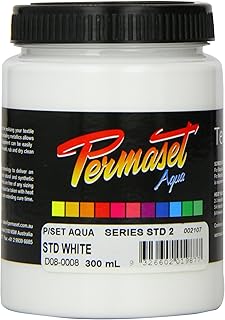
If you’re printing fabric for sale — tea towels, tote bags, art textiles, small-run clothing — you need an ink with professional-grade durability and food-safe certification. The Permaset Aqua 300ml Fabric Printing Ink – Standard White is widely regarded in the UK printmaking community as the benchmark for water-based fabric printing. With a 4.6-star rating from 54 reviewers, it has fewer reviews than the Speedball option but a marginally higher rating, and the review quality consistently reflects professional use.
Permaset Aqua is an Australian-developed ink with a strong reputation in screen printing but equally applicable to linocut on fabric. The formula is PVC-free, phthalate-free, and certified to Oeko-Tex Standard 100 — which means it’s safe for skin-contact items. If you’re making printed textiles intended for sale in the UK, those certifications matter both for customer trust and potential compliance with product safety standards.
The 300ml container gives you a generous working quantity. The ink has a slightly different texture to standard block printing inks — it’s a bit stiffer and more paste-like, which takes a moment to get used to but rewards you with excellent coverage and very sharp edge definition. On natural-fibre fabrics like cotton, linen, and bamboo, the print results are genuinely impressive: clean lines, rich opacity, and a slightly soft hand feel once cured rather than the plastic-feeling surface some cheaper fabric inks leave.
White specifically works well as both a standalone print and as an underbase for layering. The tradeoff here is that Permaset Aqua is a more demanding ink to work with than Essdee’s paper inks — it doesn’t forgive rushed technique as readily, and it requires thorough heat-setting (a dry iron at cotton setting for 2 minutes on reverse). It’s also not ideal for paper printing; the heavier body and texture don’t translate as well onto cartridge paper as they do onto fabric. Think of this as a specialist tool for specialist results — if fabric is your main substrate, this is the ink to invest in.
Best Budget Entry Kit with Ink Included: Flat Fox Screen Printing Opaque Black
The Flat Fox Screen Printing Opaque Water Based Inks (Black, 300g) occupies an interesting position in this roundup. Primarily marketed for screen printing rather than relief printing, it has a 4.8-star rating from 11 reviewers — too small a sample to be statistically robust, but an encouraging early signal. It’s worth understanding what you’re getting here: a thicker, higher-opacity opaque ink that can absolutely work for linocut, but that requires a slightly different approach.
Opaque screen printing inks are formulated for high coverage through mesh, which means they tend to be stiffer and more paste-like than standard block printing inks. For linocut use, this translates to excellent opacity — particularly useful when printing on toned or mid-grey papers where standard inks can look a little thin — but you’ll need to work a bit harder with the brayer to get an even, thin film on the block. Over-inking is a risk: too thick a layer and fine cuts will fill in immediately.
The 300g quantity is generous for the price tier, making this a reasonable choice if you need volume on a tighter budget and primarily want black for bold, graphic work rather than intricate fine-line printing. Students, school workshops, and hobbyists doing large-format printing or experimenting with mixed substrates will find this useful. Clean-up is straightforward with water while wet.
The honest caveat: with only 11 reviews, batch consistency is harder to verify than with Essdee’s far larger data set. The product may perform exactly as rated across batches, or there may be variation not yet captured in reviews. If reliability across multiple orders matters — as it would for a printmaker running consistent editions — you’d be taking a small gamble. For a hobbyist experimenting or doing one-off projects, that risk is much lower and the value is good.
What to Look For When Buying Water-Based Linocut Ink
- Substrate compatibility: Paper inks and fabric inks are not interchangeable. Check whether the ink is specifically formulated for paper/card (most block printing inks), fabric and textiles (requires wash-fastness and heat-setting), or both. Using a paper ink on fabric will result in prints that wash out immediately.
- Open time and workability: Open time refers to how long the ink stays usable on your inking plate before it begins to skin over. In warm or dry environments, inks with short open times will frustrate you mid-session. For small studios and kitchens, an ink that stays workable for at least 3-5 minutes of rolling gives you enough time to work methodically.
- Opacity vs. transparency: Some inks are formulated as transparent or semi-transparent (useful for colour layering and reduction prints), while others are fully opaque (better for dark papers, fabric, and bold graphic work). Most block printing ranges offer both; check the product description and look for the word “opaque” if that’s what you need.
- Consistency and body: Ink that’s too thin will spread unevenly and bleed into fine cuts. Ink that’s too thick won’t roll out flat. The ideal consistency for linocut is similar to soft butter or thick yoghurt — it should ribbon slightly when you pull a palette knife through it. Check buyer reviews for mentions of consistency; this is where real-world feedback is most revealing.
- Container size relative to your output: 100ml is appropriate for occasional use, learning, and small editions. 300ml suits regular sessions, larger formats, or bulk printing. Twin packs make economic sense once you’ve confirmed you like the ink. Don’t over-buy until you’ve tested a single unit — even well-reviewed inks don’t suit every printmaker’s technique.
- Safety and certifications: For printmakers selling work, particularly fabric items, look for Oeko-Tex Standard 100, EN71-3 (toy safety for craft inks used with children), or similar. For home use, the main priority is non-toxic water-based formulation — avoid anything solvent-based for domestic settings.
- Review volume and recency: An ink with 750 reviews and a 4.5-star rating has proven itself across a wide range of users and conditions. An ink with 11 reviews and 4.8 stars might be excellent, or it might be riding early luck. Weight volume alongside rating when making decisions, especially if you need repeatability across multiple orders.
Verdict
For the majority of UK printmakers working at home on paper-based linocut — whether you’re just starting out or running small editions to sell — the Essdee range is the most sensible foundation. The 100ml individual colours give you flexibility to build a colour set gradually, while the 300ml twin pack of black makes sense once black becomes your highest-use ink. The combination of well-established review evidence, consistent formula across colours, and genuine water-washability without additives makes Essdee the default choice for paper-based work.
If fabric is your primary or secondary substrate, don’t try to adapt your paper ink — reach for the Speedball fabric ink for accessible textile work, or step up to the Permaset Aqua for professional-grade, wash-fast results with full certifications. The extra care they require in technique and heat-setting is genuinely worth it when you see the durability of the finished piece.
For the modal reader of this guide — someone building a small but serious printmaking practice at home, working primarily on paper with occasional forays into fabric — we’d start with the Essdee blue, red, and yellow 100ml bottles plus the 300ml black twin pack. That combination covers almost everything you’ll want to make, and the confidence from the review base means you’re spending time on the craft, not troubleshooting the materials.
We were not paid to feature any specific product in this guide. All opinions are independent and based on publicly available specifications, verified buyer feedback patterns, and category research.
Quick Comparison Table





FAQ
Can I use water-based block printing ink on fabric?
Standard water-based block printing inks are formulated for paper and card — they won’t bond properly with fabric fibres and will wash out after the first laundering. For fabric, you need an ink specifically designed for textiles, such as Speedball’s fabric ink or Permaset Aqua, both of which require heat-setting with an iron to become wash-fast. Always check the product description for textile compatibility before printing on fabric you intend to wash.
How do I prevent water-based linocut ink from drying too quickly on the inking plate?
Work in a cooler, slightly humid environment if possible — central heating and direct sunlight both accelerate skinning. Keep your ink quantity on the plate small and refresh it regularly rather than spreading a large pool and letting it sit. Some printmakers place a damp cloth near the work area or lightly mist the inking surface with water, but be careful not to over-dilute the ink or you’ll lose opacity and body.
Do I need a press, or can I print by hand?
Hand printing is completely viable for linocut with water-based inks — many printmakers work this way throughout their careers. You apply the inked block face-down to paper and apply firm, even pressure with a baren, wooden spoon, or even your hand in a circular motion. A consistent, moderate pressure across the whole block gives you the best results. Presses help with repeatability in longer editions, but they’re not necessary for excellent print quality.
How should I store water-based linocut ink between sessions?
Keep lids tightly sealed to prevent the ink drying at the nozzle. Store bottles and tubes upright in a cool, dry location away from direct sunlight — most water-based inks will last 1-2 years properly stored. Before use, check that no skin has formed inside the container; if a thin surface skin is present, remove it carefully before rolling out. If the ink has thickened noticeably, a drop or two of water worked in with a palette knife may restore it, but don’t add too much or you’ll compromise coverage.
Can I mix different brands of water-based block printing ink?
Generally yes, as long as both inks are water-based and share a similar consistency — they won’t react chemically. The main risk is inconsistent drying times and body differences when inks from different ranges are mixed, which can make the blended colour behave unpredictably on the block. Where possible, stick to the same brand range for colour mixing to ensure consistency, particularly if you’re trying to achieve accurate colour matches across an edition.
What paper works best with water-based linocut ink?
Smooth, slightly absorbent papers give the cleanest results — cartridge paper (90-120gsm), printmaking papers like Somerset Velvet or Fabriano, and good-quality uncoated card all perform well. Glossy or heavily coated papers repel water-based inks and print poorly. Newsprint is useful for test pulls but absorbs too aggressively for final prints. Very thin papers (under 80gsm) can cockle when wet with ink, so weigh them down or tape corners while drying.