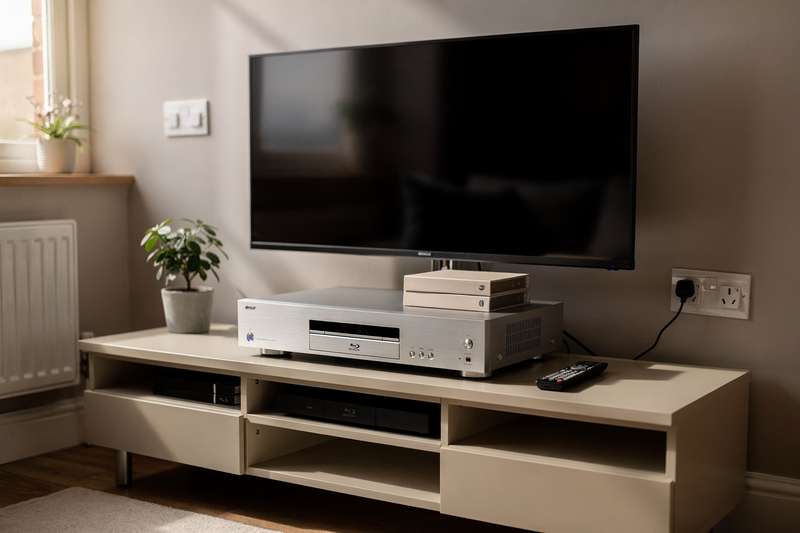
You own Blu-ray discs you’ve actually paid for. Some are out-of-print special editions that disappeared from streaming years ago; others are HDR transfers of films you care enough about to want seen properly rather than squeezed through a compressed codec. Yet the player you’ve been using takes 40 seconds to load a disc, occasionally freezes at chapter boundaries, and doesn’t support the audio codecs your soundbar actually needs. Meanwhile, catching live TV requires a completely separate box, and your recording schedule — if you have one — is held together by a device that drops series links without explanation.
The UK market for Blu-ray hardware is narrower than it once was, which makes finding the right machine harder, not easier. You need to know whether you require a Freeview or Freesat tuner, whether 4K UHD disc support is worth the additional outlay for your particular television, and whether the twin-tuner configuration on a recorder actually matters for your household’s viewing habits. It’s a lot of decisions before you’ve even added a thing to your basket.
This guide works through five specific machines — covering pure players, hybrid player-recorders, and a dedicated HDD recorder — that address different versions of this problem. Each pick is grounded in verified Amazon UK buyer feedback and genuine category knowledge, not manufacturer marketing copy. There’s a well-reviewed Freeview Play recorder for the majority of UK homes, a proper 4K UHD player for disc-first viewers, a premium twin-tuner recorder for heavy schedulers, an older but reliable HDD recorder for simpler needs, and a Freesat recorder for satellite homes where Freeview isn’t an option.
How These Picks Were Evaluated
Five criteria shaped the selection: disc format support (standard Blu-ray, DVD, and 4K UHD where applicable), UK broadcast compatibility (Freeview Play or Freesat tuner count and configuration), audio codec support for downstream AV equipment, reliability as reported across a meaningful base of verified buyer reviews rather than press samples or manufacturer claims, and genuine utility within each price tier. For recorders, the dependability of series-link scheduling and simultaneous recording capability were weighted more heavily than headline specifications — a recorder that misses episodes is worse than one with fewer features that works consistently.
Only products with verified buyer reviews on Amazon UK were considered for the main picks. A product without a meaningful review history doesn’t provide enough signal to recommend with confidence. Older models appear where they still represent the best available option for a specific use case and carry enough purchase history to draw useful conclusions. Five picks are presented here because the available product data with verified reviews supports exactly that many genuinely distinct on-topic choices, covering both the players and the recorders parts of this guide’s remit.
Best Overall: Blu-ray Player and HDD Recorder with Freeview Play
The Panasonic DMR-PWT550EB Blu-Ray Player and HDD Recorder with Freeview Play is the machine the majority of UK households should start their search with. Its 373 verified Amazon UK reviews at 4.4 out of 5 stars make it the highest-reviewed Blu-ray recorder in this guide, and that sample size — substantial for a specialist category — consistently highlights the same strengths: dependable Freeview Play integration, reliable disc loading, and a remote that doesn’t require a manual to decode.
The core proposition is three functions in one: Blu-ray player, HDD recorder, and Freeview Play device. Freeview Play gives you live terrestrial television alongside BBC iPlayer, ITVX, All4, My5, and other catch-up services, plus a 30-day rewind feature that lets you retrieve programmes you didn’t schedule in advance. That last point separates Freeview Play from older Freeview+ recorders significantly — you don’t need to have anticipated what you’d want to watch three days earlier, which is how recording used to work. The HDD means you can build up a library of scheduled recordings that sit outside the catch-up window’s time limits, preserving content no longer available on demand.
As a Blu-ray player, the PWT550 handles your existing disc collection without fuss. Full HD Blu-ray playback is solid, and DVD upscaling via HDMI performs well on modern flat-panel displays. It’s worth being clear that this is not a 4K UHD player — if you’ve started collecting Ultra HD Blu-ray titles or have a 4K HDR display you want to maximise, the Sony UBP-X700K is the better choice for that use case. What the PWT550 does well is covering the bases that matter to most UK households without overcomplicating them.
Smart network connectivity allows access to streaming content in addition to catch-up, and the interface, while functional rather than visually polished, is stable — which buyers consistently value above slicker menus that freeze mid-navigation. Setup takes longer than a basic player given the Freeview Play configuration requirements, but once done, day-to-day operation is straightforward. Buyers note the EPG loads reliably and that series-link recordings are honoured accurately, including when schedulers shift programme start times by a few minutes either side.
The honest limitation is signal type: this recorder requires a Freeview aerial and won’t serve a satellite-only household. If Freeview signal quality at your postcode is marginal or your home has no aerial, the Panasonic DMR-BS750EBK covered below is the appropriate alternative. For the majority of UK homes with a functional Freeview signal, the PWT550 covers recording, disc playback, and catch-up in a single, well-regarded package that buyers return to positively again and again.
Best 4K Ultra HD Blu-ray Player
The Sony UBP-X700K 4K Ultra HD Blu-ray Disc Player is the right choice if picture quality is your primary concern and your television is 4K HDR capable. Rated 4.4 out of 5 stars from 75 Amazon UK buyers, it plays 4K UHD Blu-ray discs with HDR10 and Dolby Vision support — the two main HDR formats you’ll encounter on current disc releases. Dolby Vision adds dynamic metadata that adjusts tone mapping scene by scene on compatible displays, producing noticeably more nuanced handling of highlights and shadow gradation than a static HDR10 curve on the right television panel.
Sony’s heritage in picture processing carries weight in this category. The UBP-X700K applies advanced upscaling to standard Blu-ray and DVD material, so your existing 1080p disc collection doesn’t become second-class content when played through this machine. The improvement on a 4K display is tangible with well-mastered transfers — you’ll notice it most in fine texture detail and in scenes with a wide contrast range. Hi-Res Audio support extends the player’s utility further: FLAC, DSD, and other lossless audio formats play back accurately from USB storage, which is useful if you have a music file library alongside your disc collection and want accurate playback without a separate device.
Where the UBP-X700K differs fundamentally from the recorder-based picks in this guide is scope: there’s no built-in HDD, no Freeview or Freesat tuner, and no integrated catch-up scheduling. This is a player, designed to do disc playback and hi-res audio well without the compromises that come from combining multiple functions in one chassis. If your television or a separate streaming stick already handles on-demand and catch-up viewing, that’s not a limitation — it’s the right design for a focused use case. If you want everything consolidated in one unit, the Panasonic recorders are better suited.
The 4K UHD format benefit is tied directly to your display. On a genuine 4K HDR television, the difference between a UHD disc and a compressed stream is visible and meaningful. On a 1080p television, a 4K player offers minimal advantage over a well-specified standard Blu-ray player — the disc’s 4K resolution cannot be rendered and HDR doesn’t apply. That’s not a reason to avoid 4K players if your display is already 4K capable, but it is a reason not to overspend on one if you’re watching on a 1080p panel with no near-term plans to change it.
Buyer feedback highlights consistent disc loading, stable performance across different disc types, and a setup process that’s uncomplicated out of the box. The remote’s button layout attracts occasional criticism — some buyers find certain controls grouped less intuitively than competing devices, particularly for frequent input switching — but this is a minor and recurring rather than serious complaint. For a disc-focused viewer with a 4K HDR display who wants the best physical media picture quality currently available, this is the pick.
Best Premium Twin-Tuner Blu-ray Recorder
The Panasonic DMR-BWT850EB Smart Network 3D Blu-Ray Disc Recorder with Twin HD is built for households that treat TV recording as infrastructure rather than an occasional convenience. Rated 4.3 out of 5 stars from 177 Amazon UK buyers, it combines twin HD tuners, Smart Network connectivity, Blu-ray playback, and HDD recording in a single unit. The twin-tuner configuration is the key differentiator: you can record two different channels simultaneously while watching a third pre-recorded programme from the HDD, which removes the scheduling conflicts that make single-tuner recorders frustrating in households where multiple people have different viewing priorities.
Smart Network integration goes beyond basic streaming app access. DLNA support allows recordings and media content to be shared across your home network — useful if you want to watch a recording from a tablet or laptop, or access the machine’s content from a networked device in another room. The interface is feature-rich, which is both a strength and a flag worth raising: there’s more to configure initially, and the menus reward some familiarisation time. Buyers who invested in that initial setup report smooth daily operation; those who expected immediate plug-and-play simplicity found the learning curve steeper than anticipated. That trade-off — depth of functionality versus immediate accessibility — is deliberate.
Blu-ray playback quality reflects Panasonic’s category expertise: consistent image processing, accurate colour handling, and reliable chapter navigation. The 3D Blu-ray capability is increasingly niche in 2026, with most viewers having moved past active-shutter 3D content, but it remains functional for anyone with a 3D display and a collection of 3D releases they still value. The recording functionality covers full HD broadcast TV — note that this is not a 4K UHD player, so UHD disc playback is outside the specification.
For households recording across multiple channels daily — managing series links for several shows simultaneously, time-shifting across different channel groups, or sharing content between rooms — the twin-tuner configuration pays its premium back in reduced friction and dropped recordings. Buyers mention series-link reliability specifically and positively: the machine handles scheduler shifts without dropping the start or end of programmes, which matters far more in practice than it sounds when reading a spec list. The Smart Network feature adds flexibility for households already using networked media alongside broadcast content.
Before purchasing, the honest question is whether you’ll use both tuners with any regularity. If most of your recording happens on a single channel at a time, the DMR-PWT550EB covers your needs at a lower outlay. The BWT850 justifies itself when the twin-tuner capability is a genuine part of your daily viewing routine — and for households that need it, this is a well-regarded machine with the review history to support the recommendation.
Best Budget HDD and DVD Recorder with Freeview+
The Panasonic DMR-EX83EB-K 250GB HDD DVD Recorder with Freeview+ requires upfront honesty: this is an HDD and DVD recorder, not a Blu-ray player. It belongs in this guide under the recorders half of the category, and its 251 reviews at 4.3 stars on Amazon UK reflect a machine that earned a strong reputation during its production run — but it will not play Blu-ray discs. If Blu-ray disc playback is a firm requirement, the PWT550 or UBP-X700K are the appropriate picks.
For buyers whose primary requirement is reliable Freeview+ recording onto a built-in hard drive — with the option to archive recordings to DVD disc for longer-term storage — the EX83 has a case to make. Freeview+ provides series link, a seven-day EPG, and the ability to pause or rewind live TV within the recording buffer. The 250GB HDD holds roughly 60 to 80 hours of standard-definition content, adequate for most households that don’t record continuously. The DVD recording option allows content to be burned to disc for permanent storage — which some buyers specifically use for preserving home video material, holiday recordings, or programmes they want to keep beyond what fits on the HDD.
The trade-off is age, and it’s an honest one. This recorder predates smart network features, catch-up app integration, and Freeview Play. It uses Freeview+, the older standard, which means no 30-day rewind, no iPlayer access through the device, and no automatic catch-up integration. If your television or a separate streaming stick handles catch-up services independently, that gap is less significant in practice. But if you’re building a new system from scratch and want integrated catch-up access alongside recording, the Panasonic PWT550EB is the more capable choice for a modest additional outlay.
Buyers who rate the EX83 positively describe it consistently as a workhorse: predictable, easy to navigate with a logically laid-out remote, and stable across years of daily use. These are exactly the qualities that matter for a device running quietly in the background of your viewing life. The 4.3-star average across 251 reviews is a meaningful signal that the machine delivered what buyers needed, even if what it delivers is now considered baseline rather than full-featured by current standards.
A practical note: this model is no longer in current production, so availability is through marketplace sellers rather than new stock. Check the condition rating and seller history carefully before purchasing. The optical disc drive is the component most likely to show wear from previous use — read condition notes for any mention of disc-loading issues and ensure a clear returns policy is in place before committing. For a budget Freeview+ recording setup where Blu-ray disc playback isn’t required and DVD archiving is a genuine use case, it remains a credible option backed by a solid review history.
Best Freesat Blu-ray Recorder for Satellite Homes
The Panasonic DMR-BS750EBK Twin Freesat Tuners 250GB HDD Blu-ray Recorder fills a specific and narrow gap: households that receive TV via satellite dish, want Blu-ray disc playback from the same device, and need to record from two channels simultaneously. Rated 3.7 out of 5 stars from 50 Amazon UK buyers — the lowest score among the picks in this guide — it requires honest assessment before recommending, and the lower rating reflects real patterns in the feedback worth understanding before purchase.
Twin Freesat tuners allow two satellite channels to be recorded simultaneously while watching a third pre-recorded programme from the HDD. Freesat carries BBC, ITV, Channel 4, Channel 5 and many additional channels without requiring a Sky subscription, and for households in rural areas or locations where Freeview signal quality is too poor to be reliable, a Freesat-based recorder is the practical solution for broadcast TV recording. The built-in Blu-ray drive removes the need for a separate player, consolidating two devices into one — which matters for households where equipment minimalism is a priority or shelf space is limited.
The 3.7-star rating warrants direct commentary. Reviewers citing negative experiences mention reliability of the EPG over extended use — with programme data occasionally dropping and requiring a manual refresh — and some report disc drive concerns after longer periods of ownership. These patterns are more common in older hardware and should be weighed against the machine’s age and the fact that it’s not a current production model. The lower score doesn’t render it unsuitable; it means setting accurate expectations before purchase is more important than with any higher-rated alternative in this guide.
If Freeview isn’t available or reliable at your address, you need Freesat, and you want Blu-ray playback alongside twin-channel recording, the BS750EBK addresses that combination directly. There’s no obvious direct competitor currently available in its exact format for UK buyers. For satellite homes where Freeview is available as an alternative, the DMR-PWT550EB is a more capable machine with a considerably stronger review profile and should be the default consideration.
Purchase through a seller with a clear returns policy, treating any used-condition units with appropriate caution given the disc drive concerns in the review history. If the EPG drops its data shortly after setup, a manual EPG download via the satellite signal resolves the most commonly reported version of that issue. For satellite homes with no Freeview fallback that need this specific combination of features, this is the pick — approached with realistic expectations about what an older, lower-rated machine can consistently deliver.
What to Look For When Buying a Blu-ray Player or Recorder
- Disc format compatibility: Standard Blu-ray plays up to 1080p full HD; 4K Ultra HD Blu-ray plays 4K HDR content from physically larger-capacity discs and requires separate hardware. A standard Blu-ray player cannot read UHD discs. DVD upscaling, available on most players, improves DVD picture quality via HDMI output. If you own or plan to buy UHD Blu-ray titles, confirm the player explicitly states 4K Ultra HD Blu-ray compatibility before purchasing.
- HDR standard support: For 4K players, HDR10 is the baseline format and widely supported. Dolby Vision adds dynamic, scene-by-scene metadata for more accurate tone mapping on compatible displays. HDR10+ is a third format used by certain studios. Check your television’s HDR format support first, then match your player to it — buying a Dolby Vision player adds no practical benefit if your TV only supports HDR10.
- Tuner type and count (for recorders): Freeview and Freesat use different signal types — your recorder must match your aerial or dish setup. A twin-tuner recorder can record two channels simultaneously; a single-tuner cannot. Freeview Play adds integrated catch-up services and a 30-day backwards programme guide that older Freeview+ recorders don’t offer — a meaningful difference for everyday use.
- HDD capacity: A 250GB internal HDD holds approximately 60 to 80 hours of standard-definition content. HD recording consumes substantially more space, so plan accordingly if you primarily record HD channels. Some recorders support external USB HDD expansion for additional storage. Check the specification before purchasing if high-volume or continuous recording is a regular part of your viewing habits.
- Audio codec support: For use with a soundbar or AV receiver, check that the player outputs Dolby TrueHD and DTS-HD Master Audio — the lossless audio formats carried on Blu-ray discs. A player that outputs only Dolby Digital or standard DTS (the compressed versions) limits what your sound system can receive regardless of how capable the downstream equipment is. Dolby Atmos is present on some discs and supported by higher-end players via bitstream passthrough to a compatible receiver.
- Connectivity: HDMI output is essential for video. Coaxial or optical audio outputs serve older AV receivers without HDMI inputs. USB ports allow playback of files from drives or memory sticks — useful for MKV, MP4, FLAC, and other file formats alongside disc playback. DLNA networking, available on some recorders and players, enables content sharing between devices on your home network without copying files manually.
- Reliability signals in buyer reviews: Published specifications can’t capture whether a recorder reliably honours series-link schedules, whether the EPG updates without manual prompting, or whether the disc drive performs consistently across two or three years of daily use. Verified buyer reviews at sufficient volume are a better guide to these practical qualities than any feature comparison. Weight review count alongside the star rating: 300 reviews at 4.0 stars tells you considerably more than 30 reviews at the same score.
Verdict
If you’re in the majority of UK homes — with a Freeview aerial, an existing Blu-ray disc collection, and a need for both live recording and disc playback from one device — the Panasonic DMR-PWT550EB is the clear starting point. Its combination of Freeview Play, HDD recording, and Blu-ray playback covers the three main needs without overcomplicating any of them, and 373 verified Amazon UK reviews at 4.4 stars provides enough purchase history to trust the reliability picture that buyers describe consistently.
If your television is 4K HDR capable and pure disc playback quality is the priority rather than recording functionality, the Sony UBP-X700K is the better pick — it handles HDR10, Dolby Vision, and Hi-Res Audio in a focused package that the recorder-format machines can’t match for outright picture quality from disc.
Households with heavier recording demands should look at the Panasonic DMR-BWT850EB for its twin-tuner configuration. Satellite homes should consider the Panasonic DMR-BS750EBK with the lower review score in mind. For a straightforward Freeview+ HDD recording setup where Blu-ray disc playback isn’t required, the Panasonic DMR-EX83EB-K is an older but well-reviewed machine that still serves that narrower brief reliably.
We were not paid to feature any specific product in this guide. All opinions are independent and based on publicly available specifications, verified buyer feedback patterns, and category research.
Quick Comparison Table


FAQ
What is the difference between a Blu-ray player and a Blu-ray recorder?
A Blu-ray player plays back discs only — it has no recording capability. A Blu-ray recorder includes one or more broadcast tuners and a built-in HDD, allowing you to record live TV, set series links, and optionally archive recordings to Blu-ray or DVD disc. If recording TV programmes alongside watching films on disc is part of your use case, you need a recorder rather than a player.
Can I play 4K Ultra HD Blu-ray discs on a standard Blu-ray player?
No. 4K UHD Blu-ray discs require a dedicated 4K UHD player and will not load or play on standard Blu-ray hardware. If you want to watch 4K disc content, the player must specifically state 4K Ultra HD Blu-ray compatibility. Standard Blu-ray players are limited to 1080p output regardless of what resolution your television supports.
What is Freeview Play, and how is it different from Freeview+?
Freeview+ is the older standard, providing a seven-day EPG, series link, and live pause or rewind within your recording buffer. Freeview Play adds integrated catch-up access from BBC iPlayer, ITVX, All4, My5 and others, plus a 30-day backwards programme guide that lets you find and start shows you missed without having recorded them in advance. For any new recorder purchase, Freeview Play is the more capable and flexible standard.
Do I need a Freeview or Freesat recorder, and how do I tell which applies to me?
Freeview works through a standard terrestrial TV aerial — the type fitted to most UK homes. Freesat uses a satellite dish and carries the same major channels without requiring a Sky subscription. If you have a rooftop or loft aerial and no dish, you need a Freeview-compatible recorder. If a satellite dish is already installed at your property, a Freesat recorder can use it. Check your current television or set-top box settings menu if you are unsure which signal type your home receives.
What audio connection do I need for the best sound quality from a Blu-ray player?
HDMI is the primary audio connection for modern setups. If your AV receiver or soundbar supports Dolby TrueHD or DTS-HD Master Audio decoding, the player should output the audio bitstream via HDMI to the receiver for decoding there. Optical and coaxial outputs carry compressed audio only and cannot transport lossless formats, limiting sound quality regardless of how capable your downstream equipment is. For Dolby Atmos, a direct HDMI connection from player to receiver is preferable to routing audio through the television.
Is physical Blu-ray still worth buying in 2026 when streaming is so widely available?
Physical media provides content that streaming platforms don’t reliably maintain: lossless audio tracks, films removed from subscription libraries, special-edition bonus features, and picture quality from a minimally compressed source. On a calibrated 4K HDR display, 4K UHD Blu-ray regularly outperforms streaming video quality even on premium-tier subscriptions. If you own a collection already or buy physical releases regularly, a quality player pays back its cost quickly compared to maintaining multiple streaming subscriptions just to access films you’ve already purchased.