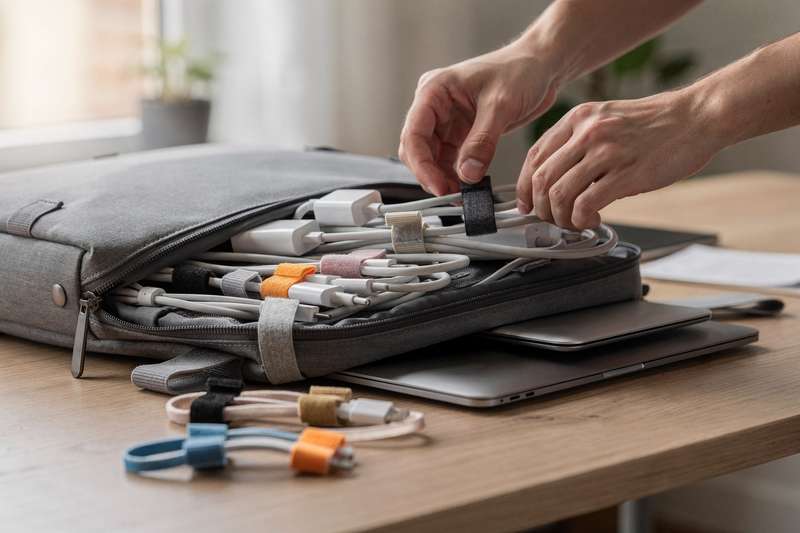
The Problem: Tangled Cables Every Time You Open Your Bag
You’ve been there. You reach into your laptop bag for your USB-C charging cable, and instead you pull out a nest — your laptop charger, a short Lightning cable, a USB-A hub, and those earbuds you forgot you’d packed are all knotted together like something from a physics nightmare. You spend two minutes unravelling the lot, usually while standing in a coffee shop queue or about to walk into a meeting. By the end of the week, one of those cables has a kink near the connector that definitely wasn’t there before.
Twist ties from the kitchen drawer? They snap after a few uses. Rubber bands? They perish, leave residue, and eventually snap at the worst moment. Zip ties? You need scissors to remove them, which rather defeats the point when you’re pulling your cable out ten times a day. You want something reusable, quick to fasten one-handed, slim enough to not bulk out your bag, and cheap enough that losing a couple isn’t a crisis.
Reusable velcro cable ties tick every one of those boxes — if you pick the right type. This guide tells you exactly what to look for and which styles and specs are worth your money on Amazon.co.uk right now.
How We Evaluated These Picks
To put this guide together, we looked at a broad range of reusable cable ties available to UK buyers, focusing specifically on velcro and hook-and-loop designs suitable for daily use inside a laptop bag, backpack, or briefcase. Our evaluation criteria were: grip strength and whether the velcro holds securely without slipping open under the friction of a packed bag; pack count versus price per unit; width and length options, since a 12mm narrow tie behaves very differently to a 25mm wide one; material durability over repeated fastenings; whether the design is one-wrap (self-fastening) or needs threading through a loop; ease of use with one hand; and real reviewer feedback patterns across verified UK purchases. We also weighed up edge cases — ties that work for thin USB-C cables but fail to hold a chunky 65W laptop charger cable, and vice versa.
Quick Picks at a Glance
| Best For | Price Range | Key Feature |
|---|---|---|
| Best overall everyday use | £5–£10 | One-wrap self-adhesive, 100-pack |
| Best for thick laptop charger cables | £6–£12 | Wide 25mm strap, high-grip loop |
| Best budget pack for commuters | Under £5 | 50-pack narrow ties, multiple colours |
| Best for neat desk-to-bag organisation | £8–£15 | Labellable surface, assorted lengths |
| Best for USB-C and earphone cables | £5–£8 | Slim 10mm width, soft backing |
| Best heavy-duty reusable option | £10–£18 | Industrial-grade hook-and-loop, 200mm length |
| Best multi-colour coding system | £6–£10 | Five colours in one pack, pre-cut 200mm |
Best Overall: One-Wrap Velcro Ties in a Large Pack
If you only buy one type of cable tie for your laptop bag, this is the format to choose. One-wrap ties are a single strip of hook-and-loop material where one face is the hook side and the other is the loop side. You wrap the tie around your bundled cable, then fold the tail back onto itself — the two surfaces grab each other instantly. No threading, no buckling, no fiddling. You can do it one-handed while the other hand holds your cable. That matters more than it sounds when you’re packing up quickly.
Look for a pack of at least 50 ties in a mixed length range — typically 150mm and 200mm options. The shorter ties handle USB-C cables, charging bricks’ output cables, and earphone leads without creating unnecessary bulk. The 200mm length is better for laptop charger cables, short extension leads, and HDMI or DisplayPort cables that have more stiffness and girth. A pack of 100 ties at this price point works out to pennies per tie, which means losing a couple in the bottom of your bag genuinely doesn’t matter.
The width to aim for is around 12–15mm. Narrower than 10mm and the velcro grip area becomes so small that the tie can pop open when your cable shifts in the bag. Wider than 20mm and you’re overkilling it for light cables — the ties become bulky around a slim USB-C lead. At 12–15mm, the grip is firm enough to stay closed through a full day of bag movement while still being easy to pull apart with a light tug.
Where this style does struggle is with very thick cables — think the chunky barrel-connector charger for an older Dell or HP laptop, or a heavy-gauge extension cable. The short length means you’re wrapping around a large circumference, and the velcro tab ends up with very little overlap. For those cables, you’re better off with the wider, longer ties described in the next section. But for 80% of what goes into a typical laptop bag — USB-C cables, Lightning cables, a compact laptop charger, earphones, a USB hub’s pigtail — this format is the right tool.
Best for Thick Laptop Charger Cables: Wide 25mm Hook-and-Loop Straps
A 65W or 90W GaN charger for a modern laptop typically has a cable that’s noticeably thicker and stiffer than a phone charger. When you bundle it into a coil, the natural spring of the cable pushes back against a narrow tie. A 10mm or 12mm tie fastened around a thick coil often pops open partway through the day because the velcro overlap zone is tiny. Wide ties — 20–25mm — solve this immediately. The grip area is proportionally larger, and the fabric itself is usually more robust.
What you’re looking for here is a hook-and-loop strap that’s at least 200mm long and 20mm wide, ideally with a sewn or reinforced loop end. The loop design differs from the one-wrap format: instead of wrapping around itself, you thread the tail through a fixed fabric loop at one end, then fold the hook side back onto the loop surface. This creates a cinching action that holds more firmly under tension — useful when a stiff cable is actively trying to uncoil. It also means you can loosen without fully removing the tie, which is handy for partial cable runs at your desk.
The tradeoff is that threading ties take marginally longer to fasten than one-wrap ties. If you’re attaching and removing your ties ten times a day, that friction adds up. Many people find a hybrid approach works best: one-wrap narrow ties for thin cables you pull out constantly, and wider threading ties for the laptop charger that goes in the bag once in the morning and comes out once at your desk.
When shopping, check that the hook side of the velcro is covered or faces inward in the bundled state. Exposed hook surfaces on cable ties are notorious for snagging on the lining of laptop bags, jacket pockets, and the loop side of other velcro straps in the same bag compartment. A well-designed wide strap stores with the hook side pressed against the loop surface or wrapped inward, so it’s not snagging anything when you rummage through your bag.
Best Budget Pick: Narrow Multi-Colour Ties Under £5
Not every cable needs a premium tie. If you’re primarily trying to stop USB-C cables, phone chargers, and earphone leads from tangling in the main pocket of your bag, a basic 50-pack of narrow one-wrap ties in the £3–£5 range does the job reliably. These tend to be 10mm wide and 150mm long — slim enough that when wrapped around a coiled cable they add almost no visible bulk.
The colour coding is the underrated feature here. When you assign a colour to each cable type — say, red for your laptop charger, black for USB-C data cables, blue for earphones — you can identify a cable by the tie colour before you even pull it out of the bag. That saves the ten seconds of unravelling and re-examining that happens when four identical-looking black cables are loosely packed together.
At this price point, the velcro quality is noticeably lower than on premium ties. The hook fibres are shorter and less dense, which means the grip degrades faster with repeated opening and closing. Expect around 300–500 fastenings before a cheap tie starts to lose its hold — which still represents months of daily use for most people. If you travel frequently and are opening and closing ties multiple times a day, spend a bit more for denser velcro. If you’re a regular commuter who packs and unpacks once daily, the budget option performs fine for a long time.
Avoid packs that don’t specify the material of the backing. Some ultra-budget ties use a very thin woven backing that frays at the edges after the first few weeks, leaving loose fibres that snag on cables. Look for ties described as having a nylon or polyester woven backing — these hold their edge integrity significantly better than plain-weave alternatives.
Best for Desk-to-Bag Organisation: Ties with Labellable Surfaces
If you’re regularly moving cables between a home office desk setup and a laptop bag — perhaps you’re hybrid working and packing the same kit every Monday — labellable cable ties are worth the small price premium. These are slightly wider than standard (typically 15–20mm), and one section of the strap has a flat, light-coloured writeable surface, either a strip of smooth polyester or an integrated label area designed for a fine-tipped permanent marker.
The practical benefit is obvious: you write “HDMI 2m”, “USB-C 65W”, “USB Hub” directly on the tie. No more pulling out four near-identical cables and tracing them by connector type under poor lighting. For anyone who manages multiple laptops or docks — say, a freelancer who works across a personal MacBook and a work Windows machine — this kind of labelling system prevents the slow-creeping chaos of accumulating cables with no easy way to tell them apart.
The label surface is worth scrutinising in reviews. Some ties have a genuinely smooth patch that takes a Sharpie cleanly and doesn’t smear. Others have a slightly textured surface that causes marker bleed, or a surface that the ink wipes off after a few days of contact with other surfaces in the bag. Look for buyer reviews that specifically mention writing legibility and longevity — these comments are usually easy to find and give you a realistic sense of whether the label surface works.
Assorted-length packs are worth seeking out in this category. Having 150mm, 200mm, and 300mm ties in the same pack lets you match tie length to cable girth — a short tie for a slim USB-C cable, a longer tie for a laptop charger that coils to a wider diameter. Some packs also include colour-coded sizes, which doubles as both a length indicator and a cable-type identifier without needing to write anything at all.
Best for USB-C and Earphone Cables: Slim 10mm Soft-Back Ties
The thinnest cables in your bag — USB-C to USB-C data cables, braided earphone leads, short Lightning cables — deserve a tie that’s proportionally slender. A 20mm wide tie around a 4mm diameter USB-C cable looks absurd and creates unnecessary bulk in a tight bag compartment. A 10mm slim tie wraps neatly, holds firmly on the small diameter, and adds virtually nothing to the packed profile.
The key specification here, beyond width, is the backing material. Earphone cables in particular are prone to micro-damage from sharp hook velcro fibres catching on the outer jacket. Look for ties that describe a soft or microfibre loop face on the inside — the part that contacts the cable directly. The hook side grips the loop side of the velcro on the outside of the wrapped tie, but the inner surface touching your cable should be smooth and gentle. Some brands specifically advertise a “cable-friendly” inner face; in practice, this just means the inner surface is the loop side rather than the hook side, which is the correct design for any well-made one-wrap tie.
Cable length is shorter for this use case — 100mm to 150mm is usually adequate. A 200mm tie on a thin USB-C cable creates excessive overlap that folds and looks untidy. At 100–150mm, you get two full wraps around a slim cable coil with a tidy finish. If you’re buying a multi-size pack and want to dedicate the smallest ties specifically to your thinnest cables, this approach keeps everything proportionate and makes opening your bag look satisfyingly organised rather than merely “less chaotic than before”.
Silicone ties are sometimes marketed for this same use case and are worth considering alongside velcro. They’re reusable, stretch to accommodate different cable diameters, and leave zero residue. The tradeoff is that silicone doesn’t stay closed as reliably as velcro under repeated movement — they can slip open in a bag. Velcro wins on secure closure; silicone wins on gentleness. For daily bag use, velcro is the more practical choice.
Best Heavy-Duty Reusable Option: Industrial-Grade Hook-and-Loop
If your laptop bag carries more than just a laptop charger — perhaps you’re a photographer, a field engineer, or someone who packs AV gear, power adapters, and short extension leads — standard consumer velcro ties may not hold reliably around the thicker, stiffer cables involved. Industrial-grade hook-and-loop ties use denser hook fibres, a heavier woven backing, and in some cases a reinforced stitch at the loop end that withstands repeated heavy tension without tearing away from the strap.
Look for ties rated to hold under repeated tensile load — some manufacturers specify a holding strength in kilograms, which gives you a sense of how robust the velcro bond is. For cable management, this is less about the cable pulling the tie off and more about the stiffness of a coiled heavy cable trying to spring open. A 200mm by 20mm industrial tie on a coiled IEC power cable or a stiff 3-metre extension lead holds where a standard consumer tie pops open within minutes.
The price premium is real: industrial ties typically cost two to three times per unit what consumer ties cost. But if you’re buying a 20-pack for specific use with your heaviest cables, the per-unit cost is still modest — and you’re solving a problem that cheaper alternatives simply fail at. Many buyers in this category report that they use industrial ties on the three or four heaviest cables in their kit and standard consumer ties on everything else, which is a sensible and cost-effective approach.
One thing to check: industrial hook-and-loop can be aggressive enough to snag soft bag linings. If your laptop bag has a fleece or microfibre interior, keep the hook side tucked inward or opt for a design where the hook surface is fully enclosed when the tie is fastened. A snagged bag lining doesn’t ruin the bag immediately, but over time it pills and wears, which is irritating given that this is entirely avoidable.
Best Multi-Colour Coding System: Five-Colour Assorted Pack
Colour coding your cables is one of those simple habits that genuinely changes how quickly you can set up and pack down your workspace. A five-colour assorted pack — typically including black, red, blue, green, and yellow ties — gives you enough distinct colours to assign one per cable type across a standard laptop bag loadout. Assign black to your laptop charger, red to your portable battery, blue to USB-C data cables, green to HDMI, and yellow to earphones. After a week of using this system, reaching into your bag becomes intuitive rather than investigative.
When evaluating these packs, look for consistency in velcro quality across colours. Cheaper multi-colour packs sometimes have inconsistent loop density between colours — the red ties grip more firmly than the blue ones, for example — which suggests the manufacturer is using offcuts from different production runs rather than a consistent product. Reviews that mention specific colours losing grip sooner than others are a warning sign worth heeding.
Pre-cut length is important in this category too. The best multi-colour packs offer all five colours at the same length (usually 200mm), so your system is consistent — every tie works the same way regardless of the cable. Some cheaper packs mix lengths within colour batches, which means your “system” breaks down when you reach for a yellow tie and find it’s 150mm rather than the 200mm you used last time. Check the product description carefully for whether each colour is available in consistent lengths.
The velcro surface colour itself is worth a brief mention. Bright colours look smart when your bag is freshly organised but can look tatty as the loop side accumulates fluff and lint over time — which all velcro does. Dark colours (black, navy, dark green) show lint accumulation less and look presentable for longer. If the organised appearance of your cable management matters to you visually, factor this in when choosing your colour scheme.
What to Look For When Buying Reusable Velcro Cable Ties
- One-wrap vs. threading loop design: One-wrap ties (hook one side, loop the other side of the same strip) are faster to use with one hand and suit thin-to-medium cables. Threading loop ties cinch more firmly and suit thicker, stiffer cables that push back against the tie. Most cable bags benefit from having both types.
- Width and length match your cables: Slim 10mm ties for USB-C and earphones; 15–20mm for standard charger cables; 25mm+ for thick laptop charger or AV cables. Length should allow at least 40–50mm of velcro overlap after wrapping — shorter overlap means weaker hold and faster pop-open failure.
- Velcro density and grade: Consumer grade is fine for daily bag use with standard cables. Industrial grade is worth paying for if you’re managing stiff cables that actively resist being bundled. Check reviews for comments on how many months before the grip starts to degrade.
- Hook side orientation: The hook side should face outward (away from the cable) and press against the loop side of the closed tie. Hook fibres facing inward against your cable jacket will gradually abrade or snag it — particularly bad for delicate braided cables and earphone leads.
- Pack size and value per unit: For casual daily commuters, a 50-pack lasts a very long time and costs almost nothing per tie. For professionals managing a lot of cables or working in environments where ties get lost frequently, a 100-pack makes sense. Avoid buying singles or very small packs — the price per unit is disproportionate.
- Colour and labelling options: Multi-colour packs add organisational utility beyond just bundling. Labellable ties add another layer. Neither is essential, but both make the habit of organised cabling easier to sustain day-to-day.
- Backing material quality: Nylon and polyester woven backings hold their shape and edge integrity far better than thin plain-weave options that fray after a few weeks. A fraying tie sheds fibres into your bag lining and onto cable connectors — annoying and preventable.
Comparison Table
| Type | Width | Typical Length | Best Cable Diameter | Pack Size | Price Range |
|---|---|---|---|---|---|
| One-wrap narrow (everyday) | 12–15mm | 150–200mm | Up to 15mm coil | 50–100 pack | £5–£10 |
| Wide threading loop (heavy cables) | 20–25mm | 200–300mm | Up to 30mm coil | 10–30 pack | £6–£12 |
| Budget narrow multi-colour | 10mm | 150mm | Up to 10mm coil | 50 pack | Under £5 |
| Labellable assorted length | 15–20mm | 150–300mm mixed | Up to 20mm coil | 20–50 pack | £8–£15 |
| Slim soft-back (USB-C/earphones) | 10mm | 100–150mm | Up to 8mm coil | 50–100 pack | £5–£8 |
| Industrial grade heavy-duty | 20mm | 200mm | Up to 40mm coil | 10–25 pack | £10–£18 |
| Five-colour coding pack | 12–15mm | 200mm | Up to 15mm coil | 50–100 pack | £6–£10 |
Verdict
For the vast majority of UK laptop bag users — a daily commuter or hybrid worker carrying a laptop charger, two or three USB-C cables, earphones, and maybe a USB hub — the best starting point is a 100-pack of one-wrap narrow ties in the 12–15mm width at the £5–£10 price point. This format handles the widest range of typical cable diameters, fastens and releases in under a second one-handed, and costs so little per unit that attrition from loss or wear is irrelevant.
If your laptop charger has a particularly thick, stiff cable (common with older barrel-connector adapters or high-wattage GaN chargers), pair this with a small set of wider 20–25mm threading-loop ties specifically for that cable. The two types together cover your entire bag for under £15 in total.
Add a five-colour pack if you want a colour-coding system — once you’ve used one for a month you’ll genuinely wonder how you managed without it. Skip the industrial ties unless you’re regularly managing AV or power extension cables heavier than a standard laptop charger. And always, always check that the hook face of the velcro is oriented outward — your braided cables will thank you.
Editorial note: We were not paid to feature any specific product in this guide. All opinions are independent and based on publicly available specifications, verified buyer feedback patterns, and category research. Prices shown were accurate at time of writing and may change.
FAQ
Are velcro cable ties genuinely reusable, or do they lose grip after a few uses?
Quality velcro cable ties are designed for hundreds of fastenings. Consumer-grade ties typically remain reliable for 300–600 open-and-close cycles before the hook fibres flatten and grip degrades. Industrial-grade ties last significantly longer. The main cause of early grip failure is lint and fluff accumulating in the loop side — a quick brush with an old toothbrush restores most of the grip.
What width of cable tie should I use for a USB-C laptop charger cable?
A 12–15mm wide, 200mm long one-wrap tie handles most compact USB-C GaN charger cables comfortably. If your charger cable is particularly stiff or thick (common with 90W+ adapters and older barrel-connector chargers), step up to a 20–25mm wide tie with a threading loop for a more secure hold. The key is having enough velcro overlap — aim for at least 40mm of hook-on-loop contact after wrapping.
Will the hook side of a velcro tie damage my cables?
It can, if the tie is designed or applied incorrectly. The hook side should face outward, gripping the loop side of the closed tie, not pressing against your cable’s outer jacket. For delicate braided cables and earphone leads in particular, always ensure the inner face touching the cable is the soft loop side. Look for ties explicitly described as having a soft or loop inner face.
How many cable ties do I actually need in my laptop bag?
For a typical laptop bag loadout — charger, two USB-C cables, earphones, USB hub cable — five to eight ties covers everything with a spare. A 50-pack will last most people over a year of daily use, accounting for occasional losses in bag pockets. A 100-pack is worth buying simply because the per-unit cost drops further and you’ll never run short.
Can I use velcro cable ties on very thin cables like earphone leads without damaging them?
Yes, provided you choose the right tie. Use a slim 10mm wide tie that’s 100–150mm long, and ensure the inner face is the loop (soft) side. Avoid tightening the tie so firmly that it pinches the cable — velcro ties should secure a coil, not constrict an individual cable. Wrapping the cable into a loose figure-of-eight before applying the tie further reduces stress on connectors and cable jackets.
Are velcro ties better than silicone ties for laptop bags?
For most bag use, yes — velcro ties stay closed more reliably under the movement and friction of a packed bag, and they’re faster to open and re-fasten. Silicone ties are gentler on cable jackets and don’t accumulate lint, but they can slip open in a bag with other items pressing against them. If you’re primarily managing delicate cables and keeping them in a dedicated cable pouch rather than loose in a bag pocket, silicone is a reasonable alternative. For general bag use, velcro wins on practicality.