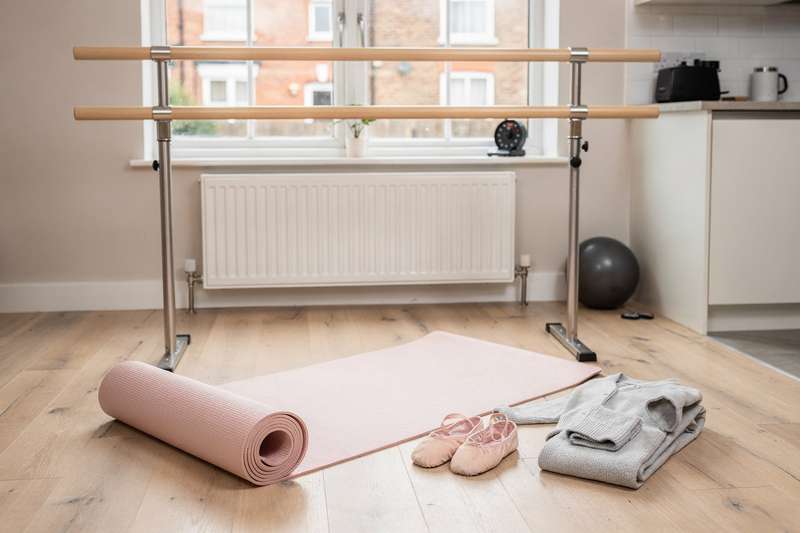
Picture this: you’ve cleared a section of the front room, pushed the furniture aside, and you’re trying to get in some meaningful practice between lessons. But the carpet creates enough friction to wreck any pirouette you attempt, the laminate in the hallway has a grain that catches your foot mid-spin, and every time you try to work on the arch point your teacher keeps mentioning, you’re not sure whether what you’re doing is helping or quietly reinforcing poor habits. If you’re a dedicated home dancer — or a parent supporting a child who takes their ballet seriously — you’ve probably already worked out that the gap between studio-quality practice and what’s achievable at home comes down partly to surface, partly to targeted training tools, and partly to the flexibility kit you build around them.
The problem is that searching for ballet equipment on Amazon returns an overwhelming mix: professional-grade barres at near-studio prices, cheap plastic boards that snap after a fortnight, and stretching bands from general fitness ranges that don’t understand the specific demands of ballet training. This guide cuts through that noise by identifying the pieces of equipment that actually make a difference to home practice — the ones that give you measurable improvements in technique, flexibility, and turn consistency without requiring a converted studio space or an unrealistic budget.
How These Picks Were Evaluated
Each product was assessed against five consistent criteria: direct relevance to ballet home training rather than general fitness crossover, build quality signals drawn from patterns in verified buyer reviews, suitability across beginner-to-intermediate skill levels, durability over repeated sessions rather than just initial impressions, and practical value relative to what you actually receive. Products attracting consistent complaints about materials failing early, misleading size descriptions, or inadequate instructions were excluded regardless of their headline star rating. Where two products served a near-identical purpose, the one with deeper, more substantive buyer feedback was prioritised. The aim throughout was tools you’ll still be reaching for after six months — not the ones that look appealing in a thumbnail and gather dust by week three.
Best for Home Practice Surface
If there is one piece of equipment that transforms the quality of your entire home practice, it is the surface you dance on — and the Brand Portable Dance Floor, Marley Flooring Ballet Training Equipment, Turning Boards for Dancers & Figure Skating Practice Mat addresses exactly that. Rated 4.8 out of 5 stars from over 340 verified purchasers, this is the most substantively reviewed premium option in this guide, and the buyer feedback tells a consistent story: once you’ve practised on a proper Marley-style surface, going back to laminate or carpet feels like working on entirely the wrong terrain.
The core function here is replicating the slip-resistance characteristics of a professional dance studio floor. A proper portable vinyl dance surface gives your foot enough grip to push through relevé without slipping, while allowing the controlled glide necessary for pirouettes and turns. Carpet is too grabby and uneven; polished hardwood and domestic laminate offer too little resistance for clean footwork and can be hazardous for pointe work. The portable format means you can roll this out in a living room, cleared hallway, or garage, run your session, and store it rolled up without any permanent modification to your home.
For serious home practice — whether you’re an adult returning to dance or a teenager preparing for a RAD or ISTD examination — this is the foundational piece of kit. Without the right surface, your turning board, foot stretcher, and flexibility bands all have to compensate for the floor’s limitations rather than addressing your technique’s limitations. Buyer reviews frequently mention this product being used for exam preparation, practice during studio closures, and regular conditioning between twice-weekly classes.
The tradeoff is clear: this sits at the premium end of this guide’s picks, and the investment is substantial. It also requires storage space when rolled up, and for a very small practice area — a bedroom rather than a cleared living room — the dimensions may feel constraining. Measure your available floor space carefully before committing. That said, the quality signals from buyer feedback are among the strongest in the ballet equipment category on Amazon UK, and a 4.8-star average across 340-plus purchases is notably high for this product type.
This suits the home dancer who treats their practice seriously enough to invest in the infrastructure around it. If you’re doing three or more home sessions per week and finding that your floor actively works against your technique — particularly for turning and footwork — the difference this surface makes is substantial. Think of it as the equivalent of buying a proper yoga mat for yoga: technically optional, practically transformative for the quality of every session that follows.
Best Foot Arch Trainer
The Ballet Foot Stretcher Set Original Pine Dance Feet Arch Enhancer for Dancer, Gymnastics, Yoga People addresses one of the most specific and persistent frustrations in ballet training: building the arch and instep flexibility that teachers ask for, at home, without a physiotherapist present at every session. Rated 4.6 out of 5 stars from 115 verified buyers, this pine-construction set achieves something relatively rare in this category — it attracts consistent praise not just for what it does, but for how thoughtfully it’s designed around a dancer’s specific anatomy and movement requirements.
The pine construction matters more than it might initially seem. Wooden foot stretchers produce a more natural, graduated stretch than rigid plastic equivalents, and pine is light enough to make the tool portable while being strong enough to hold the stretch position without flexing unexpectedly under load. The set format allows you to work on different stages of the stretch — moving from a gentler opening position to a more demanding one as your flexibility develops over weeks. For dancers whose teachers have noted that arch and pointed foot technique need attention, this kind of systematic daily conditioning fills a real gap between class days.
One thing to understand about any foot stretcher is that it should feel like a deliberate, sustained stretch — never sharp pain. The 4.6-star rating here reflects buyers who used it as directed and saw meaningful improvements over several weeks of consistent use. The review patterns also suggest it works across a wide age range: adult dancers returning to ballet find it as effective as younger students preparing for exams, and the crossover with gymnasts in the reviewer base tells you something useful about its broader effectiveness for arch development beyond ballet specifically.
The tradeoff is patience. A foot stretcher is not a quick fix — it’s a conditioning tool that requires regular use over weeks and months to produce visible improvement in your arch. Buyers who reported disappointment had typically expected faster results or used the tool sporadically. Commit to 10–15 minutes of daily stretching and you’ll likely notice meaningful changes within a few weeks; skip sessions regularly and the tool delivers little. If you’re not confident you’ll build a consistent habit around it, a door flexibility strap may give you a quicker sense of progress across a broader range of movements.
If your teacher has mentioned your arch specifically, or you’ve noticed in class recordings that your foot point lacks the instep curve ballet technique requires, this foot stretcher set is the most targeted conditioning tool available at this price level on Amazon UK. Compact enough to store in a dance bag and take to practice, it works best as a daily complement to class instruction rather than a standalone fix.
Best Turning Board for Pirouette Practice
The CampTeck U6766 Dance Turning Board Ballet Pirouette Spin Board for Ballet Dancers, Foot Balance Training, Rotation Practice, Figure Skating is the most reviewed turning board in this guide — 538 buyer assessments and a 4.5-star rating — a combination that provides solid purchasing confidence across a broad range of dancer profiles. A turning board is one of those training tools that seems almost too simple to be useful until you actually use one, at which point the feedback it creates for drilling turns becomes surprisingly compelling.
The principle is straightforward: the board’s low-friction base allows your supporting foot to rotate freely, so when you practise a pirouette, the board removes floor resistance and lets you concentrate entirely on body alignment — core engagement, spot, arm placement, and balance on your relevé — rather than fighting the mechanics of the spin itself. Used consistently, this translates into cleaner, more controlled turns when you return to a normal studio floor, because your body has learned the correct alignment cues without floor friction as a competing variable. Ballet teachers use turning boards in studio settings for exactly this training purpose.
The CampTeck U6766 specifically is well-regarded for its build stability. The consistent theme in buyer feedback is that the board doesn’t slide around during use — a problem with cheaper alternatives that undermines the whole point of the exercise. The bearing mechanism receives positive mentions for producing a smooth spin without being so frictionless that control becomes impossible to maintain. For a dancer working on anything from single pirouettes to multiple turns, the board’s rotation resistance is calibrated in a way that supports technique development rather than working against it.
Where this product is less suited: if your home floor is highly polished or tiled, place the board on a small mat or use it on your Marley surface if you have one — otherwise the board can shift mid-turn, which defeats its purpose entirely. It’s also worth being clear that a turning board is a supplementary training aid rather than a core piece of kit; it works best when your teacher has already explained what correct pirouette alignment should feel like, giving you something specific to aim for when practising solo at home.
For any dancer whose teacher has flagged inconsistent or unreliable turns, or who finds pirouettes work in isolation but fall apart in combinations, the CampTeck U6766 offers structured solo practice that targets exactly those issues. With the strongest review base of any turning board in this guide, it’s the option that carries the most confidence for a first turning board purchase on Amazon UK.
Best for Flexibility and Splits Training
The Leg Stretcher, Door Flexibility & Stretching Leg Strap – Great for Ballet Cheer Dance Gymnastics or Any Sport takes a different approach to flexibility work from a standard handheld stretch band — it uses a door anchor to hold one end of the strap, letting you work on splits, leg extension, and hip flexibility with consistent, controllable resistance that’s difficult to achieve without a fixed anchor point. Rated 4.4 out of 5 from over 400 verified buyers, this is one of the more substantively reviewed flexibility tools in the ballet equipment category on Amazon UK.
The door-anchor mechanism is the key differentiator. By fixing one end of the strap at a set height using any standard door frame, you can hold your leg at a consistent angle and focus on deepening the stretch rather than stabilising equipment simultaneously. For ballet specifically, this is particularly effective for arabesque extension work, développé height, and the hip flexor opening required for front splits — all areas where consistent daily stretching produces the most visible gains over time. Setup takes under a minute, the height is adjustable to target different muscle groups, and the door holds the position steady while you focus on alignment.
The reviewer base of 400-plus surfaces some reliable observations: the strap is durable enough for daily use, the door anchor doesn’t damage frames when used as directed, and the adjustability covers a wide height range. Parents buying this for younger dancers frequently note that the adjustability means it remains useful as a child’s flexibility improves — rather than becoming redundant once a certain range of motion is achieved — which makes it a reasonable long-term investment even for a dancer early in their training.
One limitation worth being clear about: the leverage a door anchor provides can make it easy to overstretch if you’re impatient. Ballet flexibility develops progressively, and the hip flexors, hamstrings, and lower back are areas where pushing too hard carries real injury risk. Used carefully — sustained holds of 30–60 seconds per position, never pushing into pain — this is highly effective as a warm-up or cool-down component. Used aggressively by someone chasing rapid results, the risk of strain increases significantly.
For dancers at any level working on splits, higher leg extensions, or the hip flexibility ballet demands, this leg strap is one of the more practical and affordable options for structured daily flexibility work at home. The door mechanism makes it well-suited to a domestic setting, and the 4.4-star rating across a large reviewer base gives it credibility that thinner-sample products simply can’t match.
Best Budget Spinning Aid
For dancers who want to explore turning board practice without a significant financial commitment, the Ballet & Dance Turning Spin Board Pirouettes Exercise Foot Training Tools provides an accessible entry point into this training method. Rated 4.2 out of 5 stars from 118 reviewers, it sits below the CampTeck U6766 in both review volume and rating, but for a dancer testing whether turning board practice suits their routine before investing more, it offers a reasonable starting point.
The core function is the same as any turning board: a low-friction rotating surface that lets your foot spin freely, enabling you to isolate balance, spot, and upper body alignment from floor resistance. At this price tier, the tradeoffs compared to a higher-specification board typically involve the bearing mechanism’s consistency over extended use and overall build robustness under intensive daily drilling. The review pattern reflects this honestly — buyers using it for moderate home sessions report satisfaction, while those incorporating it into daily intensive training occasionally note the mechanism feeling less consistent after extended use. For a younger dancer practising a few times per week, that distinction is unlikely to matter within a reasonable ownership period.
This product suits you specifically if you’re a parent buying for a child who’s curious about pirouette training and you want to gauge their commitment before spending more, or if you’re an adult recreational dancer who practises a couple of times per week and wants to explore turning board work alongside other home training tools. The lower cost makes it easier to absorb into an overall equipment budget without any single purchase feeling disproportionate to the session frequency it supports.
The 4.2-star rating is an honest reflection — a solid tool for its use case and price level, not something that dramatically outperforms its category. Buyers who rate it lower tend to be those who expected premium-level bearing smoothness or who used it more intensively than the build is designed for. Set realistic expectations accordingly and it serves its purpose well for moderate home practice.
Based on reviewer patterns, one practical tip: use this board on a surface with slight texture — a yoga mat, a small rug, or a Marley surface — rather than on a highly slippery floor. This reduces the risk of the board shifting mid-turn and improves the training experience noticeably. As a budget entry into turning board practice, it’s a sensible way to assess whether this category of training tool fits your routine before committing to a more robust option.
What to Look For in Ballet Training Equipment
Before adding anything to your basket, it’s worth understanding what actually separates effective ballet training equipment from products that look promising in a listing but fall short in practice. Here are the key criteria specific to this category:
- Purpose specificity: Ballet has distinct physical demands — arch flexibility, instep extension, pirouette control, leg extension — that require targeted tools. A general fitness stretching band won’t give you the same result as a dedicated dance foot stretcher designed around a dancer’s anatomy. Look for products built specifically with dancers’ movement patterns in mind, not repurposed gym accessories with dance branding applied.
- Surface compatibility: If you’re buying a turning board or portable dance floor, check that it performs on your home surface type. A board designed for studio wood floors may behave differently on domestic laminate or tiles. Buyer reviews mentioning specific home floor types are particularly useful — look for comments from people with the same surface conditions as yours.
- Build material and durability signals: For foot stretchers, natural materials like pine or solid wood produce a more organic, graduated stretch than rigid plastic. For turning boards, the bearing mechanism determines how smooth and consistent the spin is over time. Scan review patterns for mentions of materials cracking, bearings seizing, or components loosening after several months of regular use.
- Adjustability and size range: Flexibility equipment benefits significantly from adjustability. A leg strap with multiple anchor-point heights covers a wider range of exercises and body sizes. For foot stretchers, check that the dimensions suit the intended user’s foot — adult and children’s feet require different specifications, and an oversized device won’t produce the correct stretch geometry on a smaller foot.
- Portability and storage: Home practice spaces are usually shared-use rooms, so equipment that folds, rolls, or compacts easily is considerably more practical than bulky alternatives. A Marley surface rolls for storage; a good turning board fits in a standard dance bag. If storage space is constrained, prioritise compact tools over equipment that occupies permanent floor space when not in use.
- Review depth and volume: In this category, a product with 400-plus verified reviews is far more trustworthy than one with fewer than 50, even if headline ratings look similar. Look for reviews describing use over multiple weeks or months, and distinguish between negative reviews revealing a systemic product issue versus those reflecting mismatched expectations.
- Teacher guidance as a prerequisite: Ballet equipment works best when you know what you’re trying to achieve with it. A foot stretcher used without teacher-guided awareness of safe stretching technique carries a real injury risk. A turning board is most effective when you already understand what correct pirouette alignment feels like. Equipment amplifies your practice — it doesn’t replace the instruction that gives that practice its direction.
Verdict
For most home dancers reading this — whether you’re a teenager practising between twice-weekly classes or an adult returning to ballet after a break — the single most impactful piece of equipment from this guide is the portable Marley dance surface. The floor you practise on affects every technique element you’re working on: turns, relevés, footwork, and landings all behave differently on a proper dance surface compared to domestic flooring, and every other piece of kit becomes more effective when the surface underneath you isn’t working against your technique.
If the Marley floor’s investment doesn’t fit your current situation, the CampTeck U6766 Dance Turning Board Ballet Pirouette Spin Board offers the best combination of proven quality and practical impact for the outlay. With 538 buyer assessments and a 4.5-star rating, it targets one of the most common home practice frustrations — inconsistent turns — and fits in a standard dance bag. Pair it with the door leg stretcher for daily flexibility work, and you’ve built a meaningful home training toolkit that addresses the technical areas ballet development demands most, at a fraction of what additional studio sessions would cost.
Whichever pieces you prioritise, buy based on what your teacher is actively working on with you. Equipment that targets your actual training goals will outperform speculatively purchased kit every time.
We were not paid to feature any specific product in this guide. All opinions are independent and based on publicly available specifications, verified buyer feedback patterns, and category research.
Quick Comparison Table


FAQ
Do I need a barre to practise ballet at home?
A barre is useful for warm-up exercises and alignment drilling, but it’s not the only way to practise effectively at home. A sturdy chair back, a kitchen worktop at the right height, or a wall can serve as adequate substitutes for most foundation exercises. Portable freestanding barres are available if you want a dedicated setup, but for most home dancers, targeted technique tools like turning boards and flexibility straps tend to deliver more improvement per pound spent than a barre alone — particularly if floor space is limited.
At what age can a child start using a foot stretcher?
Foot stretchers are generally suitable from around age 8 upwards, once a child has been dancing for at least a year and has developed teacher-guided awareness of safe foot and ankle positioning. Younger children’s bones and connective tissue are still developing, which makes unsupervised use of any arch-stretching device higher risk. Always consult your child’s ballet teacher before introducing a foot stretcher, and supervise the first several sessions carefully to ensure correct positioning and use.
Will a turning board actually improve my pirouettes?
A turning board can meaningfully improve pirouette consistency when used as part of structured practice — it helps you isolate balance, spot, and core engagement by removing floor friction as a variable. However, it’s a supplementary tool rather than a shortcut. If your pirouette technique has fundamental issues with preparation, arm placement, or spot, a turning board won’t correct those; it will let you spin with the same issues more easily. Use it alongside teacher feedback, not instead of it.
What surface should I practise ballet on at home?
The ideal home surface is a sprung wood studio floor — which virtually nobody has at home. A portable Marley-style vinyl surface is the next best option, providing the combination of grip and controlled slide that ballet technique requires. If you don’t have a dedicated dance surface, smooth hardwood or laminate is preferable to carpet (which grabs the foot and distorts turns) and to highly polished tiles (which offer too little friction for safe footwork). Whatever surface you use, keep it clean, dry, and clear of obstacles before practising.
How often should I use a leg stretcher or flexibility strap?
Daily use of 10–15 minutes produces the most consistent flexibility gains, provided you work within a comfortable stretch rather than pushing into pain. Flexibility responds best to consistent, sustained effort — holding each position for 30–60 seconds is a widely used starting point. Unlike strength training, gentle flexibility work doesn’t typically require rest days, but if you notice muscle soreness or joint discomfort, give yourself a day’s rest before returning to that particular stretch.
Can ballet training equipment be used for gymnastics or figure skating?
Yes — most of the tools in this guide cross over directly into gymnastics and figure skating training. Foot stretchers benefit anyone who needs to develop pointed foot technique; turning boards are used by figure skaters drilling rotation balance; leg stretching straps address the hip and hamstring flexibility that gymnastics demands as much as ballet. The physical requirements of these disciplines overlap substantially in flexibility, balance, and rotation control, making ballet-specific equipment broadly useful across multiple dance and movement disciplines.