You’ve watched your child dribble a ball against the garden wall for the third weekend in a row, or perhaps you’re squeezing in shooting practice on the driveway with a hoop that wobbles every time you drive towards it. Finding the right basketball backboard in the UK is harder than it should be: search results mix complete portable systems, standalone replacement components, and a heap of products from unfamiliar brands, all listed with specifications that contradict each other and photos that make everything look equally polished.
Maybe you’ve already been through the budget supermarket route — the kind of system that goes together on a rainy Sunday, stands roughly upright for a fortnight, and then develops an increasingly worrying lean with every strong gust. Or you ordered a replacement rim that turned out to be the wrong diameter for your existing board. Either way, you want a concrete answer: which basketball backboard is worth your money for a UK garden or driveway in 2026, and what separates a system that lasts a few seasons from one that ends up at the tip before the summer is out? This guide gives you that answer, without the filler.
How We Evaluated These Picks
Narrowing down these backboard picks came down to five core criteria. Backboard size and material topped the list — a larger, stiffer board produces more predictable rebound behaviour, which matters whether you’re teaching a young child the basics or practising bank shots yourself. Height adjustability was assessed next: the best systems move smoothly from junior height all the way to full 10-foot regulation without wobble or slippage at any position on the range. Base stability is particularly relevant in the UK, where wind is a constant consideration, so weight-bag capacity and base footprint carry real weight in this assessment. Portability determined whether a system works on a shared driveway or compact garden with a car to accommodate. Finally, where buyer reviews existed, feedback patterns were examined for consistency across multiple buyers rather than just the headline star average. One product in this guide carries no buyer reviews at the time of writing — that’s flagged clearly in its own section, and the methodology for that pick reflects it. The starting point was live product data from Amazon UK, filtered for products that genuinely belong to the backboard and basketball hoop system category; off-topic results were excluded regardless of their ratings.
Best for Families & Everyday Garden Play
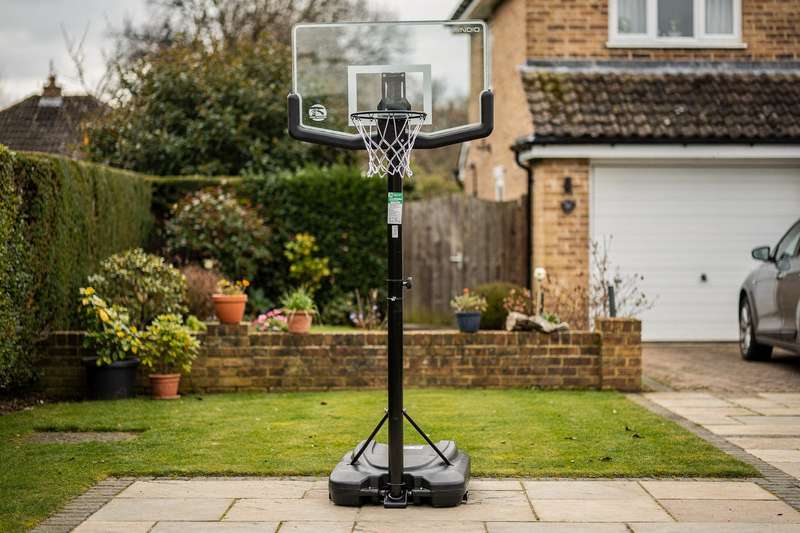
The SPOTRAVEL Height Adjustable Basketball Hoop Stand Portable Basketball Stand is the pick that comes closest to covering every need a UK household is likely to have in a single purchase, and a 4.8-star rating from 10 buyers backs that initial impression.
What sets it apart immediately is the combination of a 44-inch backboard with a wheeled base and an included water or sand weight bag. Those three features together sound like a given, but many portable systems charge extra for the bag or arrive without wheels, leaving you to manhandle a heavy base across gravel every time you need to clear the driveway. On a typical UK driveway — compact, shared, and in daily use — that practical consideration matters more than most headline specifications. The inclusion of both wheels and a fill bag in the standard package is a sign that the product was designed by someone who thought about how these hoops are actually used.
The 44-inch backboard is the right size for mixed-age household play. It’s not as wide as a competition board, which runs to 72 inches at full regulation, but it provides enough surface area that rebounds behave predictably and younger players don’t feel like they’re aiming at a narrow slot. Most budget portables drop to 32 inches, and the difference between 32 and 44 is immediately apparent when you’re playing rather than reading a spec sheet. For households where multiple age groups share the hoop — primary-school children in the afternoons, teenagers in the evenings, adults at the weekend — that additional surface area makes the system functional across the full age range without compromise.
Height adjustability is the other significant practical feature. A system that reaches 10-foot regulation height at the top end and drops low enough for younger children at the bottom grows with your household rather than becoming redundant within a couple of years. The SPOTRAVEL covers this range, so you don’t need to buy a separate kids’ hoop first and then replace it with a full-size system later on — one purchase spans the range from early learner to adult practice.
The honest tradeoff is the backboard material. At this tier in a portable format, the board is polycarbonate rather than acrylic or tempered glass. Polycarbonate handles UK outdoor conditions well — UV fade resistance matters for a board that lives outside year-round — but the rebound behaviour is slightly softer and less lively than an acrylic board. For family garden play and introducing younger players to the game, that’s not a disadvantage: overly lively rebounds on a compact driveway send the ball into the road or next door’s garden with regularity. For adults who care specifically about practising authentic bank-shot behaviour, the premium full-size option below is the more appropriate choice. Ten reviews is a modest sample, but the consistent feedback and the absence of recurring complaints about structural stability are encouraging signs for a product still building its review history.
Best Full-Size Regulation System for Adults
If your priority is replicating the experience of shooting on a proper court rather than making do with a garden hoop, the Premium Height Adjustable Full-Size Regulation Portable Basketball Backboard System For Adults is built around adult performance rather than family convenience.
The headline feature is the 18-inch solid steel hoop with padding. A properly constructed solid steel ring doesn’t flex or rattle on a clean basket, and the padded back of the rim is a detail found on official coaching and competition setups for a specific reason: it absorbs the repetitive impact energy that would otherwise transfer into the backboard material, causing cracking or delamination around the rim mount after extended use. Many entry-level hoops skip this padding entirely, which is why older budget systems often look beaten up around the rim attachment long before the rest of the structure shows any wear. It’s a small feature that has a disproportionate effect on the longevity of the board itself.
As a full-size regulation portable, this is aimed squarely at adults who either compete at a recreational or semi-competitive level and want a home setup that matches what they train on, or serious players whose at-home practice needs to transfer directly to organised games. When the dimensions and rim height match official playing standards, the technique and spatial awareness developed in the garden translates to a court in a way that a scaled-down system simply doesn’t allow. If you’ve ever practised on an undersized hoop and found it didn’t help with your shooting on a full court, this is the solution.
The caveat that matters most here is the review count. This system carries a 5.0-star rating from only two reviewers. A perfect score on an extremely small sample tells you the buyers who left feedback were satisfied — it says nothing reliable about long-term durability, how the backboard material holds up through a UK winter, or whether the base maintains stability under months of regular use. A product with 200 or 500 reviews develops informative patterns about failure modes and real-world longevity; two reviews is a starting point, not a verdict.
That doesn’t make this a system to avoid — it means buying with realistic expectations. If the full-size specification fits your needs and the tier matches your budget, the thin review base is a risk to acknowledge rather than a dealbreaker. Check the returns policy carefully before purchasing and pay close attention during assembly for any early indicators of build quality. The full-size format also means this isn’t something you’ll move easily — if your situation requires rolling the hoop aside for daily driveway access, the SPOTRAVEL with integrated wheels is the more practical answer. This system suits a dedicated, semi-permanent outdoor space where the hoop can stay put.
Best Budget Starter System
For households wanting to try basketball without a large upfront commitment, the KKB Sport Portable Height Adjustable Basketball Stand Basketball Hoop Net with Transparent 32-Inch Backboard Set System is the entry point of this roundup, covering the core mechanics for younger players without requiring a premium outlay.
The 32-inch transparent backboard is the clearest indicator of where this system sits. A 32-inch board is noticeably smaller than the 44-inch on the SPOTRAVEL, and the difference shapes the playing experience in a tangible way: the target appears tighter from any distance, and rebounds from near-misses behave differently because the board area is more limited. For adults practising with intent, that’s a real constraint. For children up to around age ten or eleven who are learning the shooting action rather than perfecting rebound angles, the smaller board is workable — at that stage the focus is on form and distance rather than bank-shot precision.
The height range of 7.5 to 9.2 feet (approximately 230cm to 280cm) is worth examining closely. The upper limit falls short of the full 10-foot regulation height (approximately 305cm), meaning this system ages out of usefulness for players who want to train at competition height. For younger children, a 9.2-foot ceiling is entirely appropriate — setting the hoop proportionally to a child’s height produces better shooting mechanics than forcing them to reach for a regulation ring. But older teenagers starting to take the game seriously will outgrow this system before long, which is worth factoring into whether the initial saving is genuinely economical over a two or three-year period.
With 3.8 stars from 7 reviewers, the KKB Sport sits below the other reviewed systems in this guide by both rating and review count. A 3.8 average typically reflects a split between buyers who found the system met expectations and those who encountered friction — at the budget tier, the most common issues relate to base stability in wind and unclear assembly instructions. Filling the base to full capacity with sand rather than water is the most effective single step to improve outdoor stability: sand weighs more per volume and doesn’t freeze or evaporate in UK conditions.
Treat this as what it is: a starter system. It’s the sensible choice for testing whether basketball is going to become a regular fixture in your household before committing to something larger and more durable. It won’t hold up as consistently as the SPOTRAVEL in exposed conditions or under heavy daily use, and the smaller backboard will become a limitation as players progress. But as a low-commitment entry point for younger or casual players, it covers the fundamentals adequately, and the transparent board at least gives you a clear visual reference for where the ball makes contact.
Best for a Permanent Backyard or Driveway Setup
The Adjustable Height Basketball Hoop with Thickened Backboard, Heavy Duty Steel Frame, Ideal Outdoor Basketball Goals for Backyard or Driveway comes with an important caveat: this listing carries no buyer reviews at the time of writing. That fundamentally changes the nature of this section — it’s based on specification analysis rather than verified buyer experience, and you should weigh it accordingly before purchasing.
What the specification suggests is a build oriented towards durability rather than portability or budget accessibility. A heavy-duty steel frame is the right material choice for a permanent or semi-permanent outdoor installation in the UK: steel handles repeated exposure to moisture, temperature variation, and persistent damp better than lighter materials or poorly sealed joints. The “thickened backboard” descriptor in the listing title points to more substantial board construction than standard entry-level systems — thicker boards dampen vibration more effectively and hold their shape better under years of repeated impact from missed shots and rebounds. That construction detail matters specifically if you’re planning to leave the hoop in place through multiple UK winters.
The product is framed explicitly for backyard and driveway use, which signals a fixed outdoor installation rather than a system you’d relocate regularly. If your situation includes a dedicated basketball space — a concrete pad, a cleared patio corner, or a driveway where the car parks in a separate area — the heavy-duty construction positions this as a longer-term investment than a portable system with a lightweight fill base. The stability you get from a purpose-built fixed setup is meaningfully different from a portable that needs to be weighted down against the wind.
This pick is for a specific type of buyer: someone with a genuine outdoor basketball space where the hoop can live as a fixture rather than a movable feature. If you’re constantly repositioning the hoop or sharing the space with vehicles, the SPOTRAVEL with its wheeled base suits you better. But if the hoop has a home and you want it to stay there through rain, wind, and UK winter conditions, a heavy-duty steel frame is the right foundation.
Without any buyer reviews, this section cannot be as specific as the others about real-world assembly complexity, how the adjustment mechanism behaves after extended outdoor use, or how the backboard performs in terms of rebound response. Before purchasing, check the listing for any new reviews that may have appeared since this guide was written, read the returns policy carefully, and treat the first few weeks of ownership as your own evaluation period. This product also appears in multiple variant listings on Amazon — comparing the specifications of each variant before committing is advisable, as height range and base configuration may differ between them.
Best Replacement Rim
The Best Sport Basketball Ring and Net – Multi-Colour, 45 cm is a fundamentally different product from the complete systems elsewhere in this guide. To be direct about it: this is a 45-centimetre replacement basketball rim with a net included — not a backboard, not a pole, not a complete system. If you already have a working backboard (wall-mounted, freestanding on a pole, or attached to a garage structure) and your existing rim is bent, corroded, or simply worn beyond use, this is precisely where this product belongs in your thinking.
With 4.2 stars from 70 reviewers — the largest review sample in this entire roundup by a considerable margin — it provides the most reliable real-world performance picture of any product here. The consistent buyer feedback is that it’s a functional replacement ring that installs without specialist tools and fits standard backboard mounting patterns. The multi-colour net is a visual feature younger players tend to enjoy, though multi-colour polypropylene nets in prolonged outdoor UV exposure can fade faster than plain white or black alternatives — worth noting if the long-term appearance of the setup matters to you.
The 45-centimetre ring diameter is standard for regulation basketball, compatible with official-size balls. Before ordering, measure the bolt hole spacing on your existing backboard carefully — this is consistently the most common compatibility issue with replacement rims, and it’s something no star rating can resolve for your specific setup. The ring diameter is standard across the category; the mounting hole dimensions are where different backboard manufacturers diverge from one another. A quick measurement before adding to basket saves a frustrating return.
Where this product doesn’t apply is if you’re building a setup from scratch or replacing an entire system. In those cases, the complete portable systems earlier in this guide are the right answer. But if you have a perfectly serviceable backboard that’s simply lost its rim to rust or physical damage, a reliable replacement ring at a fraction of the cost of a complete system is entirely logical — and 70 reviewers backing it up gives you considerably more confidence than any other option in this roundup. It’s the most field-tested product here by a significant distance, and that counts for something concrete.
What to Look For in a Basketball Backboard
- Backboard size: For meaningful recreational play and adult use, aim for at least 44 inches wide. Competition boards run to 72 inches. Boards of 32 inches are adequate for young children learning basic technique but restrict realistic practice as skill develops. Measure your available outdoor space before buying — a large board in a very confined driveway makes ball retrieval genuinely awkward after missed shots.
- Backboard material: Polycarbonate is tough, weather-resistant, and handles UK outdoor exposure well — the practical choice for portable systems that live outside year-round. Acrylic delivers a livelier, more authentic rebound response at a lower cost than tempered glass. Tempered glass is the professional standard with the most responsive rebound behaviour, but it’s heavier and considerably more expensive. For garden or driveway use, polycarbonate or acrylic are the sensible options.
- Height adjustability: Look for a system that reaches 10 feet (approximately 305cm) at the top end if adults or older teenagers will use it. Confirm the lowest setting suits the youngest player in your household. Most importantly, check that the adjustment mechanism locks firmly at each position — a pole that slips during play undermines every other positive the system has going for it.
- Base stability: Portable systems rely on a fill base loaded with water or sand. Sand is the better choice in the UK — it weighs more per volume and doesn’t freeze or evaporate. Wide-base designs resist wind-induced tipping better than narrow ones. In exposed UK gardens, base fill capacity is arguably the most important specification on the entire system, yet it’s the one most often glossed over in marketing copy.
- Portability vs. permanence: If you need to relocate the hoop regularly — for daily driveway access or a shared courtyard — wheels and manageable overall weight are essential features. If the system has a permanent or semi-permanent home on a hard surface, structural rigidity and heavy-duty construction matter more than how easy it is to move.
- Rim quality: Look for a solid steel ring with robust welding rather than a bent-tube or stamped construction. Padding on the back of the rim extends backboard lifespan by absorbing the repetitive impact energy that would otherwise stress the backboard material around the mount with every missed shot and rebound.
- Warranty and after-sales support: For outdoor sports equipment in the UK, a minimum one-year warranty covering manufacturing defects is a reasonable baseline expectation. Check whether the manufacturer provides accessible UK customer support — this matters practically if you need a replacement part or run into an assembly issue that requires real assistance rather than an automated response.
The Verdict
For the majority of UK households — families with players of different ages, a compact driveway or garden, and no dedicated indoor court — the SPOTRAVEL Height Adjustable Basketball Hoop Stand is the most practically rounded pick in this guide. The 44-inch backboard sits at the right size for household play without dominating a compact space. The wheeled base makes daily repositioning straightforward on a shared driveway. The included weight bag addresses the stability shortfall that undermines cheaper portable systems in UK wind. And the 4.8-star average from ten buyers is consistent rather than inflated by a thin handful of ratings.
If adult performance and full regulation dimensions are the priority — and you have a dedicated outdoor space where the hoop can stay put — the Premium Height Adjustable Full-Size Regulation system steps up on specification, though two reviews means accepting more uncertainty about long-term reliability than is ideal. For households just starting out who want to keep the initial commitment modest, the KKB Sport budget starter covers the basics for younger or casual players. For the very specific scenario of a working backboard that simply needs a new rim, the Best Sport Basketball Ring and Net is the safest specific buy in the entire guide — 70 reviews is a level of real-world validation that nothing else here comes close to matching.
We were not paid to feature any specific product in this guide. All opinions are independent and based on publicly available specifications, verified buyer feedback patterns, and category research.
Quick Comparison Table




FAQ
What size basketball backboard do I need for a UK garden?
For mixed-age family use on a typical UK driveway or garden, a backboard of at least 44 inches wide gives you a realistic playing experience without requiring enormous space. Smaller 32-inch boards work for young children learning the basics but become limiting as players develop. Full 72-inch regulation boards are generally too wide for most domestic settings and are better suited to school or community courts.
What’s the difference between a polycarbonate and an acrylic backboard?
Polycarbonate is more impact-resistant and handles cold temperatures and UV exposure better — the practical choice for outdoor portables in the UK climate. Acrylic offers a livelier, more authentic rebound response and looks closer to tempered glass in appearance, but it’s slightly more vulnerable to impact cracking in very cold conditions. For a garden or driveway system that lives outdoors year-round, polycarbonate is generally the more reliable material; acrylic is the step up when rebound quality is the priority.
How do I stop a portable basketball hoop from tipping over in the wind?
Fill the base to its maximum capacity — never half-fill it and expect decent stability. Sand is a significantly better fill than water in the UK: it weighs more per volume and doesn’t freeze in winter, which can crack cheaper base materials. Wide-base designs resist tipping in side-on wind better than narrow ones. In a particularly exposed location, consider whether a ground-anchored wall-mount system would suit the space better than any freestanding portable.
At what height should a basketball hoop be set for different ages?
UK basketball coaching guidance generally suggests starting at around 6 feet (180cm) for under-7 players, moving to 7.5 to 8 feet for ages 8 to 11, and introducing full 10-foot regulation height from around age 13 to 14. Adjustable-height systems let you raise the hoop progressively as a child grows, rather than buying separate equipment at each stage. Adults and competitive players should always practise at the full 10-foot regulation height.
Can I leave a portable basketball system outside all year in the UK?
Most systems with polycarbonate or acrylic backboards and steel frames handle typical UK outdoor conditions reasonably well. The most vulnerable points are usually the height-adjustment mechanism — keep it lubricated and free of debris — and the base fill. Switch from water to sand before winter to prevent freezing and potential cracking of the base. Covering the system with a weatherproof cover during extended periods of non-use extends its lifespan considerably.
Will a standard replacement basketball rim fit my existing backboard?
The 45-centimetre ring diameter is the standard for regulation basketball, but the mounting bolt spacing varies between backboard manufacturers. Before ordering a replacement rim, measure the distance between the existing mounting holes on your backboard and compare it with the product’s stated specifications. Most standard replacement rims cover common bolt patterns, but confirming compatibility before ordering saves a frustrating return process.