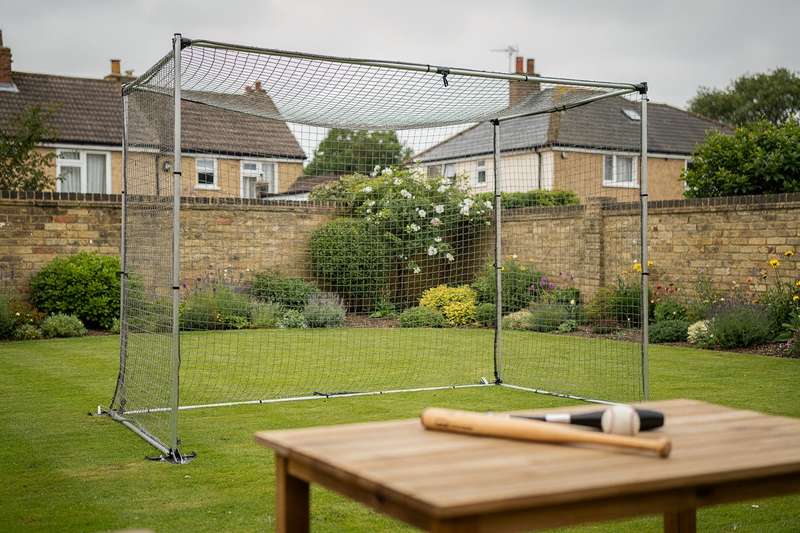
Picture this: it is a Tuesday evening in early May, the light is still good until half past eight, and your garden has just enough room for a proper batting stance. Your team’s next match is on Saturday and your timing at the crease has been off all season — but the club nets closed at seven, the nearest indoor facility charges by the half-hour, and the thought of hauling your kit across town just to get thirty minutes of hitting practice is not something you can face again. What you actually want is a set-up right there in the garden: something you can drag out in minutes, practise properly, and pack away before dark.
That scenario is exactly what drives people to buy a batting cage, and it is one of the smartest purchases a UK cricketer, baseball player, or softball enthusiast can make for their game. But it is also a purchase that is easy to get badly wrong. Buy something too short and your full swing keeps clattering the back net before the ball has travelled a realistic distance. Buy something flimsy and the first serious autumn gust will leave you with a heap of bent poles and torn mesh. And if you have not checked whether the product suits UK garden dimensions — or cricket use rather than just baseball — you can end up with something that looks right in the listing photos but does not work for your actual practice needs.
This guide works through five of the best batting cages currently available on Amazon UK, covering options from portable 22-foot tunnel cages to versatile multi-size training systems, and tells you honestly where each one excels and where it falls short.
How This Guide Was Put Together
The five products covered here were drawn from batting cages listed and available on Amazon UK. Selection came down to five criteria. First, interior dimensions: the cage has to be large enough to accommodate a real batting motion, not a cautious half-swing with the elbows tucked in. Second, netting quality and how well the mesh handles repeated ball impact without fraying or losing shape. Third, frame construction and wind resistance, since UK conditions regularly produce the kind of gusts that will fold an under-designed cage without warning. Fourth, assembly complexity for a two-person household without specialist tools. Fifth, buyer review patterns — specifically how consistent the feedback is, what the most common complaints are, and whether those complaints affect most buyers or only a narrow subset.
Products with zero reviews on Amazon UK were excluded regardless of how their specifications read on paper. Where a product carries a smaller review count, that is flagged clearly in the relevant section, because twenty reviews and two hundred carry very different levels of confidence. Price descriptions use tier language — budget, mid-range, premium — rather than specific figures, since Amazon pricing shifts frequently and any number in a guide becomes outdated within weeks.
Best Overall Batting Cage
The Baseball Batting Cage Net for Backyard 22ftx12ftx8ft Portable Baseball and Softball Batting Cages with Pitching Machine Hole is the most widely reviewed batting cage currently available on Amazon UK, and that volume of feedback — over 250 verified reviews — tells you something genuinely useful: this is a product that enough buyers have actually assembled, used across multiple sessions, and rated, giving you a more reliable picture of real-world performance than products with a handful of opinions.
The 22-foot length is the key dimension. It is enough to practise at a realistic hitting distance — working on batting mechanics with soft toss or feeding balls from a machine positioned outside the cage — while still fitting into a medium-to-large UK back garden. The 8-foot ceiling clears most cricket and baseball hitting motions without restriction, and the 12-foot width gives comfortable lateral clearance whether you are driving through the off side in cricket or working on an outside pitch in baseball. Twelve feet lets you complete your swing naturally rather than pulling it early to avoid the side netting.
The pitching machine hole is a practical feature that separates this cage from simpler setups. It allows you to position a machine outside the tunnel and feed balls through without the netting interfering — useful for solo sessions where nobody is available to hand-feed. The carry bag makes the whole unit portable: you can take it to a club ground, a park, or a friend’s garden if your own space is limited.
Where the buyer review pattern becomes relevant is in the 3.8-star average. Across more than 250 reviews, that rating signals a product that works well for the majority of buyers but has a meaningful minority who have encountered durability concerns or found the netting specification lighter than expected for heavy machine use. If you are planning regular pitching machine sessions rather than occasional hand-fed practice, that pattern is worth factoring into your decision. Assembly consistently comes up in reviews as requiring two people and closer to an hour than the fifteen minutes some listings suggest — budget your time accordingly for the first build.
This cage suits recreational players, cricket parents, and baseball families who want practical backyard practice without the complexity or cost of a permanent installation. It is a solid all-rounder at a mid-range price point, and the large review base means you are buying with a clearer picture of what to expect than you would have from a lower-reviewed alternative. If you need something that takes intensive daily use from multiple players over several seasons, look at the higher-rated options below — but for regular family or personal practice, this one does what it promises.
Best Batting Cage for Dedicated Training
The Apex Sports Portable Batting Cage 22x12x8 Ft, Baseball & Softball Net Cage shares its headline dimensions with the cage above — 22 feet long, 12 feet wide, 8 feet high — but carries a 4.0-star average across 187 reviews, which is a meaningfully stronger result for a product with a substantial feedback base. That gap between 3.8 and 4.0 across comparable review volumes points to more consistent manufacturing and a lower incidence of the frustrating assembly or durability issues that drag ratings down on competing cages.
Apex Sports has a focused presence in training equipment, which matters more than it might initially appear. Brands that centre their product lines on batting and pitching gear tend to get the small details right: how frame poles connect, how well the netting holds its shape under tension, whether the carry bag is reinforced at the stress points that fail first. None of these are things you can assess from a product listing photo, but they are what determines whether your cage is still performing well after its third season rather than held together with improvised fixes.
Assembly is consistent with what you should expect from any framed batting cage at this size. Two people are effectively required, and the first build should be treated as a learning session — give it an hour, do not rush the netting attachment, and note the pole order so subsequent setups go faster. Buyers who have assembled camping shelters or canopy frames before will find the process familiar. Those putting together a tensioned frame at this scale for the first time should read the instructions fully before starting, rather than working it out as they go.
The 22-foot length suits both cricket and baseball use effectively. Cricket players working on bowling-machine deliveries or partner-fed throw-downs will find plenty of room to set a proper batting position and play through the ball. Baseball and softball players can work at realistic hitting distances without the cramped feeling that shorter cages create. At 8 feet high, the cage provides adequate overhead clearance for almost all batting motions, though unusually tall players with a very high back-lift should confirm that measurement suits their natural stance before ordering.
This is the cage to choose if you plan to use it regularly and seriously — several sessions per week, across multiple seasons, with real cricket balls or hardballs rather than foam practice balls. The Apex Sports brand and stronger review average point to a product that performs reliably under that kind of sustained use. For players who want a cage that holds up over the long term, this is the most balanced pick in the guide.
Best for Training Versatility
The VEVOR Baseball Batting Netting, 10/35/55/70 FT Golf Softball Baseball Batting Hitting Training Net takes a different approach to practice space than the fixed-dimension cages above. Available in multiple size configurations — from a compact option for a modest garden area to substantially larger setups — this VEVOR system lets you match the size of your training area to your actual available space rather than buying a product whose single fixed dimension may not suit your garden, garage, or sports hall.
VEVOR is a well-established name in the UK for sporting and training equipment, and the range of sizes here is a practical design choice: buyers with different spaces can find a configuration that works without compromising. With 49 reviews and a 4.2-star average, the feedback base is meaningful — enough to reveal consistent patterns rather than isolated incidents, and a rating that points to buyers finding the product performs as described.
The listing title includes golf alongside cricket, baseball, and softball, which tells you something important about the design philosophy. This is multi-sport training netting built to handle a range of ball types and impact velocities. For UK buyers, that kind of multi-purpose utility is often practically useful: a garden that doubles as a cricket practice space one day and a general sports training area the next, or a household where several sports are played across the year. The netting handles the variety rather than being narrowly optimised for a single application.
Before buying, check the specific product listing carefully to confirm what is included with each size configuration — in particular, whether the system comes complete with a frame or requires a separate mounting structure. Products offering multiple size variants sometimes differ in what is bundled with each option, and it is worth clarifying this before your order arrives. The Amazon listing questions section is often helpful here, since previous buyers frequently ask and answer exactly this kind of practical question.
The VEVOR batting netting is the right choice if your priority is flexibility: because your space is an unusual shape, because the same garden area is used for multiple sports, or because you want to configure your practice setup at different scales. For buyers who want a dedicated fixed-dimension tunnel cage with a single clear purpose, one of the other picks in this guide will be more straightforward. But for versatility across sports and spaces, this one delivers it reliably at a strong rating for the category.
Best Pop-Up Batting Cage
The Baseball Batting Cage Net – Portable Batting Cages for Backyard Baseball & Softball, Pop Up Design with Detachable Door addresses one of the most consistently frustrating aspects of batting cage ownership: getting in and out of the structure during a session. Standard framed cages typically require you to duck under a side panel or wrestle with a velcro flap, which becomes quite irritating during bucket-style practice where you are repeatedly moving in, hitting, walking out, collecting balls, and returning. This pop-up design includes a detachable door — a proper entry point that opens and closes — and a tension-based frame that goes from bag to assembled in a fraction of the time a traditional tube-and-socket cage takes.
With 35 reviews and a 4.4-star average, this is the highest-rated framed cage pick in this guide by average score, even with a smaller review count than the two options above. A 4.4-star average on 35 reviews warrants a note of caution — a smaller sample gives individual reviews more influence on the overall figure — but it also tells you that the buyers who have used this are clearly satisfied with the experience. High satisfaction in a smaller review pool is a meaningful signal when the ratings are consistent rather than polarised by a few outliers driving the average up.
The pop-up design defines both the product’s primary strength and its main limitation. Tension-frame pop-up structures assemble faster and pack smaller than rigid tube frames, which is a real advantage when you are using the cage multiple times per week and putting it away between sessions. However, pop-up frames rely on internal tension rather than staked ground anchoring for their shape, which makes them less stable in high wind. If your garden is exposed to prevailing wind off open land or over a flat terrace, a traditionally staked frame cage will hold its position more reliably through a gusty British afternoon. The pop-up design is at its best in a sheltered garden, a garage, or an indoor sports hall where wind is not a variable.
The detachable door and pitching machine hole are the features that move this beyond a simple convenience purchase. The door means a coach running structured drills can walk in and out without breaking the session’s rhythm; the pitching machine hole allows machine feeding without threading cables through the netting or creating a weak spot in the mesh. These are the kind of design details that get added when someone has actually run a batting practice session and noticed what slows it down.
Buy this cage if quick setup and takedown are your primary considerations — whether because you store the cage between sessions, because you transport it to different venues, or because you use it in an indoor space where the pop-up structure is easier to handle in confined dimensions. For permanent outdoor setups in exposed gardens, one of the traditionally staked framed options in this guide will be more reliable through the full range of UK weather conditions.
Best Heavy-Duty Practice Net
The Syhood Baseball Batting Cage Net Heavy Duty Cricket Softball Hitting Practice Net Portable Pitching Cage, Training Sports Barrier Net Screen occupies a slightly different position from the framed tunnel cages reviewed above. It is designed to function as a heavy-duty netting barrier — a catching screen and practice zone that works either as part of a complete cage setup, as a backstop behind a wicket or batting tee, or as a standalone barrier attached to an existing frame or fence structure.
The explicit inclusion of cricket in the product title and description is one of the most UK-relevant signals in this guide. Most batting cage products are written for baseball and softball markets primarily, with cricket named as an afterthought if at all. Syhood naming cricket upfront suggests the netting specification has been considered for cricket ball impact rather than simply being listed for broad multi-sport appeal as a marketing decision. For UK buyers doing serious cricket practice, that specificity carries weight — cricket balls are denser and harder than softballs, and netting specified only for softball impact may not perform the same way under repeated cricket ball contact across a season.
With 11 reviews and a 4.4-star average, this has the smallest review sample in this guide, which is the most important caveat to flag clearly. Eleven reviews is enough to tell you that nobody is having a catastrophic experience with the product — a genuinely poor cage generates one-star feedback quickly — but it is not enough data to be confident about long-term durability under heavy outdoor use. The heavy-duty description and sports barrier terminology suggest a product built for actual repeated impact rather than occasional light use, which is an encouraging sign, but independent buyer confirmation is still limited compared to the other picks here.
The portable descriptor in the title is worth treating as a functional design criterion rather than just a marketing term. A heavy-duty net that is also portable offers real flexibility for UK conditions: you can set it up on dry days and bring it inside when the weather turns, protecting the netting from UV degradation and persistent damp — two things that shorten the lifespan of outdoor sports netting faster than most buyers expect. A net you actually take inside when conditions deteriorate will reliably last longer than one that stays outdoors through a full UK winter.
This is the right pick if you want quality heavy-duty netting to complete an existing frame structure, if you need a versatile barrier net that works across cricket and baseball applications, or if you prefer a lower initial outlay while you decide whether a permanent framed cage is worth the full investment. For junior cricket clubs or school settings where a net hung behind stumps transforms a thirty-minute practice session, a well-rated portable barrier net is often more practical than a full batting tunnel — easier to move between pitches and far simpler to store at the end of the day.
What to Look for When Buying a Batting Cage
- Interior dimensions: The minimum sensible length for realistic hitting practice is around 20 feet. Shorter than that and you are doing static drills rather than anything resembling live-distance practice. Width matters equally — a cage narrower than 10 feet feels cramped for cricket drives or wide baseball swings, while 12 feet gives comfortable clearance in both directions. Height should be at least 8 feet to accommodate a full upright swing and typical ball trajectories above shoulder height.
- Netting weight and specification: Batting cage netting is sometimes rated by a pound-based number common in US-specification products, where a higher number means denser, heavier mesh. Heavier netting handles harder ball impacts and wears more slowly under repeated use, but adds to the overall cage weight. For cricket ball practice in particular, a heavier netting specification is preferable since cricket balls are denser than softballs and carry more impact force per delivery.
- Frame type and ground anchoring: Steel tube frames are more durable for long-term outdoor installation but heavier to transport. Fibreglass pole frames are lighter and more manageable but less rigid in persistent wind. Pop-up tension frames offer the fastest setup but rely on internal tension rather than staking for their shape. Regardless of frame type, proper ground anchoring with stakes is non-negotiable for any UK outdoor installation — a cage without stakes will shift or tip in conditions that are entirely normal for a British spring or autumn afternoon.
- Assembly complexity: Treat any batting cage at this size as a two-person build and plan for 45 minutes to an hour on the first assembly. Read buyer reviews specifically for assembly comments before purchasing — if multiple reviewers flag missing components, confusing instructions, or connectors that require excessive force, those are patterns worth factoring in before the order rather than after.
- Pitching machine compatibility: If you plan to use an automated ball feeder or bowling machine, look specifically for a cage with a designated pitching machine hole. Without this, feeding a machine through the netting means cutting or stretching the mesh, which creates a weak point that worsens over time. A purpose-built machine hole is a small design detail that makes a genuine practical difference for solo practice sessions.
- Cricket vs. baseball labelling: Most batting cages on Amazon UK are marketed primarily at baseball and softball players. If you are buying specifically for cricket practice, look for products that name cricket explicitly in the title or description — this signals that the netting specification and dimensions have been considered with cricket ball impact in mind, rather than just broadening the appeal. Mesh size and netting weight, where stated, are worth checking for cricket-specific use.
- Storage and portability: A carry bag is standard across most cages at this level but quality varies considerably. Reinforced handles, a durable zip or drawstring closure, and sufficient bag volume to contain the folded cage without straining the seams all matter if you plan to move the cage regularly. Check buyer feedback specifically on the bag before assuming it is practical for frequent transport — a flimsy bag on a heavy steel-frame cage becomes a frustration very quickly in real use.
The Verdict
For the majority of UK buyers — a cricketer or baseball player wanting reliable backyard practice without committing to a permanent installation — the Apex Sports Portable Batting Cage 22x12x8 Ft, Baseball & Softball Net Cage is the most balanced pick in this guide. The 4.0-star average across 187 reviews, the brand’s focused presence in training equipment, and the practical 22-foot length all point to a product that performs consistently for regular individual or family use across multiple seasons. It is not the cheapest option and it is not the fastest to assemble, but it represents the best combination of reliability, usable dimensions, and buyer confidence among the products reviewed here.
If your priority is quick setup and takedown — whether for coached group sessions or solo practice where you store the cage between uses — the pop-up design option with its detachable door handles that use case better than any traditionally framed cage. And if you already have a frame structure and need quality netting to complete it, or if you want a dedicated cricket practice barrier rather than a full framed tunnel, the Syhood heavy-duty barrier net is a practical entry point at a lower initial outlay.
Whatever you choose, measure your available outdoor space carefully before the cage arrives. A 22-foot cage needs roughly 24 to 25 feet of clear ground to anchor properly and leave working room around the entrance. Grass or soft soil holds stakes far better than compacted clay or paving. Get that right, and a home batting cage becomes one of the most efficient training investments you can make — unrestricted reps on your own schedule, without a booking system or a travel time.
This guide was produced independently. We were not paid to feature any specific product in this guide. All opinions are independent and based on publicly available specifications, verified buyer feedback patterns, and category research.
Quick Comparison Table


FAQ
Can I use a baseball batting cage for cricket practice?
Yes, in most cases. The standard dimensions of a 20- to 22-foot batting cage work well for cricket practice nets, and the netting in most products at this level is robust enough to handle cricket ball impacts. Look for a minimum width of 10 feet and a height of at least 8 feet to give comfortable room for drives, pulls, and other cricket shots. Products that explicitly name cricket in their title or description have typically been specified with cricket ball impact in mind rather than just listed for broad appeal.
What size batting cage fits in a typical UK back garden?
A 22-foot cage is the most practical choice for home use and suits most medium-to-large UK back gardens. You will need roughly 24 to 25 feet of unobstructed length for the frame footprint and anchoring stakes, plus around 13 to 14 feet of width. Measure your available space before ordering — a cage that is tight on all sides is harder to anchor correctly and uncomfortable to practise in during a full session.
How long does it take to assemble a batting cage?
Budget 45 minutes to an hour for the first assembly with two people. The initial build takes longest because you are learning the pole order and netting attachment sequence. After the first setup, subsequent assemblies go considerably faster once you know the order of operations. Pop-up designs assemble much more quickly but are generally less rigid than traditional tube-frame cages under outdoor conditions.
Do batting cages need to be staked into the ground?
Yes, for any outdoor setup. Even in calm conditions, an unanchored cage can shift during active batting practice. In UK conditions, where spring and autumn afternoons regularly bring gusts, an unanchored cage presents a real risk to the equipment and to anything nearby. Most cages include ground stakes as standard, but on very soft or sandy soil you may want additional anchoring to ensure the frame stays firmly in position through a full practice session.
What is the difference between a batting cage and a batting net?
A batting cage is a fully enclosed tunnel structure — a frame with netting on all sides and overhead — that a batter stands inside during practice. A batting net is typically a single panel or barrier that stops balls from travelling beyond the practice area, without fully enclosing the batter. Cages provide a more complete and realistic practice environment; nets are simpler to install and more flexible for different drill types but do not replicate the contained tunnel experience.
Can I use a batting cage indoors?
Pop-up designs and lighter framed cages work well in a double garage, sports hall, or large utility space. The main requirements are a ceiling height of at least 8 feet and sufficient floor area for the full cage footprint. Indoor use removes wind entirely as a factor and protects netting from UV degradation and persistent damp, both of which shorten product lifespan under year-round outdoor exposure. If indoor use is your primary plan, a pop-up design is easier to position in confined spaces than a rigid tube-frame cage.