You’re halfway through a Saturday morning park run, your phone bouncing against your thigh through the mesh of your shorts pocket, keys jangling with every stride, and you’re holding an energy gel in your fist with nowhere else for it to go. Or it’s day three of a city break and you’ve spent the past ten minutes at the hotel breakfast anxiously rechecking the zip on your jeans, certain your bank card has gone walkabout. Maybe it’s simpler: you walk the dog every morning and you’re tired of your phone competing for coat-pocket space with poo bags and treats.
A waistpack — also called a bumbag or fanny pack — solves each of those scenarios with the same logic: keep what you need right on your body, distribute the weight across your hips, and leave your hands completely free. The trouble is that the UK Amazon market for waistpacks spans everything from flimsy festival accessories to thoughtful outdoor kit, and sorting the good from the frustrating based on product thumbnails alone takes real time. This guide does that work for you.
How We Chose These Picks
This shortlist of seven waistpacks was assembled by assessing packs currently available to UK buyers on Amazon across several criteria: capacity relative to stated use case, pocket organisation and accessibility, strap type and adjustment range, water resistance, and versatility across different wearing positions. Some products here are newer UK listings with limited buyer data — those are flagged clearly in the relevant section, and assessments draw on published specifications and category benchmarks rather than aggregated reviewer feedback. Where a product carries hundreds of verified reviews, those patterns inform the real-world picture presented here.
Best Overall
The Waterfly Bumbag Large Fanny Pack earns the top spot on this list because it covers the broadest range of use cases without a serious weakness in any single area. Close to a thousand UK buyers have rated it 4.6 out of 5 stars — the strongest evidence base on this shortlist — and the feedback patterns tell a consistent story of a pack that holds up well to regular use across different activities.
The defining feature is the multi-pocket layout. Rather than a single large compartment that forces your phone, keys, wallet, and snacks into one undifferentiated pile, the Waterfly distributes your load across several distinct zones. That matters in practice: keys away from your phone screen, cards separated from loose snacks, a quick-access pocket for items you reach for constantly. The water-repellent fabric handles the everyday UK reality of rain arriving without warning — your phone and wallet stay dry through a light shower without requiring you to take the pack off and shelter it.
The strap adjusts across a sensible range of waist and hip sizes, and the pack sits flat enough against the body that it doesn’t swing during movement. Reviewer feedback frequently mentions that it works well as a crossbody bag for cycling and travel, where wearing a bag at the waist can shift uncomfortably over time. The zip construction is consistently praised as solid — not the thin-gauge hardware that is the first thing to give way on cheaper options.
Its limitations are worth naming. This is a bag with visible presence on your body — if you want something almost imperceptible during a run or that tucks discreetly under a jacket, a slimmer option will suit you better. The multi-pocket design gives the pack some structure, which adds a small amount of weight relative to the most stripped-back options. And while the water-repellency handles showers comfortably, this isn’t a submersion-proof waterproof construction — keep that in mind for sustained heavy rain on exposed terrain.
For hiking day trips, cycling, travel, festivals, or everyday errands where you want everything organised and accessible, the Waterfly offers the best balance of organisation, versatility, and verified buyer confidence on this list. If you want one pack that handles most situations well, start here.
Best for Hiking
The REETEE Hiking Waist Pack is the most purpose-built outdoor option here, and its 857 verified reviews at 4.5 out of 5 stars reflect how reliably it performs for the trail-walking audience it’s designed for.
The integrated bottle holder is what sets it apart from most waistpacks in this field. Carrying water without one means hand-holding a bottle throughout your walk or looping it through a strap somewhere awkward — a minor but persistent irritation on longer outings. A dedicated holder built into the waistpack keeps a standard 500ml bottle accessible without interrupting your stride, and reviewers note that it grips securely enough that the bottle doesn’t rattle loose on descents or uneven ground. The pack itself is waterproof rather than merely water-repellent, which makes a real difference during UK hill walking where conditions can shift from clear to driving rain within a single outing.
The main compartment has enough room for the essentials of a short-to-medium trail day: a snack, a buff, a folded waterproof shell, your phone, and some cash. The strap adjusts across a wide waist range, and the hip-hugging fit means the pack stays planted on rough terrain without shifting. Buyer feedback patterns consistently highlight the durability of the zip hardware after extended outdoor use — a meaningful signal given that zip failure is the most common complaint against budget outdoor packs.
The tradeoffs are worth understanding. Even on a waterproof-bodied pack at this price point, the zips themselves won’t be fully sealed against sustained heavy rain — so in an hours-long downpour, moisture can potentially work in through zip joins over time. The design is also optimised for waist carry on the trail rather than dual-purpose crossbody use. It works in those other contexts too, but not as naturally as packs designed explicitly with that flexibility in mind.
If your primary use is trail walking, nature reserve day trips, or any active outdoor scenario where staying hydrated and keeping essentials dry genuinely matters, the REETEE is the clearest choice on this list. The bottle holder alone sets it apart from the competition, and nearly 900 verified buyers provide real confidence in its reliability.
Best for Running
The Running Belt Waterproof Adjustable Elastic Strap addresses the most significant problem with conventional bumbags for runners: bounce. A rigid nylon strap on a pouch bag cannot eliminate the movement you feel with every stride, especially once the pack is loaded. The elasticated construction here conforms to your torso during movement, cinching snugly to accommodate the expansion and contraction of your body during aerobic effort rather than working against it.
The waterproof and sweatproof construction is equally important for running-specific use. On a sustained effort, sweat soaks through unprotected fabric quickly — meaning your phone, cards, or earbuds could be sitting in a damp environment for the entire run. The sealed construction keeps contents dry whether the moisture is coming from outside or from your own body heat during a long effort in the rain.
The capacity is described as large in the listing, but that’s relative to other running-specific options rather than general waistpacks. What fits comfortably: a modern smartphone, a couple of gels or snacks, earphone cables, a key and a card. What doesn’t: a thick wallet, bulky items, or anything with significant depth. For its intended purpose — carrying the essentials for a run of up to a few hours — the space is sufficient without making the belt feel unbalanced or heavy on the hip.
With 40 reviews at 4.3 out of 5, there’s a reasonable early signal of buyer satisfaction, though considerably less data than the Waterfly or REETEE offer. Long-term durability of the elastic — how well it holds up after repeated washing across months of regular training — isn’t possible to assess with full confidence from available data. The design is also deliberately functional rather than styled for off-run use, so it’s less practical as a travel companion or day bag than the broader options on this list.
For dedicated runners who want a bounce-resistant, sweatproof option that works in wet UK conditions, this is the pick that most directly addresses running-specific needs with enough buyer evidence to support a reasonably confident recommendation.
Best Tubular Running Belt
The FlipBelt Classic Running Belt works on an entirely different principle from every other product on this list. Rather than a pouch attached to a strap, it’s a continuous tube of fabric that wraps the full circumference of your waist. Items slip in through open slots, and the tube itself rotates to seal them against your body — no zip to wrestle mid-run, no buckle to fiddle with, nothing to distract you.
The result is a belt that effectively disappears during exercise. Because there’s no separate bag creating a point of mass that swings or shifts independently, the FlipBelt delivers the closest thing to bounce-free carry available in this category. The moisture-wicking fabric manages body heat during longer efforts, and the snug, compressive fit means the belt stays exactly where you positioned it from start to finish. Marathon runners and triathletes favour this type of belt precisely because the carrying solution stops being something you’re aware of.
Capacity is constrained by the design itself. A tube-style belt is not the right place for a thick wallet, a chunky phone case, or anything with depth. It works best for flat, slim items: a bank card, a folded note, a slim smartphone without a bulky case, a key, gels, and earphones. If you regularly carry more than this on runs, you may find the capacity insufficient — it is the right tool for minimal, streamlined carry rather than all-day versatility.
A key transparency note: this listing currently has no buyer reviews on UK Amazon. The FlipBelt brand is well-established in the running accessory market, and the Classic belt’s design has been available for years, providing broader market context that supports confidence in the concept. But UK-specific verified buyer data via this listing is absent. If review scores are central to how you make purchase decisions, that’s worth factoring in. Sizing also matters more here than with adjustable-strap packs — tube belts don’t stretch to fit a range of waist sizes the way strap-based options do, so check the sizing guidance carefully before ordering. Colour and size variants exist within the FlipBelt range, so spend a few minutes with the sizing chart rather than defaulting to the first option.
For runners who have already decided that a tube-style belt is the right format for them, the FlipBelt Classic is the most recognisable name in the category and the natural starting point for that style of carry.
Best for Organising Lots of Kit
When a single-compartment bag doesn’t cut it — think a day trip, a long cycling route where you want cables and snacks alongside your wallet and phone, or a festival where everything needs its own dedicated place — the MAXTOP Large Bumbag Waist Fanny Pack offers the most internal organisation of any pick here.
Four separate zip pockets is the headline feature. In practical terms: keys in one pocket away from your phone screen, cards and cash in a second, your phone in a third, and a spare cable, lip balm, or travel document in the fourth. The headphone jack is a considered detail that lets you route audio cables out of the bag without opening a zip — useful on a commute or during outdoor activity where you’d otherwise be fishing through a pocket every time you want to adjust what you’re listening to.
The word ‘Large’ in the product name refers to capacity relative to other waistpacks rather than hiking-pack volume. This isn’t a pack for a full-day trail; it’s a bag that holds meaningfully more than slim, single-compartment options while remaining wearable at the waist or hip. The adjustable strap covers a range of body sizes, and the fabric construction appears solid from the listing specifications, with chunky zip pulls suggesting more robust hardware than the thin zips common to entry-level alternatives.
The honest limitation here is the absence of buyer reviews on this UK listing. Without verified feedback, real-world durability of the four-zip hardware, accuracy of the capacity description, and fabric performance after regular washing all remain unconfirmed. The specifications suggest a thoughtful design, but you are purchasing with less certainty than with the Waterfly or REETEE. If the four-pocket organisation matches how you actually pack, it’s a strong candidate for the organiser’s pick — with eyes open about the thin buyer evidence.
Best Budget Pick
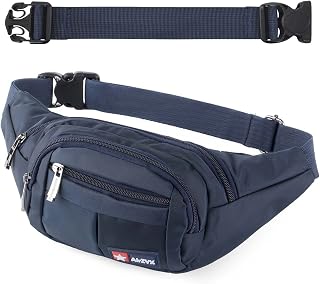
For buyers who want to test whether a waistpack suits their lifestyle before committing to a mid-range option, the Bumbags and Fanny Packs for Running Hiking Waist Bag Outdoor Sport Hiking Waistpack for Men Women (DarkBlue-Ex) is the lowest-priced option on this list.
At the budget end of the waistpack market, the key question is whether it does the basics reliably enough to justify the purchase. For straightforward tasks — carrying a phone, a key, and a card for a dog walk, a short run, or a casual cycle — a basic bumbag form factor is all you need. You’re not expecting a bottle holder, water-repellent coating, or multi-pocket organisation at the very lowest price point; you’re expecting a pouch that stays closed and a strap that doesn’t fail under regular use.
Full transparency is warranted here: this listing has only two buyer reviews at the time of writing, both five-star — which gives no statistically meaningful signal about real-world quality either way. The product images suggest a standard bumbag design appropriate for the listed activities, but the very limited feedback means this assessment rests on category context rather than verified buyer experience. As the listing matures and accumulates more reviews, the picture will become clearer.
The realistic expectation at this price tier: simpler zip hardware, thinner fabric, and less refined strap padding than mid-range options. For occasional, light-duty use, that’s often perfectly acceptable. For daily wear or demanding outdoor use, the step up to the REETEE or Waterfly is money better spent. If you’re genuinely unsure how much use you’ll get from a waistpack day-to-day, this gives you a low-risk way to find out before investing further.
Best for Everyday Wear and Dog Walking
The Bumbags Waist Fanny Pack Fashion Bum Bag with 65cm Extended Belt for Dog Walking Climbing Hiking Travel Cycling Girls Ladies Men Women positions itself at the casual, everyday carry end of this category — a bumbag you’d wear as a day bag as happily as you’d take it on a light trail.
The 65cm extended belt is the most practically significant specification. A longer strap opens up wearing options that shorter packs close off. Worn at the waist on a larger frame? The extra length accommodates that without the strap pulling taut. Want to sling it crossbody across the chest for cycling or keep the zip accessible while walking the dog? The additional length makes that work without discomfort. The ‘too short for my size’ complaint appears regularly in one-star reviews across the waistpack category — the extended belt is a real differentiator for buyers on the larger end of the size range, or for anyone who prefers crossbody wear as their default position.
The stated use cases — dog walking, climbing, hiking, travel, cycling — reflect its generalist positioning. This isn’t a pack specialised for any single discipline; it’s the bag you throw on for a morning walk, use as a lightweight day bag in a city, or take on a weekend trip when you want your phone and wallet close without carrying a full handbag or backpack. The fashion-forward framing in the title suggests a cleaner, less technical aesthetic than purpose-built outdoor packs, which means it works with casual clothing in a way that a more rugged-looking hiking pack might not.
As with several picks here, there are currently no buyer reviews on this listing, so the assessment is spec-led rather than feedback-led. For buyers whose main use is casual everyday carry — and who specifically want a longer strap for crossbody versatility — this fits that brief well on paper. For demanding outdoor use where build quality needs to be confirmed through real buyer feedback, the REETEE or Waterfly are the more credible choices while this listing remains new.
What to Look For in a Waistpack
- Capacity and pocket layout — Match the number of compartments to how you actually pack. Multiple pockets keep items separated (keys away from your phone screen); a single large compartment is easier to load at speed. Running use typically needs far less room than hiking or travel, so don’t over-buy capacity you won’t use.
- Strap type and adjustment range — Rigid nylon straps suit walking and casual carry but bounce during running. Elasticated straps move with the body during aerobic exercise. Check the maximum and minimum waist circumference stated in the listing before buying, particularly if you’re at either end of the typical size range — some packs run narrower than stated.
- Water resistance versus waterproofing — A DWR-coated fabric repels light rain and splashes; a waterproof construction handles sustained rain. Neither protection extends through a partially open zip, so check whether the zip hardware is sealed as well as the fabric if reliable wet-weather performance is a priority.
- Wearing position compatibility — If you want to switch between waist and crossbody positions depending on the activity, verify that the strap length allows it and that the bag sits comfortably across the chest. Not all packs are designed with this flexibility in mind, and some compact options have too short a maximum strap for crossbody wear.
- Zip quality — Zip failure is the most common breakdown point in budget waistpacks. Look for chunky, smooth-running zip pulls and reinforced stitching at the zip joins. Thin or plasticky zip hardware visible in listing images is a durability warning worth taking seriously before you buy.
- Phone compatibility — Many listings specify which phone sizes the main pocket accommodates. If you carry a large-format phone or one in a chunky case, verify pocket dimensions rather than assuming the pack will fit it — some slim running packs are sized for a phone without a case.
- Use-case match — A trail-running belt won’t serve a week-long city break as well as a multi-pocket travel pack, and vice versa. Buying the right pack for your most frequent use case generally beats trying to find one option that does everything adequately.
Verdict
For most readers — people who want a reliable, versatile waistpack for a mix of hiking, cycling, travel, and everyday carry — the Waterfly Bumbag Large Fanny Pack is the pick to start with. It has the strongest evidence base on this list, a practical multi-pocket layout, and water-repellent construction that handles UK weather without drama. If trail walking is your primary use and you want a properly waterproof pack with a built-in bottle holder, the REETEE is the smarter choice — nearly 900 verified buyers back that recommendation up.
For running, the Running Belt Waterproof Adjustable Elastic Strap addresses bounce and sweat with enough buyer evidence to support a confident recommendation; if you prefer a tube-style belt with minimal bulk, the FlipBelt Classic is the name to look for, with the caveat that its UK listing currently carries no buyer reviews. The MAXTOP suits buyers who carry varied kit and want four-pocket organisation; the extended-belt fashion bumbag fits the everyday casual carry and crossbody crowd. The budget pick is a sensible low-commitment entry point if you’re new to the format and want to find out whether a waistpack is something you’ll actually reach for before spending more.
This guide was produced independently. We were not paid to feature any specific product. All opinions are based on publicly available specifications, verified buyer feedback patterns where available, and category research.
Quick Comparison Table




FAQ
What is the difference between a waistpack, bumbag, and fanny pack?
They are all names for the same category of bag: a small pouch worn on a strap around the waist or hips. ‘Bumbag’ is the standard British English term; ‘fanny pack’ is the American equivalent; ‘waistpack’ or ‘hip pack’ tends to describe more structured, activity-focused versions. The terms are interchangeable when shopping, so searching with all three will help you find the full range available on UK Amazon.
Can a waistpack be worn across the chest instead of at the waist?
Yes — most waistpacks can be repositioned as a crossbody bag by lengthening the strap and wearing the pouch across the chest or one shoulder. This works particularly well for cycling and hiking, where a bag at the back of the hip can become uncomfortable over time. Check that the strap on your chosen pack is long enough to accommodate crossbody wear before buying, as some compact options have a shorter maximum adjustment that doesn’t reach comfortably across the chest.
Are waistpacks actually comfortable for running?
Standard pouch-style bumbags with rigid straps tend to bounce during running, particularly once loaded with more than a single light item. Running-specific options — elasticated belts or tube-style belts — are engineered to minimise this. If running is your main use, look specifically for packs that mention bounce-resistance, elasticated construction, or a tubular design, rather than assuming any waistpack will feel comfortable at pace.
What waist size will a standard waistpack fit?
Most adjustable-strap waistpacks are designed to cover a waist circumference of roughly 60cm to 120cm, though this varies between products. Always check the specific adjustment range in the listing before buying — some packs run shorter than stated, and compact options can fall short of fitting larger waist sizes comfortably. If you are on the larger end of the range, look specifically for packs that advertise an extended belt or extra-long strap.
How do I clean a waistpack?
Most fabric waistpacks can be hand-washed or machine-washed on a gentle cycle in cold water, ideally inside a mesh laundry bag. Avoid tumble drying, which can damage water-repellent coatings, elastic components, and zip integrity — air drying flat is preferable. For packs with a DWR water-repellent coating, repeated washing can degrade the treatment over time; a spray-on DWR product applied after washing and drying can restore it.
Are waistpacks a sensible choice for travel and airport security?
Waistpacks are popular for travel because keeping valuables close to your body reduces pickpocket risk compared with backpacks or handbags. At airport security, the pack needs to be removed and placed in a tray — the quick-release buckle on most packs makes this straightforward. A pack with an internal or back-panel pocket for your passport and bank cards keeps those items against your body rather than facing outward, adding a useful layer of security without slowing you down at checkpoints.