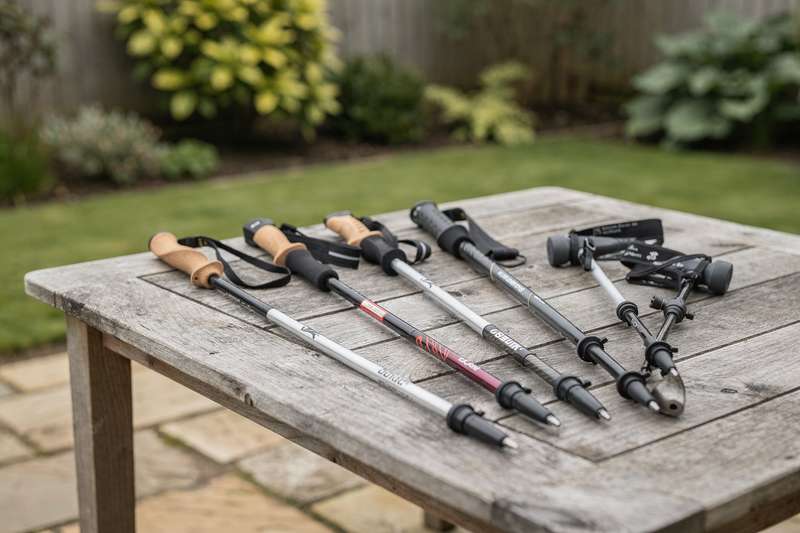
Picture this: you sign up for a Nordic walking group after your physio recommends it for knee pain management, order what looked like perfectly serviceable collapsible poles from Amazon, and turn up to the first session ready to go. Within ten minutes, the instructor politely points out that the wrist straps are working against your technique — they force you to grip rather than push — and that the twist-lock on one shaft has already slipped a centimetre. The poles you bought were trekking poles with “Nordic” added to the name, and the two are meaningfully different under load.
This happens constantly. The search results for Nordic walking poles are dominated by collapsible trekking poles that mention Nordic walking somewhere in the title. On a product page they look nearly identical. The genuine differentiators — shaft rigidity, locking mechanism reliability, strap geometry, and grip material behaviour over two hours of repetitive motion — only reveal themselves once you are actually walking. By that point you have unpacked them, used them, and forfeited your easy return window.
This guide focuses on five poles available right now on Amazon UK, each chosen for a specific reason: whether you want the most community-tested option, the lightest possible construction, something explicitly designed for Nordic technique, a budget entry point, or the reassurance of metal locking hardware — there is a distinct pick below for each scenario.
How These Picks Were Chosen
Evaluating Nordic walking poles requires looking beyond weight and price. The assessment here covered five criteria for each product: shaft material (7075 aluminium versus carbon fibre); locking mechanism type (folding bungee cord, flip lock, or twist collar, with particular attention to whether the hardware is metal or plastic); grip material (cork versus foam and how each handles perspiration across a long session); strap design and padding (Nordic technique requires an open-hand push-off rather than a closed grip, so strap width and cushioning matter more than they do on trekking poles); and tip versatility (rubber boots for pavement plus carbide spikes for soft ground is the minimum functional requirement for UK routes that regularly cross both surfaces).
Two of the five picks have meaningful community review data: the TREKOLOGY Trekking Poles with 441 ratings and the 7075 aluminium cork-grip poles with 107 ratings. The other three have limited buyer feedback on their current Amazon listings; for those, the evaluation draws on construction spec analysis and category benchmarks rather than aggregated real-world accounts, and this is noted within each relevant section. Colour and size variants have been consolidated, with the most distinguishable listing chosen to represent each product family.
Best Overall Pick
The TREKOLOGY Trekking Poles with cork handle sit at the top of this list because they are the most community-tested option in this selection by some margin — over 440 verified ratings at 4.2 stars. At that volume, a 4.2 average reflects consistent real-world performance rather than a small cluster of enthusiastic early buyers. This is a solid, dependable product with occasional rough edges, not an inflated score.
The cork grip is the most important specification choice here. Cork handles outperform foam across every metric that matters for regular Nordic walking: they wick perspiration rather than retaining it, develop a slight surface conformity to your grip pattern over time, and do not become tacky in warm or wet conditions the way foam can. If you are planning to walk two or three times a week consistently, that material difference compounds. The initial texture of a cork grip feels slightly firmer than foam, but within a handful of sessions it settles into something that feels matched to your hand.
The poles use a folding construction rather than a traditional two-section telescopic design. An internal bungee cord connects the sections, which snap together positively and separate cleanly. This makes them compact enough to carry in a day bag or stow in a car boot without the poles sticking out — useful if you are driving to a route and want a quick transition from car to trail. The tradeoff is a narrower adjustment range compared to telescopic equivalents: there is usually some top-section adjustment, but the scope is more limited. Check the stated range against your height before ordering, particularly if you are towards the taller or shorter ends of the adult height range.
Buyer feedback patterns consistently highlight comfort over longer routes and a solid locked feel once the poles are extended. The most common friction point is length for very tall walkers — this is a known characteristic of folding pole designs rather than a manufacturing defect. The strap system is padded, which distributes push-off pressure across the wrist rather than concentrating it on a narrow band. This is the correct behaviour for Nordic technique, where the strap takes progressive load as your hand opens at the rearward point of each stride. The product family also includes colour and size variants under nearby listings, so if an alternative configuration better suits your preferences, the core construction quality should be consistent across the range.
For a first or second serious pair of Nordic walking poles, these offer the most honest performance-to-value balance backed by real community evidence. They will not satisfy a committed long-distance walker who needs the lightest possible shaft, but for regular park and towpath Nordic walking at beginner-to-intermediate level, the combination of cork grip, padded strap, and proven construction makes these the default recommendation.
Best Carbon Fibre Pick
If weight is your priority — particularly if you cover long distances, have any shoulder fatigue history, or walk three or more times per week — the Foxelli Carbon Fiber Walking Poles are the option worth considering. Carbon fibre shafts are lighter than aluminium equivalents of comparable stiffness, and they absorb vibration better — meaning less impact energy travels up through your wrists and elbows over the course of a session. On flat, hard surfaces like tarmac and compacted gravel paths, the most common Nordic walking terrain in the UK, that vibration reduction is noticeable across a two-hour walk.
These poles pair the carbon shaft with cork grips and quick flip locks. The flip lock choice deserves particular attention: twist-lock collars rely on friction between two surfaces and gradually loosen under the lateral push force that Nordic walking generates with every stride. Flip locks — particularly those using metal rather than plastic hardware — give a definitive locked position you can both feel and see, and maintain that engagement across far more use cycles. Knowing your poles are locked is not a minor psychological point; it affects how confidently you push through each stride without second-guessing the mechanism.
The included accessory kit covers all-terrain tips: carbide points for soft ground, grass, and gravel, and rubber boot covers for pavement and tarmac. For UK Nordic walking routes that frequently move between surfaces mid-walk — a riverside path transitioning from tarmac to gravel to soft ground is a common scenario — having both tip types immediately removes a sourcing headache and means you can adapt to whatever surface appears without stopping.
Transparency is warranted here: at the time of writing, this listing has limited community review data. The 4.5 stars is the highest rating in this selection, but it reflects a small sample rather than broad consensus. If you weight purchasing decisions heavily on volume of verified reviews, the TREKOLOGY Trekking Poles above (with 441 ratings) are the more evidence-backed choice. What you are evaluating with the Foxelli is the construction specification: carbon fibre shaft, cork grips, and flip locks is a strong combination for regular Nordic walking, and those material choices are independently verifiable rather than dependent on review volume.
One meaningful tradeoff: carbon fibre can fracture rather than bend under a sharp lateral impact — a pole caught at an awkward angle on a rocky surface, for instance. Aluminium deforms rather than breaking, which is a relevant safety consideration for walkers with balance concerns or those tackling technically rough terrain. On the flat and moderate mixed surfaces that make up most UK Nordic walking, this distinction rarely comes into play, but it is worth understanding before choosing carbon over aluminium.
Best for Nordic Walking Beginners
The TREKOLOGY Walking Poles — specifically the Nordic Walking Poles configuration — are the most explicitly discipline-specific pick in this selection. Where the TREKOLOGY Trekking Poles above are excellent general-purpose collapsible poles that suit Nordic walking well, this model is positioned squarely for Nordic technique from the outset. That distinction shapes how the strap geometry and grip angle are configured, which matters most when you are in the early sessions of learning the movement pattern.
Nordic walking technique depends on using the strap to generate forward push rather than gripping the handle tightly. At the end of the rearward stroke, your hand opens and the strap takes the load — propelling you forward through wrist pressure rather than grip force. This is the mechanism behind the full upper-body engagement that makes Nordic walking a cardiovascular exercise rather than just a walking aid. Learning this pattern with a pole that has the right strap geometry from the start is noticeably easier than trying to adapt a trekking-pole strap to the same purpose.
The foldable design is a practical virtue at the beginner stage. Compact, portable poles reduce the friction of getting out the door — if carrying them to a starting point is slightly awkward, they gradually stop being used. A folding pair that fits in a bag or stows in a car door pocket removes that particular obstacle. The aluminium construction provides solid durability for learning-phase use, where technique is not yet fully consistent and the poles may take some incidental knocks as you find your rhythm.
This listing has limited buyer feedback at the time of writing — the 4.4 rating reflects a sound specification, but from a small sample. The reason to choose this over the other TREKOLOGY poles in this guide is not the review count; it is the explicit Nordic walking positioning and the strap configuration designed for the technique. If you are starting from scratch with Nordic form, that design focus is the most relevant differentiator at this tier.
One practical point worth checking before ordering: if you are significantly above or below average adult height, verify the adjustable length range against the manufacturer’s stated figures. Foldable poles with a single top-section adjustment mechanism have a narrower range than full telescopic designs, and getting pole length right matters for Nordic technique — your elbow should form roughly a 90-degree angle when the tip is planted at normal walking pace on flat ground. Arriving with poles that are consistently too long or too short makes learning the movement pattern harder than it needs to be.
Best Budget Pick
For anyone not yet certain that Nordic walking will stick as a regular habit — or buying for someone who wants to try the discipline without a large upfront commitment — the COVACURE Walking Poles offer the most practical entry point in this selection. Sold as a 2-pack, a confirmed pair rather than individual sticks, they are built around 7075 aluminium — the same aircraft-grade alloy used in the mid-range options in this guide. That alloy designation matters: lower-cost poles often use unspecified or cheaper aluminium grades that are heavier and less stiff for a given wall thickness.
The foam grip is the main tradeoff at this tier. Foam provides immediate, uniform cushioning without any break-in period, which is useful when you are sampling Nordic walking across a handful of sessions before deciding whether to invest further. For short to moderate walks in mild conditions foam performs adequately. The limitation becomes more apparent on longer sessions or in warmer weather: foam can become slightly tacky as perspiration builds, whereas cork handles the same conditions comfortably. If Nordic walking becomes a regular habit, upgrading to a cork-grip pair is a natural progression — but for the trial phase, foam is entirely serviceable.
The padded wrist straps are a thoughtful detail at this price level. A padded strap sits more comfortably against the back of the wrist during the push-off phase and prevents the pressure marks that bare webbing straps can leave after an hour of consistent Nordic technique. It is a small specification choice that makes a noticeable difference over a full session’s worth of repetitive movement.
The collapsible shaft makes these practical for transport and storage, and the 7075 alloy means the poles will not feel flimsy underfoot. The 4.4-star rating is encouraging, though with limited reviews at the time of writing the assessment here leans primarily on the construction specification rather than community consensus. Aircraft-grade aluminium, padded straps, and a dual tip accessory kit represent solid value at the entry level.
One sensible precaution with any budget collapsible pole: test the locking mechanism on first use before taking them onto uneven terrain. Extend the poles fully, lock them out, and apply moderate lateral pressure to confirm a stable hold. If anything feels inconsistent, address it with the seller before your first proper walk. The consequences of a lock slipping mid-stride on a descent are considerably more significant than the inconvenience of a return and exchange.
Best Mid-Range Pick
The Trekking Hiking Walking Poles Women and Men occupy the clearest value position in this selection for buyers who know exactly what they want: 7075 aluminium shafts, natural cork grips, and metal flip locks. That combination addresses the two most common failure modes of budget collapsible poles — grip discomfort on longer sessions and a locking mechanism that gradually loses bite — without stepping up to carbon fibre pricing.
With 107 verified ratings at 4.4 stars, these are the second-most reviewed option in this guide. That rating at that volume is a meaningful signal — large enough to filter out statistical noise, consistent enough to suggest buyers from varied heights, routes, and use frequencies are having similar experiences. The feedback pattern most consistently highlights grip comfort on longer routes and the dependability of the flip locks, with buyers specifically noting that the locks maintain their hold under repeated use rather than developing the soft, uncertain feel that some twist-lock designs exhibit over time.
Metal flip locks are worth seeking out if you plan to use your poles regularly. The standard on many collapsible poles is plastic flip hardware or a twist collar. Both work when new, but plastic hardware compresses under repeated clamping cycles and eventually provides a less firm grip — you notice shaft movement under hard push-off before the component shows any visible wear. Metal hardware does not share this limitation under normal conditions; a well-made metal flip lock should stay firm across several hundred kilometres of walking without requiring adjustment or replacement.
The natural cork grips deliver the same advantages described in the TREKOLOGY Trekking Poles section: consistent moisture management, gradual surface adaptation to your grip shape, and tactile feedback that stays reliable when your hands are warm and perspiring. These do not require a meaningful break-in period — the texture is comfortable from the first session rather than needing multiple outings before settling.
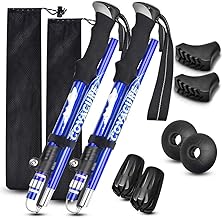
Packaged as a pair, these come with carbide tips for off-road use and rubber boots for pavement — the complete tip kit for typical UK mixed-surface routes without additional purchases. The ultralight designation in the title reflects the 7075 alloy grade, which is noticeably lighter at equivalent dimensions than the 6061 grade commonly used in lower-cost poles. For regular walkers who want proven aluminium durability, proper cork grip ergonomics, and locking hardware that holds up over time, this is the sharpest specification-per-price option in the selection.
What to Look for When Buying Nordic Walking Poles
- Shaft material: 7075 aluminium is the standard for quality collapsible poles — it is stiffer and lighter than cheaper aluminium grades and deforms rather than fractures under unexpected impact. Carbon fibre is lighter still and absorbs vibration better, making it kinder on joints over long sessions on hard surfaces. If you have balance concerns or walk on technically rough ground, aluminium’s deformation-over-fracture behaviour is a relevant safety consideration.
- Locking mechanism: Metal flip locks are the most reliable option for Nordic walking. They provide a definitive, visual confirmation of the locked position and maintain their grip across far more use cycles than plastic flip hardware or twist-lock collars. Twist locks rely on friction and gradually loosen under the lateral push force Nordic technique generates with every stride. Folding bungee systems eliminate the lock entirely — lightweight and simple, but with a limited adjustment window.
- Grip material: Cork is the preferred choice for regular Nordic walking — it wicks moisture, does not become tacky in warm conditions, and conforms slightly to your palm over time. Foam provides immediate cushioning without a break-in period and works well for occasional or short-session use, but performs noticeably worse once hands start perspiring heavily. Rubber grips breathe poorly and are unsuitable for extended Nordic walking.
- Strap design: A proper Nordic walking strap should be wide, padded, and configured to allow your hand to open at the rearward position of the stride. Nordic technique requires push-through-strap propulsion rather than grip-based control — narrow webbing loops that force a closed grip negate most of the upper-body benefit. Check that straps adjust across a range to accommodate gloves in colder weather.
- Tip system: You need both carbide spike tips for grass, gravel, and soft ground, and rubber boot covers for pavements and tarmac. A quick-change system that works without tools makes mid-route swapping practical rather than something you skip. Walking on carbide tips on pavement wears them quickly and creates an unwanted clicking sound; rubber boots prevent both problems and should be the default for urban routes.
- Adjustable length range: Your elbow should form roughly a 90-degree angle when the pole is planted at normal walking pace on flat ground. Many Nordic walking practitioners prefer poles fractionally shorter than standard trekking-pole formulas suggest, to encourage a more forward-angled plant. Check the stated range against your height, particularly with folding designs that have a narrower adjustment window than full telescopic poles.
- Weight: Lighter poles generate less muscular fatigue per stride — over a 90-minute session the accumulation shows up in the shoulders and upper arms. Carbon fibre poles weigh meaningfully less than aluminium equivalents at similar dimensions. If you walk multiple times per week, that difference will be noticeable in how fresh you feel during the final third of each session.
Verdict
For most regular Nordic walkers in the UK, the TREKOLOGY Trekking Poles with cork handle are the clearest starting recommendation. The combination of cork grip, padded strap, folding portability, and over 440 verified ratings makes them the most evidence-backed option in this selection. You are not buying on specification alone — you are buying something a substantial number of walkers have used and rated positively, which matters when the real-world differences between poles only become clear after multiple sessions.
If you have already used collapsible aluminium poles and want to reduce fatigue on longer distances, the Foxelli Carbon Fiber Walking Poles are the logical step up. The lighter shaft and flip-lock mechanism address the two most common complaints about regular aluminium poles — cumulative weight fatigue and lock reliability — without requiring a dramatic change in use pattern.
For buyers who specifically want metal flip locks and cork grips in an aluminium build and want community validation behind the purchase, the Trekking Hiking Walking Poles Women and Men — 107 ratings at 4.4 stars — represent the best balance of reliable construction and real-world-supported performance in this selection.
We were not paid to feature any specific product in this guide. All opinions are independent and based on publicly available specifications, verified buyer feedback patterns, and category research.
Quick Comparison Table




FAQ
What is the difference between Nordic walking poles and trekking poles?
Nordic walking poles are designed for a specific forward-push technique in which the strap — not the grip — provides propulsion. The shaft angle, strap geometry, and tip configuration are matched to a diagonal, active planting motion rather than the vertical braking and balance role trekking poles typically fill. Trekking poles can be adapted for Nordic walking at a basic level, but the strap design on most trekking poles prevents the open-hand push that generates the technique’s full upper-body engagement.
What length Nordic walking poles do I need?
The standard starting point is a length that creates roughly a 90-degree angle at your elbow when you hold the grip and plant the tip on flat ground. For Nordic walking specifically, many practitioners prefer poles fractionally shorter than standard trekking-pole formulas suggest, to encourage a more forward-angled plant and fuller arm drive. Most adjustable poles give you a range to experiment with — if you are between sizes, start shorter rather than longer and adjust from there.
Can I use Nordic walking poles on pavements?
Yes, but you should fit rubber boot tip covers rather than leave the carbide spike tips exposed. Carbide tips wear quickly on hard surfaces, create a persistent clicking sound, and can slip on wet tarmac. Rubber boots provide appropriate grip and protect the metal tip beneath. All the poles in this guide include both tip types; swapping to rubber boots before stepping onto pavement extends the life of your carbide tips substantially and keeps the walk quieter for everyone around you.
Are Nordic walking poles suitable for people with bad knees?
Nordic walking with correct pole technique can reduce load on the knee joints by distributing some forward propulsion and impact absorption across the arms and shoulders. The key distinction is using the poles actively — pushing off through each stride — rather than passively as balance aids. Anyone with a specific knee condition should consult a physiotherapist before starting, but the technique is frequently recommended in rehabilitation contexts because it reduces lower-limb loading compared to standard walking at equivalent cardiovascular intensity.
How do I maintain collapsible Nordic walking poles?
Wipe the shaft sections dry after wet-weather use and occasionally loosen the locking mechanism to allow any grit or moisture to clear — sand can work into lock housings over time and cause over-tightening or premature loosening. Store the poles collapsed in a dry location rather than in a damp car boot long-term. Cork grips can be lightly sanded if they develop a rough patch; they do not require oiling or conditioning. Check the rubber tip covers regularly for wear and replace them before significant thinning affects grip on pavement.
Do Nordic walking poles need to be bought in pairs?
Yes. Nordic walking is a bilateral technique in which both poles work simultaneously in a diagonal cross-body pattern, and the cardiovascular and muscular benefits depend entirely on that symmetrical arm engagement. Most listings in this guide are sold as a 2-pole set, but always confirm this before purchasing — some budget listings can be ambiguous about whether one or two poles are included, and the product description does not always make it obvious at a glance.