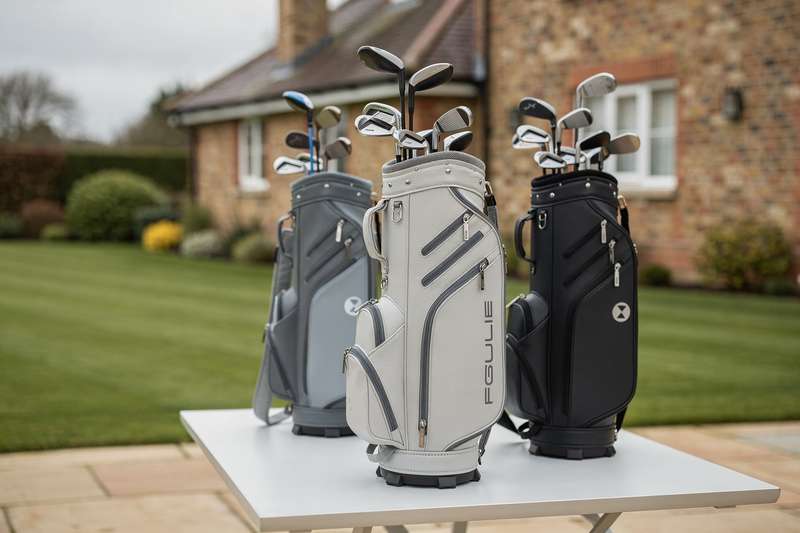
You know the moment. You’re standing at the driving range reception, trying to fit a 14-club bag sideways through the turnstile because you couldn’t find anything more practical for an hour’s practice session. Or you’re at the airport check-in desk watching a baggage handler toss your golf bag onto the conveyor belt, grimacing at the thought of what state your driver head will be in when it emerges at the other end in Faro. Or your golf mate texts at 8pm to say there’s a tee time at the local pitch-and-putt tomorrow morning, and you spend an embarrassingly long time working out which bag makes any sense for a short loop with six clubs.
The honest truth is that most UK golfers need more than one type of bag solution — or at least, the right bag for the kind of golf they actually play. The market is full of premium stand bags that look beautiful in magazine reviews and cost as much as a new set of irons, but that’s not the whole picture. If you mainly hit range balls, take the odd trip to a par-3 course, or want something that’ll survive the airline baggage carousel, the options worth knowing about are practical rather than aspirational.
This guide covers the golf bags available right now on Amazon UK with real buyer feedback behind them. Five different bags for five different scenarios — each one a specific solution to a real problem rather than a vague catch-all pick that suits nobody completely.
How These Picks Were Chosen
Every recommendation here is grounded in verified buyer data from Amazon UK. Rating alone is not enough — a product with 12 reviews at 4.9 stars means considerably less than one with 700 reviews at 4.8. The selection process therefore weighted both score and review volume together. Other criteria included: purpose fit (does this bag actually match the use-case it is marketed for?), reported build quality over time rather than first-impressions feedback, feature set relative to price tier, and whether each bag serves a distinct need compared to the others in the list.
Where products appeared to be size or colour variants of the same model, one variant was selected and a single section written — not two sections for what is essentially the same bag. Products with no verified reviews were excluded where alternatives existed. The aim was five distinct picks that do not compete for the same golfer’s money.
Best Golf Bag for Flying
If you travel with your clubs even once or twice a year, the OutdoorMaster Golf Travel Bags for Airlines belongs near the top of your shortlist. With a 4.8 out of 5 from over 700 verified buyers, it carries the highest rating and the most reviews in this guide by a clear margin — and that combination of high score and substantial review volume gives the result real credibility.
The design is built around two features that directly address the problem of flying with clubs: a hard case top section and a wheeled base. The hard top is the detail that matters most. Club heads — particularly drivers, which are large, hollow, and expensive — are the most vulnerable point in any set, and a reinforced rigid top gives them something solid to rest against rather than relying purely on foam padding. The fabric is 1680D nylon, a robust denier rating that handles repeated loading, scuffing, and the general rigours of airport transit far better than thinner materials. The overall construction is described as waterproof, which matters when your bag sits on wet tarmac between connections or gets rained on during outdoor transfers.
The wheeled base changes the airport experience in a way that is genuinely difficult to appreciate until you have struggled through a terminal with a heavy unsupported golf bag. Rolling your equipment alongside you is simply easier than lugging it, and for a bag this size and weight, that practical difference adds up across long terminal walks and car park distances. The compact folding design means the bag packs away when not in use — a real consideration for UK golfers with limited storage space at home, since an un-deflatable travel case can take over an entire cupboard for 50 weeks of the year.
The honest tradeoff is cost: this sits at the premium end of this guide’s price range, and if you fly with clubs once every three years, the case is harder to justify. But for golfers who book a golf trip annually, the cost of a cracked driver head or bent shaft can easily exceed the investment in a proper travel bag. Buyer feedback at over 700 reviews trending strongly positive reflects the experience of multiple trips rather than unboxing enthusiasm — that is exactly the review pattern you want to see for a travel product.
One clarification worth making: this is a transport case, not a playing bag. It goes over or around your regular bag during transit and protects clubs in the hold. You still need a stand bag or carry bag to use on the course itself. Think of it as specialist kit for the travel problem rather than a replacement for an everyday bag.
Best Foldable Case for Range Sessions
The PYKES PEAK Golf Clubs Case answers a question many range-goers face regularly: why carry a full 14-club bag to a driving range session when you only need seven or eight clubs? This foldable case fits clubs up to 47 inches in length — covering drivers and most fairway woods without modification — and accommodates up to 10 clubs, making it the right size for a focused practice session without unnecessary bulk. With 398 verified buyers giving it 4.3 out of 5, it has a meaningful sample of real-world feedback behind it.
The foldable construction is the key practical advantage. When you are not at the range, this case flattens for storage — no structured bag propped against the wall of your spare room or occupying half the car boot permanently. For UK golfers who want to keep a range kit in the car without it dominating the space, or who live in flats or smaller homes where storage is at a premium, a fold-flat case is a meaningful quality-of-life improvement over a structured stand bag that never deflates. A waterproof pocket provides a secured area for your phone, car keys, tees, and scorecards — items you want protected from damp regardless of what the weather does between the car park and the range shelter.
Build quality is always the question with foldable products at a moderate price, and consistent ratings across close to 400 reviews suggest this case holds up well for regular range use. For a bag you are loading, unloading, folding, and carrying back and forth multiple times a week, durability at the zips and seams is the main thing to check when the product arrives. The review volume here suggests widespread failure has not been a reported pattern.
The limitations are the logical flip side of the specialist design: ten clubs is the maximum, so you cannot bring a full 14-club set; there are no stand legs for use on the course; and the pocket layout is calibrated for practice rather than full-round play. It is also worth knowing that PYKES PEAK offer this case in multiple colour options under different variant listings — the ratings and review counts are consistent across the colour choices, suggesting quality is uniform regardless of which option you select. For exactly what it is designed for — getting a useful selection of clubs to the range efficiently and storing flat when not in use — it is a well-reviewed, practical choice.
Best Carry Bag for Pitch-and-Putt and Par-3 Play
The Findway Golf Stand Carry Bag is designed for the kind of golf a large proportion of UK players actually play most often: pitch-and-putt courses, par-3 layouts, and executive nine-hole tracks. If your game mostly involves short courses with a half-set, and you want something lightweight that does not feel like unnecessary baggage for a quick loop, this is a sensible starting point. It holds 4.3 out of 5 from 101 buyers — a credible result for a bag at this level and stated purpose.
The combination of a lightweight build and a stand system is what defines this bag’s appeal. On a pitch-and-putt or par-3 course, you are typically carrying five or six clubs and walking a compact layout — the last thing you want is a heavy bag straining your shoulder before the sixth hole. The carry strap is designed for single-shoulder carrying across the duration of a short round, and the stand legs let you set the bag down on the fairway or around the green without it tipping over or lying flat. That is the essential functional difference between a stand bag and a basic carry sleeve: you can put it down cleanly and pick it up without adjusting anything.
Durability is highlighted explicitly in the listing, which is relevant for buyers at this price tier. Budget bags often feel fine initially but show wear at the zips, strap attachment points, and stand leg hinges after a season of regular use. At 101 reviews and a consistent 4.3-star average, the feedback sample represents users who have taken the bag out on more than one occasion — which makes the sustained score more meaningful than a handful of first-week impressions.
Where the Findway is limited is in its scope: this is not the bag for full 18-hole rounds with a complete 14-club set. The design is calibrated for partial sets on shorter courses, and you would not expect otherwise given its stated purpose. If you predominantly play regulation full courses with all 14 clubs, one of the other picks in this guide serves you better. But if pitch-and-putt and par-3 play is the core of what you do, buying a full-size premium bag for that activity is unnecessary over-engineering. The Findway is proportionate to the actual requirement. It also works as a spare bag if a guest joins you for a round and needs to borrow a few clubs.
Best Lightweight Stand Bag for Regular Play
For golfers who play proper 18-hole rounds and prefer to walk and carry rather than push a trolley, the priority shifts: you need a bag light enough to carry for four hours, organised enough to find clubs quickly, and durable enough to survive a full season. The Golf Stand Bag with Adjustable Strap targets this scenario with a 2-way divider, three pockets, and a lightweight build, earning 4.5 out of 5 from 98 buyers — the second-highest rating in this guide.
The 2-way divider is what separates this from a basic range carrier or a simple pencil-style sleeve with no organisation. When you are playing a full round, you reach into the bag repeatedly across 18 holes — sometimes on a slope, often in drizzle, occasionally in a hurry. A divider that splits the bag into two sections gives you at least a working system: woods on one side, irons on the other, and you are not pulling three clubs out at a time to find the one you want. It is not the individual 14-way slot configuration of a premium tour bag, but it is meaningfully more organised than an undivided compartment for regular play.
Three pockets provide enough storage for practical rounds: a main compartment for a waterproof jacket and bulkier items, plus two smaller pockets for balls, tees, and accessories. The adjustable strap lets you tune the carrying position to your height and frame, which makes a real difference over a longer round. An ill-fitting strap shifts the bag’s weight awkwardly to one side — the right adjustment distributes load across your back, and small discomforts add up quickly after the 12th hole. The stand legs allow you to set the bag down on any terrain without it toppling, which is the essential function that distinguishes a stand bag from a carry sleeve.
The honest limitation is that this is not a premium touring bag. Waterproof zips, insulated cooler pockets, padded full-length dividers, and umbrella sleeves are features of bags in higher price brackets. For a casual to regular golfer who walks the course and wants functional organisation without spending heavily, the buyer feedback at 4.5 stars from close to 100 reviewers confirms the bag covers the fundamentals it sets out to cover. As with any stand bag at the budget end of the market, check the leg mechanism when the bag arrives and test it on sloped ground before your first round — legs are the most common failure point in this category, and catching a defect early is easier than dealing with a collapsed stand mid-fairway.
Best Budget Foldable Golf Carrier
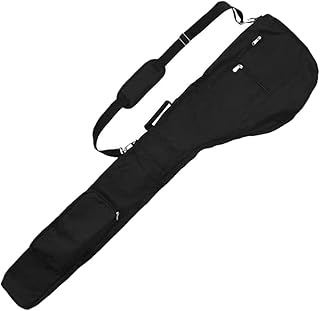
Sometimes the simplest solution is the right one. The New Golf Club Carrier Bag in black is the most budget-friendly option in this guide, and its 4.6 out of 5 from 32 buyers is an encouraging score for a carrier at this price level — suggesting the basics are handled competently without demanding a significant outlay.
Two features define the proposition: water resistance and foldability. Water resistance is not the same as waterproof — the fabric will repel light moisture and damp grass contact, but it will not hold out against sustained rain the way a fully sealed waterproof bag will. For driving range use, though, that level of protection is often sufficient. The typical journey is from your car across a car park and into a covered range shelter, not an exposed four-hour walk in November rain. Foldability means the carrier takes up minimal space when not in use — a practical advantage for golfers in smaller homes or those who want to keep a range kit permanently in the car boot without it taking over.
The foldable design also makes this a convenient companion for golf holidays where you are flying your main bag out to a resort and want something lightweight for practice days without bringing your full set-up. It is also a logical first bag for golfers just starting out who are not yet certain how regularly they will play — the financial commitment is low, and if the habit takes hold, upgrading to something more structured later is straightforward. As an entry-level or secondary carrier, it avoids the over-commitment of buying a full stand bag for what might turn out to be occasional use.
The limitation to acknowledge honestly is the review base. Thirty-two reviews is the smallest sample in this guide, and while the 4.6 rating is strong, it carries less statistical confidence than the 400-plus or 700-plus reviews behind other picks here. Treat it as encouraging rather than definitive confirmation of long-term durability. At a budget price level, the risk is proportionate — if it does not hold up as well as hoped after a full season, the financial exposure is modest. Go in with realistic expectations: this is an occasional-use carrier, not a daily-driver for multiple rounds a week.
What to Look For in a Golf Club Bag
- Match the bag type to the golf you actually play: Stand bags have fold-out legs for walking golfers who carry; cart bags are designed to sit on a trolley or buggy with side-accessible pockets; travel bags protect clubs in transit; and range or practice carriers are for taking a selection of clubs to a session. Buying the wrong type for your playing habits creates frustrations that no amount of adapting resolves.
- Divider configuration matters more than you might expect: A 14-way full-length divider gives every club its own slot and prevents shafts rubbing against each other — that is the standard for premium stand and cart bags. A 2-way or 4-way divider is functional for casual play. An undivided single compartment is adequate for a handful of clubs at the range. Choose based on how many clubs you carry and how often you are reaching in during a round.
- Waterproof and water resistant are meaningfully different: Waterproof bags use welded or taped seam construction and waterproof zip systems, meaning water cannot penetrate even under sustained pressure. Water-resistant bags have treated fabric that repels light moisture but is not sealed — extended rainfall will eventually get through. For UK autumn and winter play in particular, waterproof construction is the more reliable choice.
- Weight compounds over a full round: The difference between a 1.5kg bag and a 2.5kg bag feels trivial when you pick it up in a shop. Over four hours on a hilly course, that kilogram difference is genuinely felt. For carry bags, prioritise weight and look for a dual-shoulder (double-strap) system rather than single-shoulder — distributing load across both sides dramatically reduces fatigue over 18 holes compared to one-sided carrying.
- Stand leg quality is the most common failure point in budget bags: The leg mechanism is where cheaper stand bags most often show problems — legs that do not lock securely, collapse on slopes, or stop extending smoothly are a frequent complaint in budget bag reviews. Test the stand on arrival and try it on uneven ground before committing to a full round. For bags with solid ratings and meaningful review volume, this is typically not a widespread issue — but it is always worth verifying on receipt.
- Pocket placement matters as much as count: More pockets do not automatically mean better organisation. Five logically placed pockets beat eight that are awkward to access. For a carry bag, prioritise a quick-access front pocket for balls and tees, a main compartment for clothing, and a valuables pocket for your phone and keys. For a cart bag, side-access placement is more important since you are reaching in from the side of a trolley rather than from above.
- Travel-specific features for airline use: A reinforced or hard top section is the single most important protection for club heads during baggage handling. Wheels make airport navigation practical; lockable zips add an extra layer of security; and a fold-flat storage design means the bag does not take up excessive cupboard space for the many months a year it is not in active use.
Verdict
For the typical UK golfer who plays a round or two a month when the weather cooperates, makes regular range visits, and occasionally plays short courses, the Golf Stand Bag with Adjustable Strap is the most practical all-round pick. Rated 4.5 out of 5 from real buyers, it works for range sessions and full-course play alike, has a 2-way divider and three pockets for organised access, and does not require a large financial commitment. It is the bag that covers the widest range of common playing scenarios without over-engineering the solution or asking too much of your wallet.
If you fly with your clubs at all, the OutdoorMaster Golf Travel Bags for Airlines is the most important additional consideration — it is the highest-rated bag in this guide and addresses a problem that is expensive to get wrong. For dedicated range practice without the bulk of a full bag, the PYKES PEAK Golf Clubs Case is the streamlined, fold-flat answer. And for pitch-and-putt or par-3 play, the Findway Golf Stand Carry Bag is proportionate to that kind of golf without unnecessary complication.
The single recommendation for the modal reader is the Golf Stand Bag with Adjustable Strap — it covers the most ground for the most common UK golfer scenario, backs up its 4.5-star rating with a credible number of real reviews, and sits at a sensible price point for a bag that works both at the range and out on the course.
We were not paid to feature any specific product in this guide. All opinions are independent and based on publicly available specifications, verified buyer feedback patterns, and category research.
Quick Comparison Table



FAQ
What is the difference between a stand bag and a cart bag?
A stand bag has fold-out legs that let it stand upright on the course when you set it down, making it the right choice for golfers who walk and carry. A cart bag has no stand legs and is designed to sit securely on a push trolley or electric buggy, with pockets positioned for easy side-access rather than standing reach. If you walk the course, choose a stand bag; if you use a trolley or buggy for most rounds, a cart bag is the more practical fit.
Do I need a waterproof golf bag for UK courses?
For UK conditions, water resistance is the minimum you should accept in a bag. British weather is unpredictable enough that even a planned dry round can include light rain, damp grass, and heavy morning dew. If you play through autumn and winter, or prefer not to carry a separate bag cover, a fully waterproof bag with sealed seams and waterproof zips is more reliable — water-resistant bags will eventually soak through under sustained rainfall.
What is the difference between a waterproof and a water-resistant golf bag?
Waterproof bags use welded or taped seam construction and waterproof zip systems, meaning water cannot penetrate the material even during heavy and sustained rain. Water-resistant bags use treated fabric that repels light moisture but is not sealed — extended rainfall will get through over time. The distinction matters most for UK golfers who play in autumn and winter conditions rather than just occasional summer showers.
Can I use a stand bag on a golf trolley?
Most stand bags can be placed on a push trolley, though they are not designed for it. The pocket layout on a stand bag is calibrated for standing access, which can be awkward from the side-on position of a trolley. If you use a trolley regularly, a dedicated cart bag makes more practical sense, since its pockets are positioned specifically for horizontal trolley access. Some bags are marketed as hybrid designs intended to work comfortably in both roles.
How many clubs does a range or practice bag need to hold?
For a typical driving range session, six to ten clubs is sufficient — usually a driver, a fairway club or two, and a range of irons. You rarely need your putter or all 14 clubs for a focused practice session. A foldable case or carrier designed for 8 to 10 clubs is well-matched to range use, while a full stand bag is generally overkill unless you are doing a comprehensive pre-round warm-up with your complete set.
How do I protect my golf clubs when flying?
The most important protection for air travel is a reinforced or hard top section on your travel bag — club heads, particularly driver heads, are the most vulnerable part of any set during baggage handling. A wheeled travel bag with dense padding and secure closures gives the best chance of clubs arriving undamaged. Adding extra padding around driver heads specifically is also a sensible precaution, as those are the most expensive items to replace if something goes wrong in the hold.