You spend a solid Saturday afternoon raking your lawn, aerating it, and finally tipping a bag of lawn feed or grass seed onto it — only to stand back a week later and stare at a patchwork of dark green stripes and pale, untreated sections. Or you try the hand-scatter approach, doing your best to eyeball an even distribution across the turf, and end up with burned yellow spots where the granules clumped and bare areas where none arrived. It’s one of the most reliably frustrating lawn-care experiences in UK gardening, and it is almost entirely avoidable.
The problem isn’t the product — it’s the application method. Distributing granular lawn treatments by hand is inconsistent by nature. Your wrist action varies stride to stride, granules stick together in damp palms, and maintaining a steady, even rate across an entire lawn without over-applying in some spots and missing others is essentially impossible. A lawn spreader removes that inconsistency from the equation. You load the hopper, dial in the rate, walk at a steady pace, and the mechanism does the distributing. The result is visibly more even, your expensive products go further, and you don’t end up with chemical burns or bare patches to correct the following month.
The challenge for UK buyers right now is that Amazon’s search results for “spreaders” surface an unhelpful mix of kitchen butter knives, crepe-making tools, glue applicators, and putty scrapers alongside the actual lawn tools. If you’ve tried searching and ended up confused about what’s actually on offer for garden use, you are not alone. This guide cuts through all of that and focuses solely on the three products on Amazon UK right now that genuinely belong in a garden shed — assessing each honestly against the practical realities of UK lawn care, garden sizes, and seasonal use including winter path salt distribution.
How We Evaluated These Picks
Amazon UK’s current catalogue for dedicated lawn spreaders is narrower than it should be for such a common garden task. After filtering out off-topic products — kitchen tools, craft applicators, and DIY scrapers that appeared in search results for “spreaders” — only three products remain that genuinely fit the garden spreader category. This guide evaluates those three against the following criteria: spreading width and adjustability, hopper capacity relative to typical UK residential lawn sizes, build material and corrosion resistance, gate mechanism quality and shut-off reliability, ease of cleaning and storage, and real buyer feedback where available.
Two of the three picks carry substantial verified review counts from UK buyers; the third, the Gardena handheld model, currently has no UK reviews in the live product data. That product is assessed using Gardena’s published product specifications and the brand’s established reputation in the European garden-tools market, and we note this clearly in the relevant section. The methodology here doesn’t claim uniform review-based vetting across all picks — it describes what was actually done, because honest evaluation means acknowledging when review data is absent rather than pretending otherwise.
Best Walk-Behind Spreader for UK Lawns: Miracle-Gro Compact Lawn Spreader
The Miracle-Gro Compact Lawn Spreader is the most complete and practical option currently available on Amazon UK for typical British residential gardens, backed by a 4.5-star rating from 173 verified buyers — a solid foundation of real-world signal in a product category where Amazon UK is underpopulated.
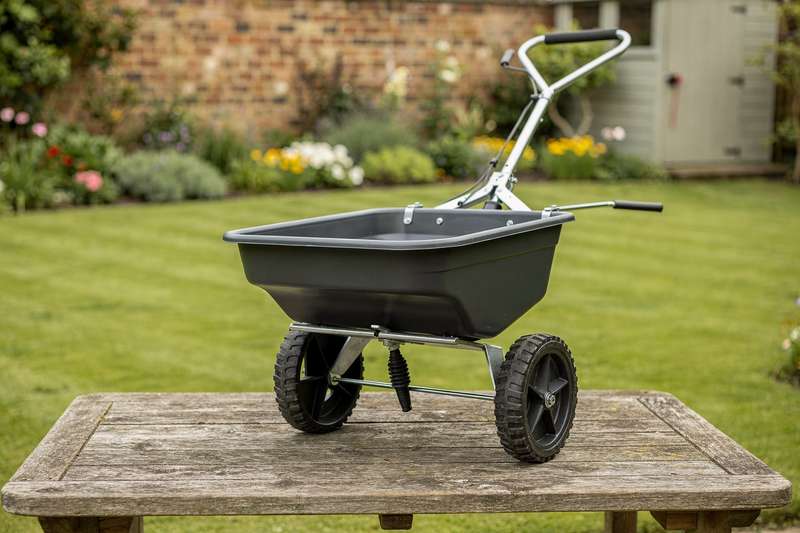
This is a walk-behind rotary broadcast spreader, which is the most efficient format for home lawn use. You fill the hopper with granular product — fertiliser, lawn sand, seed — dial in the distribution rate, and push the spreader across the lawn while the spinning impeller broadcasts material in a wide fan pattern ahead of you. The walking pace, combined with the dial setting, determines how much product lands per square metre. Compared to hand application, the consistency improvement is immediate and obvious: you get even green growth across the whole lawn rather than stripes and patches.
The standout practical advantage of this spreader is its compatibility with the Miracle-Gro and Scotts Evergreen product ecosystem. Bags of Evergreen Complete, Miracle-Gro EverGreen Fast Green, and similar products commonly sold in UK supermarkets, garden centres, and DIY stores print specific dial settings for Miracle-Gro spreaders on the packaging. That means you don’t have to guess the rate or do complex conversions — you read the bag, set the dial, and walk. This single feature eliminates one of the most common complaints about cheap spreaders: vague or non-existent calibration guidance that leads to over- or under-application, wasted product, and poor results.
The compact design suits the storage reality of most UK garden sheds. It doesn’t have an oversized frame or unnecessarily large hopper, which keeps it light enough to manoeuvre through a narrow side gate or lift onto a shelf between uses. Assembly is minimal — multiple buyers mention it being ready to use quickly after unboxing. The trade-off on compactness is refill frequency: for larger gardens, you’ll need to stop and top up the hopper more often than with a higher-capacity model. The hard plastic wheels, standard at this price tier, are fine on flat lawns but can skip slightly on uneven ground, affecting spreading consistency. If your garden has significant slopes or lumpy terrain, that’s worth keeping in mind.
For the broad majority of UK gardeners who use Miracle-Gro or Scotts products — which is genuinely most of the market, given those brands dominate UK garden retail — this spreader is the most sensible starting point. Dial compatibility, proven buyer feedback, compact storage, and simple operation make it the pick that will frustrate you least on a wet Saturday morning when you just want to get the lawn fed and get back inside. Rinse it out after every session, and it will serve you reliably through multiple growing seasons.
Best Handheld Spreader: Gardena Hand-Held Spreader M
The Gardena Hand-Held Spreader M takes a completely different physical approach to the walk-behind format — this is a one-handed, trigger-and-impeller device with no wheels, no frame, and no assembly needed, designed for gardeners who prioritise portability and minimal storage impact above all else.
One important caveat upfront: this product currently carries no UK buyer reviews in our live product data. Our assessment draws on Gardena’s published product specifications and the brand’s broader standing in the European garden-tools market. Gardena, owned by the Husqvarna Group, is among the most established garden-tool manufacturers in Europe, with a product range that sells across Germany, the Netherlands, France, and the UK. Their handheld spreader line has received positive reception in continental European market listings and the brand’s quality control is well regarded. That said, if having a large body of UK-specific buyer feedback matters to you before purchasing, the Miracle-Gro or Combination Spreader picks will provide more reassurance in that respect.
The key specification that sets this model apart within the handheld category is its spreading width adjustment range: 1 to 4 metres, variable. Most basic handheld spreaders operate at a fixed spread width with no meaningful adjustment. The Gardena’s adjustability means you can narrow the spread to 1 metre when working along a border, path edge, or narrow strip — keeping product on the lawn and off the paving or flower beds — and open it back to 4 metres for sweeping coverage across open turf. That precision reduces waste and saves money on expensive fertiliser or seed that would otherwise land on non-lawn areas.
You hold it with one hand, squeeze the trigger to release granules from the rotating impeller, and walk at an even pace. The impeller flings material outward in a fan pattern, covering ground ahead and to the sides as you move. The footprint is genuinely small: it weighs very little, stores on a nail in the shed or in a cupboard, and requires no maintenance of wheels, no frame to keep clean, and no assembly of any kind. For anyone with limited storage space, a flat-dwelling gardener with window boxes and planting areas to treat, or someone who just needs to apply seasonal treatments once or twice a year, this format solves the storage and effort problem entirely.
Where the handheld format struggles is on larger lawns or when you have a lot of ground to cover. Arm fatigue becomes real after twenty or thirty minutes of one-handed squeezing and walking. You’ll need to refill the hopper frequently, and you cannot cover as large an area per hour as a walk-behind spreader does. The lever mechanism, while simple, does require continuous engagement — you cannot set it and walk, the way you can with a wheeled spreader’s dial. For quick jobs, path salt application in winter, small courtyard gardens, or allotment patches, this is genuinely efficient. For a full suburban back garden that needs feeding multiple times a season, the Miracle-Gro walk-behind will give you better value in terms of time and effort.
Best Budget Pick: Combination Spreader
The Combination Spreader is the entry-level option on Amazon UK right now, with a 4.3-star rating from 398 verified buyers — the largest review count of any spreader currently listed, which reflects its longevity on the platform and substantial real-world use across UK gardens.
The “combination” designation indicates this unit is designed to handle multiple types of granular product — seed, granular fertiliser, lawn treatment — rather than being optimised for a single task. At this price point, you are explicitly not getting a premium frame, pneumatic tires, or industrial-grade components. What you are getting is core spreading function: a mechanism that distributes granular material reasonably evenly across a garden for light to moderate seasonal use.
With nearly 400 UK buyer reviews on record, clear patterns emerge from the feedback base. Buyers consistently report that the product works adequately for occasional seasonal use — a couple of feeds per year, an autumn overseed, spring path treatment. Build quality, as you would expect at this price, reflects modest materials: plastic hopper, simple gate mechanism, hard wheels. The gate can develop stickiness with repeated use, and plastic components show wear sooner than more expensive models. However, the reviews also show that with diligent cleaning after every session, the spreader remains functional across multiple seasons of occasional use. Buyers who neglect cleaning — leaving granules to dry and harden in the hopper overnight — report premature failure.
This is an honest budget entry point: if you need a spreader for a first-time trial before committing to a more expensive model, if you rent and don’t want to invest heavily in tools, or if you genuinely only treat your lawn once or twice a season, this spreader does what it promises at a price that doesn’t sting if you eventually decide spreading isn’t for you. The critical caveat is cleaning discipline. A five-minute rinse and dry after every use will extend the lifespan substantially. Neglect that step and you’ll be replacing it sooner than you’d like.
One practical limitation worth noting: the product listing provides minimal detail on hopper capacity and spreading width. Before purchasing, check the full product specifications to confirm the hopper volume is adequate for your lawn size. Based on review patterns from similar budget spreaders, expect capacity suited to small-to-medium gardens (up to about 200–300 square metres) in one or two fills. If your lawn is significantly larger, investing in the Miracle-Gro model will give you more capacity per refill and better long-term value.
What to Look For in a Lawn Spreader
- Spreader type: Broadcast (rotary) spreaders throw product in a wide fan pattern and cover ground quickly — ideal for open lawns where speed matters and even coverage is the goal. Drop spreaders release material directly below the hopper in a precise strip, giving tight control near borders but requiring slower, overlapping passes. For most UK home gardens, broadcast spreaders are more practical and efficient.
- Hopper capacity: Measured in litres or kilograms, capacity determines refill frequency and your work pace. Small gardens (under 100 sq m) work fine with handheld units or compact 5–10 litre hoppers. Medium gardens (100–500 sq m) benefit from a 12–20 litre walk-behind hopper. Larger plots need higher-capacity models that typically require sourcing from specialist retailers rather than Amazon. Check the bag contents of your fertiliser or seed — this tells you how many refills you’ll need for a full application.
- Spreading width adjustment: The ability to narrow or widen the broadcast pattern is valuable for reducing waste and overspray near borders, paths, flower beds, and paving. Look for stepless or multi-position adjustment rather than simple open-close gate control. The Gardena’s 1–4 metre range is a good benchmark; fixed-width spreaders offer less versatility and waste more product.
- Gate mechanism and shut-off: The gate control determines whether granules stop flowing reliably when you stop walking or turn around. A sticky, sluggish, or incomplete gate allows spillage and wastes product. Test the gate action physically if you can; if you cannot, search buyer reviews mentioning “gate” or “leaks” as a warning sign. A responsive, positive gate mechanism is worth paying for — cheap gates are a common source of frustration.
- Corrosion resistance: Granular fertilisers, lawn treatments, and especially rock salt are all corrosive to bare metal and can degrade plastic over time if left sitting in contact. Look for powder-coated or epoxy-coated steel frames, stainless steel or plastic gate hardware, or fully plastic construction. Any exposed bare metal will rust within weeks if left damp with product residue. Avoid spreaders with unpainted metal components unless they’re explicitly stated as stainless steel.
- Wheel type (walk-behind models): Hard plastic wheels are standard on compact budget models — they work fine on billiard-table-flat lawns but skip and bounce on bumpy or sloping ground, disrupting the spread pattern. Pneumatic (air-filled) tires handle uneven terrain far better and are standard on premium models. If your garden is anything other than very smooth, prioritise pneumatic tires where the budget allows. At the price tier of current Amazon UK spreaders, pneumatic tires are not a feature — so factor that into expectations.
- Ease of cleaning: A hopper with a wide opening and smooth, accessible interior is far faster to rinse than one with a narrow funnel or ribbed interior chambers. Trapped granules are the primary cause of corrosion and gate jamming. Before buying, look carefully at product photos to assess how easy the hopper will be to clean and dry thoroughly. This matters more than the marketing copy claims it does.
- Weight and portability: Handheld spreaders typically weigh 2–3 kg; compact walk-behind models 5–8 kg. For anyone with strength limitations, shoulder issues, or a compact shed, weight genuinely matters. Heavier is not inherently better — the lightest spreaders are often the most portable and easiest to store, though they may have smaller hoppers or less robust frames. Think through the physical reality of your use, not just the pure specification.
Verdict
For the majority of UK gardeners — someone with a standard semi-detached or terraced house garden, using common UK lawn products a few times per year — the Miracle-Gro Compact Lawn Spreader is the sensible starting point. It has the strongest combination of verified buyer feedback, a design built around the products most UK gardeners already use, and a practical compact format that suits typical UK storage constraints. If you use Evergreen, Miracle-Gro, or Scotts products — and statistically most UK gardeners do — the dial compatibility alone removes a major frustration point and saves product waste.
If your garden is very small, you prefer to avoid wheels and bulk, you want something equally useful for winter path salt, or you just need occasional spot treatment of borders and beds, the Gardena Hand-Held Spreader M offers lightweight portability and variable spread width — though it currently carries no UK buyer reviews, so it requires more of a trust-based purchase decision. And if budget is your primary concern and you only treat your lawn one or two times seasonally, the Combination Spreader gets the job done at entry-level cost, provided you commit to rigorous post-use cleaning.
It’s worth being transparent: Amazon UK’s lawn spreader selection is thin compared to garden centres and specialist retailers. If your garden is large, if you need pneumatic tires for bumpy ground, or if you want a high-capacity model, a visit to Homebase, Wickes, or a dedicated garden centre will give you a broader range than any online search currently surfaces. For typical UK garden sizes and seasonal use, though, the three options above cover the practical bases well.
We were not paid to feature any specific product in this guide. All opinions are independent and based on publicly available specifications, verified buyer feedback patterns, and category research.
Quick Comparison Table


FAQ
What is the difference between a broadcast spreader and a drop spreader?
A broadcast (rotary) spreader uses a spinning impeller to throw granules in a wide fan pattern as you walk, covering ground quickly and efficiently — ideal for open lawns where speed matters more than absolute precision. A drop spreader releases product directly below the hopper in a precise strip the same width as the machine, giving much more controlled placement with virtually no overspray. Drop spreaders are better for narrow or formal gardens where borders and paths sit close to the lawn, but they’re slower and require very accurate, overlapping passes to avoid stripes. For most UK home lawns, a broadcast spreader is the more practical choice.
Can I use a fertiliser spreader for grass seed?
Yes — most rotary broadcast spreaders handle both granular fertiliser and grass seed without modification. The key difference is the rate setting: grass seed is typically lighter and finer than fertiliser granules, so the flow rate needs adjusting accordingly. Check the packaging of your grass seed product, as reputable brands print recommended spreader settings directly on the bag. Always clean the hopper thoroughly between product types to avoid contamination.
Can a lawn spreader be used to distribute path salt in winter?
Yes, and it’s one of the most practical off-season applications for any broadcast spreader. Hand-scattering path salt is uneven and hard on your skin; a spreader distributes it consistently and keeps your hands out of contact with the material. Be especially diligent about cleaning afterwards — rock salt is highly corrosive to metal components and will rapidly degrade unprotected frames and gate mechanisms if left sitting in the hopper overnight, even in damp conditions.
How do I calibrate a spreader for accurate product application?
Start with the rate setting printed on your lawn product’s packaging for your spreader model — reputable brands including Miracle-Gro, Evergreen, and Johnsons list specific dial settings. If your spreader model isn’t listed, use the general broadcast spreader rate as a starting point. For a rough verification, fill the hopper with a weighed amount of product, spread it over a measured test area, and compare what was used against the bag’s recommended rate per square metre. Adjust the dial up or down from there and repeat on a small strip before treating the full lawn.
How often should I clean my lawn spreader?
After every single use, without exception. Granular fertilisers and lawn treatments contain salts and compounds that begin corroding metal and degrading plastic components within hours of application, particularly in the UK’s damp climate. Rinse the hopper, gate mechanism, and frame with clean water, shake out excess moisture, and allow everything to dry fully before storing. A light application of lubricant spray to the gate mechanism at the end of the season will also help prevent sticking when you pull it out the following spring.
What spreader size do I need for a typical UK garden?
Most UK residential lawns fall between 50 and 200 square metres — well within the capability of a compact walk-behind or handheld spreader. A compact broadcast walk-behind will cover a standard suburban back garden in one or two hopper fills. Only when your lawn significantly exceeds this — approaching half an acre or more — do you need to look at high-capacity push spreaders or tow-behind models, which are best sourced from specialist garden retailers rather than the current Amazon UK range.