When Standing Still Stops Working
You splashed out on a height-adjustable desk. You set a timer to stand for 30 minutes every hour. You even bought a decent anti-fatigue mat. And yet by mid-afternoon your lower back is complaining, your legs feel stiff, and you’re shifting your weight restlessly from foot to foot — which does absolutely nothing for your posture and almost certainly looks a bit odd on video calls.
This is the standing desk paradox that nobody warns you about: static standing is only marginally better than sitting. Your calves stiffen, your hips lock into a fixed angle, and your core muscles switch off almost as completely as they do in a chair. What you actually need is low-level, continuous movement underfoot — enough to keep your muscles subtly engaged and your joints mobile, but not so much that you wobble off a call with a client or ruin your typing rhythm. A balance board, chosen carefully, delivers exactly that.
The catch is that most balance boards on the market are designed for sport training or physiotherapy — not for working at a desk. They’re either too unstable to type on comfortably, too bulky to tuck under a desk, or built from materials that will mark your floor within a fortnight. This guide cuts through those options and focuses specifically on what works for office use in the UK.
How These Picks Were Evaluated
Every pick in this guide was assessed against a set of criteria built around one specific scenario: using a balance board while doing real desk work — typing, mousing, reading, video calls — for 30 minutes to several hours at a time. The evaluation framework covered six dimensions: ergonomic stability (can you type without degrading accuracy), size and deck dimensions (does it fit a standard office footprint), surface texture (grip versus slip, especially in socks), floor contact design (will it mark wood, laminate, or carpet), weight capacity and build quality, and value versus longevity.
Review patterns from verified UK buyers were analysed alongside technical specifications and the research output from occupational health and ergonomics specialists. Where tradeoffs exist between workout intensity and work usability, the desk-use case is prioritised every time — because that’s why you’re here.
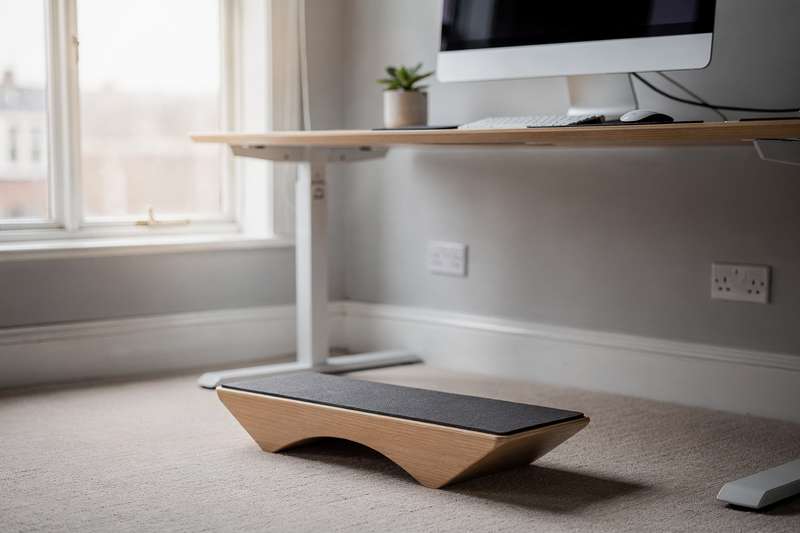
Best for First-Timers: The Ergonomic Rocker Board
If you’ve never used a balance board while working, starting with a full wobble or roller board is a mistake most people make once. The constant micro-corrections required to stay upright eat into your concentration and you end up achieving neither good work nor a decent workout. An ergonomic rocker board solves this problem almost completely. It has a defined tilt range — typically 15 to 20 degrees side to side — which means it moves with you when you shift your weight, but it doesn’t tip unexpectedly when you stop paying attention to it.
The geometry is the key feature to look for here. A quality ergonomic rocker board uses a curved base with a radius wide enough to feel gently responsive rather than twitchy. The deck should be long enough to accommodate your full natural stance — ideally 80 cm or longer — with a textured or rubberised surface that keeps your feet in place in socks or light trainers. Look for a weight capacity of at least 120 kg so the board doesn’t flex under you, and check whether the base contact material is cork, rubber, or a broad silicone pad: these are the options least likely to mark your floor.
In practice, this style of board lets you rock gently forward and back, or sway side to side, with enough resistance that the movement feels purposeful rather than chaotic. Your typing accuracy stays largely intact after a short adjustment period — most people find they’re comfortable within two or three sessions. The tradeoff is that it offers less of a proprioceptive challenge than a cylinder or wobble board, so if you’re looking for a genuine balance training tool to use outside work hours, you’ll need something more demanding.
What to avoid: boards in this category made entirely from polypropylene plastic. They feel hollow underfoot, the tilt can be harsh and jerky rather than smooth, and they wear quickly at the pivot points. Solid wood or bamboo decks with a moulded or carved base are meaningfully better and typically not much more expensive in the £30–£50 bracket.
Best Budget Pick (Under £30): The Centre-Dome Wobble Board
If your goal is simply to stop standing completely still at your desk without spending a lot, a basic circular wobble board with a central dome or hemisphere on the underside is the most accessible entry point. These boards are widely available for under £30, they’re lightweight, and they do create the ankle and lower-leg engagement that makes standing more dynamic than static.
The design is simple: a flat or very slightly dished circular platform, typically 40 to 50 cm in diameter, balanced on a central rubber or plastic dome. This allows movement in all directions — front to back, side to side, and diagonally. For desk use, that multi-directional freedom is both a benefit and a limitation. The benefit is that it keeps more muscle groups engaged than a rocker. The limitation is that it requires more active attention to stay centred, especially if you get absorbed in a task and your weight drifts without you noticing.
For most desk workers, a wobble board in this price range is best suited to standing sessions of 20 to 40 minutes rather than long stretches. It’s also worth pairing it with an anti-fatigue mat nearby so you can switch off the balance element when you need to concentrate on detailed mouse work or a complex spreadsheet. Look for boards in this category that have a non-slip top surface (raised dots or a rubber coating rather than bare wood), a dome height of around 7 to 10 cm — which gives a manageable tilt angle — and a dome base made from natural rubber rather than hard plastic, since the latter will leave pressure marks on wood floors over time.
The honest tradeoff at this price: build quality varies significantly between sellers. The wood on cheaper boards can feel thin and may develop a slight warp after a few months of regular use in a warm office. Read verified buyer reviews carefully and prioritise boards with a stated weight limit of at least 100 kg, which usually indicates a thicker deck and better-quality dome bonding.
Best for Small Spaces: The Compact Lightweight Rocker
Not everyone has room for a full-length ergonomic board. If your standing desk is in a spare room, a corner of a kitchen, or a shared open-plan office where floor space is contested, a compact rocker board — typically 60 to 70 cm long — becomes the practical choice. The priority here is a small footprint combined with easy storage: a board you can tip on its side and slide under the desk or lean against a wall in seconds.
In this sub-category, weight matters almost as much as dimensions. A board under 2.5 kg can be moved one-handed without disrupting your workflow. Look for a tapered or slightly convex rocker base rather than a sharp ridge, because a sharp ridge concentrates floor contact pressure into a very small line — which will mark timber floors more quickly and can feel unstable on softer surfaces like carpet. A broad, gently curved base distributes pressure better and gives you a smoother rock that’s easier to sustain through a working afternoon.
One practical consideration for shared office environments: noise. Some boards in the sub-£55 range use hard plastic or MDF bases that clack against the floor at the end of each rock. If you’re in an open-plan setting, this becomes an anti-social habit quickly. Look for a base that has felt pads, rubber edges, or a recessed rubberised strip along the contact surface. Boards in this bracket with a bamboo deck and a rubberised rocker base tend to hit the best combination of compact size, low noise, and decent durability.
The tradeoff with compact boards is simply that a shorter deck limits your natural stance width. If you have larger feet or tend to stand with your feet more than shoulder-width apart, a 60 cm board will feel cramped. In that case, stepping up to a 75 cm model — even if it’s slightly heavier — is worth it for the comfort of a full natural stance.
Best for Active Users: The Cylinder Roller Board
Cylinder or roller boards — sometimes called balance trainers — sit at the demanding end of the usability spectrum. The flat deck rests on a separate cylindrical tube, which can roll in one axis (front to back), making this the most dynamically challenging type for desk use. If you’re younger, already reasonably fit, and looking for a board that also serves as a skill-training tool for snowboarding, skateboarding, or general athletic development, this is the category to explore.
For office use, the cylinder board demands a different approach from other types. You don’t stand on it passively and let gentle movement happen — you need to actively manage your balance at all times. This means it’s genuinely not suitable for use during focused cognitive tasks like writing, detailed data work, or long calls. Where it earns its place is during the parts of your standing day when you’re doing lighter tasks: reading, reviewing a document, or just thinking. For those windows, the proprioceptive challenge is significantly higher than any rocker or wobble board, and the core engagement is correspondingly greater.
When evaluating cylinder boards for this context, the key spec is the cylinder diameter. A wider cylinder — 15 cm or more — gives a shallower tilt and is more manageable for beginners to this type. A narrower cylinder creates a more aggressive rock and suits experienced users. The deck surface should be high-grip: look for boards where the deck has a skateboard-tape-style grip surface or a deeply textured rubber coating, since bare wood on a cylinder board will send you off balance unexpectedly in socked feet. Also check that the end caps on the cylinder are solid rubber rather than open plastic — open plastic ends will damage hardwood floors quickly.
The tradeoff is straightforward: this board will reduce your work output during active use because your brain is genuinely occupied with balance. If your standing desk workflow involves a lot of typing and you expect to be on the board for long periods, this isn’t the right pick. It’s the right pick if you want two things from one product — desk use and athletic training — and you’re happy to use it selectively rather than continuously.
Best for Heavier Users or Long Sessions: The High-Capacity Hardwood Board
Weight capacity figures on balance boards are often optimistic marketing numbers. A board rated to 120 kg in the small print may use that figure for static loading — not the dynamic loading that happens when you shift, sway, and rock repeatedly over months of use. For users over 90 kg, or anyone who plans to stand for two hours or more at a stretch, selecting a board with a genuinely robust construction pays back in longevity and safety.
What you’re looking for in this tier is a deck made from solid hardwood — oak, beech, or bamboo composite — rather than MDF, plywood, or polypropylene. The deck thickness should be at least 18 mm, and ideally closer to 22 mm for heavier users. The base mechanism should be secured to the deck with recessed hardware rather than adhesive alone, because repeated dynamic loading will eventually separate an adhesive joint. Look for boards that explicitly state their rated capacity under dynamic use, not just static load.
In this price bracket (£60–£100), you also tend to get better floor-protection design. Look for boards with a wide rubberised base or a large-footprint cork underside — both of which spread the contact pressure across a much larger area than a narrow roller or small dome, reducing the risk of floor marking. Some boards in this tier also come with an optional anti-scratch mat or floor pad, which is a sensible inclusion.
The ergonomic profile of a quality hardwood board in this range tends to be well-balanced for desk use: stable enough to type on, with enough gentle movement to engage your legs and core over a long session. The tradeoff is weight — a solid hardwood board will often sit between 3.5 and 5 kg, which makes it less convenient to move in and out of storage daily. If you’re setting up a fixed standing desk zone and the board will live in one spot, that’s no issue. If you’re packing up at the end of each day, look for a lighter composite option instead.
Best for Gentle Movement: The Inflatable Wobble Cushion
Wobble cushions — inflatable disc-shaped pads, typically 33 to 40 cm in diameter — occupy a slightly different category from rigid balance boards, but they deserve a place in any honest office-use roundup. They’re recommended by physiotherapists for people recovering from ankle or knee injuries, for older adults looking for proprioceptive stimulation with a lower fall risk, and for anyone who finds rigid boards too aggressive on their joints.
The main practical advantage is adjustability. You inflate the cushion to a firmer setting for more stability and a gentle wobble, or deflate it slightly for a softer, more demanding surface. This means the same product can serve a 55-year-old office worker looking for mild joint engagement and a 30-year-old using it during physiotherapy. It also means you can dial in the resistance to exactly the level where your concentration isn’t disrupted — which rigid boards can’t offer.
For desk use, wobble cushions work well during the initial phase of building standing tolerance, or as an ongoing tool for users who find even a gentle rocker board too demanding for extended periods. The typing experience on a wobble cushion is actually very good — because the surface compresses slightly under your weight, sudden shifts are dampened rather than amplified, so your upper body stays fairly still. Look for cushions with a dual-textured surface (small raised nubs on both sides) and a valve that allows fine air adjustments with a standard pump rather than a proprietary tool.
The limitations are real, though: a wobble cushion doesn’t offer the front-to-back rocking motion of a rocker board, and the range of movement is smaller overall. For users who want active engagement of the larger leg and hip muscles, a rigid board will deliver more. Wobble cushions also require occasional re-inflation as the air slowly escapes over weeks of use — a minor maintenance task, but worth knowing about. Expect to pay £40–£70 for a quality option with a decent PVC-free construction and a reliable valve system.
Best for Floor Protection: The Wide-Base Rubberised Board
Floor damage is genuinely under-discussed in balance board buying guides. The physics are simple: a balance board concentrates your body weight through a small contact area and then moves repeatedly across the same patch of floor. For a narrow dome or cylinder, that contact pressure can exceed 5 kg per cm² — enough to dent softwood, mark laminate, or scuff the finish off engineered oak over time. If you’re renting, or if you’ve invested in good flooring, this matters.
The solution is a board designed with a wide, flat rubberised base — either a large-area domed base that spreads weight across at least 15 to 20 cm of floor contact, or a rocker board with rubberised curved edges that makes contact across the full length of the rock rather than at a single point. Some boards in the £45–£75 range are specifically marketed as floor-safe or come with a base layer of natural rubber or cork that’s thick enough to protect most floor types.
When evaluating for floor safety, run your hand along the underside of the board (or check photos carefully if buying online). Any exposed wood, sharp plastic edges, or bare MDF at the contact points will eventually cause damage. The base material should be completely covered with a soft, grippy compound. Natural rubber is better than synthetic rubber for both grip and floor protection. Cork is excellent on hard floors but compresses and wears over time on carpet.
For carpet users, the calculus is slightly different — most balance boards are harder to use on carpet because the surface itself adds resistance, and carpet fibres can work their way into base materials over time. A compact, flat-base rocker board or a wobble cushion tends to work better on carpet than a cylinder or dome board. If your standing desk is on carpet, factor that into your decision and look for boards where the base material is carpet-compatible rather than designed exclusively for hard floors.
What to Look For When Buying a Balance Board for Desk Use
- Ergonomic stability rating: The single most important factor for desk use. A board should allow you to type with minimal disruption to your rhythm. Rocker boards and wide-base ergonomic boards score best here; cylinder and narrow-dome wobble boards score lowest. If you’re buying primarily for desk use rather than athletic training, prioritise this above all else.
- Deck dimensions and stance width: Your feet need to sit comfortably within the deck boundaries at your natural standing width. Measure your natural stance before buying — most people stand with feet roughly hip-width apart (45–60 cm). A deck of at least 70 cm length and 30 cm width accommodates most adults; compact boards under 60 cm will feel cramped for anyone with a wider stance or larger feet (UK size 10 and above).
- Surface grip: Standing on a balance board in office attire — socks, loafers, or light trainers — is very different from standing in training shoes. Look for a deeply textured surface, raised rubber nodes, or grip tape. Bare varnished wood in socks is a slip hazard and will make you tense your feet constantly, which defeats the ergonomic purpose.
- Base material and floor safety: Check what makes contact with your floor. Natural rubber and cork are safest for most flooring types. Hard plastic, bare wood, and thin felt pads are problematic. If your floor is important to you, this criterion should rank near the top of your list.
- Weight capacity under dynamic load: Treat any stated maximum weight with scepticism and look for evidence of robust construction — deck thickness, hardware type, base bonding method. For users over 85 kg, focus on solid hardwood or bamboo composite decks with mechanically fixed bases rather than adhesive-bonded constructions.
- Noise: A board that clacks, creaks, or thumps on every rock is an anti-social presence in an open-plan office or a thinly-floored flat. Look for boards with soft base materials and avoid MDF or hard plastic rocker bases. Reviews from verified buyers often mention noise — check those specifically.
- Storage convenience: If your balance board needs to be moved daily, weight and shape matter. Boards under 2.5 kg with a flat profile can be stood upright or slid under a desk easily. Boards over 4 kg with an asymmetric shape become a minor chore to move, which means they tend to stay out on the floor as a trip hazard or get left in a corner unused.
Verdict
For the majority of UK desk workers — someone who stands for one to three hours a day, works in a home office or open-plan environment, and wants to add movement without sacrificing typing accuracy or marking their floor — the ergonomic rocker board in the £30–£50 bracket is the right starting point. It offers the best balance between usability and joint engagement, suits a wide range of fitness levels, and is forgiving enough that you won’t abandon it after a week because it’s too demanding to concentrate on.
If you’re over 90 kg, already comfortable on unstable surfaces, or plan to stand for very long stretches, step up to the high-capacity hardwood option in the £60–£100 range — the construction quality and deck size justify the extra spend. And if you have any joint concerns or are returning from injury, the inflatable wobble cushion is the safest first step, with the option to switch to a rigid board once your tolerance builds.
Whatever you choose, pair it with a quality anti-fatigue mat for the moments when you need to be completely still. The two accessories complement each other — you don’t need to be on the board constantly, just often enough that static standing becomes the exception rather than the rule.
Editorial note: This guide was produced independently. No manufacturer or retailer paid for placement or influenced the recommendations. All opinions are based on publicly available specifications, verified buyer feedback patterns, occupational health research, and category analysis. Prices shown are indicative ranges accurate at the time of writing and may vary.
Quick Comparison Table




FAQ
Can I use a balance board for a full working day at my standing desk?
Most people shouldn’t, at least not initially. Even ergonomic rocker boards engage your lower legs and core in ways that cause fatigue if you’re on them for hours without a break. A more sustainable approach is to alternate: 20 to 40 minutes on the board, then switch to your anti-fatigue mat for static standing, then alternate with sitting. Over several weeks, your tolerance builds and longer sessions become comfortable. Jumping straight into multi-hour sessions typically results in sore calves and abandoning the board entirely.
Will a balance board damage my hardwood or laminate floor?
It can, depending on the base design. Boards with a small central dome, a narrow cylinder, or a sharp plastic rocker edge concentrate your body weight into a very small contact area, which creates enough pressure to dent or mark most floor types over time. To protect your floor, choose a board with a wide rubberised or cork base, or place a protective mat underneath. Natural rubber bases are the safest option; hard plastic and bare wood bases carry the highest risk.
Is a balance board safe to use if I have knee or ankle problems?
It depends on the type and the severity of your condition. Inflatable wobble cushions are commonly recommended by physiotherapists for mild knee and ankle rehabilitation because the air-filled surface is softer and the movement is dampened. Rigid wobble boards and cylinder boards are generally not appropriate if you’re in active recovery from a joint injury. If you have any ongoing joint issue, speak to your GP or physio before purchasing — they can advise on which type and what tilt range is appropriate for your situation.
What size balance board do I need for a standing desk?
Measure your natural standing width — the gap between your heels when you stand comfortably — before buying. Most adults stand with feet roughly 40 to 55 cm apart. You want a deck that’s at least as long as your stance width so both feet are fully supported. For most people this means a deck of 70 cm or longer. If you have large feet (UK size 10 and above) or a wider natural stance, aim for 80 cm or more. Compact boards under 60 cm will feel restrictive and may cause you to narrow your stance unnaturally, which defeats the ergonomic benefit.
Do I need special footwear on a balance board at my desk?
You don’t need specialist footwear, but footwear choice matters. Bare feet give the best proprioceptive feedback and grip on textured surfaces, but if your office is cold or you prefer socks, make sure the board’s surface has enough texture to prevent slipping — smooth varnished wood in socks is a genuine hazard. Lightweight trainers work well on most boards. Avoid heavy boots or thick-soled shoes, which reduce the sensory feedback that makes balance boards beneficial in the first place.
How long does it take to get used to working on a balance board?
Most people find that gentle rocker or ergonomic boards feel natural within two to five sessions — typically a week of regular use. Wobble boards and cylinder boards take longer, often two to three weeks before you can use them without consciously thinking about balance. The adjustment period is shorter if you start with short sessions (15 to 20 minutes) and gradually extend rather than trying to stand on the board for your entire standing window from day one. Your typing accuracy may dip slightly in the first few sessions on any board type; this normalises quickly.