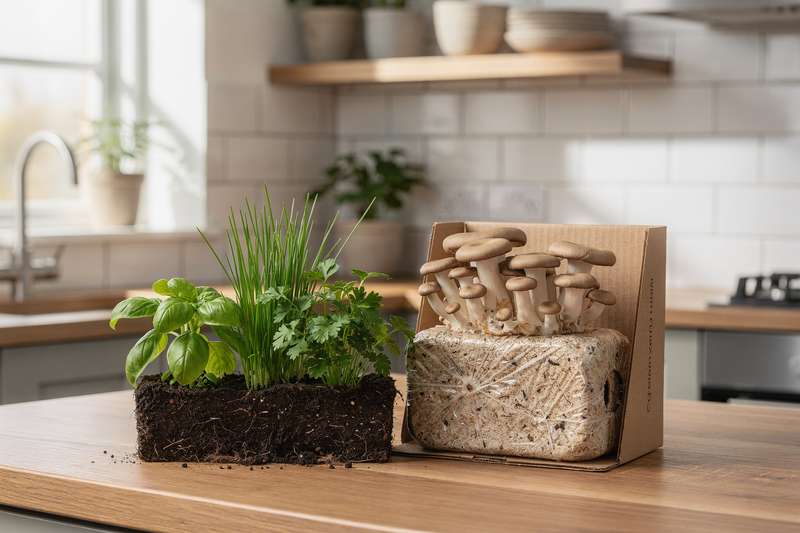
You’ve got a sunny windowsill going to waste, or maybe you’re tired of paying supermarket prices for a sad bunch of basil that wilts within three days of getting home. Perhaps you want something genuinely hands-on to do with the kids on a rainy Saturday, or you’re just curious about growing your own food but have no idea where to start. The problem is that every time you look into it, you’re confronted with bags of compost, multiple seed packets, mysterious soil amendments, and gardening advice that assumes you already know what you’re doing. You buy a few things, nothing germinates, and the whole project quietly dies on the kitchen counter before it ever really got going.
That’s exactly what grow your own kits are designed to solve. A good kit removes the guesswork: seeds, substrate, containers, and instructions come together in a single box. You don’t need a garden, prior experience, or a garage full of equipment. But the UK Amazon marketplace is a mixed bag — some kits are genuinely excellent, others are novelty products that’ll disappoint anyone who actually wants to grow something, and a handful sit somewhere in between. This guide cuts through the noise and gives you an honest look at the kits worth your attention right now.
How We Evaluated These Kits
Every product in this guide was assessed against the same set of criteria. First, topic fit: does this product genuinely help you grow something, or is it just a novelty item dressed up in garden-centre language? Second, completeness: does the kit include everything a beginner needs, or does it quietly assume you already own a propagator, specialist compost, or grow lights? Third, verified buyer feedback: we looked at real review patterns on Amazon UK — not just star averages, but the substance of what buyers actually said, including complaints. Fourth, space requirements: UK homes and flats aren’t large, so we prioritised kits that work on a windowsill, kitchen counter, or small balcony. Finally, we considered the growing experience itself — is this genuinely satisfying to do, and does the end result (edible harvest, decorative plant, or otherwise) justify the effort? Products with fewer than ten reviews or suspiciously low ratings were excluded unless there was a compelling reason to mention them. The result is a focused shortlist of four on-topic kits that genuinely deliver on their promises.
Best Self-Watering Herb Kit: Gift Republic Self Watering House Herb Grow Kit
If you want to grow something edible and genuinely useful in your kitchen, the Gift Republic Self Watering House Herb Grow Kit is the most practical starting point in this guide. It comes with seeds for basil, rosemary, thyme, and parsley — four of the most commonly used culinary herbs in British cooking — along with self-watering pots, compost discs, and all the instructions you need to get started. Rated 4.2 out of 5 stars from 99 buyers, it has a solid track record for a kit at this size.
The self-watering design is the feature that separates this from cheaper herb starter kits. A reservoir in the base of each pot wicks water up to the roots as needed, which means you’re not constantly second-guessing whether you’ve over- or under-watered. For anyone who’s killed a herb plant by giving it too much love (or too little), this is a practical safeguard. The white ceramic-style aesthetic also means the pots look at home on a kitchen windowsill rather than looking like a science experiment.
In terms of what to expect from the growing experience: basil and parsley germinate relatively quickly in a warm spot, while rosemary and thyme are slower and prefer drier conditions — which can be a slight tension when all four are in the same self-watering system. Some reviewers noted that rosemary in particular can take a long time to establish. Managing the reservoir carefully during the earlier stages (letting it dry out slightly more for the woody herbs) helps here.
This kit is also sold as a gift, and the packaging reflects that — it’s presented well enough to give to someone without any additional wrapping needed. That said, if you’re buying purely for function rather than aesthetics, the price reflects some of the premium on presentation. It’s genuinely a good kit for beginners and also works well as a housewarming or birthday gift for someone who cooks. The main caveat is that it’s designed for indoor windowsill use, so if you’re hoping to grow herbs at scale outdoors, you’ll want something larger.
Best for Growing Edible Mushrooms (Gourmet): Lions Mane Mushroom Grow Kit
Mushroom growing has genuinely taken off in the UK over the last few years, and the Lions Mane Mushroom Grow Kit (Hericium erinaceus) is one of the more interesting options available. Lion’s mane is a gourmet mushroom with a meaty texture and a subtle seafood-like flavour that makes it a genuinely useful ingredient, not just a novelty. The kit is rated 4.3 out of 5 stars from 74 verified buyers, which is a respectable result for a product in a category where growing conditions vary considerably between households.
The kit works by providing a pre-inoculated substrate block — essentially a bag of growing medium already colonised with mycelium — which you then cut, mist with water, and keep in a humid environment. Within a couple of weeks under the right conditions, you’ll see the distinctive white, shaggy fruiting bodies beginning to emerge. The instructions are included, and lion’s mane is generally considered one of the more forgiving gourmet mushrooms to grow at home compared with, say, shiitake.
What makes this kit stand out is the quality of the end product. Lion’s mane is sold in specialist food shops and online delis at a premium, so harvesting your own from a kit represents genuine value beyond just the novelty of growing something. Sautéed in butter with a splash of soy sauce, it’s an excellent ingredient. The kit description mentions it specifically in that context, and buyers tend to agree.
The honest tradeoff here is that mushroom growing is more temperature-sensitive than herb growing. Lion’s mane prefers cooler temperatures and high humidity — conditions that are naturally easier to maintain in a UK home during autumn and winter than in a warm summer kitchen. If your kitchen runs warm, you may need to find a cooler spot (a shaded utility room, for instance). The substrate block will typically yield one or two flushes of mushrooms before it’s spent, so this isn’t an indefinitely renewable harvest, but the first flush alone is usually enough to make the kit feel worthwhile.
Best Mushroom Kit for Beginners: Pink Oyster Mushroom Growing Kit
The Pink Oyster Mushroom Growing Kit takes a slightly different approach to home mushroom growing and is particularly well-suited to beginners. Rated 4.0 out of 5 stars from 70 buyers, it positions itself as both a gardening experience and a potential gift for women, men, and kids — which tells you something about how approachable the process is designed to be.
Pink oyster mushrooms (Pleurotus djamor) are visually striking — the fruiting bodies emerge in vivid pink clusters that look almost theatrical before they’re harvested. They’re also fast-growing compared with many other gourmet varieties, which means you get a quicker sense of progress and reward, particularly useful if you’re new to growing mushrooms and need that early visual confirmation that something is actually happening. Like lion’s mane, oyster mushrooms are grown from a pre-colonised substrate block that you mist and monitor.
The flavour is milder than lion’s mane — pink oysters have a slightly silky texture and work well in stir-fries, pasta, and omelettes. One thing to be aware of is that pink oyster mushrooms actually prefer warmer temperatures than many other oyster varieties, making them somewhat more forgiving in a warm kitchen during the spring and summer months. This is the inverse of the lion’s mane situation, so if you’re buying in summer, this kit has a practical seasonal advantage.
Where it’s honest to acknowledge a limitation: some buyers noted that the yield from the kit was smaller than they’d hoped, and pink oysters don’t keep as long after harvest as grey or king oyster varieties — you’ll want to cook them fairly promptly. But as a first mushroom growing experience, the speed of growth, the visual payoff, and the edible result make this a satisfying choice. It also makes for a genuinely useful gift for someone who enjoys cooking but has never grown their own food before.
Best Novelty Grow Kit for Kids (or a Chuckle): Funtime Gifts Grasshead Novelty Grow Your Own Grass Head
Not every grow kit needs to end in a harvest. The Funtime Gifts Grasshead Novelty Grow Your Own Grass Head is the highest-rated product in this guide at 4.6 out of 5 stars from 135 reviews, and it earns those reviews by doing exactly what it says. You fill the novelty head-shaped container with the included grass seed and growing medium, water it, and watch a head of “hair” (grass) grow over the course of a week or two. It’s a laugh, it works, and it’s a proper growing experience — just not one that ends with anything edible.
This is the kit to reach for when the goal is to get children interested in growing things, explain germination and plant growth in a tangible, hands-on way, or find a fun novelty gift that still has a legitimate growing element to it. The bright green result is genuinely amusing, and kids tend to be fascinated by the rapid visible growth of grass seed, which germinates and shows progress much faster than herbs or vegetables. It’s the kind of product that earns its place in a classroom or on a child’s bedroom windowsill.
In terms of what actually happens: the grass head contains a growing medium packed into the novelty container along with grass seed. You add water, keep it in a warm spot, and within days you’ll see sprouts emerging. The grass can be trimmed, styled, or left to do its thing. Instructions are included and the process is genuinely simple enough for a child to manage largely independently (with a bit of initial supervision for the watering).
The honest limit of this kit is straightforward: if you want to grow food, this isn’t the right product. It’s a novelty, and it’s sold honestly as one. The price is low, the execution is reliable (which is exactly what those 135 reviews reflect), and the growing experience is genuine even if the end result is grass rather than something you’d cook with. For the right occasion — a birthday gift for a younger child, a classroom project, or just a bit of weekend fun — it’s one of the most consistently successful products in this category.
What to Look For When Buying a Grow Your Own Kit
- Completeness of contents: The best kits include everything you need — seeds, growing medium, containers, and instructions — without hidden requirements. Check whether the kit asks you to source additional compost, pots, or equipment before it’ll work. A kit that needs you to buy extra materials before you can even start defeats much of the purpose.
- Growing environment match: Consider where in your home the kit will live. Herb kits generally need a sunny windowsill; mushroom kits prefer cooler, shadier spots with high humidity. If you only have a warm, south-facing kitchen, a lion’s mane kit may struggle in summer. Match the kit to your actual conditions, not your ideal ones.
- Realistic yield expectations: Some kits, particularly mushroom grow kits, produce one or two flushes of harvest from a single substrate block. Others, like herb kits with self-watering pots, can continue producing for many months if you maintain them properly. Know what you’re buying — a one-time experience or an ongoing harvest.
- Edible vs. decorative vs. novelty: Grow kits span a wide range of outcomes. If you want something to cook with, an herb or mushroom kit is the right choice. If you want a growing experience for children or as a fun gift, a novelty kit like a grass head serves a different but equally valid purpose. Neither is superior — they just have different goals.
- Review quality, not just quantity: A kit with 50 detailed, specific reviews that mention actual harvests is more trustworthy than one with 500 vague five-star ratings. Look for reviews that mention whether the seeds actually germinated, how long it took, and what the harvest was like — these tell you the kit actually works.
- Gifting presentation: If you’re buying as a gift, packaging matters. Some kits are packaged in attractive, gift-ready boxes; others come in plain functional packaging that would need additional wrapping. Check the product photos carefully if presentation is part of what you’re paying for.
- Substrate freshness for mushroom kits: For mushroom grow kits specifically, freshness of the substrate block matters. A block that has sat in a warehouse for several months may have degraded mycelium and produce weaker results. Where possible, buy from sellers who clearly state the blocks are freshly prepared, or choose products with recent positive reviews indicating live performance.
Verdict
For most readers coming to this guide — someone who wants to grow something genuinely useful and edible, doesn’t have a lot of outdoor space, and hasn’t grown anything from scratch before — the Gift Republic Self Watering House Herb Grow Kit is the most practical starting point. It gives you four genuinely useful culinary herbs, solves the most common beginner mistake (inconsistent watering) with its self-watering design, and produces results you’ll actually use in the kitchen week after week.
If you’re specifically interested in growing your own food beyond herbs, the Lions Mane Mushroom Grow Kit is the pick that will genuinely surprise you — both in how straightforward the process is and in the quality of what you harvest. Pink oyster mushrooms are an excellent alternative if you’re buying in warmer months or want something with faster, more dramatic visual growth. And if there are children involved, the Funtime Gifts Grasshead kit is the reliable crowd-pleaser in this group. Whatever your situation, one of these four kits will give you a genuine growing experience without the faff of building a setup from scratch.
We were not paid to feature any specific product in this guide. All opinions are independent and based on publicly available specifications, verified buyer feedback patterns, and category research.
Quick Comparison Table





FAQ
What is the easiest grow your own kit for complete beginners?
A self-watering herb kit is typically the most forgiving option for beginners. The self-watering reservoir removes the guesswork from watering — the most common reason herb seedlings fail — and culinary herbs like basil and parsley germinate reliably in a warm indoor spot. Mushroom kits are also very accessible, since the substrate arrives pre-colonised and you simply need to mist it and monitor humidity.
Do grow your own kits actually work, or are they mostly gimmicks?
The better kits genuinely work, particularly herb kits with quality seeds and mushroom kits with freshly prepared substrate. The key is matching the product to realistic expectations: you won’t be self-sufficient in herbs from a single windowsill kit, but you will get fresh cuttings for cooking. Look for kits with a meaningful number of verified reviews that specifically mention successful harvests, rather than relying on star ratings alone.
Can I use a grow kit if I don’t have a garden?
Yes — in fact, grow kits are primarily designed for people without gardens. Most herb kits are built specifically for windowsill or kitchen counter use, and mushroom kits can thrive in a shaded spot indoors. All four kits in this guide work inside a standard UK flat or house without any outdoor space required.
How long does it take to get a harvest from a grow kit?
It varies by type. Grass head novelty kits show visible growth within a few days. Oyster mushrooms can produce their first flush within one to three weeks under good conditions. Lion’s mane mushrooms typically take two to four weeks to fruit. Herb kits take longer — expect four to eight weeks before you have enough growth to begin harvesting, depending on the variety and how much light the plants receive.
Are mushroom grow kits safe for children to use?
Yes, mushroom grow kits are safe to use with children under adult supervision. The substrate blocks are non-toxic, and the mushrooms produced by kits such as lion’s mane and pink oyster are edible culinary varieties, not wild or toxic species. Children should wash their hands after handling the kit, as with any gardening activity. If the goal is a growing project specifically for children, a novelty grass head kit may be more engaging due to its faster visible results.
How many times can I harvest from a mushroom grow kit?
Most mushroom grow kits will produce two to three flushes of mushrooms before the substrate block is exhausted. The first flush is typically the largest. Between flushes, you soak the block in water to rehydrate it and then return it to a humid environment. After the block stops producing, it can be composted or used as a garden mulch amendment.