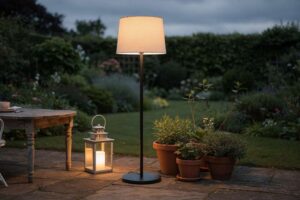
You’ve finally finished the decking. The boards are down, the furniture is out, and for about three weeks you sit outside in the evenings in total darkness — or squinting under a single harsh security light that makes your garden look like a police incident. You start looking at how your neighbour’s deck glows softly from recessed plinth lights and think: that can’t be that difficult. Then you search online and immediately hit a wall of confusing specs: IP ratings, low voltage transformers, RGB controllers, solar lux claims that seem wildly optimistic for the UK’s grey skies. You don’t know whether you need an electrician, a transformer, or just a pack of something that plugs into a socket. You just want your patio to look good and be safe to walk on after dark.
This guide cuts through that confusion. Whether you have a compact urban patio, a multi-level timber deck, or a garden with steps that are genuinely hazardous at night, there’s a right lighting solution for your setup — and it’s probably easier and less expensive to install than you think. The picks below cover everything from no-wire solar fence lights to smart dimmable LED plinth sets that integrate with your phone, so you can find the approach that fits your outdoor space and your patience for DIY.
How These Picks Were Chosen
Every product featured here was assessed against a consistent set of criteria: ingress protection rating (IP44 minimum for covered patios, IP67 for direct exposure to rain and standing water), light output and colour temperature, ease of installation for a competent DIYer, the quality of the driver or transformer solution included, and patterns across verified buyer reviews. Where review volumes were sufficient, repeated feedback themes — both positive complaints about build quality and praise for longevity — were weighted more heavily than star averages alone. Pack sizes were compared against typical UK deck sizes to assess real-world cost. Products with zero reviews were included only where a reviewed alternative in the same form factor was not available, and those picks are flagged accordingly.
Best Smart Deck Light Kit: SMY Lighting Dimmable LED Deck Lights with Timer and Photocell Sensor (20 Pack, φ32mm)
The SMY Lighting Dimmable LED Deck Lights with Timer and Photocell Sensor (20 Pack, φ32mm, IP67) represent what most decking light shoppers actually want: a complete kit where the intelligence is built in. The photocell sensor means the lights switch on automatically at dusk and off at dawn without you touching anything, and the timer function lets you set a cut-off time so they’re not burning electricity all night. These are the features that get requested most often in buyer reviews, and SMY has packaged them into a 20-pack with the protective shell already fitted to each fitting.
The φ32mm diameter is compact enough to sit neatly flush in most standard decking boards without looking oversized, and at IP67 the units are rated for full immersion — so standing water after a heavy UK downpour isn’t a concern. The 4.4-star rating from 71 reviewers is a genuine signal: at this unit count, you’d expect to see more variance if build quality was inconsistent, so the clustering around 4.4 suggests the product performs reliably across a full 20-fixture installation.
Where this kit asks more of you is installation. Because it runs on low voltage DC, you’ll need a compatible 12V driver (sold separately, though SMY offers compatible ones). Running the cable through your decking boards requires a bit of planning — you’ll want to lay the cable runs before fixing your final board row if you’re installing during a build. The dimmer functionality is a genuine bonus for anyone who wants different moods: bright enough for dinner outside, much lower for a late-evening wind-down. The timer and photocell combination means you essentially set it once and forget it, which is exactly what most buyers want from a permanent installation.
The main tradeoff is that the photocell and timer features add a small layer of complexity versus a straightforward always-on kit. If you’ve never wired low-voltage garden lighting before, budget an extra hour to read the instructions carefully, particularly around the transformer sizing — running too many watts through an undersized driver is the most common installation mistake and will shorten the driver’s life. For most UK decks of average size, the 20-pack is well suited, and the φ32mm shell gives the finished installation a clean, professional look that justifies the extra setup effort.
Best Budget-Friendly LED Plinth Set: HIBOITEC 16PCS Decking Lights
If you want a proven, affordable LED plinth set with a solid review base, the HIBOITEC 16PCS Decking Lights is the pick that consistently earns its spot at the budget end of the permanent-install category. With 261 reviews at 4.3 stars, this is the most-reviewed product in this guide — and for a decking light set, that number of real-world installers giving feedback is genuinely useful signal about long-term reliability.
The HIBOITEC lights run at 0.6W per unit on a 12V low-voltage system, which means the running costs are negligible and the total load for all 16 lights is modest enough for a relatively small transformer. The warm white output suits timber and composite decking beautifully — cooler white temperatures tend to look clinical against natural wood grain, and warm white creates the ambient glow that photographs well and feels right for a social outdoor space. IP67 waterproofing means these are rated for outdoor exposure without cover.
The 16-pack suits a medium-sized deck or patio perimeter well. Buyers frequently note that the warm white tone is more accurate to the listed spec than some competitors, and that the physical build feels solid rather than hollow-cheap. The most common criticism in reviews is around the cable connectors — a few users report needing to pay attention to connection tightness to avoid intermittent failures, which is worth bearing in mind during installation. Taking a few extra minutes to ensure each connector is fully seated will save you a frustrating fault-finding exercise later.
The HIBOITEC set doesn’t offer dimming or smart features — it’s straightforward on/off via the transformer switch. For most people, that’s absolutely fine. If you want automation, you can pair it with a smart plug or a plug-in timer on the transformer rather than paying for a premium smart kit. That flexibility makes this set a pragmatic choice: you get reliable, good-looking LED plinth lighting without paying for features you may not use.
Best for Colour and Customisation: RGB WiFi LED Decking Lights (6 Pack)
The LED Decking Lights RGB Ø45MM 12V 0.5W WiFi LED Decking Patio Lighting with Remote Control (6 Pack) takes a different approach to deck ambiance: instead of fixed warm white, you get full RGB colour control via WiFi and a remote. This is the pick for anyone who wants to shift mood dramatically — blue for an evening pool session, amber-warm for dining, a festive colour cycle for a party. The 45mm diameter fitting is slightly larger than the 32mm alternatives, so it makes more of a visual statement when set into decking boards.
With 45 reviews at 4.4 stars, the feedback pattern is positive. Buyers specifically mention that the colour accuracy is good and that the WiFi integration works reliably once the initial setup is done — which matters, because RGB smart lighting products have a higher failure rate for connectivity than single-colour alternatives. The remote control fallback is a sensible inclusion: if your router is too far from the garden for consistent WiFi signal, you still have physical control without pulling out your phone.
The six-pack format is the key tradeoff here. For a small patio or a compact decked area, six lights is enough for a defined feature strip or step section. For a full large deck, you’d need to buy multiple packs and ensure the controllers daisy-chain properly — check the product listing for controller compatibility before ordering quantities. The 12V low-voltage operation is the same approach as other plinth lights in this guide, so the transformer requirements are similar.
Where RGB lights genuinely struggle is in a context where you simply want consistent, warm ambient light every evening. The colour flexibility that’s an asset for some buyers becomes a maintenance overhead for others — someone in the household will inevitably change it to something you don’t love and you’ll spend five minutes sorting it out. If your primary use case is relaxed evening dining rather than parties and mood lighting, the warm-white-only alternatives will suit you better. But if you have a covered outdoor kitchen or a deck that doubles as an entertainment space and you want flexibility, this is the most capable option in the group.
Best for Steps and Pathways Without Wiring: GIGALUMI Solar Fence Lights (12 Pack)
Not every decking lighting project is a planned permanent installation — sometimes you need lighting on existing steps or fence panels and running cable is simply not practical. The GIGALUMI Solar Fence Lights Outdoor Garden (12 Pack Solar Step Lights) fills that gap: 12 solar-powered lights that clip or fix to steps, gutters, fences and patio edges with no wiring required at all.
The 4.3-star rating reflects a product that does what it promises within realistic expectations. The key realistic expectation for UK buyers: solar garden lights perform significantly better from April through September than in winter months. In December and January, a British garden gets perhaps four to five hours of usable daylight on a good day, and overcast skies further reduce charging time. That means you should budget for these to provide step safety lighting rather than full ambient illumination during the colder months. From spring through autumn, they perform well — most buyers report automatic dusk-to-dawn operation working reliably and brightness being adequate for stair safety.
The 12-pack format is genuinely useful for steps: a standard garden staircase of four to six steps gets two lights per tread, which looks balanced and provides even coverage. The waterproof construction handles UK rain without issue, and the no-drill mounting options on some units mean rental tenants or anyone who doesn’t want to make permanent fixings can use them. The decorative design language is more traditional than the flush plinth-light look of LED recessed units, which suits cottage gardens, brick patios, and timber fence panel settings particularly well.
Where solar always loses ground to mains-powered alternatives is consistency. On consecutive overcast days in November, you may find the lights offer only a brief period of low-level illumination. If your primary concern is safety lighting for steps used year-round in all weather conditions, a low-voltage mains-connected alternative is more dependable. But for seasonal outdoor living where you’re primarily using the garden from spring to autumn, the GIGALUMI 12-pack offers excellent value and zero installation complexity.
Best for Professional-Looking Uplighting: EBION Outdoor Ground Lights (4 Pack GU10)
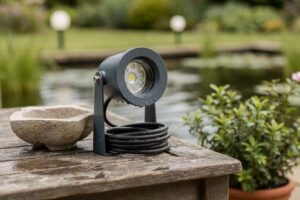
The EBION Outdoor Ground Lights 4 Pack IP67 Decking Buried Lights (GU10 Garden Ground Path Decking Uplights) are a different beast to the plinth-light format. These are in-ground uplights designed to be set flush into the ground or into decking, pointing upward to wash a wall, tree, post, or structural feature with light. The GU10 fitting means you choose and replace your own bulb — smart, since it lets you pick wattage, colour temperature, and even smart bulbs independently of the fitting itself.
At 46 reviews and 4.1 stars, the EBION units have enough real-world feedback to draw conclusions. Buyers use them primarily for uplighting fence posts, pergola uprights, and the trunks of statement garden trees — exactly the elevated, layered-lighting effect that makes outdoor spaces look professionally designed rather than simply well-lit. The IP67 rating means they tolerate full submersion, which matters for in-ground fittings where rainwater pooling is a genuine concern.
The GU10 socket is both the main advantage and the main consideration here. The advantage: flexibility. You can fit a 3W LED for subtle accent lighting or a 7W for a more dramatic uplight effect. You can use a colour-tuneable smart bulb if you want. The consideration: you are buying the housing and cable separately from the light source, which adds a step to the shopping process. Budget accordingly and confirm your chosen GU10 LED bulb is rated for outdoor use before installing — not all GU10 lamps tolerate sustained moisture exposure from the inside even when the housing is IP67 rated.
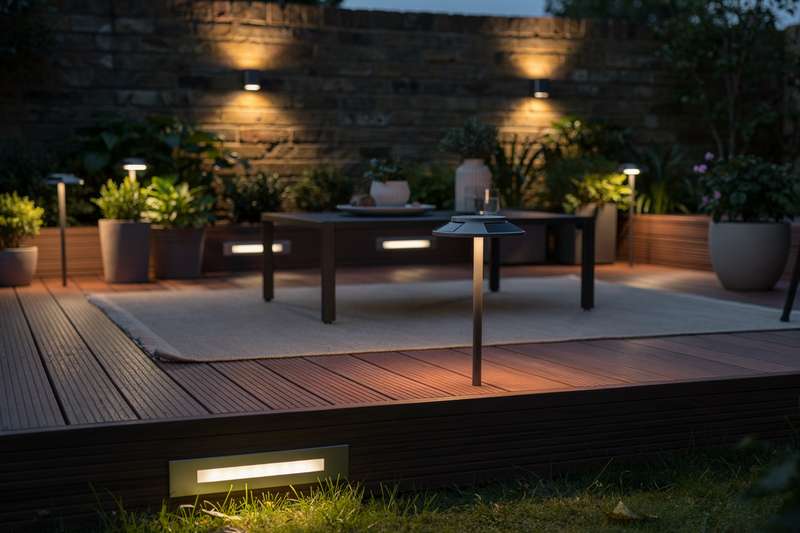
These lights work best as accents within a broader scheme rather than as primary deck illumination. Four uplights placed around a pergola or at the base of garden trees, combined with plinth lights in the deck surface, creates exactly the layered effect that makes outdoor spaces feel considered and complete. The 4-pack format suits this accent role — it’s not a format that’s trying to light an entire deck evenly, and it does its specific job well.
Best Mid-Range Smart Deck Light Alternative: SMY Lighting Dimmable LED Deck Lights (20 Pack, No Shell)
The SMY Lighting Dimmable LED Deck Lights with Timer and Photocell Sensor (20 Pack, IP67 Waterproof for Garden and Yard) shares the same smart feature set — photocell dusk sensor, timer, and dimmer — as the other SMY kit in this guide, but this version ships without the protective shell. For some installations, that’s perfectly fine: if you’re fitting these into a pre-routed channel in composite decking where the board material itself acts as the housing, the shell adds unnecessary bulk. For timber decking where the fitting sits more exposed, the shelled version is worth the marginal price difference.
The 4.4-star rating from 71 reviews matches the shelled variant identically — which makes sense, since the core LED module, sensor electronics, and driver compatibility are the same product with different physical packaging. Buyers who have installed both variants tend to choose based on their specific decking material and routing method rather than any performance difference.
This variant is worth considering if you’re fitting into a proprietary decking system that has its own housing channel, or if you’re mounting in a surface where the surrounding material provides the protective border. It’s also worth noting if you’re replacing existing fittings that were designed for a shell-less format. The dimming range is the feature that buyers mention most positively in reviews — being able to set a lower level for late-evening background light while having full brightness available for outdoor dining is a genuinely useful operational difference from fixed-output alternatives.
One honest note: because both SMY variants share the same review pool pattern and the same core electronics, the decision between them is almost entirely about your specific installation geometry. If you’re unsure which suits your decking, the shelled version (B0DCZ87GC1) is the safer default since it adds physical protection without meaningful downside for standard board installations.
Best Entry-Level Stainless Steel Plinth Light: LED Decking Lights 10 x 30mm Stainless Steel Round Plinth Lights
The LED Decking Lights 10 x 30mm Stainless Steel Round Plinth Lights (IP44 Waterproof) offer a different aesthetic to the larger-diameter plinth lights: at 30mm they are particularly discreet, and the stainless steel housing gives a premium finish that suits contemporary grey composite decking and stone patios. The 10-pack format suits a single run of steps or the perimeter of a compact patio without requiring a large investment.
It’s worth being transparent: this listing carries no buyer reviews at the time of research. That’s an honest limitation, and it means the spec claims — IP44 waterproofing, stainless steel construction, the listed lumen output — cannot be independently validated through buyer experience in the same way as the reviewed products in this guide. IP44 is a lower protection rating than the IP67 of other picks here: it means splash and rain protection, but not immersion resistance. For a covered patio or a sheltered deck where standing water is not likely to accumulate around the fitting, IP44 is adequate. For exposed, flat deck surfaces where water pools after rain, IP67 is the safer specification.
The stainless steel housing is the genuine differentiator here. Polycarbonate and ABS housings dominate the budget end of this market, and while they are perfectly functional, stainless steel gives a visually sharper result that ages better in a garden setting. The 30mm diameter is among the smallest in this guide, which means the visual footprint on the deck surface is minimal — these disappear into the boards by day and provide a subtle glow strip by night, which is exactly the look many buyers are after.
Given the absence of reviews, this pick is best suited to buyers who prioritise the stainless steel aesthetic and the compact 30mm format above all else, and who are comfortable accepting that they are among the earlier purchasers of a listing without an established review track record. If confidence from verified buyer experience is your priority, the HIBOITEC or SMY options offer more reassurance.
Best Low-Voltage Starter Kit: SMY Lighting 16 Pack Decking Lights (φ32mm, Warm White)
The SMY Lighting 16 Pack Decking Lights with Protecting Shell φ32mm Warm White IP67 Waterproof 12V Low Voltage is the foundational, no-frills version of SMY’s deck light range: warm white, IP67, 12V low voltage, with the protective shell — and without the photocell sensor or timer of the more advanced variants. If you want a well-built, permanently installed warm white LED plinth set and you intend to control the on/off timing through your own smart plug, transformer timer, or home automation setup, this is the most straightforward physical kit to work with.
The 4.5-star rating is the highest in this guide, though it comes with zero verified reviews — so that rating figure should be treated cautiously. The SMY brand has a solid reputation across its reviewed products, and the φ32mm shell format is consistent with the reviewed variants, which provides some confidence in quality consistency. But without buyer reviews to draw on, any specific claims about real-world longevity, cable connector reliability, or colour consistency across the pack are unverified.
Where this variant has genuine appeal is for DIY installers who prefer to manage automation themselves. If you already have a smart outdoor socket or a low-voltage transformer with its own programmable timer, paying extra for built-in photocell and timer electronics that you’ll never use is wasteful. The 16-pack size and the warm white colour temperature suit the majority of UK garden deck projects — most timber and composite decking looks best under 2700K–3000K warm white rather than neutral or cool daylight tones.
Installation approach is the same as other 12V plinth lights: plan your cable runs before fixing the final deck boards, size your transformer conservatively (allow headroom above the calculated total wattage), and take care with connector seating. The protective shell is a practical asset during installation, protecting the LED module from knocked during the board-fixing process. For straightforward, clean-look deck plinth lighting without the automation premium, this is a solid kit — just go in with clear eyes about the absence of verified buyer reviews.
What to Look For When Buying Decking and Patio Lighting
- IP Rating — and what it actually means for your space: IP44 means protection from water splashing from any direction — suitable for covered patios, pergolas, and sheltered spots. IP67 means the fitting can survive temporary immersion in up to one metre of water, which is what you want for flat decking where puddles form after heavy rain. Don’t accept anything lower than IP44 for any outdoor application, and default to IP67 for any surface-mounted deck fitting.
- Voltage — 12V low voltage versus mains: Almost all deck plinth lights in the UK operate at 12V DC via a transformer (driver). This is safer to install yourself than mains voltage, more energy efficient at this scale, and the standard approach for decking installations. Confirm your transformer is rated for at least 20% more wattage than the sum of all your light fittings — running a driver at its exact maximum load shortens its lifespan significantly.
- Colour temperature — warm white versus daylight: For deck and patio settings, warm white (2700K–3000K) almost always looks better than neutral or cool daylight temperatures. It flatters timber, stone, and people, and creates the ambient relaxation tone that most garden lighting aims for. Cool white (5000K+) looks clinical outdoors and tends to attract insects more noticeably. Only choose cool or neutral white if you have a specific reason — a modern architectural garden where you want a sharper, more structured effect.
- Diameter and format — plinth lights versus uplights versus solar clips: 30mm–32mm plinth lights are the most discreet recessed format and suit most decking. 45mm fittings make more of a visual statement. In-ground GU10 uplights serve a completely different function — accent rather than ambient. Solar clip/fence lights require no wiring but perform seasonally. Match the format to what you actually need the lighting to do: safety, ambient, accent, or a combination.
- Smart features — photocell, timer, dimmer: A built-in photocell sensor (automatic dusk/dawn switching) is the single most useful automation feature for deck lights. A timer adds the ability to cut off after midnight. Dimming is a genuine quality-of-life feature if you want flexible brightness levels. RGB colour control suits entertainment spaces. If none of these matter to you, a simple on/off kit controlled by your own smart plug keeps the installation straightforward.
- Pack size versus your deck area: Measure your deck perimeter and planned light positions before ordering. A common mistake is ordering a pack that’s either too small (leaving odd gaps) or too large (overpaying and having unused units). For board-edge plinth lights, spacing of 400mm–600mm is a typical starting point for balanced coverage — adjust for your deck dimensions.
- Cable and connector quality: The fittings themselves are rarely the failure point in a low-voltage deck lighting system. Cable connectors and the transformer are where most long-term problems originate. Look for products where the cable terminations are weatherproof, and check buyer reviews specifically for comments about connector reliability. If you’re laying cables under boards, use outdoor-rated cable that can tolerate damp conditions indefinitely.
Verdict
For the majority of UK garden owners installing decking lights for the first time, the HIBOITEC 16PCS Decking Lights is the most straightforward recommendation. It has the largest verified review base in this guide at 261 reviews, the warm white output is well-suited to British gardens, IP67 waterproofing is the correct specification for exposed decking, and the 12V low-voltage format is safe to install without an electrician. It doesn’t include smart automation features, but you can add those via a transformer timer or a smart outdoor plug for a fraction of the cost of a built-in smart kit.
If you want built-in automation — automatic dusk-switching and timer control without any additional kit — move up to the SMY Lighting Dimmable 20 Pack with Photocell and Timer. The photocell sensor alone removes a daily friction point, and having 20 units in a pack suits larger decks or more generous spacing. The dimmer capability is a genuine quality upgrade for how the space feels in the evening.
For step safety lighting on an existing garden with no desire for cable-laying, the GIGALUMI 12-pack solar step lights are the practical choice — just go in knowing that UK winters will limit their output, and view them as a spring-to-autumn solution rather than a year-round safety system.
We were not paid to feature any specific product in this guide. All opinions are independent and based on publicly available specifications, verified buyer feedback patterns, and category research.
Quick Comparison Table


FAQ
Do I need an electrician to install deck lights in the UK?
Most deck lights operate at 12V DC via a low-voltage transformer, which you can install yourself without a qualified electrician. The transformer itself should be plugged into a weatherproof outdoor socket — if you don’t already have an external socket in the right location, you will need a Part P-registered electrician to install one. Once the outdoor socket is in place, the low-voltage cable runs and plinth light fittings are DIY territory for most competent homeowners.
What IP rating do I need for deck and patio lights?
For any fitting that sits in the surface of outdoor decking where rainwater can pool, IP67 is the standard you should look for — it indicates the fitting can survive temporary immersion. For lights under a covered pergola or sheltered patio where direct rain won’t reach the fittings, IP44 (splash protection) is technically sufficient, though IP67 never hurts. Avoid IP44 fittings in open, exposed deck surfaces.
How many deck lights do I need for my patio?
A common starting point is spacing plinth lights at roughly 400mm to 600mm apart along the deck board edges or perimeter. For a standard 4m × 3m deck, you might run 12–16 lights around the perimeter for a balanced glow without over-lighting. Steps benefit from at least one light per tread, ideally two for even coverage. Measure your deck before ordering and check whether the pack size you’re considering matches your layout — being short by two or three fittings on an otherwise complete installation is a frustrating outcome.
Are solar deck lights reliable enough for UK gardens?
Solar deck and step lights work well from spring through early autumn in the UK, when daylight hours and solar intensity are adequate for reliable charging. In winter months — roughly November through February — reduced daylight and frequent overcast days mean solar lights may only provide brief or low-level illumination. If year-round reliable step safety lighting matters to you, a low-voltage mains-connected system is more dependable. Solar works best as a seasonal accent or as a no-wiring-required solution for less critical areas.
What colour temperature is best for outdoor deck lighting?
Warm white, typically in the 2700K–3000K range, is the most popular and flattering choice for garden decking. It enhances the colour of timber and composite boards, creates a relaxed ambient atmosphere, and looks natural against garden greenery. Neutral white (4000K) and cool daylight (5000K+) tend to look harsh and clinical in outdoor residential settings, though they can work in very contemporary architectural gardens. If you want flexibility, an RGB system lets you adjust between colour modes.
Can I mix different types of deck lights in the same garden?
Yes, and layering different light types is generally how professional garden lighting designers approach outdoor spaces. A typical layered scheme might combine recessed plinth lights in the deck surface for ambient coverage, in-ground GU10 uplights to accent a pergola or feature tree, and solar clip lights on fence panels or steps for perimeter definition. The key is to keep colour temperatures consistent across the mains-powered elements — mixing 2700K warm white with 4000K neutral white in the same eyeline looks disjointed. Solar lights are often slightly inconsistent in colour temperature, so treat them as accent rather than primary sources.