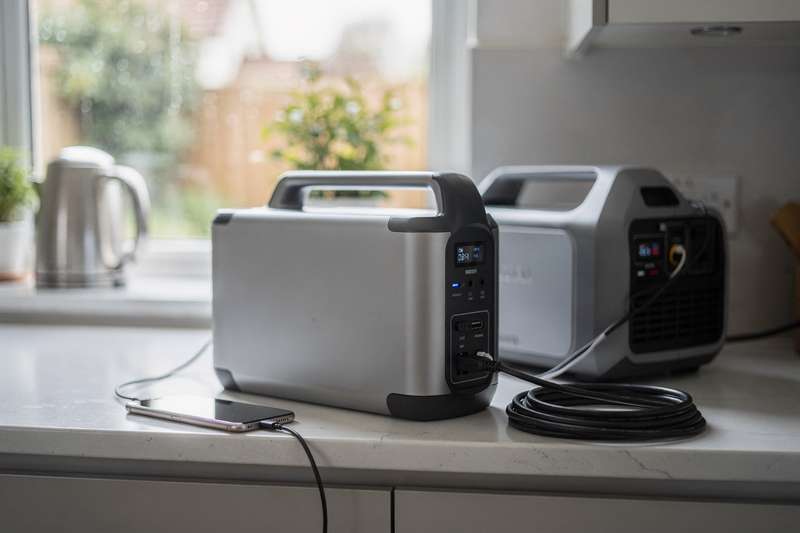
You’ve been there: the pitch is perfect, the camping chairs are out, and then someone realises the phone battery is dead, the electric cool box is warm, and there’s no way to charge anything without a 45-minute drive back to civilisation. Or perhaps it’s closer to home — a winter storm knocked out your street’s power for six hours and you sat there staring at your warm freezer slowly becoming an expensive compost bin. Maybe you’re running power tools at the far end of a garden or field where the extension lead ran out of reach three plots ago.
Whatever the scenario, the solution is the same: you need a reliable source of portable power. The trouble is, the market has exploded in the last few years. There are petrol inverter generators, compact lithium power stations, solar-compatible units, and hybrid bundles — and the naming conventions are chaotic enough to confuse anyone. This guide cuts through that noise. You’ll find specific product picks drawn from what’s genuinely available on Amazon UK, honest assessments of what each unit does well and where it falls short, and a clear framework for deciding which type of portable power actually fits your situation.
How We Evaluated These Picks
Every product in this guide was selected from live Amazon UK listings and assessed against a consistent set of criteria. For petrol generators, we looked at inverter technology (which determines whether the power output is clean enough for laptops and phones), noise ratings, fuel flexibility, and how genuinely portable the unit is in terms of weight and form factor. For battery-based power stations, we focused on battery chemistry (LiFePO4 cells are significantly longer-lived than standard lithium-ion), usable watt-hour capacity, peak vs continuous output, available ports, and whether solar charging is genuinely supported.
We filtered out zero-review products where the catalogue offered enough reviewed alternatives. Where a zero-review product was included — specifically where it offered something meaningfully different — that caveat is noted clearly in its section. Buyer feedback patterns from verified purchasers informed our assessment of real-world reliability, particularly around things that specs sheets often hide: startup reliability, actual runtime, and how well units hold up after repeated use cycles.
Best Compact Petrol Inverter Generator for Camping
The AIVOLT 1200W Petrol Inverter Generator is the only traditional fuel-powered generator in this guide, and it earns its place by being genuinely small and light in a category that often isn’t. Rated at 4.4 stars from 335 reviewers on Amazon UK, it has a meaningful base of buyer feedback that confirms what the specs suggest: this is a practical choice for camping, caravanning, and light outdoor use where you need mains-style power without the bulk of a full-size generator.
The 1200-watt continuous output won’t run a kettle and a hair dryer simultaneously, but it’s more than sufficient for charging laptops, keeping a cool box ticking over, running LED lighting, and even powering a small television or portable speaker. As a 4-stroke engine, it’s cleaner-running and more fuel-efficient than 2-stroke alternatives, which matters when you’re looking at extended trips where fuel weight and cost add up. The suitcase-style enclosure is an important feature — it protects the inverter electronics, contains noise better than open-frame designs, and makes the unit genuinely easy to slot into a boot or a van without snagging on everything else you’ve packed.
The true sine wave output is the spec that really matters for sensitive electronics. Pure sine wave means the current waveform is smooth and clean, which is what laptops, phone chargers, camera equipment, and medical devices (like CPAP machines) require. Cheaper generators sometimes produce a modified sine wave, which can cause problems with certain electronics, reduce efficiency, or even damage equipment over time. For camping and outdoor events, where everyone is plugging in phones, cameras, and portable computers, this distinction genuinely matters.
Where the AIVOLT has limitations: it’s still a petrol generator, which means noise, exhaust fumes, and fuel logistics. You cannot run it inside a tent, caravan, or enclosed space — carbon monoxide is a serious risk with any combustion engine. It’s also worth knowing that 1200W is a relatively modest output; if you need to run a full-size kettle (typically around 2000–3000W), you’ll be disappointed. Think of this as a step up from a power station, not a full household backup generator. For what it is — a lightweight, quiet-ish, clean-power petrol unit — it’s a solid option for weekend campers and outdoor workers who genuinely need mains-style output on the go.
Best Mid-Range Power Station for Camping and Emergencies
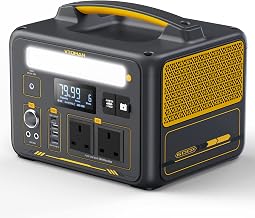
The VTOMAN Jump 600X Portable Power Station is the standout in this category for buyers who want genuine versatility without spending at the top of the market. With 4.4 stars from 416 reviewers, it’s the most reviewed mid-range option in this selection and the feedback is consistently positive about its real-world performance.
The key specs here are the 600W continuous AC output (with 1200W surge capacity), a 299Wh LiFePO4 battery, and pure sine wave output. LiFePO4 — lithium iron phosphate — is a significantly more durable battery chemistry than the standard lithium-ion cells found in cheaper power stations. Manufacturers typically rate LiFePO4 batteries for around 3,000 charge cycles before capacity noticeably degrades, compared to 500–800 cycles for conventional lithium-ion. For something you’re going to charge, drain, and charge again regularly over several camping seasons or as a home emergency backup, that longevity difference is real money over time.
299Wh of usable capacity is a practical middle ground. You can run a laptop through a full working day, charge multiple phones, keep a small cool box running for several hours, or power LED lighting through a night. You won’t be running a kettle or a hairdryer — at 600W continuous, anything drawing much more than that will trip the overload protection. But for the realistic load most campers, van-lifers, or emergency backup users actually put on a portable station, this is a capable unit.
The solar charging capability is genuine, not just a marketing box-tick — the unit accepts solar input and the battery chemistry handles partial-state-of-charge cycling well, which standard lithium-ion does not. If you’re pairing this with a folding solar panel for off-grid use, LiFePO4 is the chemistry you want. The unit also charges via mains and car DC, giving you multiple options for topping it up before or during a trip. Reviewers highlight the clear display, the reliability of the AC output under load, and the compact form factor as particular strengths. The main tradeoff is weight — lithium iron phosphate is heavier than standard lithium-ion at equivalent capacity — but that’s an acceptable tradeoff given the longevity benefit.
Best Budget Power Station for Light Outdoor Use
If you want a portable power station without spending significantly and your needs are genuinely light — charging phones, running a small light, keeping a tablet or camera battery topped up — the Powkey 100W Portable Power Station is a reasonable entry point. It has 930 reviews on Amazon UK and a rating of 3.9 stars, making it one of the more widely tested budget options in the category.
The 99Wh / 27000mAh capacity keeps the unit under the 100Wh threshold that most airlines allow in carry-on luggage — worth noting if you travel by air and want to bring a power station. The 100W AC output is modest; it’ll run a laptop that draws under 65W, charge phones, and power LED accessories, but it won’t cope with anything more demanding. Think of it as a substantial power bank with a mains socket rather than a generator replacement.
The port selection is reasonable for a budget unit: AC output, DC ports, USB-A, and USB-C are all present. The USB-C port matters for modern laptops and fast-charging smartphones, and its inclusion at this price point is a practical plus. The weight is low enough to carry in a rucksack without noticing it, which makes it genuinely useful for day hikes, picnics, outdoor photography sessions, and short camping trips where you’re not trying to power anything heavy.
The 3.9-star rating is honest about the tradeoffs. Some reviewers report that real-world capacity is somewhat lower than the headline spec suggests under sustained load — which is common in budget lithium units. The AC output can also be inconsistent when pushed toward its 100W rated limit, with some units being more conservative about their peak draw than others. For light, intermittent use the Powkey performs well. Push it hard and you may find it less reliable than you’d hoped. For the buyer who needs something portable and affordable rather than something that will work a heavy shift every weekend, it makes sense. Just be honest with yourself about what you’ll actually use it for.
Best Small LiFePO4 Power Station for Everyday Carry
The VTOMAN Jump 100 Portable Power Station fills a specific niche: maximum battery longevity and fast charging in the smallest, lightest package available with a genuine AC socket. With 31 reviews and a 4.3-star rating, the sample size is small but the feedback is notably positive, and VTOMAN’s track record with their larger Jump 600X adds some weight to the brand’s credibility here.
The 89.6Wh LiFePO4 battery is again the chemistry highlight. Like the larger Jump 600X, this unit benefits from the extended cycle life of lithium iron phosphate, which matters if you’re going to use this regularly rather than just keeping it in the car for occasional emergencies. The 100W AC output (200W peak) is in line with the Powkey reviewed above, but the PD 65W fast charging via USB-C is notably fast — charging a modern laptop, tablet, or phone via USB-C at 65W is genuinely quick and avoids the frustrating trickle-charge you sometimes get from lesser units.
What makes this interesting compared to the Powkey is the battery chemistry. If you’re planning to use a power station regularly — weekly camping trips, frequent outdoor working — LiFePO4 will hold its capacity far longer. A standard lithium-ion unit that degrades noticeably after 500 cycles isn’t great value if you’re doing two camping weekends a month. The VTOMAN Jump 100’s chemistry means you’re looking at a unit that should still be performing well years down the line, even with heavy regular use.
The caveat is that 89.6Wh is a small capacity. You’re realistically charging phones and running small electronics, not powering a cool box for a weekend. This is the right pick if portability and longevity are your primary criteria — perhaps you’re a regular wild camper, a photographer who needs reliable power for camera gear on day trips, or someone who wants a genuinely compact emergency backup for the office drawer or car boot. It’s not the right pick if you need to power anything substantial or sustain output over many hours.
Best Solar Bundle for Off-Grid Camping
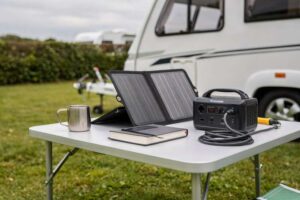
The POWKEY Portable Powerstation 100W with 40W Solar Panel takes a different approach to the other entries in this guide: rather than selling you just the power station, it bundles a 40W folding solar panel in the box. With 53 reviews and a 3.5-star rating, the feedback is more mixed than the other picks, and it’s worth being direct about why.
The appeal is obvious. If you’re heading off-grid for more than a weekend — festival camping, a long motorhome trip, wild camping in Scotland — the ability to top up your power station from sunlight without needing to carry fuel or find a mains socket is genuinely useful. The 99Wh power station paired with a 40W solar panel creates a self-sustaining system in reasonable sunlight. In UK summer conditions with four to five hours of usable solar per day, a 40W panel can meaningfully recharge the 99Wh battery, keeping you in usable power for longer trips.
The 3.5-star rating reflects real compromises. Some reviewers found the power station’s AC output less stable than expected, particularly under heavier loads. The solar panel’s actual output in UK conditions — where overcast skies are common — will frequently be below the 40W rated maximum. Treat the solar panel as a supplement rather than a primary charger, and manage your expectations accordingly. The panel’s folding design is practical, though build quality at this price point is not on par with premium solar brands.
Where this bundle makes sense: you’re a budget-conscious camper who wants a power station and solar panel and doesn’t want the hassle of sourcing and matching components separately. The convenience of a pre-matched bundle at an accessible price is real. Where it doesn’t make sense: if you need reliable, heavy-duty power output or you’re camping somewhere with consistently poor solar conditions. Go in with clear expectations and this bundle can serve you well for light use across an extended off-grid trip.
What to Look For When Buying a Portable Generator or Power Station
- Petrol generator vs battery power station: Petrol generators produce more sustained power and can run indefinitely as long as you have fuel. Battery power stations are silent, fume-free, and safe to use indoors or in a tent — but they have a fixed capacity and need recharging. The right choice depends on whether you need high power output for a short period or moderate output sustained over days.
- Wattage (continuous vs peak): Always look at the continuous output rating, not just the surge or peak figure. A unit rated at 600W continuous and 1200W surge will handle a 500W device comfortably, but will struggle with a device that continuously draws 900W. Check the actual running wattage of any device you intend to power before buying.
- Battery chemistry for power stations: LiFePO4 (lithium iron phosphate) batteries last significantly longer than standard lithium-ion — typically 2,500–3,500 cycles versus 500–800. If you plan to use a power station regularly, LiFePO4 is worth seeking out even at a higher upfront cost.
- Pure sine wave vs modified sine wave: Inverter generators and most quality power stations produce pure sine wave output, which is safe for all electronics including laptops, medical equipment, and variable-speed motors. Modified sine wave output is fine for basic resistive loads (simple light bulbs, some power tools) but can cause issues with sensitive electronics. Always confirm the output type before connecting valuable equipment.
- Noise level (petrol generators): Decibel ratings matter enormously in practice. A generator rated at 65–68 dB is genuinely quieter than you might expect — roughly the volume of a normal conversation. One rated at 80+ dB is noticeably louder. For campsite use, quieter is almost always better, and inverter generators are typically several decibels quieter than conventional open-frame models at equivalent output.
- Charging options for power stations: Look for units that support mains charging, car DC charging (12V), and solar input. Multiple charging options give you flexibility. Also check the maximum solar input wattage — a power station that accepts 100W of solar will recharge faster from a panel than one limited to 40W input, regardless of what panel you connect.
- Port selection and real-world usability: Count the AC sockets, USB-A ports, USB-C ports, and DC outputs. Consider what you’ll actually plug in: modern laptops almost universally use USB-C now, so a unit with PD (Power Delivery) USB-C charging is increasingly valuable. If you’re running a cool box or electric air pump, you’ll need an AC socket rated high enough to handle the startup surge of those devices.
Verdict
For most UK buyers — weekend campers, caravan owners, people who want emergency backup for their home, or outdoor workers who need to power tools away from a socket — the VTOMAN Jump 600X Portable Power Station is the pick we’d point you toward first. The combination of LiFePO4 battery chemistry, 299Wh capacity, and 600W pure sine wave AC output hits a useful practical middle ground. It’s powerful enough for real-world outdoor use — cool boxes, laptops, lighting, phone charging — while the battery chemistry means you’re buying something that will genuinely last across hundreds of charge cycles without significant degradation.
If you have a specific need for traditional mains-style output without worrying about battery depletion, the AIVOLT 1200W Petrol Inverter Generator is the most accessible petrol option here, with a solid review base and the key feature of true sine wave output. For buyers on a tighter budget with lighter needs, the Powkey 100W Portable Power Station covers the basics without a significant outlay. Whatever you choose, the single most important thing is matching the unit’s continuous watt rating to your actual load — overestimate what you’ll plug in and you’ll be disappointed; match it accurately and any of these picks will serve you reliably.
Quick Comparison Table



Editorial Note
We were not paid to feature any specific product in this guide. All opinions are independent and based on publicly available specifications, verified buyer feedback patterns, and category research.
FAQ
What is the difference between a portable generator and a portable power station?
A portable generator runs on petrol (or sometimes propane) and generates electricity continuously as long as it has fuel. A portable power station stores electricity in a battery and discharges it when needed. Generators produce more sustained high-wattage power but create exhaust fumes and noise; power stations are silent, fume-free, and safe for indoor use but have a finite charge that needs replenishing.
Can I use a portable power station to run a kettle or microwave?
Most compact portable power stations cannot run a standard kettle or microwave, as these appliances typically draw 1500–3000W continuously. You would need a power station rated at 2000W or more continuous output to do so safely. The units reviewed in this guide are suited to laptops, phones, lighting, cool boxes, and small appliances — not high-draw kitchen equipment.
Is it safe to run a petrol generator inside a tent or caravan?
No — running any combustion engine in an enclosed space is dangerous and potentially fatal due to carbon monoxide buildup. Petrol generators must always be used outdoors, well away from tents, caravans, windows, and vents. If you need power inside a confined space, a battery power station is the safe choice.
What does LiFePO4 mean, and why does it matter for a power station?
LiFePO4 stands for lithium iron phosphate, a specific battery chemistry that offers significantly longer cycle life and greater thermal stability than standard lithium-ion. LiFePO4 batteries typically handle 2,500–3,500 charge cycles before noticeable capacity loss, versus 500–800 for conventional lithium-ion. If you plan to use a power station regularly, LiFePO4 chemistry is a meaningful durability advantage worth paying for.
How much capacity do I need for a weekend camping trip?
For a typical two-person weekend trip — charging two smartphones nightly, running LED lighting, and keeping a small cool box on a power-saving mode — a 200–300Wh power station is a realistic minimum. If you add laptop use or want to run a portable projector, a unit in the 300–500Wh range gives you more comfortable headroom. Very light users (just phone charging and a light) can manage with 99Wh.
Can I take a portable power station on an aeroplane?
Most airlines permit lithium battery power stations under 100Wh in carry-on luggage without prior approval. Units between 100Wh and 160Wh may require airline approval. Anything above 160Wh is generally not permitted in carry-on or hold baggage on commercial flights. Check your specific airline’s policy before travelling, as rules vary and enforcement differs between carriers.