You’ve committed to a summer of wild camping in the campervan, or you’re finally tackling that garden workshop that’s been running an extension lead from the house for three years. Either way, you’ve arrived at the same uncomfortable realisation: buying a solar power kit on Amazon UK can be genuinely baffling. The wattage numbers sound straightforward until you discover they assume full Californian sun, the spec sheets bundle controllers and panels from different manufacturers without warning, and the review sections are split between people who loved the kit for their Arizona cabin and people who can’t get it to charge anything in Northumberland in October.
The frustration isn’t with solar technology — it’s with the presentation. Most buying guides either go too deep into technical theory (you’re not building a power station, you just want lights in the shed) or stay so surface-level that you end up choosing by price alone and discover six months later that your “complete kit” was missing three key components. What you actually need is a clear breakdown of which kit suits which specific situation, with an honest account of the tradeoffs.
This guide covers five solar kits available right now on amazon.co.uk, matched to five different real-world UK scenarios. Whether you need a foldable panel to charge your phone on a backpacking trip, a roof-mountable system for your caravan, or a portable setup for weekend motorhome use, there’s a clear recommendation here — along with a straightforward explanation of why that kit and not one of the others.
How Each Kit Was Evaluated
Each solar kit in this guide was assessed on five criteria: realistic power output for UK sun conditions (not the theoretical maximum under Mediterranean sun), the type and quality of included charge controller where applicable, what accessories actually ship in the box, how approachable the installation process is for a competent DIYer without specialist electrical training, and patterns across verified buyer reviews on amazon.co.uk. Products aimed at children’s educational science kits, garden irrigation systems, or other applications that happen to incorporate a small solar cell were excluded — this guide covers kits that provide useful electrical output for camping, caravanning, or off-grid power needs. Where a kit carries no buyer reviews at time of evaluation, this is stated explicitly in its section rather than glossed over.
Best All-Round Portable Kit
The DOKIO Foldable Portable Solar Panel 100 Watt 12 Volt Monocrystalline Solar Suitcase with Waterproof Charge Controller is the pick for anyone who wants a capable 12V charging system without drilling holes in a roof. With 977 reviews averaging 4.4 out of 5, it’s the most thoroughly tested solar kit in this guide, and that review volume provides confidence in real-world performance that no specification sheet can replicate.
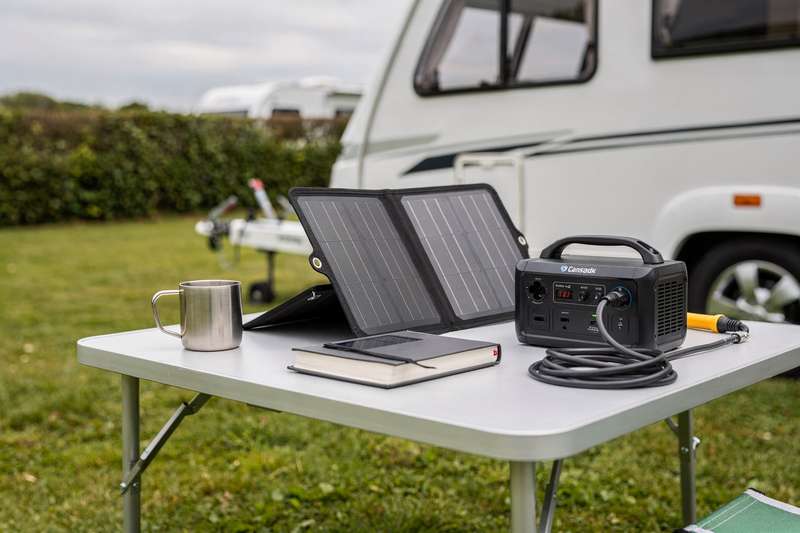
The format is the key practical advantage. The two monocrystalline panels fold together into a compact suitcase shape with an integrated handle — it stows comfortably in a campervan’s under-bed locker, a car boot, or a motorhome storage bay. When you arrive at a campsite, you unfold it, angle it towards the sun, and connect the included charge controller to your 12V leisure battery. No roof penetration, no permanent wiring, no commitment to a single vehicle. That flexibility matters if you move the solar setup between a motorhome, a tent awning frame, and a garden bench depending on the season.
In terms of practical output, 100W in UK conditions delivers roughly 250–350 watt-hours (Wh) on a decent summer day in southern England — three to four peak sun hours is a working figure. That covers a weekend of LED lighting, phone and tablet charging, and a 12V fan. It won’t sustain a 12V compressor fridge running continuously through a full day without a proper battery bank behind it, so if a fridge is central to your setup, a 200Ah lithium battery is a sensible minimum and overcast days require managed expectations. The suitcase format gives you a practical advantage here: repositioning the panel throughout the day to track the sun meaningfully increases real output compared with a fixed-angle installation.
The included charge controller is waterproof, which matters for outdoor use — it can live outside without routing cables through a wall to stay sheltered. The controller handles standard protection functions (overcharge prevention, low-voltage cutoff) that keep your battery healthy. If you later want to expand the array, the controller’s maximum input rating sets the ceiling for how many additional panels can be added before a standalone controller upgrade is needed.
Where this kit has limitations: being portable also means it’s vulnerable to being knocked over on an exposed campsite. Some buyers report the controller as the first component to show wear in extended use, particularly in hot summer conditions. For a system running year-round, treat the included controller as a starter and budget for a quality standalone MPPT unit when you’re ready for a more permanent setup. For weekend and holiday use, the stock configuration is more than adequate — and nearly a thousand verified buyers confirm it.
Best for Caravans and Campervans
The ECO-WORTHY 240W Mono Solar Panel Kit 12V Off-Grid for Caravan Campervan is for the buyer who has moved past “I might try solar” and is ready to install a proper roof-mounted system that handles daily caravan power demands. At 4.6 out of 5 from 76 verified buyers, it’s the highest-rated kit in this guide, and the consistent thread in those reviews is reliable, meaningful output for caravanning and motorhoming use.
The kit ships with two 120W monocrystalline panels, a 30A PWM charge controller, and Z mounting brackets — the complete hardware list for a fixed roof installation without sourcing components separately. The Z brackets are designed for flat-roofed vehicles and attach the panels at a shallow pitch, appropriate for most caravan and campervan roof profiles. You’ll need to source appropriately rated cable for the runs between panels, controller, and battery separately, along with sealant for any roof penetrations — neither is expensive, but plan for them before installation day rather than discovering the gaps halfway up a ladder.
The combined 240W makes a substantial difference over a smaller system when conditions work with you. On a solid UK summer day in the south, you’re realistically generating 600–800Wh, which comfortably covers LED lighting, phone and tablet charging, a 12V water pump, and a reasonably efficient 12V compressor fridge for much of the day. For a couple using a caravan for several weeks at a time, this capacity shifts the experience from “solar as a top-up” to “solar as a primary power source” — provided your battery bank is sized to store it. A 100Ah lithium battery is a workable minimum; 200Ah gives comfortable headroom.
The 30A PWM controller is a sensible match for this system size. PWM controllers are simpler and more affordable than MPPT alternatives. At 240W, upgrading to MPPT would recover some additional output — particularly in partial cloud — but the included PWM unit is a reasonable starting point for buyers new to solar installation. If the array expands to 400W or more later, revisiting the controller makes sense; at 240W, the current controller is appropriately matched. Monocrystalline cells are more efficient per square metre than polycrystalline alternatives, important when roof space isn’t unlimited, and standard MC4 connectors on the panels keep future expansion relatively straightforward.
The honest limitation: a fixed roof installation demands more confidence with electrical work than a portable suitcase kit. You’re connecting panels in parallel, routing cables through the vehicle structure, and terminating at a battery safely. Use the supplied documentation alongside a reputable wiring guide specific to your vehicle type, and do not skip fusing at each stage of the circuit. Done correctly, this is a straightforward DIY afternoon; rushed or incorrectly wired, it poses real risks. Take the wiring seriously and the system will serve you well for years.
Best for Backpacking and Hiking
The FlexSolar 20W Portable Solar Panel Charger for Camping Foldable Solar Panel addresses a use case that the larger kits in this guide don’t cover: charging your phone, camera, or earbuds directly from the sun without carrying an additional battery pack or understanding charge controller settings. With 468 reviews at 4.0 out of 5, it’s a well-tested product with a specific purpose, and understanding that purpose is the key to knowing whether it suits your needs.
The outputs are USB-A with QC3.0 (Quick Charge 3.0) and USB-C — no 12V output, no MC4 connectors, no battery bank charging capability. This panel connects exclusively to USB devices. QC3.0 is meaningful for compatible Android and Samsung smartphones: it charges them measurably faster than a standard 5W USB connection, which matters when you have limited hours of good sun and a lot of battery to refill. The USB-C port handles modern phones and some lower-power devices in reduced-demand mode, though a 20W panel on a cloudy British afternoon won’t rapidly recharge a depleted laptop under load — manage expectations accordingly.
The foldable design fits in an outer rucksack pocket, and the waterproof construction tolerates rain without needing to be packed away at the first sign of cloud. The most practical use for backpackers is clipping it to the back of a rucksack while walking — the panel receives intermittent sun throughout the day and trickle-charges whatever’s plugged in. Output in that position is well below the rated 20W because the panel angle relative to the sun changes constantly, but even a few extra percentage points of battery across an eight-hour walking day is useful when you’re relying on your phone for navigation in the hills.
The 4.0 rating — the lowest in this guide — warrants an honest look. The main friction points in buyer review patterns are output consistency in overcast British conditions (a limitation that applies to all solar panels, not just this one) and occasional USB port reliability at the lower end of the market. On a properly sunny day, the panel returns reasonable output; on a grey British summer afternoon, temper your expectations. For anyone whose power needs extend beyond USB devices — you want a 12V battery charged or LED lighting run from a battery — one of the other kits here is the right choice. For the hiker who needs a working phone through a multi-day walk, this is a practical, packable option that requires no technical knowledge to use.
Best Entry-Level Fixed Installation Kit
The ECO-WORTHY 25W 12V Solar Panel Kit with Mounting Brackets & Corner Guards is the starting point for small, permanent solar installations — the garden shed, the static caravan battery maintenance, the narrowboat top-up, or the gate opener that needs a trickle of power without a mains supply. Worth being transparent upfront: this kit carries only 9 reviews at time of writing, which is a limited sample compared with the DOKIO or FlexSolar above. The specification set and ECO-WORTHY’s broader product track record inform this recommendation alongside buyer consensus, so factor that in when weighing it up.
The included accessories tell the story of the intended use: mounting brackets, corner guards, a PWM charge controller, and an SAE cable. The SAE connection type is found on battery tenders and maintainers across the leisure sector, making it compatible with many common battery setups without adapters. The corner guards protect the panel frame during installation — a small but practical detail. This kit is designed to be fixed to a shed roof, fence post, or static caravan roof and left to work quietly over years without regular intervention.
At 25W, be precise about realistic output. In a good UK summer (approximately four peak sun hours in southern England), you’re generating roughly 80–100Wh per day. That’s enough to keep a 12V battery at float charge — preventing the slow self-discharge that kills a battery left idle for months — to run a few hours of 12V LED lighting per evening, or to power a small 12V device such as a security camera or gate controller. It won’t run a fridge, a television, or any significant appliance. Think of this as a maintenance and convenience system rather than a primary power source, and it will meet that remit without complaint.
The PWM controller is matched appropriately to the panel size — at 25W, the efficiency advantage of an MPPT controller would not justify the additional cost. Standard MC4 connectors on the panel mean you could add a second panel later if needs grow, though a higher-rated controller would be needed at that point. Where this kit doesn’t fit: if you’re imagining solar running a workshop compressor or a caravan fridge, the 240W ECO-WORTHY kit earlier in this guide is the correct starting point. For battery maintenance in a narrowboat, static caravan, or garden building, this does exactly what’s needed without over-engineering the solution.
Best Solar Power Bank
The BLAVOR Solar Power Bank with 4 Foldable Solar Panels, 20000mAh External Battery Pack 18W Portable Fast Charging Phone Charger takes a different structural approach to portable solar charging: rather than a separate panel that charges an external battery, it integrates a large-capacity power bank with fold-out solar panels built directly into the unit. Before anything else: this product carries zero buyer reviews on amazon.co.uk at time of writing. It’s included here because the format fills a real gap in this guide’s coverage — no other pick here combines a high-capacity power bank with integrated solar panels — but treat it with appropriate caution compared with the reviewed picks above.
The 20,000mAh internal battery is the primary draw. At that capacity, you’re carrying enough charge to refill a typical smartphone six or seven times from a full battery — covering three to four days of moderate phone use without any solar input at all. The 18W output enables fast charging for compatible phones, a practical advantage over older power banks that trickle charge at 5W and take most of an afternoon to top up a modern battery. The four foldable solar panels open out to expose more cell area than a single fixed panel on the casing would allow, which affects how quickly the internal battery recharges from solar input during the day.
The honest limitation — one that applies across the solar power bank category, not just this product — is that built-in panels on a handheld device are necessarily small relative to the 20,000mAh battery they’re feeding. Even with four foldable panels, real-world solar input on a unit this size is modest. On a clear summer day with the unit positioned well, you’ll accumulate useful supplementary charge; on a typical overcast British afternoon, the solar contribution is limited. The realistic use pattern is: charge the unit fully at home before your trip, use the battery capacity during it, and rely on the solar panels to extend that range during daylight hours rather than expecting them to rapidly recharge the unit from empty.
For music festivals, multi-day walking trips, or sailing passages where mains access is intermittent, the combination of a large internal battery and a solar supplement is a legitimate strategy. The 20,000mAh capacity covers most people’s critical device needs for several days without solar input; the panels become meaningful when you’re actually off-grid for an extended stretch. The absence of buyer reviews means build quality, real-world solar input rates, and long-term reliability are all unverified by independent users. If that uncertainty concerns you — and it reasonably does — the FlexSolar 20W panel paired with a separately purchased high-capacity power bank gives you a modular equivalent with hundreds of verified ratings behind each component.
What to Look for When Buying a Solar Power Kit
- Panel type and efficiency: Monocrystalline panels are more efficient per square metre than polycrystalline alternatives, which matters when roof space or pack volume is limited. In UK conditions, where maximising every watt counts, monocrystalline is the better choice for most fixed and portable kits. Flexible panels exist for curved surfaces like boat decks but often carry lower efficiency ratings and are harder to mount securely on standard structures.
- Controller type — PWM vs MPPT: PWM (Pulse Width Modulation) controllers are simpler and more affordable; MPPT (Maximum Power Point Tracking) controllers extract more power from the panels, particularly in partial shade and varying light. In the UK, where consistent full sun is not guaranteed, MPPT controllers become worthwhile on systems above 200W, where the efficiency improvement more than justifies the higher cost. At smaller sizes and on tighter budgets, a quality PWM controller is adequate. If your kit includes a controller, confirm which type it uses before assuming performance levels.
- Complete kit versus panels-only: A genuine kit should include the panel or panels, a charge controller (for any 12V battery-charging system), mounting hardware, and the cables to connect everything. Some listings describe themselves as “kits” but omit the controller, cabling, or connectors. Check the item list carefully before purchasing. For direct USB charging, no controller is needed; for any 12V battery system, a controller is non-negotiable for safe operation.
- Connector standards — MC4: MC4 is the standard connector type for solar panels used across the industry. MC4-compatible panels and controllers connect without adapters and future expansion is straightforward. If you plan to add more panels later, confirm your current components use MC4 from the outset — it avoids significant frustration when expanding the array months down the line.
- IP rating and weatherproofing: Any outdoor installation needs an appropriate IP (Ingress Protection) rating on junction boxes and charge controllers. For UK outdoor use — rain arrives without warning — look for at least IP65 on exposed components. Junction boxes on lower-cost panels can be less well-sealed than the glass panels themselves; check buyer review patterns for any reports of water ingress before committing.
- Battery compatibility: Most 12V solar kits work with lead-acid (flooded, AGM, and gel) and lithium (LiFePO4) batteries, but the charge controller must be set to the correct battery type. A smart PWM or MPPT controller will have selectable battery modes; a basic PWM controller may default to lead-acid settings, which can undercharge or overcharge a lithium battery over time. Verify controller compatibility with your battery chemistry before connecting to an expensive lithium bank.
- Realistic UK output expectations: Assume two to three peak sun hours per day as an annual UK average; approximately four hours in summer in southern England; fewer in winter, Scotland, or during extended overcast periods. A 100W panel delivering three peak hours gives you 300Wh — useful, but not the theoretical maximums sometimes quoted in marketing material. Size your battery bank and daily power budget for British conditions rather than laboratory figures.
Our Verdict
For most UK buyers — a caravan or motorhome owner who wants a capable portable system that doesn’t require committing to a permanent installation — the DOKIO 100W Suitcase folding panel is the clearest recommendation in this guide. The format travels well between vehicles and use cases, the waterproof controller handles the basics reliably, and close to a thousand verified buyers provide a level of confidence in real-world performance that the other kits can’t match at this stage of their product lifecycle. It’s not the most powerful system here, and the included controller isn’t the ceiling for the technology, but for flexible use across caravanning, motorhoming, and boat trips, it covers the majority of situations without demanding a professional installation.
If you’re ready to commit to a fixed roof installation and want output that handles daily caravan life — running a fridge, a television, and multiple devices simultaneously — the ECO-WORTHY 240W Mono Solar Panel Kit is the step up to make, and its rating of 4.6 from verified buyers backs that up. For backpackers and hikers whose only requirement is USB device charging, the FlexSolar 20W is the lightweight, packable choice that asks nothing of you technically. Match the kit to your actual use case: a 25W maintenance panel on a narrowboat does far more useful work than a 240W kit that can’t be properly installed on a temporary setup.
This guide was produced independently. We were not paid to feature any specific product. All opinions are based on publicly available specifications, verified buyer feedback patterns from amazon.co.uk, and category research. Products were included or excluded based on relevance to real UK solar power use cases, not commercial relationships.
Quick Comparison Table


FAQ
What does a 100W solar panel actually produce in the UK?
In real UK conditions, a 100W panel typically delivers around 250–350 watt-hours (Wh) on a good summer day in southern England, based on roughly three to four peak sun hours. In Scotland, Wales, northern England, or during overcast weather, expect significantly less — 100–200Wh is more realistic as a daily average across the year. Size your battery bank and daily power budget for British conditions rather than the panel’s rated maximum, which assumes ideal sun angles and full irradiance.
What is the difference between a PWM and an MPPT charge controller?
PWM (Pulse Width Modulation) controllers are simpler and more affordable — a perfectly reasonable choice for kits below 200W. MPPT (Maximum Power Point Tracking) controllers dynamically adjust their operation to extract more power from the panels, particularly in partial shade and changing light conditions. In the UK, where cloud cover regularly reduces panel output, MPPT controllers become increasingly worthwhile on larger systems (200W and above), where the additional efficiency more than accounts for the higher purchase cost.
Do I need a battery storage system alongside solar panels?
If you want power available at night or during cloudy periods, yes — a solar panel only generates electricity while irradiance is sufficient, and a battery stores that energy for later use. Most 12V solar kits in this guide connect to an existing leisure battery or battery bank. For USB device charging during daylight hours only, a direct-output USB panel such as the FlexSolar eliminates the battery requirement entirely, simplifying the setup considerably.
How many watts do I need to run a 12V compressor fridge in a caravan?
A typical 12V compressor fridge draws 40–60W when the compressor is running, cycling on and off for a combined daily draw of roughly 30–50Ah from a 12V battery. To offset that reliably from solar in UK conditions, you’d want at least 200W of panels alongside a battery bank of 100Ah or more (lithium chemistry preferred for discharge depth and longevity). A 100W portable kit can reduce fridge energy drain but shouldn’t be the sole power source for a 12V fridge in British weather without significant battery backup.
Are solar panels worth using in the UK given the frequent cloudy weather?
Yes — particularly for caravanning and motorhoming, where the alternative is a petrol generator or mains hook-up fees at every site. Modern monocrystalline panels continue to produce useful output in diffuse and overcast light; output is reduced but not zero. The key is sizing the system for UK conditions rather than assuming Mediterranean sun hours. Even in Scotland, a properly specified solar setup makes a meaningful contribution to daily battery management and reduces dependence on hook-up or engine charging.
What is the difference between a solar panel kit and a solar generator?
A solar panel kit consists of panels, a charge controller, and mounting hardware — it charges a separate leisure battery that you already own. A solar generator combines a battery, an inverter, and solar input connectors into a single portable unit. Solar generators are more convenient and require no installation knowledge, but they typically offer less capacity per unit of cost. Panel kits connected to a quality leisure battery bank generally offer better long-term value for permanent or semi-permanent installations where you’re willing to assemble the components yourself.