You’ve been scrolling through Instagram watching people build elaborate paper models, sculpt animals with glowing pens, or assemble intricate wooden contraptions that actually move — and you want in. The trouble is, the moment you start searching for “beginner 3D craft kits” on Amazon, you’re confronted with dozens of options ranging from mysterious bead sets to elaborate mechanical puzzles, and absolutely no guidance on which one suits someone who’s never done anything like this before.
Maybe you tried a craft kit once before — one of those paint-by-numbers sets that looked glorious on the box and ended up as a muddy mess — and you’re wary of wasting money again. Or perhaps you’re shopping for a child, a teenager, or a partner who mentioned wanting to “do something creative” and you need a starting point that won’t overwhelm them on the first sitting. The problem isn’t a lack of options. It’s that “beginner” means something different in every product description, and very few listings tell you honestly how long setup takes, how forgiving the learning curve is, or whether you’ll need extra supplies that aren’t in the box.
This guide cuts through all of that. Below you’ll find seven specific picks — each one a distinct type of 3D craft — evaluated for how genuinely beginner-friendly they are, what you actually get in the box, and where each one falls short. No filler, no fluff.
How We Evaluated These Picks
To put this guide together, we looked at a cross-section of 3D craft types available on amazon.co.uk right now: 3D pens, eco-card model kits, wooden mechanical puzzles, string art kits, and stencil/template accessories. Each pick was assessed against five criteria: how quickly a complete newcomer can get started (setup friction), how forgiving mistakes are (reversibility), what skills the activity builds, whether the box is genuinely self-contained or requires additional purchases, and what verified buyer feedback patterns suggest about real-world experience rather than marketing copy. Ratings and review counts are taken directly from the live Amazon data. Where a product has very few reviews, that’s flagged honestly — low sample sizes mean less reliable signal, and we’ve weighted our enthusiasm accordingly.
Best All-in-One 3D Pen Starter Kit
The SCRIB3D P1 3D Printing Pen with Display is one of the most complete entry-level 3D pen packages you’ll find. It ships with the pen itself, three starter colours of PLA filament, a stencil book, a project guide, and a charger — so you’re genuinely ready to draw in three dimensions within minutes of opening the box. That’s a rarer proposition than it sounds; many 3D pens on Amazon arrive without filament or without any guidance on what to actually create, leaving beginners stranded.
The built-in display is the feature that separates the P1 from bargain-basement alternatives. It shows you the current temperature and speed setting, which matters more than it might seem when you’re starting out. PLA filament needs to be extruded at the right temperature or it either clogs (too cool) or droops and strings uncontrollably (too hot). Having a visible readout means you can troubleshoot by the numbers rather than guessing. For kids or adults new to 3D pens, that visibility takes a significant source of frustration off the table.
The stencil book is a thoughtful inclusion. One of the biggest hurdles with a 3D pen is not knowing how to start — the blank-canvas anxiety is real. The included stencils let you trace over flat patterns and then lift and connect them into three-dimensional shapes, which is far less intimidating than freehand sculpting. You’re building spatial thinking incrementally rather than being thrown in at the deep end. The project guide adds structured progression, so you’re not just making random blobs.
Where the SCRIB3D P1 has limitations: three colours of filament is enough to get going, but you’ll exhaust them fairly quickly if you use the pen regularly, and you’ll need to source PLA refills separately. The pen works with standard 1.75mm PLA, which is widely available — this isn’t a proprietary-cartridge trap. Also, 3D pens require a steady hand and patience; if your beginner is under around eight years old, supervision is advisable both for safety (the nozzle gets hot) and for managing expectations about results. It holds a solid 4.4/5 rating, which inspires reasonable confidence even without a large review base.
This is the pick if you want an active, skill-building craft where you’re literally drawing sculptures out of thin air. It suits creative types aged roughly ten and upwards who enjoy the process as much as the finished object.
Best Eco-Friendly 3D Card Model Kit
The EUGY 3D Chameleon Craft Kit is the standout recommendation for anyone who wants a genuinely low-pressure, no-mess introduction to 3D crafting. EUGY models are made from recycled cardboard, pre-scored and ready to fold and slot together without glue, scissors, or any additional tools. The chameleon version is particularly well suited to beginners because the form is chunky and forgiving — misaligned folds are less obvious than on a flat-faced geometric model.
The numbers back this up convincingly: 4.8 out of 5 stars from 144 reviews is one of the strongest ratings in this entire product category. At that review count you’re getting genuine signal rather than a handful of friends-and-family entries. Buyers consistently highlight how satisfying the snap-together construction feels, how the finished model looks genuinely display-worthy, and how the instructions are clear enough for younger children to follow with minimal adult help. This isn’t a product that over-promises.
What makes EUGY particularly good as a first 3D craft is the zero-barrier-to-entry experience. There’s nothing to plug in, no filament to load, no glue to dry, and no sharp tools required. You open the box, punch out the pieces, and start folding. Sessions can be as short as twenty minutes or stretched over an afternoon, which suits both restless children and adults who want something to do with their hands while watching television. The tactile quality of the cardboard is pleasant — it has a slight texture and doesn’t feel cheap.
The honest limitation is longevity: once you’ve built the chameleon, the kit is done. EUGY models aren’t multi-use in the way that, say, a 3D pen is. If the recipient is likely to want ongoing crafting sessions, you’d want to pick up two or three kits at once or treat this as a taster before graduating to a more involved format. The finished model is also delicate — it’s not a toy to be handled roughly, but rather a decorative object. Keep it away from pets and toddlers. Still, as an introduction to spatial reasoning, following assembly instructions, and the satisfaction of building something three-dimensional with your hands, it’s hard to beat.
Best Premium Mechanical 3D Wooden Puzzle
If you want something that doubles as a display piece and a genuine engineering challenge, the Robotime 3D Wooden Puzzle for Adults – Lighted Rotating Globe Model Kit with LED Light sits at the more ambitious end of the beginner spectrum. This is a mechanical wooden building set — the globe actually rotates, and it incorporates an LED lighting element — so you’re not just assembling a static shape but constructing something with moving parts and an electrical component.
The Robotime brand has a strong reputation in the wooden puzzle space for precise laser-cutting and detailed instruction booklets. The globe kit holds a 4.4/5 rating, and while the review count in the current live data is limited, the brand’s broader catalogue has accumulated substantial positive feedback across multiple retailers. The pieces punch out from pre-cut wooden sheets — no sawing or special tools needed — and the assembly process is systematic enough for a methodical beginner to follow, though it’s genuinely more demanding than a flat-pack model.
Expect to invest several hours across multiple sessions. This isn’t an afternoon project for most people; it’s closer to a weekend build. That’s not a flaw — it’s the point. Adults who enjoy the meditative quality of detailed assembly work, and who want a finished result that looks genuinely impressive on a shelf, will find this deeply satisfying. The LED element adds a theatrical quality to the completed model: a softly glowing rotating globe is a conversation piece in any room.
Where it asks more of you: the small wooden components require careful handling, tweezers or a toothpick are useful for coaxing tight-fitting joints, and patience is non-negotiable. If you or the recipient tends to get frustrated when things don’t go together first time, a simpler kit is a better starting point. This is a mid-range to premium pick — positioned for adults or older teenagers who are committed to the process rather than looking for a quick creative fix.
Best Mechanical 3D Wooden Puzzle for Train Enthusiasts
The ROWOOD Steam Train 3D Puzzle is the most confidently recommended mechanical wooden kit in this guide, backed by the strongest evidence base: 4.6 out of 5 stars from 525 reviews. That’s a genuinely meaningful sample size, and the consistent theme in buyer feedback is that the finished steam train looks spectacular while the assembly process is achievable for adults with no prior woodworking or modelling experience.
The kit contains laser-cut wooden sheets from which you punch out each component. Instructions are diagram-based and follow a logical sequence, building up from the chassis through the boiler and finally the detailing. The mechanical element — the wheels and drive rods have an authentic vintage locomotive aesthetic — means there’s visible payoff at each stage of the build, which keeps motivation high across what is typically a multi-session project.
One practical note: like most kits in this format, no glue is required for the main assembly (the joints are designed to slot and lock), but some builders opt to add a small amount of wood glue at stress points to improve durability, particularly if the finished model will be handled regularly. The kit doesn’t include glue, so factor that in if structural permanence matters to you.
The ROWOOD Steam Train is particularly well suited as a gift. It has that quality of being accessible enough that a non-crafty adult won’t feel immediately defeated, but complex enough that completing it feels like a genuine achievement. It also photographs beautifully, which matters if the recipient is likely to share their finished work. The only real limitation is thematic: if trains don’t resonate with you or the recipient, the Robotime globe offers a more universally appealing subject. But for rail enthusiasts, history buffs, or anyone who appreciates vintage mechanical aesthetics, this is the pick.
Best 3D String Art Kit for Beginners
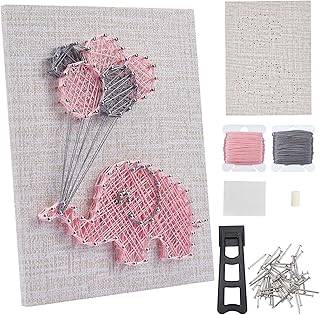
The WEBEEDY DIY 3D String Art Kit for Adults Beginners takes a completely different approach to three-dimensional craft. Rather than assembling pre-cut components, you’re hammering nails into a frame and weaving thread between them to create a geometric image with genuine dimensionality — the layered strings create depth and shadow that shifts as the light changes. The elephant design in this kit is well chosen for a beginner: the curved outline gives you gradual practice at managing thread tension without requiring the hairpin precision that more complex geometric patterns demand.
It holds a 4.5/5 rating from 180 reviews — solid confidence-inspiring numbers. Buyers highlight that everything needed is in the box: the frame, pre-drilled holes, nails, thread in multiple colours, a hammer, and the pattern guide. That self-contained nature is genuinely valuable. The single most common frustration with craft kits is discovering partway through that you need something not included — a specific glue, a particular tool, an extra material. WEBEEDY have avoided that pitfall here.
String art has a particular appeal for adults who want a meditative craft. The rhythmic process of winding thread — following the numbered sequence, watching the image emerge — is absorbing in a way that quiets mental noise. It’s also a forgiving format: if a thread is placed slightly off, you can unwind and redo that section without affecting the rest of the work. The finished piece is a wall decoration, which means there’s a practical endpoint — you’re not creating clutter, you’re creating décor.
The tradeoff is physical: hammering nails requires a degree of hand strength and precision that might make this less suitable for younger children or anyone with limited dexterity. The nails are small, and if they go in at an angle, later threading becomes awkward. This is a pick for adults and older teenagers rather than a children’s family craft. It’s also a project that takes a few hours of focused work, so it suits someone who can commit to a sitting rather than a five-minute dipping-in-and-out approach.
Best 3D Pen Stencil Book for Template-Based Practice
The MOCOBO 3D Printing Drawing Book for Kids is an accessory rather than a standalone craft, but it earns its place here because it solves one of the most specific and underappreciated problems beginners face with 3D pens: not knowing what to make. This reusable template book contains 40 colourful patterns printed on thick paper, paired with two clear acrylic plates that sit on top of the pattern. You extrude filament onto the clear plate, following the pattern below, then peel the cooled piece off and connect the flat sections into three-dimensional forms.
The 4.2/5 rating from 36 reviews gives moderate confidence — enough reviews to indicate the product does what it promises, though not a huge sample. Buyers note that the thick paper holds up to repeated use without warping, and the clear plates are stiff enough to provide a stable working surface without the filament sticking permanently. The 40-pattern range includes animals, geometric shapes, letters, and simple objects — enough variety to keep a beginner occupied across many sessions and to gradually build spatial confidence.
This is the pick if you’ve already acquired a 3D pen (or are buying one alongside a pen like the SCRIB3D P1 above) and want structured practice material beyond whatever stencils came in the box. It’s also a smart standalone purchase for someone who received a 3D pen as a gift but ran out of creative ideas quickly. The reusable format means the investment goes further than disposable template sheets, and the coloured patterns make it easier to follow detail even for younger users.
Bear in mind that this is an accessory — it requires a 3D pen and filament to be useful, neither of which are included. It works with standard 1.75mm PLA, so compatibility with most consumer 3D pens is not a concern. If you’re buying for a complete beginner who doesn’t yet own a pen, buy the pen first and treat this as a natural complement purchase.
Best Budget 3D Pen Template Starter Pack
For anyone who wants a lower-cost entry point into template-guided 3D pen work, the 3D Pen Printing Drawing Book – Reusable 40 Pattern 3D Pen Stencil Book with Transparent Copy Sheet covers similar ground to the MOCOBO book but sits at a noticeably more accessible price tier. It also offers 40 patterns with a transparent copy sheet, thick paper templates, and a format designed for DIY drawing sessions with a 3D pen.
There is an important honesty note here: this product has only one review at the time of writing, which means you’re taking a position with limited buyer-verified information. The 4.0/5 rating from a single reviewer is a signal, not a guarantee. The product description and format are consistent with other stencil books in this category, and the construction appears to follow the same reusable-clear-sheet approach that makes the MOCOBO book functional. But if you’re risk-averse, the MOCOBO with its 36-review base is the safer bet. This pick makes sense if budget is a primary concern and you’re comfortable accepting a little more uncertainty about quality consistency.
In practical terms, what you’re paying for is the same concept: a structured set of patterns that removes the blank-canvas anxiety from 3D pen sessions. The 40-pattern range is identical in count to the MOCOBO, though the specific designs and layout differ. As with all 3D pen accessories, this is only useful if you already own a compatible 3D pen — it is not a standalone craft kit. Treat it as a budget supplement or a way to double your template library if you already own the MOCOBO book and want more variety.
What to Look for When Buying a 3D Craft Kit for Beginners
- Self-contained box contents: The single biggest frustration with craft kits is discovering mid-project that you need something not included — a specific adhesive, a particular tool, extra materials. Before buying, read the product listing carefully (or the Q&A section) to confirm whether glue, scissors, or additional materials are required. The best beginner kits include everything.
- Age and dexterity match: “Beginner” doesn’t mean “suitable for all ages.” A 3D pen nozzle reaches high temperatures — not appropriate for young children without supervision. String art involves a small hammer and sharp nails. Wooden puzzle pieces can be fiddly. Eco-card kits like the EUGY range are genuinely accessible from around six years old. Match the physical demands of the craft to the actual user.
- Session length and interruptibility: Some 3D crafts — particularly mechanical wooden puzzles — are best tackled across multiple sessions. Others, like eco-card kits, can be completed in a single sitting. Consider whether the recipient prefers short, satisfying projects or enjoys longer, evolving builds. There’s no wrong answer, but mismatching this leads to abandoned kits.
- Finished-object utility: Think about what happens to the object once it’s built. A 3D pen creation, a string art piece, and a wooden globe all sit differently in a home — decoration versus toy versus display piece. If storage or display space is limited, a compact finished object matters.
- Reusability vs. single-use: Kits like EUGY are one-and-done — once built, the kit is spent (though you can buy further kits in the range). Template books and 3D pens are ongoing tools you use repeatedly. Decide whether you want a one-time project experience or an ongoing hobby platform.
- Review volume and recency: A 4.8-star rating from 144 reviews (like the EUGY kit) tells you far more than a 4.5 from two reviews. Where review counts are low, weight your confidence accordingly and read the actual written reviews rather than relying on the star average alone.
- Compatibility for accessories: If you’re buying a 3D pen or a stencil book, check that filament is standard 1.75mm PLA (the most widely available type) rather than a proprietary format. Proprietary consumables lock you into one supplier and often cost more in the long run.
Verdict
For the majority of UK beginners coming to 3D crafting fresh — whether you’re shopping for yourself, a teenager, or an adult who mentioned wanting a new hobby — the EUGY 3D Chameleon Craft Kit is the place to start. It has the most convincing evidence base (4.8/5 from 144 reviews), demands nothing except your hands and about an hour of your time, and produces a finished object you’ll actually want to keep. There’s no learning curve, no setup, and no additional purchases required. It’s the lowest-friction way to discover whether three-dimensional crafting is something you want to pursue further.
If you already know you want an ongoing creative tool rather than a single-project experience, the SCRIB3D P1 3D Printing Pen is the step up — it opens a much broader creative space and grows with your skills. And if you want a project that will occupy a full weekend and result in something genuinely display-worthy, the ROWOOD Steam Train 3D Puzzle, with its 525-review confidence base, is the mechanical wooden kit that consistently delivers.
We were not paid to feature any specific product in this guide. All opinions are independent and based on publicly available specifications, verified buyer feedback patterns, and category research.
Quick Comparison Table





FAQ
What is the easiest 3D craft for a complete beginner?
Eco-card model kits — like the EUGY range — are the lowest-barrier entry point. They require no tools, no glue, and no prior experience: you simply fold and slot pre-cut cardboard pieces together. For most beginners, a completed model takes under an hour and the instructions are clear enough for children and adults alike to follow independently.
Are 3D pens safe for children?
Most 3D pens work by heating a nozzle to melt plastic filament, which means the tip reaches temperatures that can cause burns. Many manufacturers now produce lower-temperature pens designed specifically for younger users (typically using a different filament type that melts at a safer temperature). For children under around ten, look specifically for pens marketed as low-temperature or suitable for kids, and supervise use regardless. Adult 3D pens like the SCRIB3D P1 are best suited to teenagers and adults.
Do wooden 3D puzzle kits require glue or special tools?
Most laser-cut wooden puzzle kits — including the ROWOOD and Robotime ranges — are designed to be assembled without glue, using interlocking joints. The pieces punch out from pre-cut sheets, and no sawing is required. That said, many experienced builders add a small amount of wood glue at stress points for durability, particularly if the finished model will be handled frequently rather than displayed. Any additional materials like this are not included in the box.
How long does a beginner 3D craft project take to complete?
It varies significantly by type. An eco-card kit like EUGY typically takes 30–60 minutes. A string art kit like the WEBEEDY elephant usually requires two to four hours of focused work. Mechanical wooden puzzles such as the ROWOOD Steam Train commonly take six to ten hours spread across multiple sessions. If you want a single-sitting project, choose a simpler kit; if you prefer an extended, evolving build, a wooden mechanical model is more rewarding.
What filament type do most 3D pens use, and can I buy refills easily?
The majority of consumer 3D pens use 1.75mm PLA (polylactic acid) filament. PLA is widely available from numerous suppliers on Amazon and in craft shops, is biodegradable, and comes in a very large range of colours. Before buying any 3D pen, confirm it uses standard 1.75mm PLA rather than a proprietary filament format — the latter locks you into buying refills from a single supplier, which is both limiting and often more expensive.
Can I give a 3D craft kit as a gift without knowing the recipient’s skill level?
Yes, provided you match the kit type to what you know about them. Eco-card kits and string art kits with complete materials included are safe choices for most adults and older children — they require no prior skills and the instructions are self-contained. Mechanical wooden puzzles are better suited to people who have expressed an interest in modelling or construction, as they require patience and several hours of work. If in doubt, an eco-card kit is the most universally accessible option.