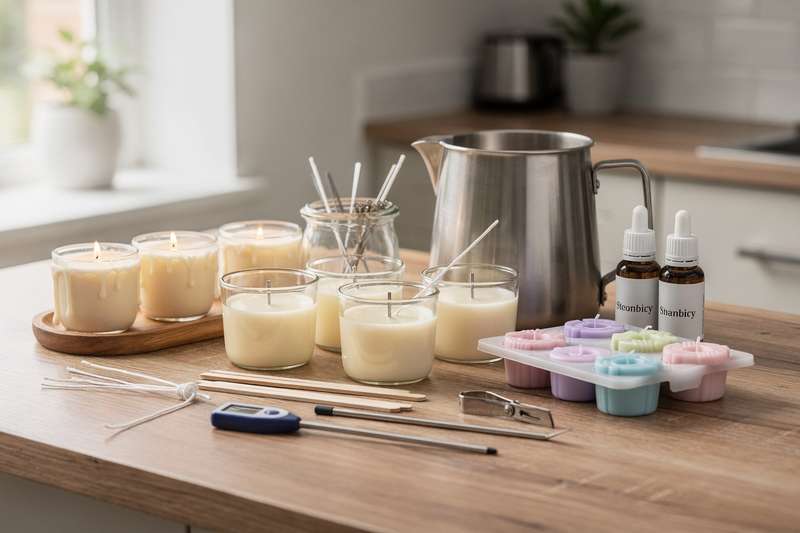
You’ve seen the beautifully scented candles at craft fairs, scrolled through satisfying pour videos on Instagram, and thought: I could do that. Maybe you’ve even tried — melting some old wax in a saucepan, burning yourself slightly, producing a lopsided blob that smells faintly of regret. Or perhaps you’re brand new to the hobby and you’re staring at Amazon wondering why there are so many kits, so many wicks, so many wax types, and absolutely no guidance on which combination won’t leave you with a warped, scent-free disappointment. The good news is that candle making is genuinely accessible and genuinely rewarding — but only when you start with the right equipment. The frustrating news is that the market is flooded with starter kits ranging from genuinely well-thought-out sets to cheap bundles that are missing a crucial piece (usually the thermometer, always the instructions). This guide cuts through all of that. Whether you want an all-in-one beginner kit or individual components to build your own setup, every pick here costs under £30 and is available right now on Amazon.co.uk.
How We Chose These Picks
Candle making involves more variables than most beginners expect: wax type, wick diameter, fragrance load, pour temperature, cure time. A kit that looks complete on the product listing page can still fail you if the wicks are the wrong diameter for the included tins, or if the thermometer tops out below the temperature you actually need. To evaluate these picks, we looked at several criteria. First, completeness — does a kit include everything you need to make at least one finished candle, or does it leave you shopping for extras immediately? Second, component quality — are the wicks cotton or synthetic? Does the melting pot hold enough wax? Is the thermometer readable at a glance? Third, real buyer feedback patterns, focusing on verified UK reviewers who mentioned specific outcomes (burns evenly, good scent throw, wick stayed centred). Fourth, value for the spend — not the cheapest, but the best return on what you actually get in the box. Finally, we considered whether individual tool purchases offered better value than a kit for someone who already owns some supplies.
Best All-Round Beginner Kit
The Candle Making Kit, Make Your Own Candles, Candle Making Supplies for Beginners with Beeswax, Wicks, Candle Tins, and More is the pick you want if you’re starting from scratch with zero equipment and want to make a real candle on your first evening. It sits at a budget-friendly price point and pulls together the core components that beginners most often forget to buy separately: the wax (beeswax in this case, which burns cleanly and has a naturally pleasant scent), pre-tabbed wicks, and candle tins that are already the right size to pair with the included materials. That coherence — everything designed to work together — is what separates it from the cheaper bundles that mix mismatched parts.
Beeswax is worth highlighting here because it’s a slightly different experience from the soy wax most beginners expect. It has a higher melting point, a naturally golden tone, and a subtle honey-like scent even without added fragrance oils. It doesn’t hold fragrance quite as aggressively as soy, so if you’re chasing a strong scent throw on your first attempt, manage expectations slightly — the burn will be clean and long-lasting, but the room-filling intensity you get from a pro-grade soy candle takes more practice and fragrance oil experimentation. That said, rated 4.5 stars from 94 reviewers, the consistent feedback points to this being a solid first-time experience rather than a frustrating one.
The included tins are a practical choice over glass jars for beginners — they’re sturdier, won’t crack if you overheat the wax slightly, and travel well if you want to gift your first candles. The kit is also compact enough to store in a kitchen drawer between sessions, which matters if you’re working from a flat or a small house. Where it’s less ideal: if you want to experiment heavily with colours and fragrance combinations, you’ll exhaust the included materials fairly quickly and find yourself needing to buy wax and wicks in larger quantities. Think of this as a proper introduction rather than a long-term supply haul.
For absolute beginners who want one box, one evening, and one finished candle: this is the right choice. It also rates well as a gift — the packaging is presentable and the instructions are reportedly clear enough for a complete newcomer to follow without watching a tutorial first.
Best Kit for Scent and Colour Experimentation
The Yinuo Mirror Candle Making Kit DIY Supplies of Scented Candles with Beeswax Dyes Fragrances Oils Melting Pot Thermometer Candle Wicks Stickers is the most comprehensive single-purchase kit in this guide. With 365 reviewers giving it 4.4 stars, it has enough real-world feedback to trust, and the breadth of what’s included sets it apart: dyes, fragrance oils, a melting pot, a thermometer, wicks, and stickers for labelling your finished candles. If you’ve ever watched a candle-making video and felt overwhelmed by the shopping list, this kit answers most of it in one go.
The fragrance oils and dyes are where this kit genuinely shines for someone who wants to experiment. Being able to blend colours and scents on your first attempt — without ordering five separate items — removes the barrier that puts most beginners off. The included fragrance oils typically cover a small range of classic scents (think floral, fresh, and warm categories), and while they won’t replicate the complexity of premium fragrance houses, they give you enough to start understanding how scent load affects throw. Candle makers generally work between 6% and 10% fragrance load by weight of wax — above 10% and the oil can pool, below 6% and the scent barely reaches across a small room.
The melting pot included is a key differentiator. Having a dedicated pouring pot with a handle and a spout is much safer and more accurate than melting wax in a general saucepan, and most budget kits skip this component entirely. The thermometer is similarly important: pour temperature affects how your candle sets, how the surface looks, and how well it holds fragrance. Soy wax typically needs fragrance added around 80–85°C and poured slightly cooler — having a thermometer rather than guessing is the single biggest upgrade you can make to your process.
Where the Yinuo kit falls short is in scale. The included wax quantity is enough for a small number of candles, and once you’ve worked through it, you’ll need to source wax separately (soy wax in larger blocks or flakes is widely available and affordable). The containers included are smaller than many people expect. But as a learning kit — one where you understand the entire process from melting to labelling — it’s excellent value for the spend.
Best Mini Soy Kit for Quick Wins
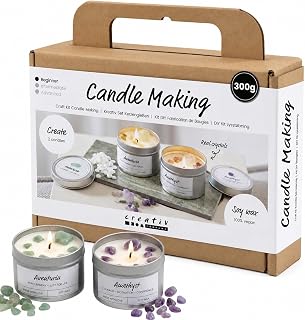
The CREATIVE Mini Craft Kit Candle Making, Cream, Off White, Soy Candles, 1 Pack, Multicolour has a small review count but a notably high rating of 4.7 stars, which is worth paying attention to even with fewer reviews — this tends to indicate a consistent positive experience among those who’ve used it. It’s specifically soy-based, which is good news for beginners who want a cleaner burn, better scent throw potential, and a wax that’s slightly more forgiving on pour temperature than paraffin.
The “mini” in the name is accurate — this is a compact kit designed to produce a small number of finished candles, not to stock your craft room for months. That’s actually a feature for the right person: if you’re unsure whether candle making will become a regular hobby, or you want to test the process before committing to a larger kit, a mini set removes the risk of wasted materials. It’s also a solid option for craft sessions with children (with appropriate supervision — hot wax and an adult’s steady hand are non-negotiable) or for a single themed gifting project.
Soy wax has some practical quirks worth knowing before you start. It can develop a frosted appearance on the surface as it cures — this is normal and doesn’t affect burn quality, though it surprises some beginners who expect a perfectly smooth top. Soy also tends to contract slightly as it cools, which can leave a small dip around the wick; a second thin pour often fixes this. The cream/off-white natural colour of soy means your candles will have a soft, artisanal look even without added dye, which appeals to people aiming for that handmade aesthetic.
If you’re buying this as a gift or as a low-commitment entry point, it delivers. If you’re serious about developing your candle-making skills with room to experiment widely, you’ll outgrow it quickly and should consider one of the fuller kits in this guide instead.
Best for Candle Makers Who Already Have Wax
The JULWHISPER Candle Making Kit with Hot Plate for Beginners, Starter Candle Making DIY for Adults with 900ML Wax Melting Pot, Thermometer, Wicks takes a different approach from the other complete kits: it focuses on the tools rather than the materials. The standout inclusion is the hot plate — an electric heating element that lets you melt wax without using your hob, which is both safer and more controllable. If you’ve ever tried to regulate a double boiler on an electric hob and ended up with either scorched wax or a two-hour wait, a dedicated hot plate is a genuine quality-of-life upgrade.
The 900ml melting pot is generously sized for a starter kit, accommodating enough wax for several standard candle tins or a couple of larger vessels in a single pour session. This matters more than beginners often realise: small melting pots force you to do multiple short batches, which means managing temperature consistency across each one, which compounds the chances of uneven results. Rated 4.4 stars from 39 reviewers, this kit sits in a slightly higher price bracket than most picks in this guide — it occasionally dips at or just under the £30 threshold, so check the current price before purchasing.
What you don’t get here is wax, fragrance, or containers — so this is explicitly a tools-only purchase. That’s actually ideal if you’ve already used a starter kit, enjoyed the process, and now want to invest in equipment that will serve you for years rather than run out after three candles. The hot plate and thermometer combination gives you proper temperature control, and the included wicks and holders cover the consumable side without overcomplicating things.
The tradeoff: if you truly are a complete beginner with nothing at home, you’ll still need to buy wax, fragrance oil, and containers separately. Budget for that additional spend before purchasing this kit. But for a second step — or for someone who wants to gift a tool-focused set to a maker who already has materials — it’s a thoughtful and practical choice.
Best Budget Wick Set for Refilling Your Supplies
The Candle Wicks for Making Candles, 50 Pcs 10cm/20cm Cotton Pre Waxed Candle Wicks with 4 Pcs Candle Wick Holders & 60 Pcs Dot Stickers is the right purchase once you’ve finished your first kit and realised that wicks are the consumable you run through fastest. At a very low price for 50 wicks in two lengths (10cm and 20cm), this set gives you the flexibility to work with both small tins and taller vessels without ordering two separate products.
These are pre-waxed cotton wicks with metal tabs at the base — the pre-waxing makes them stiffer and easier to position in the centre of a container before pouring, which is one of the small frustrations beginners encounter with raw, floppy wicks. The included wick holders (the cross-bar style that rests across the top of your container and keeps the wick upright while the wax sets) and adhesive dot stickers for fixing the metal tab to the bottom of your tin are the kind of accessories that cost almost nothing but make a real difference to your finished candle’s neatness.
The rated 4.5 stars is based on a small sample, so take that with appropriate caution. What the listing makes clear is the specification: cotton (not synthetic), pre-waxed, with tabs — these are the correct parameters to look for in any wick purchase. Synthetic wicks can smoke and spit; untabbed wicks require separate holders or clever DIY fixing; un-waxed wicks need priming before use, which adds a step most beginners skip and then wonder why their candle burns unevenly.
The key buying consideration with wicks is diameter — and this is where even experienced candle makers make mistakes. A wick that’s too thin for your container will tunnel (burning a narrow hole down the centre, leaving a ring of unmelted wax around the edges). A wick that’s too thick will produce a large, sooty flame and potentially overheat the container. The 10cm and 20cm lengths here refer to the wick length, not the diameter, so check the product listing carefully for the recommended container diameter range and match it to your tins or jars before buying.
Best Alternative Wick Set with Low-Smoke Claim
The Candle Wicks for Making Candles 50Pcs 10cm Long Pre-Waxed Wicks with Metal Tabs & 3-Hole Wick Holder — Low Smoke & Longer Burning Time addresses one of the most common complaints about budget candle making: excessive smoke when a candle is extinguished. The “low smoke” claim relates to the cotton construction and the pre-waxing — though it’s worth noting that smoke production is also heavily influenced by wick diameter (too large for the container) and fragrance oil type, so the wick is only one part of the equation.
The distinguishing feature here compared to the previous wick set is the 3-hole wick holder rather than a standard crossbar design. The three-hole format allows you to centre a wick precisely in round containers of varying diameters, which is genuinely useful if you’re working with different-sized tins or jars and don’t want a separate holder for each size. Rated 4.5 stars, the specification is clean: cotton, pre-waxed, tabbed, 10cm — which covers the majority of standard candle tin depths.
If you already have one of the wick sets above in your kit, you don’t need both — they serve the same core function. But if you’re choosing between the two, the 3-hole holder system gives slightly more versatility for mixed-container work, while the previous set’s dual-length option (10cm and 20cm) gives more flexibility for taller vessels. Pick based on your container situation.
One practical tip that applies to any wick you buy: always test-burn a single candle before making a batch. Light it, let it burn for two hours, and check the melt pool. It should reach the edges of the container within that time without the flame being excessively large or producing black soot. If it tunnels, size up to the next wick diameter. If it smokes or the melt pool is too wide, size down. No wick set — budget or premium — removes the need for this basic testing step.
Best for Standalone Temperature Control
The Candle Making Thermometer — Essential Candle Making Kit for Melting Soy and Paraffin Wax, 300mm Probe with Clip is the single-item purchase that will improve any candle-making setup more than almost anything else at this price point. If you’ve been estimating wax temperature by look or feel — or using a cooking thermometer that doesn’t read high enough or sit stably in a melting pot — upgrading to a dedicated candle thermometer is the most impactful low-cost improvement available.
The 300mm probe is long enough to submerge properly in a standard melting pot without the handle overheating, and the clip allows it to rest hands-free against the side of the pot while you prepare your containers and wicks. This hands-free positioning is a practical detail that makes the process smoother: you can monitor temperature without holding the thermometer, which frees both hands for safer handling of hot equipment. The easy-to-read scale is important — candle making requires precision at a few specific moments (adding fragrance, adding colour, pouring), and a scale you have to squint at in a warm kitchen adds unnecessary stress.
Soy wax generally reaches working temperature between 75°C and 85°C; paraffin slightly higher. Both types benefit from adding fragrance at a consistent temperature each time, because the oil binds to the wax differently at different temperatures, affecting scent throw in the finished candle. Knowing your exact temperature — rather than guessing — is the difference between consistent results and unpredictable ones. With a rating of 4.5 stars, this is a well-regarded standalone tool that complements any of the kits above that don’t include a thermometer, or replaces a cheap one that came bundled with a kit.
This isn’t a complete kit — it’s a precision tool. Buy it as an addition to any of the kits that include wax and wicks, or as a standalone upgrade if you’ve been making candles without proper temperature monitoring and wondering why your results are inconsistent.
Best for Bulk Candle Containers
The TOPCZY 135 Pcs Candle Jars for Candle Making, Candle Containers, Candle Tins for Candle Making Bulk, Mini Storage Jars for DIY Candle Making is the pick for anyone who’s moved past the beginner kit stage and needs containers in bulk. At a very low price per unit for 135 pieces, these mini tins give you the volume to experiment freely — burn tests, different fragrance combinations, gifting batches — without rationing your containers as if they’re precious.
Mini tins have a specific niche in candle making: they’re ideal for sample candles, gift sets, and testing new fragrance blends before committing to a larger pour. They’re also a popular choice for favours at weddings, parties, or craft fairs, where uniformity and compact size matter more than burn time. The tradeoff is exactly that — burn time. A small tin filled with soy or paraffin wax will give you a relatively short burn compared to a standard jar candle, so set buyer expectations accordingly if you’re giving these as gifts.
The 3.8-star rating from 5 reviews is the lowest in this guide, and it’s worth being honest about that. Five reviews is too small a sample to draw strong conclusions, and the rating range for this type of product (simple tin containers) is generally narrower — most complaints tend to be about lids fitting less precisely than expected, or minor surface imperfections on the tins rather than fundamental defects. If you’re buying 135 tins, some variation in quality across the batch is realistic at this price point. Inspect a few from the first delivery before committing your best wax pour to the entire set.
If consistency across every single unit matters — for example, for a professional-looking craft fair display — consider ordering a smaller sample quantity first. But for home use, burn testing, and gifting where charm matters more than perfection, 135 tins at this price is a practical and cost-effective stock-up.
What to Look For When Buying Candle Making Supplies
- Wax type and application: Soy wax is the most popular choice for beginners — it burns cleanly, holds fragrance well, and is widely available in flakes that melt quickly. Beeswax burns longer and has a natural scent but is less receptive to added fragrance. Paraffin gives strong scent throw but produces more soot. Know which type your kit uses before you buy, as it affects every other variable in your process.
- Wick diameter for your container: This is the most common beginner mistake. Wicks are rated for a range of container diameters — always check the manufacturer’s guide and match it to your tin or jar. Using the wrong diameter causes tunnelling (too thin) or excessive flame and sooting (too thick). When in doubt, buy a few different sizes and run a burn test.
- Thermometer inclusion: Any kit without a thermometer requires you to either buy one separately or guess your pour temperature. Guessing leads to inconsistent results. A probe thermometer with a clip that reads up to at least 120°C is the minimum you need.
- Fragrance load guidance: Quality kits will indicate how much fragrance oil to use relative to the weight of wax. As a general rule, most soy waxes perform well between 6% and 10% fragrance load — above that, the oil can pool or leak; below that, the scent throw will disappoint. If a kit doesn’t mention this, check the wax manufacturer’s guidance.
- Container material: Tins are forgiving for beginners (no cracking risk, good heat resistance), while glass jars look more professional but require more careful temperature management. Avoid very thin glass for your first pours.
- Kit completeness vs. tool investment: Starter kits are excellent for learning the process, but they run out quickly. If you’re serious about the hobby after your first kit, consider investing in proper equipment (a dedicated melting pot, a good thermometer, a hot plate) and sourcing materials (wax, fragrance, wicks) in bulk separately — the per-candle cost drops significantly.
- Instructions and support: Clear, step-by-step instructions make a genuine difference on your first attempt. Look for kits with good reviews specifically mentioning instruction quality, or supplement with a candle-making guide or online tutorial before your first pour.
Verdict
For most readers coming to this guide — beginners who want to make their first proper scented candle without buying six separate items — the Yinuo Mirror Candle Making Kit is the strongest overall pick. The combination of fragrance oils, dyes, a melting pot, a thermometer, and wicks in a single purchase means you can sit down and make a finished, scented, coloured candle on your first session. With 365 verified reviews and a 4.4-star rating, it has enough real-world evidence to trust, and the thermometer inclusion alone makes it better than most competitor kits at a similar price.
If you’ve already made a few candles and want a tool upgrade, the JULWHISPER kit with hot plate is the most logical next step — the hot plate and larger melting pot make batch production easier and safer. And if you’re simply restocking consumables, the 50-piece pre-waxed wick set or the dedicated candle thermometer are smart, low-cost additions to any existing setup. Whatever your starting point, stay within this guide and you won’t find yourself with a half-finished project and a missing crucial component.
We were not paid to feature any specific product in this guide. All opinions are independent and based on publicly available specifications, verified buyer feedback patterns, and category research.
Quick Comparison Table



FAQ
Can I make candles at home under £30 as a complete beginner?
Yes, easily. Several of the kits in this guide include everything you need — wax, wicks, containers, fragrance, and a thermometer — for under £30. The key is buying a kit that includes a thermometer and a proper melting pot, rather than a stripped-back bundle that leaves you improvising with kitchen equipment.
What type of wax is best for beginners?
Soy wax is generally recommended for beginners because it melts at a lower temperature, holds fragrance well, and burns cleanly. It’s also widely available in flake form, which melts more evenly than blocks. Beeswax is a good natural alternative with a longer burn time, but it’s less receptive to fragrance oil additions, so your scent throw may be milder.
How do I stop my candle from tunnelling?
Tunnelling — where the candle burns a narrow hole down the middle, leaving unmelted wax around the edges — is almost always caused by a wick that’s too thin for the container diameter. The fix is to size up your wick. On the first burn, always let the melt pool reach the edges of the container before extinguishing, which sets the candle’s memory and prevents future tunnelling.
How much fragrance oil should I add to candle wax?
Most soy wax formulations work best with a fragrance load between 6% and 10% of the total wax weight. Below 6%, the scent throw will be weak; above 10%, the oil can pool on the surface or prevent the candle from setting properly. Always check the specific guidance for the wax you’re using, as maximum fragrance load varies between formulations.
Are candle making kits under £30 good for gifting?
Yes — several of the kits in this guide, particularly the beeswax starter set and the mini soy kit, are well-packaged and presentable enough to give as gifts. They work well for craft enthusiasts, people who burn a lot of candles and would enjoy making their own, or as an activity kit for an evening in. Check the review count and rating before gifting to ensure the recipient gets a positive first experience.
Do I need any special safety equipment to make candles at home?
You don’t need specialist protective gear, but basic precautions matter. Use a dedicated melting pot rather than an unattended saucepan, keep a thermometer in the wax at all times to avoid overheating, work on a heat-resistant surface, and keep children away from the immediate workspace. Hot wax above around 65°C can cause burns, and fragrance oils are flammable, so never heat wax over a direct open flame — use a double boiler method or a hot plate with temperature control.