You’ve done the picture books, the jigsaws, the foam letters stuck to the bath wall. Your child can recognise their name and count to five—but getting them to sit with anything educational for longer than four minutes is a different problem entirely. You type “electronic learning toy” into Amazon, hit search, and face a wall of listings with keyword-stuffed titles, stock photos of beaming toddlers, and age ranges so broad they claim to suit every child from birth to secondary school. Some are priced suspiciously low. Others have impressive review counts but zero useful detail in the description. You click through three listings, feel no more confident, and close the browser thinking: how hard can it possibly be to find something that actually teaches the alphabet without also making the dog bark?
This guide is written for exactly that frustration. Five well-reviewed electronic learning toys are examined here, chosen from Amazon UK to reflect different ages, learning goals, and budgets—so you can make one confident decision rather than ordering, returning, and reordering over the course of a month.
How These Picks Were Chosen
Every product in this guide was pulled from a live Amazon UK search, then assessed against criteria that go beyond headline star ratings. Age-range accuracy was the first filter: does the toy actually engage children at the ages stated, or is “suitable for 1–6 years” there to maximise appeal? From there, I considered curriculum scope (letters, phonics, numbers, writing, or a mix), interaction quality (does the toy respond meaningfully to a child’s actions, or beep on contact with anything?), audio clarity, durability signals in buyer feedback, and battery or charging practicalities. Products with smaller review bases were included where the specification justified it, with clear caveats in the relevant sections. Verified review counts and rating distributions—particularly the content of three-star reviews—informed the final comparisons alongside seller-provided descriptions.
Best for Teaching Early Writing
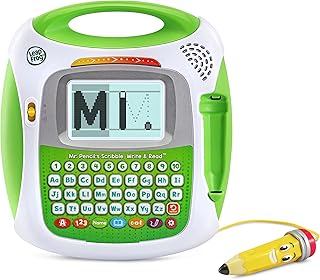
The Leapfrog Mr. Pencil’s Scribble, Write & Read is the pick here for parents who want their child to move from recognising letters to actually forming them—a step that surprisingly few electronic toys tackle directly. With 468 verified reviews at 4.7 stars, it carries the strongest review base of any product in this shortlist and the highest rating among those with substantial buyer feedback.
The design centres on a stylus character—Mr. Pencil—who guides children through structured writing activities. Rather than rewarding any tap or swipe, the activities teach letter formation technique: where to start a stroke, which direction to move, and how individual letters connect into words. That makes it meaningfully different from a standard alphabet-button toy, where pressing “B” and hearing “bee!” is the entire educational arc. Here, children practise a genuine motor skill alongside the literacy content.
Buyers consistently report that children aged three to five engage with this toy in longer, more focused sessions than with simpler light-and-sound alternatives. The activity scope spans reading recognition, spelling, letter tracing, and—at the upper end of the age range—early writing practice. That breadth matters: a toy that challenges a child across 18 to 24 months of development represents better long-term value than one that plateaus after a few weeks of novelty.
The honest tradeoffs: this toy is not designed for young toddlers. Under two and a half, most children won’t have the motor coordination to use the stylus with purpose, and the structured activities may produce frustration rather than reward. The writing surface takes reasonable daily punishment—parents in the reviews note it holds up well—but the format is intentionally structured, which suits some children and puts others off. One recurring note in reviews is that the volume ceiling isn’t especially high, which can be an issue in noisier households. For most family environments, though, the audio is clear and appropriate.
If literacy is your priority—specifically bridging the gap between letter recognition and writing readiness—this is the most targeted, well-validated option in the current Amazon UK catalogue at this price tier. It fits best in a household with a child between three and five who already shows some interest in scribbling or mark-making.
Best 2-in-1 Laptop-Tablet for Ages 1-3
The Yeeammk 2-in-1 Kids Laptop and Tablet sits at the younger end of the spectrum, designed specifically for children aged one to three—an age bracket where the challenge is as much about physical engagement as educational content.
The 2-in-1 format has practical appeal at this age. Younger toddlers tend to prefer the flat tablet configuration for tapping and touching, while slightly older children often enjoy the laptop-style clamshell setup that mimics what they see adults using. The device includes over 120 activities across four play modes, along with more than 70 quiz questions, lights, and music feedback. That breadth gives it more developmental range than single-mode toys—children can return to it at different stages and find different content to engage with.
Transparency is important here: at time of review this product has seven reviews, all rating highly, producing a 5.0-star average. That’s a promising early signal—not the same as 400 reviews at 4.7 stars. The top score may reflect real quality, but it hasn’t been tested across the range of household conditions, age variations, and use cases that higher-reviewed products have absorbed. If a substantial review body matters to your decision, this product isn’t there yet. If you’re comfortable with a smaller evidence base for a well-specified product, the feature set at this price tier is competitive.
The activities cover the foundational areas expected at this age: letters, numbers, colours, and shapes. The lights and music responses keep very young children engaged without relying on a full screen—this is more of a physical learning toy than a children’s tablet, and that distinction matters for parents managing screen time. The stated age range of one to three is narrow and specific, which is usually a positive indicator that the design was targeted rather than artificially broadened.
The main limitation is limited durability data, given the small review pool. For children aged one to two, any toy needs to survive being dropped, chewed, and stored under a cushion. The design appears robust, but the evidence base is thin. One practical note: check what batteries the device requires and stock up before wrapping it as a gift—few things deflate birthday morning faster than a toy that needs AAs you haven’t got.
Best Screen-Free Phonics Toy
If you’re managing screen time carefully but still want an interactive electronic learning experience, the JoyCat Kids Learning Tablet is worth serious attention. Despite the “tablet” name, this is a screen-free device that works with 156 pages of physical tap-to-read flash cards—children insert card pages and interact by touching illustrated areas, with the device responding through audio.
Each flash card page covers a specific theme—numbers, letters, animals, shapes, food, transport, and more—and touching a word or image triggers an audio response. The product description lists over 40 themes and more than 600 words across the full card set, alongside 20 built-in interactive games covering alphabet recognition, phonics, word building, and vocabulary development. At 105 reviews and 4.6 stars, it has a credible and consistent review base for a product at this price tier.
The tap-and-respond mechanism supports self-directed discovery rather than rote repetition. Children choose which card to explore, touch what interests them, and get an immediate audio reward. That loop—curiosity, action, response—mirrors how young children naturally investigate their environment, and for children aged two to six it helps sustain engagement across a wider developmental range than most single-mode toys manage.
The practical downside is card management. With 156 pages of flash cards, keeping the set complete becomes an ongoing organisational task. Cards can bend, go missing, or get chewed, and a partially complete set narrows the learning coverage. Several buyers mention keeping the cards in a small folder or zip pouch from day one—that’s sensible advice worth acting on immediately. Audio quality is reported positively in reviews, but like most electronic learning toys, it performs better in reasonably quiet environments than alongside a loud television or in a busy kitchen.
For families with children in the two-to-five-year window who are actively working on phonics and early reading, this is the most curriculum-aligned screen-free option in this shortlist. It works particularly well for children who already show curiosity about letters and words—the responsive format rewards that curiosity quickly. Used alongside the phonics reading schemes common in UK primary schools, it provides a useful home reinforcement tool that doesn’t add to overall screen time.
Best All-Round Toddler Electronic Toy
The Toddler Toys for Girls Age 1 2 3 4 occupies the broad middle ground of the electronic learning toy market: designed for children aged one to four, covering multiple learning areas without drilling deep into any single skill. With 230 reviews averaging 4.6 stars, it has the largest verified review base of any generic-format product in this shortlist—a solid signal that it consistently meets buyers’ expectations in real households.
At this end of the market, products like this typically combine lights, sounds, and music responses with activities covering colours, shapes, numbers, and basic vocabulary. The value is in versatility rather than specialisation. A one-year-old will interact with this toy as a sensory object—pressing buttons to trigger sounds and lights—while a three-year-old will begin engaging with its actual educational content. That developmental span is useful if you have children at different ages, or if you want a single toy that remains relevant across a child’s early years without needing replacement every few months.
With generic electronic learning toys, the key differentiator between a 4.6 and a 3.8 rating is almost always audio quality and response speed. If buttons lag or speakers distort at higher volumes, toddlers lose interest quickly—and parents leave negative reviews to say exactly that. The score here suggests neither issue is significant, which is the clearest available evidence that the build quality clears the threshold for daily use by young children.
The honest limitation is depth. If you have a specific learning goal in mind—writing practice, phonics progression, early maths—this toy won’t deliver the targeted rigour of the more specialised options on this list. It’s a reliable general learning companion rather than a curriculum tool. For a birthday or Christmas gift for a toddler you don’t know especially well—a cousin, a neighbour’s child—it’s a safe and well-reviewed option that parents are unlikely to return. For your own child with identified learning priorities, the LeapFrog or JoyCat picks will serve better.
One practical note: electronic toys at this price tier almost universally run on AA or AAA batteries rather than built-in rechargeable options. Factor the ongoing battery cost into your assessment of overall value; if the toy sees daily use, a set of rechargeables will pay for itself quickly.
Best Budget Pick
The 1-2-3 Year Old Girl Boy Gifts Toddlers Learning Toys is the most accessible option in this guide by price, aimed at children aged one to four and designed for both boys and girls. With 113 reviews at 4.1 stars, it’s reasonably received for a budget product—though the rating deserves honest context rather than a simple “good enough” summary.
A 4.1-star average is worth reading carefully. Products in the 4.0–4.2 range often have a bimodal review distribution: a solid cluster of five-star reviews from buyers whose children engaged enthusiastically, and a meaningful tail of one- and two-star reviews citing inconsistent build quality, audio issues, or batteries that fail faster than expected. That pattern doesn’t mean the product is bad—it frequently signals greater variability between individual units, or a mismatch between some buyers’ expectations and what the toy actually delivers. At a budget price point, some degree of variability is standard rather than exceptional.
Where this type of toy collects its stronger reviews is in straightforward engagement for younger toddlers: bright lights, responsive buttons, cheerful sounds, and large contact areas that work even with imprecise pressing. For a one-to-two-year-old in the early phase of button-pressing discovery, the core loop of “I did something and something happened” is developmentally meaningful, and this type of toy delivers that loop reliably. Parents buying a first electronic toy for a baby who has recently become mobile and curious will likely find it meets that brief well.
The honest tradeoffs: don’t expect the curriculum depth of the LeapFrog or JoyCat options. This is a sensory-engagement toy with educational framing rather than a structured learning device. At the upper end of its stated age range—a four-to-five-year-old—children will outgrow it fairly quickly. Build quality at this price tier also tends to vary; some buyers report buttons that stop registering reliably after a few months of heavy use.
For a first birthday or Christmas gift where budget is a real constraint, this covers the bases adequately. If your child is already two and a half or older, spending a little more for the JoyCat or the toddler toy above will buy noticeably more durable construction and more engaging content at that developmental stage. Think of this as a starter toy: effective for the early button-pressing phase, but with a shorter useful life than mid-range alternatives.
What to Look For in an Electronic Learning Toy
- Age-range honesty: Listings claiming “suitable for 1–6 years” are typically broadening appeal rather than reflecting accurate usability. Check what the actual activities involve—if they require writing, counting beyond ten, or multi-step sequences, a one-year-old won’t engage with them meaningfully. Narrower, more specific age ranges are usually a sign the design was genuinely targeted rather than stretched for marketing purposes.
- Curriculum scope versus depth: A toy covering letters, numbers, colours, shapes, and animals all at once offers breadth but shallow depth in each area. If you have a specific learning goal—phonics, early writing, number skills—look for a toy built around that skill rather than a broad “educational” label that could describe almost anything on the shelf.
- Audio quality: Legibility of spoken words is particularly important for phonics and vocabulary toys. Look for reviews that specifically comment on sound. Multiple reviewers noting “hard to hear what it’s saying” or “too quiet” is a meaningful warning, especially for phonics-focused products where mishearing a word undermines the learning loop entirely.
- Screen versus screen-free: Flash-card-style and button-press toys offer electronic interactivity without a display. If you’re managing total screen time carefully, this category opens up well-designed options with audio-response engagement but no visual screen. Screen-based toys offer richer visual content and more complex interactions but typically require more active parental oversight of duration and content.
- Battery type and charging: Most toys in this category use AA or AAA batteries. Check how many the toy requires and whether reviews mention battery life. Toys with USB-C or Micro-USB charging are more convenient for daily-use items; if a toy requires disposable batteries, factor in the cost of a set of rechargeables from the outset.
- Review depth over headline score: A 4.7-star average from 450 reviews tells you significantly more than a 5.0 from seven reviews. Reading a sample of three-star reviews specifically is the most reliable way to find balanced assessments of where a toy performs well and where it disappoints after a month or two of real use.
- Growth potential: The best-value electronic learning toys have layered content—activities that challenge a two-year-old differently from a four-year-old on the same device. Look for multiple modes, adjustable difficulty, or progressive content that justifies keeping the toy past the initial novelty window.
Our Verdict
For most UK families with a child aged three to five, the Leapfrog Mr. Pencil’s Scribble, Write & Read is the clearest recommendation from this shortlist. It’s the only option here that treats writing as an active skill to practise—not just letter recognition, but the physical process of forming letters correctly—and it backs that purposeful design with the most substantial review evidence in the guide (468 reviews at 4.7 stars). That combination of specific educational intent and genuine buyer validation is difficult to match at this price tier.
If your child is younger—one to three years—the Yeeammk 2-in-1 Kids Laptop and Tablet is worth tracking, though its limited review base means you’re accepting some uncertainty. For families prioritising phonics and wanting to avoid additional screen time, the JoyCat Kids Learning Tablet offers a well-structured, screen-free option with a credible review body behind it. The Toddler Toys for Girls Age 1 2 3 4 is the right pick for gift-giving situations where you need something broadly reliable; the 1-2-3 Year Old Girl Boy Gifts Toddlers Learning Toys fits best as a starter toy for a baby just entering the button-pressing phase on a tighter budget.
If you’re only buying one thing from this list: the Leapfrog Mr. Pencil’s Scribble, Write & Read. Its review depth gives real confidence that it backs up its promise for children in the three-to-five bracket.
We were not paid to feature any specific product in this guide. All opinions are independent and based on publicly available specifications, verified buyer feedback patterns, and category research.
Quick Comparison Table




FAQ
What age are electronic learning toys suitable for?
Most electronic learning toys are designed for children aged one to six, but the right fit depends on the specific toy’s activities. Simple button-and-light toys work well from around 12 months, while writing or phonics-focused devices are better suited to children aged three and above who have developed sufficient fine motor control and attention span. Always match the toy’s actual activities to your child’s current developmental stage, not just their age in years.
Are screen-free electronic learning toys better than screen-based ones?
Neither is categorically better—it depends on your priorities and your child’s age. Screen-free options such as flash card devices and button-press toys avoid visual screen stimulation, which many parents and health professionals prefer for under-twos. Screen-based toys can offer richer visual content and more complex interactions. The most important factor is whether the toy responds specifically to what the child does—active participation—rather than playing content regardless of the child’s input.
How do I know if an electronic learning toy is actually educational?
Look beyond the word “educational” on the packaging—it’s applied to almost every children’s product and means nothing specific on its own. Ask whether the toy responds to what the child does, or plays content on a loop regardless. Toys that teach a defined skill—letter formation, phonics progression, number sequencing—and progress in difficulty as the child improves are more meaningfully educational than those that simply repeat the alphabet song and call it done.
Do electronic learning toys need to be expensive to be effective?
Not necessarily, but the correlation between price and quality is more meaningful in electronic toys than in many other toy categories. Budget electronics are more likely to have audio problems, short battery life, and inconsistent button responses—all of which undermine the learning experience. The most effective option within a given age range isn’t always the most expensive, but budget options tend to have a shorter effective developmental window and less consistent build quality between units.
What’s the difference between a kids’ learning tablet and an electronic learning toy?
A children’s learning tablet is essentially a general-purpose device—a scaled-down adult tablet with educational apps, a touchscreen, and parental controls. Electronic learning toys are purpose-built for specific skills: writing, phonics, early maths. Toys tend to be more physically robust, require no Wi-Fi, and offer more structured educational content; tablets offer far more flexibility and variety but require more active parental oversight of what the child accesses and for how long.
How long do electronic learning toys hold a child’s interest?
This varies by toy design and child temperament, but as a rough guide: toys with multiple modes and progressive difficulty hold interest for three to twelve months of regular use. Single-mode toys with repetitive, limited content typically see engagement drop off within a few weeks once the novelty fades. Reading three-star reviews on Amazon specifically for comments about how quickly interest waned is one of the most reliable ways to gauge this before purchasing.