You’ve decided to learn piano. Maybe it’s a childhood ambition you’ve finally given yourself permission to pursue, or perhaps your child has been asking for months and you’ve caved. Either way, you’ve opened Amazon, typed something like “keyboard piano beginner UK” and been immediately overwhelmed. There are instrument bundles with headphones and benches at suspiciously low prices, 61-key portables that look identical but cost wildly different amounts, and results that mix actual instruments with sheet music books in the same page. You close the tab. You come back tomorrow and do the same thing.
The frustration is real — the beginner keyboard market is genuinely confusing, even for people who know what they’re looking for. Key action, polyphony, bundled accessories, sound quality: none of these are easy to evaluate from a listing photo and a bullet-point spec sheet. And if you’ve never played before, you may not even know which questions to ask. This guide is designed to cut through that noise and give you honest, specific guidance on the keyboards available right now on Amazon UK — and the sheet music resources that will actually help you use them.
How We Evaluated These Picks
The live Amazon UK product set for this category currently contains a mix of beginner keyboards at different price tiers and sheet music resources. For the keyboard instruments, evaluation was based on buyer review patterns and volume (where available), bundled accessory value, key count and action type, speaker quality, and suitability for the intended audience. For the sheet music picks, we looked at reviewer feedback patterns, arrangement difficulty, and whether the content genuinely serves someone learning at home on a beginner keyboard.
Two keyboard products in this set — the Alesis Melody 61 and the Alesis 88 Key — currently show zero UK buyer reviews. We’ve included them because they are legitimate products from an established brand and offer distinct value propositions (full 88-key range in particular is unusual at this tier), but we flag that absence of review data clearly. Our Verdict reflects only instruments with meaningful buyer feedback. For sheet music, three of the four books carry substantial review counts and those form the backbone of our recommendations in that category.
Best Entry-Level Keyboard Bundle: Casio CT-S100AD
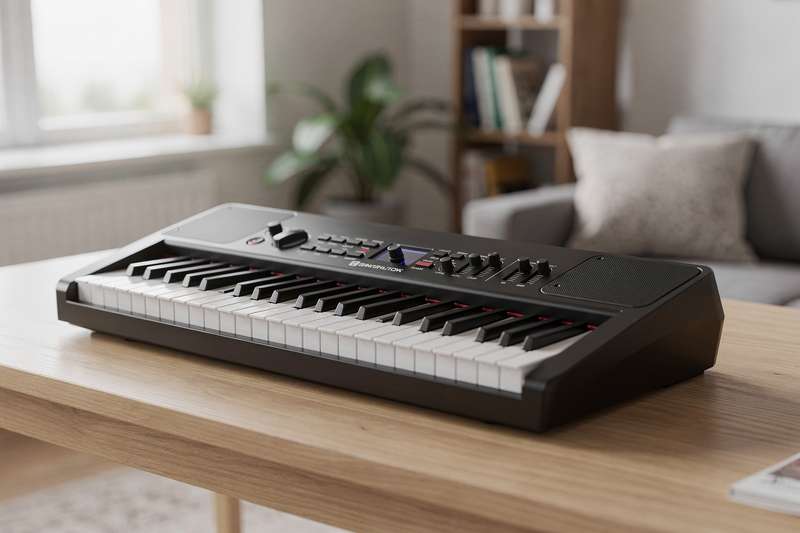
If you want one keyboard that just works straight out of the box, the Casio CT-S100AD 61 Key Portable Electronic Keyboard is the most consistently praised beginner instrument currently available on Amazon UK in this set, and it earns that position honestly. With 399 UK buyer reviews and a 4.6/5 rating, it’s the only keyboard here with enough feedback to identify genuine patterns — and those patterns are largely positive.
The CT-S100AD comes with an AC adapter included, which sounds like a small thing until you realise how many budget keyboards ship without one and expect you to run on batteries. The 61-key layout covers everything a beginner needs: it’s wide enough to learn both hands and basic chord progressions without feeling cramped, and compact enough to sit on a desk or a portable stand. The keys are unweighted (touch-sensitive, not hammer-action), which is standard at this price point and fine for building early technique — though if you’re serious about progressing to an acoustic piano eventually, you’ll want to upgrade to a weighted action within a year or two.
Casio’s sound quality at this tier is decent. The CT-S100AD won’t fool anyone into thinking it’s a concert grand, but the piano voices are usable and the speaker output is adequate for a small room. The bundled access to Rhythm Warriors animated online lessons is a genuinely useful addition for complete beginners — interactive lesson content removes the barrier of not knowing where to start. Reviewers consistently mention that children take to this quickly, and that adult beginners find it approachable without feeling patronising.
Where the CT-S100AD struggles is depth. Experienced players or anyone progressing quickly will find the feature set limiting. There’s no weighted key action, polyphony is limited compared to more expensive instruments, and the built-in sounds, while adequate, aren’t the reason you’d buy this. It’s also worth noting that 61 keys covers most beginner repertoire but excludes some pieces that use the full upper or lower register. For what it is — a well-supported, reliable beginner instrument from a reputable brand — it’s the safest recommendation in this category.
Best Ultra-Budget Starter: Shayson Electronic Keyboard Piano 61 Keys
If the Casio sits above your budget, the Shayson Electronic Keyboard Piano 61 Keys with LED Light is the alternative at the more accessible end of the market. It carries 164 UK reviews and a 3.9/5 rating — lower than the Casio, and that gap in rating is meaningful rather than cosmetic.
The LED light feature is the headline differentiator here. Keys illuminate to show you where to place your fingers, which is genuinely useful if you’re learning completely by ear or working through colour-coded beginner sheet music (the Play by Color book reviewed below pairs naturally with this). It also comes bundled with a microphone, sheet music stand, and piano notebooks — a lot of physical kit for the price. For a child’s first exploration of a keyboard, or for someone who just wants to noodle around without any serious commitment, that bundle value is hard to argue with.
The tradeoffs, though, are real. A 3.9 rating from 164 reviewers suggests a meaningful minority of buyers encountered issues — common themes in lower-rated instruments at this tier include inconsistent build quality, keys that feel plasticky, and sound output that lacks warmth. The Shayson is not an instrument you’d buy for a motivated learner who’s going to practise daily; it would likely frustrate them within a few months. It’s better framed as a casual entry point: something to confirm genuine interest before investing in a more capable keyboard.
The microphone inclusion is a fun novelty but largely irrelevant to keyboard learning. Don’t let it skew your decision — evaluate this instrument on its playing quality, not its accessories list. If you find yourself using it regularly after a month, that’s your cue to upgrade to the Casio or consider a model with weighted keys entirely.
Best 88-Key Bundle (No UK Reviews Yet): Alesis 88 Key Keyboard Piano
The Alesis 88 Key Keyboard Piano with 480 Sounds, Speakers, USB MIDI, Carry-Bag, Stand, Headphones, Pedal and Piano Lessons for Beginners occupies a genuinely different category from the two keyboards above — 88 keys is the full piano range, which matters more than most beginners initially appreciate.
First, the honest caveat: this listing currently carries zero UK buyer reviews. That means we cannot cite buyer experience patterns, and we’d encourage you to check whether reviews have appeared since this guide was written. Alesis is an established American instrument brand with a long track record in entry-level electronic instruments, and the specification of this bundle is impressive on paper — 480 onboard sounds, a sustain pedal, headphones, carry bag, stand, and built-in lessons all included in a mid-range package.
The 88-key range matters if you’re learning with any degree of seriousness. A significant chunk of classical piano repertoire and even many pop arrangements use keys outside the 61-key range. If you’re an adult learner who knows they’re committing to this properly, starting on 88 keys means your instrument won’t become a bottleneck the moment you try to learn a full piece. The USB MIDI connectivity is also valuable — it means you can connect the keyboard to a computer and use software like GarageBand or free learning apps, which significantly expands both your learning options and your creative possibilities.
The keys on this model are described as semi-weighted, which is a meaningful step up from the fully unweighted synth keys on the Casio and Shayson. It’s not true hammer action, but semi-weighted keys have more resistance and begin to build the finger strength that acoustic piano playing requires. For the step between casual exploration and genuine practice, this is a reasonable place to be. Approach with eyes open given the lack of UK review data, but if you want the full keyboard range and a substantial accessory bundle, this is the most fully-specified instrument in this category right now.
Best Beginner Bundle with Accessories (No UK Reviews Yet): Alesis Melody 61
The Alesis Melody 61 Keyboard Piano for Beginners with 61 Keys, Speakers, Stand, Bench, Headphones, Tablet/Sheet Music Stand, 300 Sounds and Music Lessons is the most accessory-complete bundle in this roundup. If you’re buying a keyboard for a child or a complete beginner who needs everything in one delivery, this bundle removes every logistical excuse — you get a keyboard stand, a padded bench to sit at, headphones, a dedicated tablet or sheet music stand, and headphones, all alongside the instrument itself.
As with the Alesis 88 Key above, this listing currently has no UK buyer reviews, so we’re working from specifications and Alesis’s general brand reputation rather than verified buyer experience. That’s an important caveat. The 61-key layout keeps this in beginner territory, and 300 onboard sounds is a solid library for the price — more than enough variety to keep early learners engaged without being overwhelmed.
The bundled bench is worth singling out. Beginners often overlook seating, then wonder why their back hurts after twenty minutes of practice. Having a purpose-built piano bench that positions you at the right height relative to the keys makes a real difference to posture and technique from day one. Most keyboards at this price point make you source your own seating, so this inclusion is practically valuable rather than just a marketing tick.
The 61-key range shares the same limitation as the Casio — you’re not getting the full piano spectrum. But for a beginner who’s going to spend the first six to twelve months on scales, chord shapes, and simple melodies, 61 keys is entirely adequate. Once again: if reviews have emerged since publication, check them before committing. If the rating holds up, this bundle offers strong all-in-one value for absolute beginners.
Best Sheet Music for Visual Learners: Play by Color Piano and Keyboard Songs for Beginners
Moving into the sheet music resources that appeared in this product set, the Play by Color: Piano and Keyboard Songs for Beginners with Colored Notes (including Christmas Sheet Music) is specifically designed for people who find standard musical notation intimidating. With 308 UK reviews and a 4.2/5 rating, it has a clear and reasonably happy audience.
The concept is straightforward: notes are colour-coded, and if your keyboard or a sticker set maps the same colours to the same keys, you can play recognisable songs before you’ve learned a single note name. That’s a confidence builder, and confidence is what keeps beginners practising through the early weeks when progress feels slow. The Christmas sheet music inclusion makes this particularly popular as a gift purchase — parents buying this alongside a beginner keyboard in November or December will find immediate repertoire to work through.
The limitation is the ceiling. Colour-coded learning is a scaffold, not a foundation — if you rely on it too long, you delay learning to read standard notation, which is what eventually opens up the full world of written music. Use this book as a motivational bridge, not as your primary learning method. Pair it with a structured course or tutor who introduces notation in parallel, and you’ll get the best of both approaches.
Best Sheet Music for Mixed-Level Learners: 100 of the Best Songs Ever! For Keyboard
For anyone past the very early stages who wants a comprehensive song collection to work through, the 100 of the Best Songs Ever! For Keyboard — Easy to Intermediate All-Keyboard Sheet Music Collection for Students Teachers and Adult Learners is the most practically useful sheet music book in this set. It carries 114 UK reviews and a 4.5/5 rating — strong satisfaction from a broad audience.
The easy-to-intermediate difficulty range is the key appeal. This isn’t a book of simplified nursery rhymes, nor is it demanding classical repertoire that will defeat a self-taught learner. It sits in the productive middle ground where you’re challenged enough to improve but not so challenged that you give up. The song selection spans genres and decades, which matters for maintaining motivation — if you’re a fifty-year-old learning to play songs you actually love, a book that includes standards, pop classics, and timeless melodies will keep you at the keys far longer than a methodical exercise book.
Adult learners and teachers consistently mention this collection in reviews for its breadth. If you’re learning independently and don’t have a teacher setting you specific pieces, having 100 arranged songs means you can follow your curiosity rather than grinding through the same three beginner pieces on repeat. It’s also a useful resource for teachers working with students at different points in their learning — the difficulty spread means a single book covers several months of lessons.
Best Graded Exam Repertoire: The Best of Grade 4 (Piano)
For learners progressing through the Associated Board of the Royal Schools of Music (ABRSM) grade system, the The Best of Grade 4 (Piano) is a standout resource with the highest rating in the sheet music group — 4.8/5 from 60 UK reviews. That rating from a smaller but clearly engaged group of buyers reflects genuine quality.
Grade 4 is the point at which piano learning starts to feel musically rewarding in a serious way. You’re no longer just playing scales and short exercises — Grade 4 repertoire includes genuine pieces with character, dynamics, and technical demands that feel like actual music rather than practice drills. This collection gathers the best pieces from across multiple years of ABRSM Grade 4 syllabi, which means you get a broader selection than any single year’s exam list provides.
This book is not for beginners — if you’re at Grade 4, you’ve been playing for at least two to three years and you know it. But it belongs in this guide because a significant proportion of people buying a keyboard or digital piano in the UK are either returning to the instrument after a break or buying for a child who’s already progressing through grades. If that’s your situation, this collection gives you high-quality, properly edited repertoire at a genuinely useful level. The ABRSM editorial standards ensure the notation is accurate and the editorial markings are useful — something that’s not always guaranteed in cheaper sheet music collections.
What to Look for When Buying a Beginner Keyboard or Piano
- Key count: 61 keys suits most beginners and covers the vast majority of beginner and intermediate repertoire. 88 keys is the full piano range and future-proofs you against needing to upgrade — worthwhile if you’re committed to progressing seriously. Anything below 61 keys restricts your learning options quickly.
- Key action: Unweighted (synth-action) keys are the norm at entry level and are fine for absolute beginners. Semi-weighted keys add resistance and are better for building technique. Fully weighted hammer-action keys replicate an acoustic piano most closely and are worth seeking out if your budget allows — they make transitioning to an acoustic piano much easier later. Never buy a keyboard with non-touch-sensitive keys; velocity sensitivity (how hard you press affecting the volume) is basic and essential.
- Polyphony: This refers to how many notes the keyboard can produce simultaneously. 32-note polyphony is the bare minimum; 64 or 128 is much better. Low polyphony causes notes to cut off mid-sustain when you’re playing with the pedal, which sounds wrong and breaks your concentration.
- Built-in sounds and speakers: For home practice, built-in speakers are necessary unless you’re always going to play through headphones. Wattage matters for volume and clarity — anything under 2W per speaker will be thin in a normal-sized room. More built-in sounds are nice but not essential; what matters is that the core piano sound is convincing enough not to annoy you.
- Bundled accessories: A sustain pedal, headphones, music stand, and stand or bench are all things you need. Buying them separately adds cost quickly. Assess what’s bundled and compare like-for-like — a keyboard that includes a stand and bench at a mid-range price may represent better overall value than a bare instrument at a lower price.
- Connectivity: USB MIDI connectivity allows you to connect the keyboard to a computer or tablet and use it with learning software, DAWs, or interactive apps. This significantly expands your learning options and is worth prioritising if you’re comfortable with technology. A headphone output is essential for quiet practice — make sure any keyboard you buy has one.
- Brand and warranty support: Established brands like Casio and Alesis have better parts availability and customer service infrastructure than unknown brands. At the budget end of the market, brand reputation is one of the few proxies for reliability you have — review counts and ratings are the other.
Verdict
For the majority of people reading this guide — a UK adult or parent buying a first keyboard for a beginner — the Casio CT-S100AD is the clearest recommendation. It’s the only keyboard in this set with meaningful UK buyer data (399 reviews, 4.6/5), it comes from a brand with genuine piano heritage, the AC adapter is included, and the bundled online lessons address the “but where do I start” problem that stops many beginners making progress.
If you know you’re committed and want the full 88-key range from the start, the Alesis 88 Key bundle is worth considering once it accumulates more UK reviews — the specification is strong and the accessories are comprehensive. Hold off if you need the reassurance of verified buyer feedback.
For sheet music, pair whichever keyboard you choose with the 100 of the Best Songs Ever! For Keyboard if you’re past the very first week, or the Play by Color book if you want a colourful confidence-builder before tackling notation. If you’re buying for a child progressing through ABRSM grades, The Best of Grade 4 is excellent — but only if they’re genuinely at that level.
Don’t overthink the first keyboard. Buy something with reliable reviews, from a known brand, with touch-sensitive keys. Play it regularly. Then upgrade when you outgrow it — and you’ll know exactly what you need the second time around.
We were not paid to feature any specific product in this guide. All opinions are independent and based on publicly available specifications, verified buyer feedback patterns, and category research.
Quick Comparison Table


FAQ
Is 61 keys enough to learn piano properly?
For the first year or two of learning, 61 keys covers almost everything you’ll encounter — scales, chords, beginner and intermediate pieces, and most popular song arrangements. You only start to feel limited when you tackle classical repertoire or full piano arrangements that use the extreme ends of the keyboard. If you know you’re serious about progressing to that level, starting on 88 keys saves you a future upgrade.
Do I need weighted keys as a beginner?
You don’t strictly need them to start, but they help. Weighted or semi-weighted keys build finger strength and touch sensitivity in a way that unweighted synth keys don’t. If you ever intend to play an acoustic piano, or sit down at a keyboard and have your playing sound natural, starting on at least semi-weighted keys means you won’t have to unlearn bad habits later. At the entry level, touch-sensitive (velocity-sensitive) keys are non-negotiable — weighted action is a bonus.
Can I learn piano without a teacher using these keyboards?
Yes, and many people do — especially with the availability of YouTube tutorials, interactive apps like Simply Piano or Flowkey, and structured online courses. A keyboard with USB MIDI connectivity lets you use these apps with direct feedback. That said, a teacher catches technique problems early (posture, finger position, tension) that apps can’t spot. Even a few lessons at the start to establish good habits is worthwhile if you can access them.
What is polyphony and why does it matter for beginners?
Polyphony is the number of notes a keyboard can sound simultaneously. When you hold the sustain pedal down, notes continue ringing while you play new ones — low polyphony means the keyboard has to cut off older notes to play new ones, creating an unnatural, clipped sound. For a beginner playing simple melodies, 32-note polyphony is survivable. For anything more complex, 64 or 128 is noticeably better and worth seeking out.
Should I buy a bundle or just the keyboard on its own?
Bundles make sense at the beginner level because you genuinely need the accessories. A stand to position the keyboard at the right height, a sustain pedal for expressive playing, and headphones for quiet practice are all things you’ll use from week one. Buying them separately is more expensive and more effort. The main risk with bundles is that included accessories are sometimes lower quality than standalone equivalents — but for beginner use, they’re generally adequate.
Are sheet music books still useful when there are so many free online resources?
Yes, for two reasons. First, a well-edited physical book sits on your music stand without requiring a charged device, Wi-Fi, or a screen competing for your attention. Second, curated collections from reputable publishers have been properly edited — notes are accurate, fingering suggestions are practical, and the arrangements are idiomatic. Free resources online vary enormously in quality. A good sheet music book is a one-time cost that you’ll use for years, and it doesn’t have a subscription fee.