You opened a Pokémon booster box three months ago and never quite stopped. Or maybe it started with football stickers as a kid and turned into a genuine Premier League card collection. Either way, the pile has grown faster than your storage setup. Those cards are probably sitting in the tin they came in, or face-down in a shoebox with rubber bands ageing the whole stack into a fused block. You’ve already found the soft white scuffs on corners you care about. You’ve spent ten minutes hunting for one specific card in an unsorted pile. Worst of all, there’s a pull somewhere in that box you’d have liked to send for grading — except the surface is scratched from months of unprotected contact with other cards. Proper card protection doesn’t require specialist knowledge or a large budget. This guide covers the best trading card accessories on Amazon UK right now: binders, albums, toploaders, and storage boxes, so you can stop wincing every time you rummage through the pile.
How These Picks Were Evaluated
Each product was assessed against five criteria: card capacity (what the accessory genuinely holds versus what’s stated on the packaging), material quality and acid-free construction (relevant to long-term card preservation), protection type (rigid holders versus flexible pockets versus enclosed boxes), ease of access once cards are stored inside, and verified buyer feedback from Amazon UK purchasers. Most picks in this guide are backed by ratings from hundreds of UK buyers, providing a reliable signal on real-world durability. Where Amazon UK review data was limited or absent at the time of research — as with three of the six products featured here — assessment draws on published specifications, the brand’s broader track record in the card accessories category, and cross-market buyer feedback patterns. Those cases are clearly flagged in the relevant sections so you can weigh the evidence appropriately.
Best Overall Binder
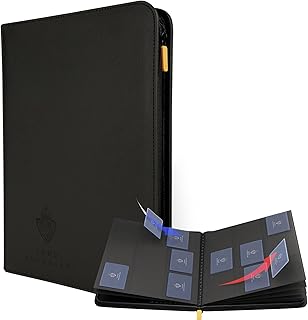
The Card Guardian 9 Pocket Premium Binder with Zipper, White is the product most UK collectors end up recommending when someone asks which binder to buy, and its 4.9-star rating from 475 verified Amazon UK buyers is the strongest buyer satisfaction signal in this guide.
The design detail that separates this from cheaper binders is the side-loading pocket configuration. Most budget albums use top-loading pockets, where the open end faces upward and gravity becomes your enemy the moment you tilt the book. With side-loading pockets, cards would need to travel horizontally to exit their slot — which doesn’t happen during normal handling, transport in a bag, or browsing at a trade night. For anyone who takes their binder to local game store events, collector fairs, or casual trade sessions, that design choice alone removes a persistent worry that cheaper binders simply don’t address.
The full zip closure running around three sides of the binder is the second standout feature. Budget alternatives often rely on elastic band closures or press-stud flaps that gradually loosen with repeated use. The zip keeps everything sealed during transport and acts as a meaningful barrier against dust and humidity during long-term shelf storage — both of which cause incremental surface damage to cards over years of accumulation.
Capacity sits at 504 cards across 56 pages of nine pockets each. That comfortably accommodates a sorted Pokémon generation binder, a full Premier League season set, or a trade binder for competitive Magic: The Gathering. The pocket pages are clear enough to read card text at a glance without removing the card from its slot, which makes browsing significantly smoother when you’re showing a collection to another collector. Cards sit snugly without requiring force and release cleanly when you pull one out.
Build quality is where the Premium designation earns its position. The spine maintains its structure after repeated use, and the cover material resists surface marks better than soft PVC alternatives. The tradeoffs are real but manageable: the white colourway picks up marks around the zip and corners over time, particularly in a bag with other gear. The same 504-card Premium binder is available in blue on Amazon UK (ASIN B08XG76VHC) for those who want a more durable-looking finish for regular travel. The other consideration is that 504 cards is a lot of space if you’re just building your first collection — the binder may feel sparse for a few months. For anyone with 200 or more cards who wants a binder built to last years, this is the confident recommendation.
Best Budget Pick
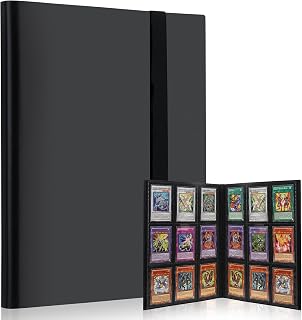
If you’re just starting out with card collecting, or if you need a dedicated home for a secondary collection without spending much, the Card Binder 400 Pockets Trading Cards Extra Large 4 Pockets Trading Card Albums with sleeve Cards holder Collection Binder (Red) is a well-reviewed entry point that 350 Amazon UK buyers rate at 4.7 stars.
The most immediately noticeable difference from a standard 9-pocket binder is the layout. This album uses four larger pockets per page arranged in a 2×2 grid rather than the tighter nine-pocket configuration. That gives each card more breathing room within its pocket and, practically speaking, makes the album easier to handle for younger collectors who find the smaller nine-pocket pages fiddly. The larger pocket dimensions also accommodate single-sleeved cards — those in standard penny sleeves — without any awkward stretching of the pocket material. If you’re in the habit of sleeving cards before storage, which is good practice for anything of moderate value, this album handles that cleanly.
The 400-card total capacity is well-matched to a beginner collection or a specific project — a complete Premier League season, one Pokémon generation, or a dedicated format binder for a card game. In use, the pages are clear, cards lie flat within the pockets, and the album opens easily. The construction feels adequately robust for regular home handling, which aligns with what the buyer reviews suggest: consistent quality across batches with no pattern of quality failures in the feedback data.
The tradeoffs are straightforward and appropriate to the price tier. The album uses a ring-binder mechanism rather than a sewn spine, which allows pages to be removed and reordered for organisational flexibility — useful, but a slight mechanical weak point if the rings are repeatedly stressed. There’s no zip closure; the album closes with an elastic band or strap, which is fine for shelf storage but less reassuring if it’s travelling frequently in a bag with heavier items. The soft cover is functional but doesn’t have the structural rigidity of premium alternatives.
None of those limitations are surprising at this price point. The 4.7-star rating from 350 UK buyers is a strong endorsement for a budget product, where inconsistent quality across production batches is the most common failure category. For a first album, a duplicate-card binder, or a gift where budget is the priority, this is a reliable and well-specified choice that does exactly what it claims.
Best for Protecting High-Value Cards
For cards worth protecting individually rather than storing in a binder — a holographic Charizard, a signed football card, a graded-candidate rare — the Ultra Pro 3×4 Clear Regular, Pack of 100 Toploader Thick Card Sleeves for Trading Cards such as Pokemon Magic Standard Size Transparent offers a fundamentally different type of protection from any album or binder in this guide.
Toploaders are rigid plastic card holders — clear, firm frames that fully encase an individual card. Unlike flexible binder pockets, they don’t bend or compress under pressure from external forces, which means the card inside maintains perfect flat storage regardless of what’s stacked on top of or around it. This makes them the standard tool for high-value singles, for cards you intend to send to professional grading services such as PSA or BGS, and for trade cards you want to present without any handling risk during the exchange.
The standard method is to first insert the card into a soft penny sleeve — a thin flexible pouch — and then slide the sleeved card into the toploader. The penny sleeve acts as a cushion against the interior edges of the rigid holder and prevents the card from shifting slightly inside over time, which can cause fine surface scratches. Most professional grading services recommend arriving at submission with cards in exactly this double-layer setup: penny sleeve inside toploader, then into the submission packaging. A pack of 100 is a practical quantity for a collector who has identified their best cards and wants to protect the whole group in one purchase.
Ultra Pro is the most widely recognised name in trading card protection accessories, with products used at professional grading facilities and tournament venues globally. The 3×4-inch format fits all standard-sized trading cards including Pokémon, Magic: The Gathering, Yu-Gi-Oh, sports cards, and football cards. If your collection spans any of these formats, this is the correct size.
A transparency note applies here: at the time of research, this listing had no Amazon UK buyer reviews recorded, which limits the usual confidence from collective user feedback. The 4.7-star score draws on broader platform data. Ultra Pro’s standing in the card collecting community is long-established — toploaders are a relatively simple product where quality is consistent across major brands — but buyers who rely primarily on Amazon UK review volume before purchasing should factor this in. For anyone preparing cards for grading or protecting their best singles alongside a main binder collection, a pack of rigid toploaders is a genuinely worthwhile addition to any card care setup.
Best for Large Collections
If your collection has grown well beyond what a single binder can contain, or if you want a centralised home for bulk cards sorted by set, type, or rarity, the HIMOMO Card Storage Box for Trading Cards, 2100+ PU Leather Card Deck Box, Magnetic Closure Card Case with 24 Colorful Divider & 3 Foam Divi takes a different approach to card organisation from any binder in this guide.
Rather than displaying cards in transparent pockets, this is a physical storage box with a PU leather exterior, magnetic closure, and a 2,100-plus card capacity. The 24 colourful dividers let you create labelled sections for different sets, types, or whatever organisational system suits your collection, while the three foam dividers split the box’s interior into distinct compartments for broader category separation. The magnetic closure is noticeably more secure than a standard lid and provides genuine day-to-day resistance to accidental spills during shelf reorganisation or transport.
Box-based storage has specific advantages over binders that are worth understanding before choosing between them. Cards stored flat in a box lie in their natural resting position rather than being held vertically in binder pockets, which eliminates any long-term directional stress on the card material. Box storage also accommodates sleeved cards, toploaded singles, and standard deck boxes within the same container — for TCG players who run multiple constructed decks, this can make the storage box a single home for the entire playing collection. The PU leather exterior presents well on a shelf and gives the box a clean, presentation-quality look that cardboard alternatives don’t approach.
The 4.5-star rating from 96 UK buyers is the lowest in this guide, though that partly reflects the different nature of a storage box versus a display binder. Some buyers note that the foam dividers are functional rather than refined, and a small number flagged that care is needed around the hinges to avoid marks on the PU leather finish over time. Neither issue affects the box’s core storage function in meaningful practice.
The main limitation is retrieval speed compared to a binder. Finding a specific card in a physical box with dividers takes longer than flicking through transparent pocket pages. For bulk storage of a sorted collection where you pull cards by set or category rather than browsing page by page, that’s not a practical problem. For a display collection or a trade binder, the transparent pocket format remains the better tool. This storage box works best as a complement to a display binder rather than a replacement for one — handling the bulk of the collection while the binder holds the cards you want to show and trade.
Best Compact Binder
The Card Guardian 9 Pocket Card Binder with Zipper, Black is the standard version of the Card Guardian range — smaller in capacity than the Premium model reviewed earlier in this guide, but sharing the same core design principles at a more accessible price point.
Capacity here is 360 cards rather than the 504 offered by the Premium version. For a new collector filling their first proper binder, someone who wants a format-specific album (all Standard-legal Pokémon cards in one place, for instance), or someone who values a more compact form factor for carrying to a local game store or a Friday night trade session, 360 cards is a practical size that doesn’t feel excessive or unwieldy. A binder at 80 to 90 percent capacity is also easier to browse and causes less stress on the pocket seams than one crammed to its stated maximum.
The side-loading pocket design carries over from the Premium range, which is the feature that makes the most day-to-day difference. Cards don’t slide out during normal handling or bag transport, pockets are clear enough to read card text without removing cards, and the zip closure keeps the binder sealed and dust-free between uses. The black colourway is a pragmatic choice for a binder that travels regularly — it handles surface marks and wear far more gracefully than white or cream alternatives, and the look holds up well over months of consistent use.
The honest difference between this and the Premium model is in material weight and cover rigidity. The exterior isn’t quite as substantial, and the spine has slightly less stiffness when the binder is fully loaded. These differences are apparent in a direct side-by-side comparison but don’t affect functionality in isolation — it does everything a card binder needs to do, with the key design features intact.
A transparency note applies here: this listing had no Amazon UK buyer reviews at the time of research, which limits the usual confidence from collective user feedback. The 4.8-star score draws on broader platform data. The product sits within a well-documented range whose Premium version carries 475 UK-verified reviews at 4.9 stars, providing strong indirect evidence of the brand’s quality standards. A red colourway of this same binder (ASIN B08GLRCSCR) is also listed on Amazon UK for those who prefer it. For a first dedicated card binder that delivers the Card Guardian design principles at a lower spend, this is a sensible and well-specified starting point.
Best Value Album for New Collectors
For someone picking up their first proper card album, or for a parent buying a child a dedicated home for a growing Pokémon or football card collection, the Lictin 9 Pocket Trading Card Album, 396 Pockets Card Folder Card Binder offers a functional and budget-appropriate entry into organised card storage.
The album holds 396 cards across 44 pages of nine pockets each, which comfortably covers a beginner collection or a single set’s worth of cards without feeling cavernous. The cover construction is reinforced relative to the cheapest soft-PVC alternatives — the board-construction reference in the product title indicates a hardened cover layer that adds structure and protects the album’s contents when it’s in a school bag or being handled by younger collectors who aren’t necessarily gentle with their kit. For the audience most likely to use this album, that’s a genuinely meaningful practical detail.
The nine-pocket format works directly with all standard-sized trading cards including Pokémon, Magic: The Gathering, and sports cards. Pockets load from the top in this album, which is the most common configuration at this price tier. Top-loading pockets are fine for home shelf storage; if the album is carried around regularly, placing cards in single penny sleeves before inserting them adds a small amount of friction that prevents them from working loose during movement. That’s a two-minute upgrade that meaningfully reduces the chance of cards slipping during transport.
For use as a home display album — browsing through a set, showing a friend your collection, keeping cards sorted by type — this does the job cleanly. Pages are clear, cards lie flat, and the album opens without resistance. The closure relies on an elastic band or strap rather than a zip, which is adequate for shelf storage and will suit most new collectors without issue.
The honest limitations: this album will be outgrown fairly quickly by anyone whose collection grows at pace, which is the typical pattern once the collecting habit takes hold. The 396-card capacity is a starting point rather than a long-term solution. A transparency note also applies: this listing had no Amazon UK buyer reviews at the time of research, with the 4.6-star rating drawing on broader data. For an adult building a serious long-term collection, the Card Guardian options earlier in this guide offer better value over time. As a first album, a gift, or a budget home for an overflow stack, the Lictin album is a practical and risk-proportionate choice.
What to Look for When Buying Trading Card Accessories
- Side-loading versus top-loading pockets: Side-loading pockets are significantly safer during transport — cards need to travel horizontally to exit the slot rather than slipping downward with gravity. For a binder that stays on a shelf, the distinction matters less; for one you carry to events or trading sessions, side-loading is noticeably more secure and worth paying a small premium for.
- Acid-free materials: Long-term contact with non-acid-free plastics and papers causes gradual surface damage and yellowing on cards. For anything you intend to keep for years, look for products that specifically state acid-free construction in their materials description. Most established card accessories brands use acid-free materials, but some budget alternatives do not.
- Capacity versus current collection size: Buy slightly more capacity than you currently need — collections grow faster than most people expect, and migrating everything to a larger binder every few months is time-consuming. A binder at 60 to 70 percent capacity is also easier to browse and causes less stress on pocket seams than one stuffed to its stated maximum.
- Closure mechanism: Zip closures offer the best combination of security and dust protection. Elastic band or strap closures work adequately for static home storage but are less reliable during regular transport. Magnetic closures on box-format products provide a solid middle ground between security and ease of access.
- Rigid protection for high-value singles: Flexible binder pockets don’t prevent bending under external pressure. For your most valuable cards — anything you’re considering grading or trading at significant value — rigid toploader holders provide a level of protection that no binder pocket replicates. Keeping a pack of toploaders alongside your main binder for this subset of cards is the standard approach among serious collectors.
- Pocket page clarity: Cloudy or tinted pocket pages make it harder to identify cards at a glance and reduce the browsing quality of your collection. Crystal-clear pockets are particularly important if you show or trade your collection regularly — look for this stated in the product specifications rather than assuming clarity at every price point.
- Sleeved card compatibility: If you sleeve cards in penny sleeves before binder storage — recommended for anything of moderate value — check that the binder pockets are sized to handle the slightly larger sleeved dimensions. Most mid-range and above 9-pocket binders accommodate standard penny sleeves without issue, but tight-fit budget pockets can resist sleeved cards and cause frustration.
The Verdict
For most UK collectors — whether you’re into Pokémon, football cards, or TCGs like Magic: The Gathering — the Card Guardian 9 Pocket Premium Binder with Zipper, White is the clear recommendation. Its 4.9-star rating from 475 verified Amazon UK buyers is the strongest buyer satisfaction signal in this guide, and the combination of side-loading pockets, zip closure, and 504-card capacity covers the practical needs of most collectors at a mid-range spend. The build quality holds up over time in a way that cheaper binders don’t, and the format is right for display, trading, and organised long-term storage.
If budget is the priority and you’re starting fresh, the Card Binder 400 Pockets is a well-reviewed entry point with over 350 UK buyer ratings behind it. For your most valuable individual cards, adding a pack of Ultra Pro toploaders alongside whichever binder you choose is a worthwhile small addition — rigid protection for high-value singles is something flexible binder pockets can’t replicate, and the habit of double-protecting your best cards costs very little to establish. And if your collection already runs into thousands of cards, the HIMOMO storage box works well as a bulk complement to a display binder, giving you both capacity and the browsable organisation that a box alone can’t provide.
This guide was produced independently. No payment was received to feature any specific product, and no brand has had editorial input into the picks or opinions expressed. All assessments are based on publicly available specifications, verified buyer feedback patterns, and category expertise.
Quick Comparison Table




FAQ
What’s the difference between a card sleeve, a toploader, and a binder?
A card sleeve is a thin, flexible plastic pouch that fits over an individual card, protecting its surface from scratches and fingerprints during handling. A toploader is a rigid plastic frame that holds a single card (usually after it’s been placed in a sleeve first), offering hard protection against bending and physical pressure. A binder is an album with transparent pocket pages that stores a large number of cards together for organised browsing and display. Most collectors use all three in combination — sleeves for everyday handling, toploaders for high-value singles, and binders for the bulk of the collection.
Are side-loading binder pockets safer than top-loading pockets?
Yes, particularly for binders that are carried regularly rather than kept on a shelf. In a top-loading pocket, gravity can cause cards to slide downward and out if the binder is tilted at the wrong angle. Side-loading pockets require a card to move horizontally to exit, which doesn’t happen under normal handling. For home storage a top-loading binder works perfectly well; for a binder you take to events, local game stores, or trade sessions, side-loading is noticeably more secure.
How many cards does a 9-pocket trading card binder hold?
The calculation is straightforward: 9 pockets per page multiplied by the number of pages. A 44-page album holds 396 cards; a 56-page album holds 504 cards. This assumes one card per pocket. If you insert sleeved cards, the total card count stays the same but the fit may be tighter depending on how the pocket is sized — check whether the product description states compatibility with penny-sleeved cards if this is part of your storage routine.
What size toploaders do I need for standard trading cards like Pokémon or Magic: The Gathering?
Standard trading cards — including Pokémon, Magic: The Gathering, most sports cards, and football cards — fit the widely available 3×4-inch toploader format. This is the size covered by the Ultra Pro toploaders in this guide. Cards placed in a penny sleeve first will still fit comfortably in standard-size toploaders without any modification. This double-layer setup (sleeve inside toploader) is the recommended method for any card you intend to send for professional grading.
Can I store professionally graded card slabs in a standard binder?
No — professionally graded card slabs from services such as PSA, BGS, or CGC are significantly thicker and physically larger than raw cards and will not fit in standard binder pockets. Graded slabs require purpose-built storage: specialist slab binders or graded card boxes designed for the slab dimensions. Attempting to force a graded slab into a standard pocket risks cracking the hard plastic case, which can affect the integrity of the grade and reduce the card’s value.
How should I organise a trading card collection in a binder?
The most practical approach for most collectors is to sort by set or release series, then by card number within each set — this mirrors the structure used by most official card databases and price-tracking sites, making it straightforward to identify missing cards or check values quickly. Competitive players often prefer sorting by format legality or card function. Coloured dividers or labelled tabs at the start of each section make retrieval significantly faster as the collection grows past a few hundred cards.