When Your Macarons Keep Sticking, Spreading, or Coming Out Lopsided
You’ve watched the videos, followed the recipe to the letter, and still pulled a tray of cracked, footless, or stuck-fast shells from the oven. It’s one of the most demoralising experiences in home baking — especially when you know the batter looked right going in. You blamed the weather (humidity, fair enough), then the oven temperature, then the resting time. What you probably haven’t examined closely enough is what you’re baking on.
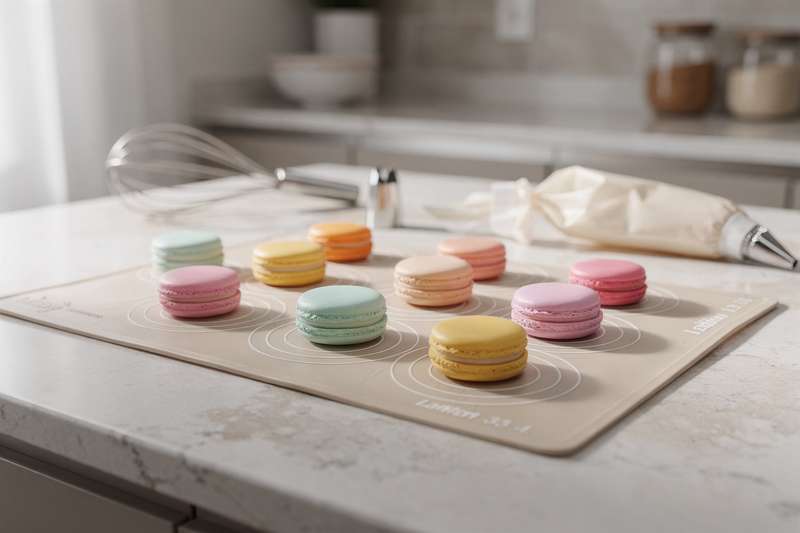
Parchment paper is the default recommendation, and it works — but it moves when you pipe, bunches at the edges, and gives you no guide for consistent sizing. Some bakers try spraying their trays directly; the results are rarely worth discussing. Silicone baking mats designed specifically for macarons solve several of these problems in one go: printed circle guides keep your piped rounds uniform, the surface releases cleanly once the shells have cooled, and the mat sits flat every time. The catch is that not every silicone mat sold as a “macaron mat” actually performs consistently. Some are too thin and warp; others have circle prints that bleed ink after a few washes; others simply don’t release the foot without tearing it.
This guide cuts through that. It’s written for UK bakers who want an honest, practical breakdown of what to look for — and which types of mat are worth buying from Amazon UK right now.
How These Picks Were Evaluated
Each category recommendation here is based on a structured set of criteria drawn from verified buyer feedback patterns, published product specifications, material science basics around food-grade silicone, and category research across baking communities. The criteria used were: mat thickness and fiberglass reinforcement (which affects flatness and heat transfer), circle guide accuracy and legibility after repeated washing, non-stick release performance for delicate macaron shells specifically, tray compatibility with standard UK half-sheet and quarter-sheet pans, heat tolerance relative to typical macaron baking temperatures (140–160°C fan / 150–170°C conventional), ease of cleaning, and overall set value. Picks were selected to cover different baker needs — beginners wanting guided prints, experienced bakers wanting professional-grade release, budget-conscious buyers, and those wanting a complete kit with piping accessories.
Best Overall Value: A Fiberglass-Reinforced 2-Pack Around £10–£15
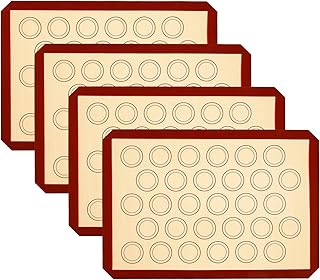
If you bake macarons more than once a month and want a reliable everyday mat without spending much, a well-made 2-pack in the £10–£15 range should be your first port of call. Look for mats measuring approximately 42 x 29.5 cm (16.5 x 11.6 inches), which is the standard half-sheet size that fits most UK oven trays. The template should print 30 macaron halves per sheet — enough for a full batch of 15 finished macarons — with circles sized at roughly 3.5 cm in diameter, which is the classic French macaron target size.
The single most important construction detail at this price point is fiberglass reinforcement. Mats without it tend to curl and lift at the edges during baking, which disrupts airflow underneath and leads to uneven browning. A fiberglass mesh core keeps the mat flat, which in turn keeps the heat reaching the base of your shells consistent across the whole tray. This directly affects whether your macarons develop proper feet — those ruffled edges that signal a well-baked shell. Thin, unstructured mats flex too much and allow localised hot spots.
A good 2-pack at this tier should be oven-safe to at least 230°C (though macaron baking rarely exceeds 160°C, headroom matters for other uses). Non-stick release at the macaron-specific temperature range should be reliable — shells should peel away cleanly after cooling, without tearing the foot. One honest tradeoff: even quality mats at this price can develop slight print fading on the circle guides after 50+ wash cycles. That’s cosmetic rather than functional, but worth knowing. Also, silicone mats do sometimes affect browning on the base of shells compared to bare parchment — some bakers find the base stays paler. If you prefer a darker, crisper base, you may want to bake on a slightly higher oven shelf or use a perforated tray beneath.
A 2-pack is also simply practical — one mat in the oven while the other sits piped and resting at room temperature is a genuine workflow improvement. Avoid single-mat sets at this price; the small saving isn’t worth the bottleneck.
Best Complete Starter Kit: Mats Plus Piping Accessories
If you’re newer to macarons and don’t yet own piping bags, tips, and couplers, buying a kit that bundles everything together makes more sense than purchasing each component separately. You’ll typically find kits in the £12–£18 range that include two half-sheet silicone mats plus six piping tips, two reusable piping bags, bag ties, and couplers. The kit format means everything is sized to work together — the piping tips are appropriate for macaron-sized nozzles (a round tip of around 10–12 mm is standard), and the bags are large enough to hold a full batch of batter.
What to look for in the mats within these kits: the same fiberglass reinforcement mentioned above, circle guides for 30 halves per sheet, and BPA-free food-grade silicone. Some kit mats are slightly thinner than standalone premium mats to keep the price down, so inspect thickness specifications. Around 0.6–0.7 mm is acceptable; below that starts to feel flimsy and may warp over time. The piping accessories are generally functional rather than professional-grade — the tips may be plastic rather than stainless steel — but for someone building their first macaron setup, they’re entirely sufficient.
The real advantage of this format is confidence. Beginners often underpipe because they’re uncertain about nozzle size, or they wrestle with mismatched couplers. Having a matched set removes one layer of friction from an already technically demanding bake. Once you’ve practised your technique and decided macarons are a regular pursuit, you can upgrade individual components without needing to replace the mats.
The tradeoff is that you’re paying partly for accessories you may not need if you already own piping equipment. If you have a decent piping bag and a round tip already, skip this category and spend the extra budget on a thicker standalone mat set instead. Also check that the silicone mats in the kit specify food-safe certification — a few cheaper kits are vague on this point, which is worth scrutinising.
Best for Multiple Tray Sizes: A 3-Pack Including a Quarter-Sheet Mat
Most macaron recipes are written for a standard half-sheet tray, but there are legitimate reasons to want a smaller mat. Toaster ovens, compact UK ovens (common in flats and smaller kitchens), and situations where you want to bake a test batch of just 10–12 shells all call for quarter-sheet coverage. A 3-pack that combines two half-sheet mats with one quarter-sheet mat addresses this without requiring you to buy two separate sets.
The quarter-sheet mat typically measures around 33 x 23 cm and fits proportionally smaller trays. For bakers who use their mats for more than macarons — rolling pastry, making sweets, setting chocolate — the smaller mat is also handy on a countertop as a clean work surface without having to drag out a full-size liner. The three-mat configuration also means you can run a continuous production line during a big bake: two trays in rotation through the oven while one sits resting.
Some 3-packs in this category come in different colours — often cream, blue, or red — which is practically useful if you’re making multiple flavours at once (you can designate one colour per flavour). It sounds minor, but when you have several trays in progress, colour-coding prevents mix-ups. Look for sets that use coloured silicone uniformly throughout the mat rather than just a surface dye, as surface colour can degrade faster with repeated washing.
Construction quality is the watch point here. Adding a third mat to a set at a similar price to a 2-pack sometimes means thinner silicone. Check that the half-sheet mats in the set are at least 0.6 mm thick with fiberglass reinforcement — don’t assume a 3-pack automatically represents better value if the mats are lighter. Reviews mentioning curling or lifting at the edges during baking are a red flag for under-reinforced mats at any price.
Best for Durability and Long-Term Use: The Thick 3-Mat Set
If you bake macarons frequently — weekly or more — the cumulative wear on a budget mat adds up. Circle guides fade, edges start to curl slightly, and the non-stick surface can develop microscopic pitting that makes release less clean over time. The answer is a set built to a higher specification: three mats at approximately 0.75 mm thickness, with a robust fiberglass mesh core and food-grade silicone that maintains its surface integrity through repeated oven cycles.
At 0.75 mm, the mat feels noticeably more substantial. It lies completely flat on the tray without any encouragement, and it doesn’t shift when you’re piping over it. The additional thickness also means the mat acts as a more consistent buffer between the tray and the base of your shells — this can actually help if your oven has hot spots, since the mat smooths out minor temperature variations across the tray surface. That said, this thermal buffering effect is modest; it won’t compensate for a seriously uneven oven without also using an oven thermometer and rotating your trays.
Durability sets rated for a wide temperature range — typically from around -40°C up to 250°C — are worth seeking out if you use your mats for freezing as well as baking. Silicone that’s been certified across this range has generally been tested more rigorously for material integrity. For macaron baking specifically, the oven-side of this spec is what matters: the mat shouldn’t off-gas, warp, or degrade at conventional macaron temperatures.
The tradeoff is price: these sets typically run £14–£20, which is slightly more than a budget 2-pack. That’s reasonable for what you get, but if you’re baking macarons only occasionally, the extra spend isn’t justified. This tier makes sense if macarons are a regular part of your baking repertoire, or if you’ve already burned through a cheaper mat and want something that will last several years of regular use rather than several months.
Best Budget Entry Point: A Basic Circle-Guide 2-Pack Under £12
Not everyone wants to commit significant spend to a product they haven’t tried. If you’re making your first macaron attempts and want to experiment with a silicone mat before deciding whether to invest in a premium set, a basic 2-pack with printed circle guides under £12 is a perfectly sensible starting point. These mats typically match the standard half-sheet dimensions (around 42 x 29.5 cm), include printed guides for macaron-sized circles, and are food-safe and oven-safe to the temperatures you’ll actually use.
What you trade away at this price: the fiberglass reinforcement is either absent or minimal, so the mat may flex slightly and will require care to stay flat on the tray. Placing the mat on a cold, flat baking sheet before piping helps. The non-stick performance is generally adequate for macarons baked at the correct temperature, but if your oven runs hot or you bake above 160°C (fan), you may get more sticking on a thinner mat than you would on a premium one. The circle guides may also be less precisely etched or printed, so sizing accuracy relies more on your own piping eye.
One area where budget mats consistently underperform is longevity. After 20–30 wash cycles, the surface can feel slightly tackier and the printed guides can begin to blur. This doesn’t mean the mat is unsafe — it just becomes less useful as a sizing reference. For occasional bakers who’ve developed an eye for consistent piping anyway, this isn’t a deal-breaker. For beginners who really rely on the guide, it’s more of an issue.
If you decide macarons are for you and you want to upgrade later, you won’t have wasted much by starting here. Consider this tier a testing ground rather than a long-term solution. Spending £10 to find out silicone mats genuinely improve your results is far more sensible than spending £20 before you know whether you’ll stick with the hobby.
Best for Professionals and Batch Bakers: High-Spec BPA-Free with Fiberglass Core
If you’re baking macarons in volume — for a small business, for regular event catering, or simply because you enjoy producing 200 shells at a time — the mat specification that matters most shifts from convenience to consistency and durability under heavy use. What you want here is a mat with explicit BPA-free certification, a dense fiberglass mesh core, and circle guides that are etched or embedded rather than surface-printed. Surface-printed guides wear off; etched or deep-moulded guides persist through hundreds of wash cycles.
At this level, you’re also looking for mats that maintain dimensional accuracy over time — meaning the circles stay the right size and spacing, and the mat doesn’t develop stretch or warping that shifts the position of shells relative to the edges of the tray. A mat that’s shifted 2 cm to one side mid-bake because of oven airflow is a minor frustration for a home baker; for someone piping 90 shells at a time, it causes real waste.
The best mats in this category typically come with documentation: food-safe certification details, temperature ratings in writing, and guidance on how many oven cycles they’re rated for. That kind of transparency from a manufacturer usually correlates with better quality control in production. Mats that offer none of this — just a vague “food-grade” label — may still be fine, but you’re taking more on faith.
One practical note for high-volume bakers: budget for a set of at least 4–6 mats if you’re running multiple trays through the oven. The per-mat cost becomes very low at that quantity, and having enough mats means you’re never waiting for one to cool and be washed before piping the next batch. Buy more than you think you need; you’ll use them.
What to Look for When Buying a Silicone Macaron Mat
- Fiberglass reinforcement: A fiberglass mesh core keeps the mat flat during baking, preventing the edges from lifting and ensuring consistent heat transfer across the base of your shells. This is the single most important structural feature — more so than thickness alone. An unreinforced mat will curl, especially at oven temperatures, disrupting the airflow that helps macarons develop their feet.
- Mat thickness: Look for at least 0.6 mm; 0.75 mm is better for regular use. Thicker mats are more rigid, less prone to warping, and typically last longer. Very thin mats (below 0.5 mm) are false economy — they feel flimsy, shift under piping pressure, and degrade faster.
- Circle guide type and legibility: Printed guides are fine initially but fade with washing. Etched or debossed guides last longer. Check that the circle diameter matches your intended macaron size — 3.5 cm is the standard French macaron diameter. Guides that are too small lead to overfilling; too large and you’re piping to fill space rather than portion accurately.
- Tray compatibility: Measure your own baking trays before buying. UK half-sheet pans are typically around 40–42 cm x 28–30 cm. A mat that overhangs the edge of the tray will fold down during baking, affecting heat distribution and potentially causing uneven shells. A mat slightly smaller than your tray is fine; a mat that’s significantly smaller wastes space.
- Food-safe and BPA-free certification: Reputable mats will specify food-grade silicone and BPA-free construction. This matters particularly if you’re using mats at the upper end of their temperature rating. Vague labelling is a signal to look elsewhere.
- Oven temperature range: Macarons bake at modest temperatures (typically 140–160°C fan), so almost any silicone mat rated to 200°C or above is technically suitable. What matters more is that the mat’s rating is stated clearly — a mat rated only to 180°C with no margin isn’t ideal if your oven runs hotter than its dial suggests.
- Ease of cleaning: Silicone mats should be easy to rinse or wash with warm soapy water after baking. Mats that trap sugar syrup or caramel in textured surfaces become hygiene problems. Smooth-surface mats are preferable. Note that most manufacturers recommend hand-washing rather than dishwashers for longevity — the heat and detergent in dishwasher cycles can accelerate surface degradation.
Verdict
For the majority of UK home bakers — someone who bakes macarons every few weeks, has a standard fan oven, and uses a regular half-sheet baking tray — the best silicone macaron mat is a fiberglass-reinforced 2-pack in the £10–£15 range. It covers everything you actually need: consistent circle guides for 30 shells per sheet, reliable non-stick release, flat contact with the tray, and enough durability to last through a serious amount of baking. It’s not the thickest mat available, and the printed guides will fade eventually, but the core performance is there from the first bake.
If you’re a complete beginner, step up to the starter kit that includes piping accessories — the added cost is worthwhile while you’re learning. If you bake in volume or your kitchen is your business, the 0.75 mm thick set is the one to buy. But for the typical reader of this guide? The straightforward 2-pack is the pick. It’s well-matched to what UK ovens and trays need, and it will genuinely improve your macaron consistency without asking you to spend heavily or research further.
This guide was produced independently. No manufacturer or retailer paid for inclusion or influenced the recommendations. All opinions are based on publicly available specifications, verified buyer feedback patterns, and category research. Prices shown are indicative and were accurate at time of writing — check current listings for up-to-date figures.
Quick Comparison Table




FAQ
Do silicone mats actually help macarons develop feet?
A silicone mat contributes to foot formation primarily by keeping the shell base flat and in consistent contact with the tray, which supports even heat distribution at the base of the piped rounds. However, feet are primarily driven by batter consistency (correctly aged egg whites and macaronage), resting time before baking, and oven temperature accuracy. A good mat removes one potential variable, but if your batter or oven is off, the mat alone won’t compensate.
Should I reduce my oven temperature when using a silicone mat instead of parchment?
There’s no standard rule that requires lowering your oven temperature when switching from parchment to silicone — both materials conduct heat to the shell base at similar rates during macaron baking. If your results seem to be over-browning on the base after switching to a mat, the more likely cause is an oven running hotter than its thermostat suggests, which is worth checking with an independent oven thermometer. Adjust your temperature based on your specific oven’s performance, not on the mat material.
Can I use a silicone macaron mat for other baking?
Yes — the same properties that make these mats useful for macarons (non-stick release, flat surface, easy cleanup) work equally well for cookies, meringues, tuiles, nougat, caramel setting, and general pastry work. The printed macaron circles don’t interfere with other uses. Some bakers also use them as a clean countertop surface for rolling pastry or working with chocolate. A good mat is a versatile kitchen tool well beyond its marketed use case.
How do I clean a silicone macaron mat properly?
Warm water and a small amount of washing-up liquid is all you need. Rinse the mat immediately after use if possible, while any residue is still soft — sugar-based deposits are much harder to remove once they’ve set and cooled. Avoid abrasive scrubbers, which can damage the non-stick surface over time. Most manufacturers recommend hand-washing rather than machine-washing, as repeated dishwasher cycles can degrade the silicone surface and fade printed guides faster than hand-washing would.
What size mat do I need for a UK standard baking tray?
Most UK half-sheet baking trays measure approximately 40 x 28 cm (sometimes listed as 16 x 12 inches). A mat labelled at 42 x 29.5 cm (16.5 x 11.6 inches) fits these trays correctly with a small border all round. Before buying, measure your own tray — cheap oven trays vary more than professional ones. If you have a compact or countertop oven, look for quarter-sheet mats (around 33 x 23 cm) or opt for a 3-pack that includes one of each size.
How long does a silicone macaron mat last?
A well-made, fiberglass-reinforced silicone mat should remain functional through several hundred bake cycles with proper care. The non-stick surface is the element most likely to degrade first — usually after a year or two of frequent use — and you’ll notice shells sticking slightly more than they did initially. Printed circle guides often fade before the mat itself loses performance. Budget mats with thinner silicone and no reinforcement typically last 6–18 months of regular use before warping or surface degradation becomes noticeable.