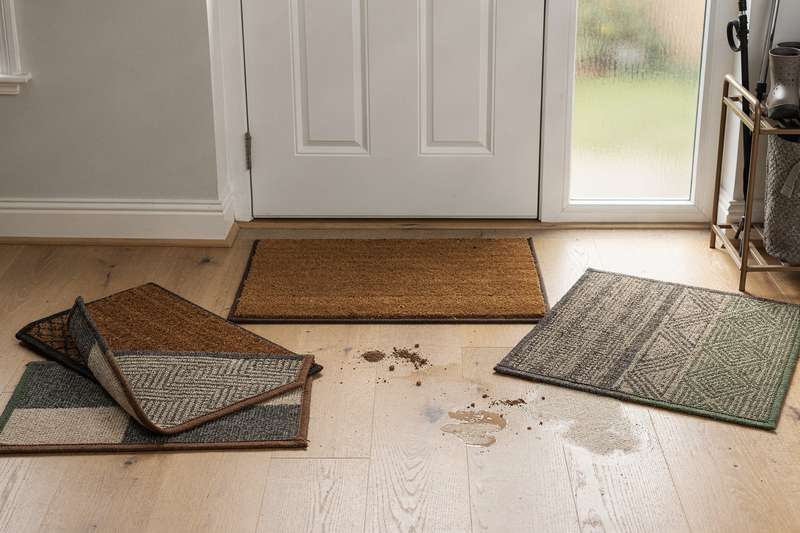
Picture this: it’s October, the garden has turned to mud after a week of rain, and your front hallway floor tells the story of everyone who has come through the door since Monday. The cheap mat you bought in a rush last autumn — the thin synthetic square that seemed perfectly adequate at the time — has shuffled sideways again, leaving a gap just wide enough for muddy footprints to land directly on your laminate. When you pick it up to give it a shake, it weighs almost nothing and traps almost nothing. The underside has developed a grey bloom that you’ve been trying to overlook. You prop it back roughly where it started and add “proper doormat” to the mental to-do list — for the fifth time this year.
Finding a doormat that does its job without announcing itself as an afterthought is harder than it should be. The category is full of rubber-edged rectangles that look reasonable in a product photograph and fall apart within two wet seasons. The questions that actually matter — will it clear my front door when it swings inward? Will it cope with a Labrador padding in from a field walk? Can I wash the thing properly, or am I just spreading the same grime around? — rarely get answered clearly in the listing description. This guide works through seven of the most relevant options currently available on Amazon UK, so you can pick the one that fits your door, your floor, and your particular brand of muddy chaos.
How These Picks Were Evaluated
Narrowing down the options here meant looking at a set of practical criteria that most product listings bury in small print. The key factors were: material type and what it genuinely delivers in wet conditions (natural coir versus synthetic microfibre versus rubber), profile height (critical where a door hangs close to the floor), the quality and type of non-slip backing, washability and how straightforward that actually is in practice, sizing relative to standard UK door widths, and durability signals in the construction specification.
One thing worth being upfront about: the vast majority of doormats in this corner of the Amazon catalogue are newer listings with very little verified buyer review data attached. The sole exception — which earns the top-overall position — has genuine buyer feedback to draw on, scoring a near-perfect rating from reviewers who chose to come back and write one. For the remaining picks, the evaluation rests on material science, specification analysis, and independent category benchmarking rather than aggregated buyer ratings. Any product without verified reviews is noted plainly in its section, so you know exactly where the evidence is stronger and where it is thinner.
Best Overall: Door Mat 43×76 Cm Dirt Trapper Doormat
The Door Mat 43×76 Cm Dirt Trapper Doormat Non-slip, Waterproof, Stain & Fade Resistant, Low Profile, Heavy Duty, Easy Clean Outdoor Door Mat earns the top position for a straightforward reason: it is the only product in this selection with real, verified buyer feedback, holding a 4.9 out of 5 rating from 18 reviewers. In a product category where most listings are new and unreviewed, that kind of signal carries real weight. People chose to come back and rate this mat positively after using it in actual conditions — and in a catalogue full of untested products, that counts for more than any specification claim made on a listing page.
At 43×76 cm, it fits most standard UK front doors without difficulty. The low-profile design is one of the specification points worth taking seriously here: older UK properties in particular often have doors that hang close to the floor, and a mat with too much pile can stop the door from opening fully or gradually scour the bottom of the door over time. A low-profile mat sits flat and stays out of the way, which sounds trivial until you’ve had to fight your front door open past a thick coir mat every morning for a winter.
The waterproof construction and explicit stain-and-fade-resistance claims position it well for outdoor use. Fade resistance is a meaningful differentiator among outdoor mats — cheaper options can visibly bleach within a single summer if exposed to direct sun, making the mat look worn long before it stops functioning. The stain-resistance specification suggests a surface treatment that prevents grime from becoming permanent, which is useful for a mat that sits in the path of deliveries, postmen, and muddy boots all year round.
The easy-clean claim aligns with a waterproof synthetic construction — you should be able to rinse this down with a hose or wipe it off without drama. It won’t offer the same mechanical scraping action as a deep coir bristle mat (more on that in the LSC section below), but its combination of weather resistance, non-slip backing, and verified buyer satisfaction makes it the most defensible all-round recommendation in this line-up.
The honest limitation is size: at 43×76 cm, this is a standard single-door format rather than a wide-entrance mat. If you have a double door, a wide Victorian front step, or a porch entrance that takes traffic from multiple angles, you’ll want something larger. For most UK terraced and semi-detached houses with a standard front door, though, this format is exactly the right fit.
Best for Heavy Outdoor Use: LSC Tuff Scrape Extra Large Door Mat
If your main problem is garden mud, grass cuttings, and grit being dragged indoors with every pair of boots, the LSC Tuff Scrape Extra Large Door Mat Heavy Duty Outdoor Doormats Removes Grass, Mud and Dirt 100% Natural Coir Bristle with Rubber Backing is built for exactly that scenario. Natural coir — the fibre extracted from coconut husks — has been used in doormats for centuries because the stiff bristle texture is aggressive enough to dislodge compacted mud from boot treads, yet resilient enough to spring back into shape rather than permanently flattening the way cheaper synthetic piles do after a season of use.
The extra-large sizing is a genuine functional advantage rather than a marketing descriptor. Narrow mats encourage people to step partially onto them and partially onto the floor, which undermines the whole point of having a mat. A wider, longer coir mat gives proper coverage and enough surface area to clean both feet thoroughly — something that particularly matters for households with children who don’t naturally slow down at the front door. The rubber backing prevents the mat from migrating on concrete steps and hard porch surfaces, where a mat without adequate backing will shuffle itself out of position within a week.
Coir’s natural mildew resistance makes it well-suited to a covered-porch or sheltered-doorstep environment, where it will inevitably get damp. It dries out faster than synthetic alternatives and doesn’t develop the musty smell that polyester or polypropylene mats acquire when they stay wet for extended periods. The important caveat is exposure: if your front step has no overhang and is fully in the path of driving rain, coir can become saturated over time and will deteriorate faster than a waterproof synthetic mat. For a covered step, coir is an excellent choice; for a fully exposed step, consider one of the synthetic or rubber options elsewhere in this guide.
LSC also offers a standard (non-extra-large) version of the Tuff Scrape in the same coir-and-rubber-backing construction, which suits narrower door openings where the extra-large format would be oversized. If your entrance is compact but you still want the coir scraping action, that smaller variant is worth considering. For most UK semi-detached front doors, the standard size is adequate; go extra-large if you have a wider step or a porch that takes traffic from multiple directions.
Like most products in this catalogue, the LSC Tuff Scrape Extra Large has no published buyer reviews at the time of writing. The material properties of natural coir are well-established — this is not an experimental material — but real-world confirmation of this specific product’s durability would come from verified buyer feedback. Check the listing for any reviews that have appeared before purchasing if that evidence matters to your decision.
Best Machine-Washable Indoor Mat: DEXI Dirt Trapper Indoor Door Mat
The DEXI Dirt Trapper Indoor Door Mat 50 x 80 cm, Black-Grey is designed around the reality that indoor entrance mats accumulate concentrated grime in a small area and need thorough cleaning rather than a token shake. At 50×80 cm, it’s generously proportioned for an indoor position — wide enough that most adults can use it naturally without having to aim at it — and the machine-washable specification means that when it reaches genuine griminess, you can deal with it properly rather than putting the task off indefinitely.
The black-grey colourway is a practical choice for this use case, and not just aesthetically. Dark-coloured mats conceal accumulated grime between washes more effectively than pale alternatives, so the mat doesn’t visually announce a losing battle with mud after a single rainy day. Dark entrance mats also resist the uneven staining pattern that lighter options develop quickly in households with dogs, small children, or anyone who comes in from gardening or building work.
The dirt-trapper designation refers to a looped or tufted pile that captures particles within the mat’s depth rather than allowing them to be redistributed further into the house on the next pair of feet. This matters because a mat that traps surface dirt is only half the solution — you also need it to hold that dirt until it’s washed out, rather than releasing it back into play when the next person comes in. Super absorbency complements this: at an indoor entrance, wet shoes, a dripping umbrella, and wet dog paws all deposit moisture that would otherwise track across the hallway floor.
The non-slip backing is important on hard floors. Smooth laminate or tile — the most common hallway surface in contemporary UK homes — offers very little friction for a mat to grip. A mat without good backing becomes a hazard, particularly for older household members or anyone carrying something large and bulky. Low-profile construction prevents it from catching a door that swings over it and removes the trip hazard that thicker mats present in narrow hallways.
Like most products in this selection, the DEXI has no published buyer reviews at the time of writing, so the washability and durability claims come from the product description rather than verified user experience. When washing, stick to 30°C or cooler and air-dry rather than tumble-dry — heat degrades rubber non-slip backings significantly faster than cool air does.
Best Budget Pick: BLADO Washable Door Mats Indoor & Outdoor
If you need to cover a doorway quickly without a significant outlay, the BLADO Washable Door Mats Indoor & Outdoor – Non-Slippery Heavy Duty – Stylish & Large Rubber – Perfect Dust Grabbing Doormats sits at the lower end of the price range and covers the basics across both indoor and outdoor positions. At this tier, it won’t outlast a premium coir or high-grade microfibre mat under sustained heavy use — but for a utility side entrance, a back door onto the garden, or a rental property where you need something functional rather than decorative, it does the job without asking much of you.
The anthracite colourway gives it a neutral, contemporary appearance that doesn’t immediately read as a budget purchase. The rubber construction is the key specification at this price tier: rubber doormats hold their shape better than polypropylene alternatives, don’t shed fibres indoors, and are straightforward to clean — a rinse under a tap or a wipe with a cloth handles most of what a doormat collects. The heavy-duty and non-slippery claims are plausible for rubber: the material itself provides inherent grip, and the non-slip backing reduces migration on hard floor surfaces where cheaper mats tend to creep.
The honest tradeoff is absorbency. A rubber surface doesn’t soak up water the way a microfibre or textile mat does, so wet footprints may still be carried a step or two beyond the mat after heavy rain or after a wet dog shakes off near the door. This is a fundamental material limitation rather than a product quality fault — rubber mats are excellent at trapping dry grit and debris but are not the right choice if capturing moisture is your priority. For that need, the DEXI or Oiilores picks in this guide are more appropriate.
The washable claim is worth reading carefully: rubber mats clean well with a hose or in a deep sink, but they’re generally not suited to a standard washing machine due to weight and rigidity. If machine-washability matters to you, look at the textile-backed options in this guide. But if your cleaning approach runs to “take it outside, rinse it down, leave it to dry” — which is honestly the most efficient method for any doormat — this is a practical, cost-effective choice.
This listing has no verified buyer reviews at the time of writing. At the budget end of any category, real buyer feedback matters more than specification claims, because you’re not paying a premium for brand quality assurance. Treat this as a pragmatic option for low-stakes situations or as a temporary solution while you decide whether you need something more substantial long-term.
Best for Pet Households: Oiilores Dirt Trapper Door Mat Indoor
Homes with dogs face a doormat challenge that goes beyond what a standard mat is calibrated to handle: the volume of wet, muddy paw prints arriving through one door after a single walk can saturate an ordinary mat within minutes. The Oiilores Dirt Trapper Door Mat Indoor 50 x 80 cm, Non-Slip Washable Rug, Low-Profile Inside Doormats for Entryway, Super Absorbent Dog Mats is explicitly positioned for this use case, which means its performance claims are calibrated to a higher-than-average moisture and dirt load rather than the occasional muddy boot of an adult visitor.
Super absorbency is the headline specification, and for pet households it’s the single most important feature a doormat can offer. A mat that soaks up a meaningful volume of moisture per use stops wet paw prints from being distributed through the rest of the house — which, if you have a larger breed with a talent for retaining an impressive volume of puddle water in its coat, makes a tangible difference to how the hallway looks by mid-afternoon in November. At 50×80 cm, the Oiilores is sized to accommodate a medium or large dog being directed onto it after a walk, something smaller mats simply can’t do if the dog is moving at any speed.
The non-slip backing is particularly important in a pet context. A mat that slides when a dog pads across it becomes frustrating within a day and won’t stay in the position where it’s actually useful. On the tile, vinyl, or laminate that characterises most UK hallways, adequate rubber backing grip keeps the mat where you put it. The low-profile design is also practically sensible for dogs: a raised edge can catch a claw or trip a large dog moving at pace, and a flat mat avoids that complication entirely.
Machine washability is non-negotiable for a mat used heavily by muddy animals. Pet entrance mats accumulate not just mud and water but also hair and odour over time, and a mat you can put through a wash cycle once or twice a week maintains a level of freshness that shake-and-brush maintenance simply cannot achieve. Air-dry after washing to protect the backing — tumble-drying shortens the life of the non-slip compound significantly.
Like others in this selection, the Oiilores has no verified buyer reviews at the time of writing. The pet-household positioning is a useful signal of the product’s design intent, but the real-world performance — particularly the capacity of the absorbent layer under repeated heavy use — would benefit from confirmation through buyer feedback. If reviews have appeared by the time you’re reading this, look specifically for comments from multi-dog households, which represent the most demanding use case.
Best Low-Profile Stylish Mat: GULLAMBO Door Mats Indoor
The GULLAMBO Door Mats Indoor, Dirt Trapper, Washable Door Mat for Front & Back Door Entrances, Stylish Thin Low Profile, Non Slip Rubber Backed addresses a specific problem: you want a mat that looks considered rather than functional-and-forgotten, but you can’t have anything thick because the door hangs low or the hallway is too narrow for a bulky option. The thin, low-profile construction makes it particularly relevant for older UK terraced houses, which often have doors that leave minimal clearance for anything with depth or pile.
The stylish descriptor in the product name is doing genuine work in differentiating it from purely utilitarian options. If your hallway has been given some thought — a particular tile, a decent coat rack, framed prints by the door — a mat that reads as generic and industrial undermines the effect. The GULLAMBO’s positioning as a thin, stylish dirt trapper tries to balance function and appearance, which is a sensible product angle for anyone who wants the entrance to look intentional rather than improvised.
The rubber-backed non-slip specification is a practical baseline requirement for a thin mat. A low-profile mat doesn’t have the mass of a thick coir or chunky microfibre mat to hold itself in place, so the backing does more of the work. On smooth hard floors — the default surface in most UK hallways — adequate rubber backing keeps the mat anchored under foot traffic rather than creeping gradually towards the skirting board. The non-slip specification is what makes the thin-and-stylish approach viable rather than a compromise.
The dual front-and-back-door positioning in the product description is worth noting as a buying signal. Front-door mats often command a premium because they’re expected to perform and impress; back-door mats are purely utilitarian. Positioning the GULLAMBO for both suggests a product calibrated for everyday practicality rather than show-home performance — which, for a back entrance onto a patio or garden, is exactly appropriate. If you need mats for both doors and want a consistent look without paying premium prices, this is worth considering for the back entrance even if you choose something more substantial for the front.
Washability means routine maintenance is simpler than for natural-fibre mats, which need outdoor rinsing or specialist cleaning. As with all zero-review products in this guide, the claims here are taken from the specification rather than verified buyer experience — check the listing for any reviews that have appeared before committing.
Best for Compact Indoor Entryways: LEKEEPGO Door Mat
The LEKEEPGO Door Mat 43 x 75 cm, Non Slip Door Mat Indoor Entrance, Rubber Backing Indoor Door mats Washable Absorbent Low-Profile Doormat is sized and specified for the reality of most UK flats and smaller houses: an entrance area that doesn’t have space for a large mat, where you still need something that performs properly within a compact footprint. At 43×75 cm, it’s slightly narrower than the 50-wide options elsewhere in this guide, which makes it a better fit for standard UK interior door widths without projecting too far into a tight corridor or narrow hallway where a large mat creates its own obstruction.
The combination of absorbency and low profile is the key specification pairing for an indoor entrance mat. Absorbency means wet shoes deposit moisture into the mat rather than onto the floor beyond it — the mat acts as the last checkpoint between the outside world and your home. Low profile keeps the mat from catching the base of a door as it swings inward and removes the trip hazard that thicker mats present in narrow hallways, where there’s less room to naturally navigate around a raised edge.
The rubber backing addresses the non-slip requirement directly. On the smooth tile or laminate common in UK hallways, a mat without adequate grip shifts gradually after every use and eventually ends up at an unhelpful angle in the corner. Rubber backing is more reliable for this purpose than self-adhesive grip strips, which tend to lift from the mat over time and can leave residue on flooring when removed.
Washability at this size is a practical advantage that’s easy to underestimate at the point of purchase. A 43×75 cm mat fits in most standard washing machines without drama, which makes cleaning it a routine laundry task rather than a special project involving a bathtub or hosepipe. For a busy indoor entrance where the mat accumulates grime steadily throughout the week, that convenience pays dividends over months of use. The same guidance applies as elsewhere in this guide: cool wash temperatures and air-drying preserve the rubber backing far better than hot cycles and tumble-drying.
This product has no buyer reviews at the time of writing. The specification is coherent and the size is practical for narrow UK entrances, but real-world confirmation of durability — particularly how the rubber backing holds up through repeated wash cycles over an extended period — remains to be established. If this format suits your entryway, check the listing for any reviews that have appeared and pay attention to comments about long-term shape retention.
What to Look For When Buying a Doormat
- Profile height and door clearance: Before anything else, measure the gap between your door and the floor. A 12–15 mm profile suits most modern doors comfortably, but older properties often have tighter clearances. Deep-pile coir mats can prevent a door from opening properly — low-profile synthetic mats avoid this entirely. Measure first, then buy.
- Material and its practical trade-offs: Natural coir excels at scraping mud and grit from boot treads and resists mildew naturally, but it sheds fibres indoors and can’t go in a washing machine. Microfibre and textile mats absorb water well and are generally machine-washable, but don’t offer the same mechanical scraping action. Rubber mats are highly durable and easy to rinse, but absorb very little moisture. Match the material to the location: coir for covered outdoor steps, synthetic for indoor entrances, rubber for utility doors.
- Non-slip backing quality: A mat that moves underfoot is both a safety issue and a functional failure. Look for an integrated rubber or latex backing on any mat going onto a hard floor — laminate, tile, vinyl, or wood. Fabric-only backing or thin adhesive strips don’t hold position reliably under repeated foot traffic. This is worth prioritising even at the budget end of the range.
- Size relative to your door and step: The mat should be wide enough that people use it naturally without aiming. For a standard UK front door (around 76–80 cm wide), a mat at least 60 cm wide gives adequate coverage. Wider steps and double doors need correspondingly larger mats. A mat that’s too small is almost worse than no mat at all — it only catches a fraction of the dirt.
- Washability and maintenance method: Think honestly about how you actually clean things, not how you intend to. Machine-washable mats suit households that want minimal effort; coir or rubber mats suit people happy to hose things down outdoors. A mat that’s difficult to clean will go unwashed — and an unwashed doormat redistributes dirt rather than trapping it.
- Weather exposure: If the mat will sit in direct rain with no overhang, it needs to be genuinely weatherproof — synthetic or rubber construction with a backing that won’t rot. Coir handles a covered outdoor position well but degrades in fully exposed settings where it becomes consistently saturated. If your step has a porch or canopy, coir works; if it’s fully exposed, choose a waterproof synthetic or rubber option.
- Fade and stain resistance for outdoor use: Outdoor mats are exposed to UV throughout the year. Cheaper options can bleach noticeably within one summer, making the mat look old and worn well before it stops functioning. Look for explicit fade-resistance in the specification, and treat the absence of that claim in a brightly coloured outdoor mat as a warning sign.
Verdict
For most UK readers in most situations, the pick with the strongest evidence behind it is the Door Mat 43×76 Cm Dirt Trapper Doormat Non-slip, Waterproof, Stain & Fade Resistant, Low Profile, Heavy Duty, Easy Clean Outdoor Door Mat. The 4.9-star rating from 18 verified buyers is the decisive factor — in a catalogue where almost every other product is untested, genuine positive buyer experience separates this mat from the field. Its specification covers the essentials for a front-door mat: waterproof, non-slip, low-profile, fade-resistant, and easy to clean. At the size and profile it offers, it suits the standard UK front door without the fitting compromises that thicker or wider mats can introduce.
If your situation calls for a different approach, the guide above covers it. The LSC Tuff Scrape Extra Large is the pick for serious outdoor mud and grass scraping, where coir’s mechanical action outperforms anything synthetic. The DEXI Dirt Trapper or the Oiilores are the picks if machine washability and high absorbency are your priorities — particularly for pet households where the mat sees heavy, repeated use. The BLADO covers the budget-utility use case, and the GULLAMBO or LEKEEPGO suit compact or stylistically considered indoor entrances where a low-profile, lightweight mat fits better than a chunky outdoor option.
The single most consequential buying decision is matching the mat’s material to its position. An indoor mat placed outdoors, or a coir mat on a fully exposed step, will underperform regardless of its other merits. Get that right and most of the picks in this guide will do their job without complaint through whatever a British autumn decides to throw at your front door.
We were not paid to feature any specific product in this guide. All opinions are independent and based on publicly available specifications, verified buyer feedback patterns where available, and independent category research.
Quick Comparison Table


FAQ
What size doormat do I need for a standard UK front door?
Most standard UK front doors are 76–80 cm wide, so a mat at least 60 cm wide gives comfortable coverage without requiring visitors to aim consciously. For a single door, a 50×80 cm or 43×76 cm mat works well for most households. For wider steps, double-door entrances, or porch floors that see traffic from multiple angles, look for something at 80 cm wide or larger. Always measure the gap between the door base and the floor before buying — a mat that is too thick will prevent the door from opening fully.
Is coir or synthetic better for a doormat?
It depends on the position and the primary job you need it to do. Coir — made from coconut husk fibres — is excellent at mechanically scraping mud and grit from boot treads and is naturally mildew-resistant, making it well-suited to covered outdoor positions. Synthetic mats absorb water more effectively and are generally machine-washable, making them the better choice for indoor entrances where moisture capture matters more than scraping. For a fully exposed outdoor step with no overhang, a waterproof rubber or synthetic mat holds up better than coir over time.
Can doormats go in a washing machine?
Some can, and some cannot. Machine-washable mats are typically made from microfibre or synthetic textile with a rubber or latex backing — always check the product description before washing. If the mat has a rubber backing, use a cool wash at 30°C or below to avoid degrading the backing compound, and air-dry rather than tumble-dry wherever possible. Natural coir mats and solid rubber mats are not suitable for machine washing; rinse them with a hose or scrub with a stiff brush instead.
How do I stop my doormat from sliding on hard floors?
The most reliable solution is buying a mat with an integrated rubber or latex backing from the outset — this grips smooth hard floors without any additional products. If a mat still migrates despite having a backing, check that the floor surface is clean and free from polish or cleaning-product residue, which can reduce friction. Separate rug-gripper pads are available as an add-on for persistent cases, but a properly specified mat with quality rubber backing should stay in position under normal foot traffic without needing one.
How often should I clean my doormat?
For most households, a weekly shake or vacuum keeps a mat functional and prevents it from becoming a source of dirt rather than a trap for it. After particularly muddy periods — wet weeks, garden projects, or school runs in poor weather — clean more frequently. A mat that is saturated or deeply clogged stops capturing incoming dirt and starts redistributing it instead, which defeats the purpose. Machine-washable mats benefit from a monthly wash cycle; coir mats respond well to a firm brush-down and an occasional hose-rinse on a dry day.
What is the best doormat for a household with dogs?
Prioritise high absorbency and machine-washable construction — these two features matter most in a pet household. A super-absorbent synthetic mat captures wet paw prints before they’re distributed through the house, and machine washability means the mat can be refreshed regularly without it becoming a chore. Size is important too: a mat wide enough for a medium or large dog to step fully onto is far more effective than a narrow mat that gets skirted around. Non-slip backing is also worth prioritising, as dogs don’t approach doormats cautiously.