The Problem with Morning Coffee That Nobody Talks About
You’ve upgraded your kettle. You bought decent beans from a local roaster. You even invested in a proper pour-over dripper or a decent drip machine. And yet, every morning, your filter coffee tastes somehow flat — or worse, bitter and gritty in a way you can’t quite pin down. You’ve blamed the beans, the water temperature, even the paper filters. But here’s what’s actually happening: your grind is inconsistent.
If you’re using a cheap blade grinder — or worse, pre-ground coffee from a bag that’s been open for two weeks — you’re losing the most important variable in filter coffee before the water even touches the grounds. Blade grinders don’t grind; they bash and chop. The result is a mix of coarse chunks and fine powder in the same batch, which means some grounds are over-extracted (bitter) and some are under-extracted (sour and weak) in a single cup.
You don’t need a professional café setup. You don’t need to spend £300. But you do need a grinder that produces a consistent, even particle size — and you need it to be compact enough to actually live on your kitchen worktop without taking over. This guide covers exactly that: the best small coffee grinders for filter coffee, tested against real-world criteria, for UK buyers shopping on Amazon.
How We Evaluated These Grinders
Every pick in this guide was assessed against a set of criteria directly relevant to filter coffee at home. Grind consistency came first — specifically, how uniform the particle size is across a batch, since uneven grinding is the primary cause of poor filter coffee. We also looked at grind size range, because filter methods (drip machines, Chemex, V60, AeroPress) all sit in the medium to medium-fine range and you need to dial in precisely.
Capacity mattered for real-world use — most home brewers make one or two cups at a time, but some batch-brew for the whole household. Build quality and ease of cleaning were assessed through verified buyer review patterns and material specs. Noise level, footprint, and price-to-performance ratio all factored into final rankings. We deliberately included a spread across price bands so you can find the right fit regardless of budget.
Quick Picks
| Best For | Price Range | Key Feature |
|---|---|---|
| Best overall compact burr grinder | £50–£80 | Conical burr set, multiple grind settings, consistent medium-fine output |
| Best budget blade grinder (starter) | Under £20 | Stainless steel blades, fast operation, multi-use (spices, grains) |
| Best hand grinder for pour-over | £30–£60 | Portable, ceramic burrs, near-zero noise, excellent grind uniformity |
| Best mid-range electric burr grinder | £40–£70 | Flat burr set, dose-by-time, compact footprint, removable hopper |
| Best for batch brewing (4+ cups) | £60–£100 | Larger hopper, multiple grind settings, consistent output at higher volumes |
| Best grinder under £30 with adjustable settings | £20–£30 | Dial-adjustable coarseness, safety lid lock, compact housing |
| Best premium compact grinder for serious home brewers | £80–£150 | Stepped grind adjustment, low retention, high-quality burr material |
Best Overall Compact Burr Grinder for Filter Coffee
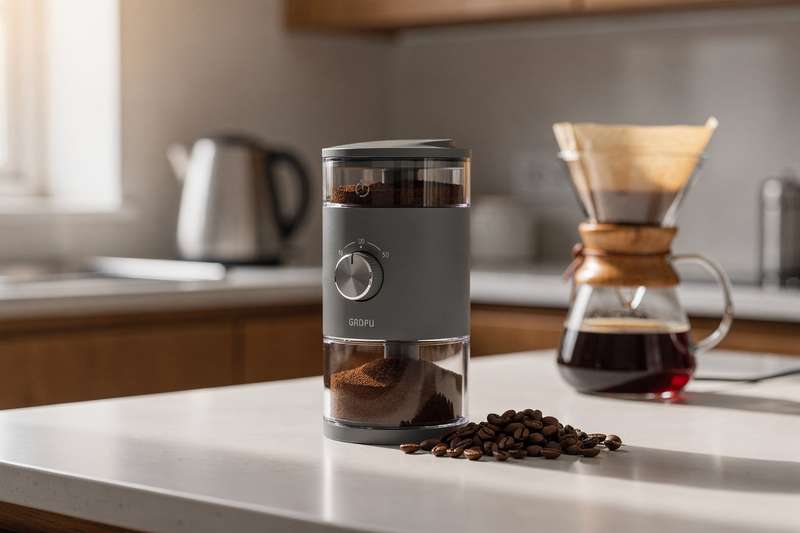
If you brew filter coffee daily and you’re done compromising on flavour, a compact electric burr grinder in the £50–£80 range is where the most meaningful improvement happens. At this price point, you’re getting a conical burr set — two cone-shaped abrasive surfaces that crush beans between them rather than chopping them — which produces a far more uniform particle size than any blade grinder can achieve. For filter methods like V60, Chemex, or a standard drip machine, that consistency is what separates a flat cup from one with clarity and sweetness.
Look for a grinder with at least 10 distinct grind settings, and ideally 15 or more, so you can fine-tune for different filter methods. The medium to medium-fine range is where most filter coffee lives, but you’ll want the flexibility to go slightly coarser for a drip machine or slightly finer for an AeroPress on the same device. A removable upper burr for cleaning is a significant practical advantage — coffee oils accumulate quickly and a grinder you can’t clean properly will start tasting stale within a few weeks.
Capacity is usually 40–60g of beans in the hopper, which is ample for one to two cups. The grind chamber — the container that catches the grounds — is typically smaller, so for batch brewing of 4+ cups you may need to run two cycles. The motor on grinders in this bracket is quiet enough that you won’t disturb a sleeping household, though you’ll still hear it clearly in a small flat. Noise is noticeably lower than blade grinders, which tend to sound like a small aircraft taking off.
The main tradeoff at this price is grind retention — fine coffee dust that clings inside the burr chamber and contaminates your next batch. It’s a minor issue for most home brewers, but if you switch between coffee types frequently, it’s worth factoring in. Overall, this is the pick for anyone who has decided that coffee quality actually matters and wants a device that will genuinely last three to five years with regular use.
Best Budget Blade Grinder (Starter Pick)
A blade grinder under £20 is not the tool of choice for a serious filter coffee enthusiast — and it’s worth being direct about that. The stainless steel blades spin at high speed and chop beans randomly, producing a mix of particle sizes that makes consistent extraction nearly impossible. However, if you’re brand new to grinding fresh beans at home, or if you primarily use a drip machine and aren’t chasing nuance, a budget blade grinder is a perfectly reasonable starting point. It’s dramatically better than pre-ground coffee that’s been sitting on a supermarket shelf for months.
The best examples in this category grind around 30g (roughly two cups’ worth) in 10 seconds flat. The key feature to look for is a clear safety lid that lets you watch the grind progress without opening the device — this is how you compensate for the lack of grind settings. You pulse the grinder in short bursts and stop when the grounds look roughly right. It’s not precise, but with practice you’ll get a serviceable medium grind for drip coffee.
These grinders earn their keep as multi-use kitchen tools. The same blade that handles coffee beans will also grind dried herbs, whole spices, flaxseeds, and oats. If your kitchen is small and counter space is limited, a device that pulls double duty has real practical value. Stainless steel blades are preferable to plastic — they stay sharper longer and don’t retain odours as badly.
Where blade grinders genuinely struggle: anything requiring precision. Pour-over methods like V60 or Chemex are unforgiving of inconsistent grinds, and you’ll taste the difference. If you start brewing more seriously and experimenting with recipe-driven filter methods, you’ll quickly outgrow this tool. Think of it as a starter device — useful, affordable, and a clear step up from pre-ground, but not the destination.
Best Hand Grinder for Pour-Over
A manual hand grinder is the single best value upgrade for a home pour-over enthusiast, and it’s consistently underrated. In the £30–£60 range, you can get a grinder with ceramic or steel conical burrs that produces genuinely excellent grind consistency — comparable to electric burr grinders costing twice as much. The reason is straightforward: you’re paying for the burr quality and precision, not for a motor and housing.
The practical case for a hand grinder is strong if you brew one or two cups at a time. Grinding 15–20g of beans by hand takes about 60–90 seconds with a good-quality hand grinder — not a hardship. The process is completely silent, which matters if you’re up before the rest of the household. The footprint is tiny: most hand grinders are the size of a travel mug and can be stored in a drawer. They’re also genuinely portable — useful for travel, camping, or taking to the office.
Look for models with a stepped adjustment mechanism (a click-stop dial) rather than a stepless system. Stepped adjustments are easier to return to a known setting after cleaning, which saves time when you’re half-awake at 7am. Ceramic burrs are easier to clean and don’t retain heat, though steel burrs are marginally more durable for heavy daily use. The catch capacity is typically 20–25g, which is right for one to two cups of filter coffee.
The limitation is volume. If you’re batch-brewing for three or four people, grinding 60–80g by hand becomes genuinely tedious. Hand grinders also require slightly more physical effort than you might expect — the torque on denser, lighter-roasted beans can be significant. For a solo coffee drinker who takes their V60 seriously, though, this category represents the best possible grind quality per pound spent.
Best Mid-Range Electric Burr Grinder
The mid-range electric burr grinder category — roughly £40–£70 — has improved dramatically over the past few years. You’re now getting flat or conical burr sets with genuine consistency, compact housings designed for small kitchens, and features like dose-by-time operation that make the morning routine genuinely frictionless. This is arguably the sweet spot for most UK home brewers who want quality without overthinking it.
Dose-by-time means you set a timer (typically in 1–2 second increments) and the grinder automatically stops after your chosen duration, delivering a consistent dose of grounds each morning. Combined with a fixed grind setting you’ve already dialled in, this means you can get a reliable, repeatable cup with minimal effort. It’s a significant quality-of-life feature once you get used to it.
Look for a removable hopper — ideally one that holds 150–200g of beans — and a separate grounds container with a capacity of at least 60g. The grounds container should have an anti-static design or coating if possible; static is a genuine nuisance with electric grinders, causing fine coffee dust to cling to everything. Some models solve this with a grounded metal container; others use a silicone lining.
At this price point, build quality can vary significantly. Avoid models with entirely plastic burr housings — the burrs themselves should be steel or ceramic regardless. Pay attention to verified buyer reviews that mention longevity at the 12–24 month mark, not just initial impressions. A grinder that works beautifully for the first three months and then starts producing inconsistent grinds due to burr wear is not a bargain at any price. A solid mid-range electric burr grinder will serve a daily home brewer well for several years with occasional cleaning.
Best for Batch Brewing (4+ Cups)
If you’re regularly brewing for a household of three or four — or you batch-brew a litre of filter coffee to last you through a morning of work — the capacity constraints of most compact grinders become frustrating quickly. You need something with a larger hopper, a bigger grounds container, and ideally a motor rated for continuous use rather than short pulse cycles.
In the £60–£100 range, you can find electric burr grinders with hoppers that hold 200–250g of beans and grounds containers rated for 60–80g per cycle. These grinders are still classified as compact — they typically have a footprint of around 12 x 15cm — but they’re meaningfully larger than the single-serve options above. The motor is usually more powerful, rated at 150W or above, and can handle longer continuous grinding sessions without overheating.
Grind consistency at this size and price tends to be good but not exceptional. You’re making a tradeoff: volume and convenience over the absolute peak grind quality you’d get from a premium single-serve burr grinder. For a household that brews drip machine coffee as a daily ritual, that tradeoff is entirely reasonable. The flavour improvement over pre-ground is still significant, and the convenience of not needing to run three separate grinding cycles each morning is worth something.
Look for models with a minimum of 12 grind settings, a well-designed anti-clump mechanism in the grounds container, and ideally a bean hopper lid that seals reasonably well to protect freshness. One thing to watch for: larger hoppers tempt you to store beans in them, which degrades freshness. Even with a lid, a transparent hopper exposed to kitchen light will stale beans faster than you’d like. Use the hopper for daily doses only, and store beans in an opaque airtight container.
Best Grinder Under £30 with Adjustable Settings
The £20–£30 band is where blade grinders and very basic electric burr grinders overlap. The best value here is a blade-based grinder with a dial or selector that adjusts the chamber size — effectively controlling how long the blades run before the lid can be opened, which creates a crude but functional coarseness adjustment. This is not the same as a proper burr grinder with stepped grind settings, but it’s a meaningful step up from a pure pulse-only blade grinder.
Look for a model with at least three coarseness options (coarse, medium, fine), a safety lid lock that prevents operation with the lid open, and a stainless steel bowl. The safety lid lock is not just a safety feature — it also slightly improves grind consistency by keeping the environment inside the grinding chamber consistent through each cycle. Bowls with measurement markings on the side are a practical bonus.
At this price point, the burr-grinder options are very limited and often disappointing in build quality. If a grinder claims to be a burr grinder under £25, treat the claim with scepticism and check verified buyer reviews carefully — the burr material and alignment at this price is often poor enough that the practical improvement over a blade grinder is minimal. A well-designed blade grinder with thoughtful settings will often outperform a poorly made budget burr grinder in real-world use.
This category is a solid choice if you’re buying for a kitchen where coffee is one of several priorities rather than the main event — a family setup where someone occasionally wants fresh ground coffee but doesn’t want to invest heavily. It’s also a reasonable gift for someone who currently buys pre-ground and would benefit from any step towards freshness, without the pressure of a larger purchase.
Best Premium Compact Grinder for Serious Home Brewers
If you’ve caught the filter coffee bug properly — you’re weighing your doses, timing your pours, adjusting your grind between different roasts — then you’ll eventually hit the ceiling of mid-range grinders. At £80–£150, you enter a category where build quality, grind uniformity, and low retention are genuinely exceptional for a compact home device. These grinders are designed by companies that take coffee seriously, and the engineering shows.
The key differentiators at this level are burr material and alignment precision. High-quality conical steel burrs, precisely aligned during manufacturing, produce a dramatically narrower particle size distribution than cheaper alternatives. In practical terms, this means less bitterness from over-extracted fines and more sweetness and clarity in the cup. If you’ve dialled in everything else in your brew process and your coffee is still slightly muddy or lacks brightness, the grinder is often the last remaining variable.
Look for grinders with a stepless or high-stepped adjustment system (40+ steps across the full range) so you can make micro-adjustments as you work through a bag of beans — roast level, bean density, and ambient humidity all affect optimal grind size, and being able to dial in precisely matters. Low retention design — meaning minimal coffee grounds remain inside the burr chamber between uses — is worth prioritising if you enjoy trying different coffees frequently.
Noise at this tier is usually well-managed, with rubberised feet and motor damping. Cleaning systems vary: some premium compact grinders have a sweep mechanism or magnetic grind chamber that makes cleaning straightforward; others require a small brush and occasional disassembly. Factor cleaning frequency into your decision — a grinder you actually clean regularly will always outperform one you avoid cleaning because it’s fiddly. At this price, you’re buying a long-term relationship with the device, so make sure it’s one you’ll maintain.
What to Look For When Buying a Small Coffee Grinder for Filter Coffee
- Burr grinder vs blade grinder: For filter coffee, a burr grinder is significantly better. Burrs crush beans to a consistent particle size; blades chop randomly. Even a basic conical burr grinder will produce more uniform grounds than the best blade grinder. If budget forces you towards a blade grinder, use short pulse bursts and stop when the grounds look even — never run continuously until it stops on its own.
- Grind settings and range: Filter coffee sits in the medium to medium-fine range, but different methods require different settings (a flat-bed drip machine needs a slightly coarser grind than a V60). Look for at least 10 distinct grind settings, and ideally more. Stepped adjustment (click-stops) is more user-friendly for daily home use than stepless, which requires more experimentation.
- Capacity — hopper and grounds container: Match the grinder’s capacity to your actual brewing volume. For one to two cups, a 30–40g grind capacity is sufficient. For batch brewing, look for a 60–80g grounds container. Larger hoppers sound convenient but encourage storing beans in the grinder, which degrades freshness — beans should ideally be stored in a separate airtight, opaque container.
- Build quality and burr material: Stainless steel or ceramic burrs outlast plastic alternatives significantly. Look for a solid, weighted base (rubber feet prevent the grinder sliding during operation), and a grounds container that doesn’t generate excessive static. Verify the material claims in buyer reviews, not just product descriptions.
- Ease of cleaning: Coffee oil residue builds up quickly and turns rancid, affecting flavour within weeks. A grinder you can clean without tools — removable upper burr, detachable grounds container, accessible hopper — will always taste better than a sealed unit you barely touch. Check how straightforward disassembly is before buying.
- Noise level: Electric blade grinders are notably loud. Electric burr grinders are quieter but still audible. Hand grinders are nearly silent. If you live in a flat with thin walls, or brew before 7am, noise is a genuine consideration worth checking in buyer reviews.
- Footprint and storage: Compact grinders are classified as anything with a base under roughly 15 x 15cm. Hand grinders take up drawer space rather than counter space. If you’re working with a small kitchen, measure your available worktop area before ordering — some grinders described as compact are still 25cm tall with a full hopper and don’t fit neatly under overhead cabinets.
Comparison Table
| Category | Grinder Type | Grind Settings | Capacity (grounds) | Noise Level | Price Range |
|---|---|---|---|---|---|
| Best overall compact burr grinder | Electric conical burr | 10–18 steps | 40–60g | Low–moderate | £50–£80 |
| Best budget blade grinder | Electric blade | None (pulse control) | 25–35g | High | Under £20 |
| Best hand grinder for pour-over | Manual conical burr | 12–30+ steps (ceramic/steel burrs) | 20–30g | Near-silent | £30–£60 |
| Best mid-range electric burr grinder | Electric flat/conical burr | 12–18 steps, dose-by-time | 50–70g | Low–moderate | £40–£70 |
| Best for batch brewing | Electric conical burr | 12–15 steps | 60–80g | Moderate | £60–£100 |
| Best under £30 with adjustable settings | Electric blade (with dial) | 3 coarseness modes | 25–40g | High | £20–£30 |
| Best premium compact grinder | Electric conical burr (high-precision) | 30–40+ steps | 40–60g | Low | £80–£150 |
Verdict
For the majority of UK home brewers — someone who makes one or two cups of filter coffee each morning, cares about flavour, and wants a grinder that works reliably without a steep learning curve — the compact electric burr grinder in the £50–£80 range is the clear recommendation. It’s the point where grind consistency becomes genuinely good, the device fits on a standard kitchen worktop without dominating it, and the daily routine stays quick and simple.
If budget is the primary constraint and you’re just starting out, a blade grinder under £20 is a legitimate entry point — but buy it knowing you’ll likely want to upgrade within a year once you taste what consistent grinding actually does to your cup. If you’re a pour-over enthusiast who brews solo and values silence or portability, a quality hand grinder in the £40–£60 range will give you grind quality that punches well above its price. And if you’ve already spent money on good beans, a proper dripper, and a gooseneck kettle, don’t leave a mediocre grinder as the weak link in that chain — it’s always the grinder.
We were not paid to feature any specific product in this guide. All opinions are independent and based on publicly available specifications, verified buyer feedback patterns, and category research. Prices shown were accurate at time of writing and may change.
FAQ
Is a burr grinder really necessary for filter coffee at home?
For filter methods like V60, Chemex, or a pour-over drip machine, a burr grinder produces noticeably better results than a blade grinder. The uniform particle size from a burr grinder means more even extraction — which translates to less bitterness and more sweetness in the cup. A blade grinder is a workable starting point, but the improvement from switching to even a basic burr grinder is one of the more noticeable upgrades in a home brew setup.
What grind size should I use for filter coffee?
Filter coffee generally falls in the medium to medium-fine range. A useful reference point is the texture of coarse sea salt for most drip machines, or slightly finer — closer to table salt — for a V60 or Chemex. If your coffee tastes sour and weak, grind finer. If it tastes bitter or over-extracted, grind coarser. Adjust in small increments and keep everything else (dose, water temperature, brew time) consistent so you’re only changing one variable at a time.
Can I use a coffee grinder for spices as well as coffee?
Yes, but with caveats. Blade grinders handle spices well and the multi-use case is a genuine practical benefit for kitchen drawers and small spaces. Burr grinders can technically grind spices, but most manufacturers advise against it — spice oils penetrate the burr surfaces and are very difficult to remove fully, affecting the taste of your next coffee batch. If you want to grind both coffee and spices, keep a dedicated blade grinder for spices and use your burr grinder exclusively for coffee.
How often should I clean my coffee grinder?
For daily home use, a thorough clean every two to four weeks is a sensible baseline. This means removing the burrs (or clearing the blade chamber), brushing out old grounds, and wiping down the hopper. Between cleans, a quick brush of the grounds container after each use prevents stale residue building up. Some burr grinder owners run a small amount of dry white rice through the grinder occasionally to absorb oils — though check your manufacturer’s guidance first, as not all grinders recommend this.
Does a more expensive grinder actually make better-tasting coffee?
Up to a point, yes. The most meaningful improvement comes from switching from any blade grinder to any decent burr grinder — that’s the step change. Within the burr grinder category, the improvement from a £40 model to a £100 model is noticeable but less dramatic. Beyond £150, improvements in flavour are real but increasingly incremental — you’re paying for lower grind retention, finer adjustment precision, and build quality that lasts a decade rather than three to five years. For most home brewers, the £50–£80 range hits the point where more money yields diminishing returns.
What’s the difference between a hand grinder and an electric grinder for filter coffee?
Hand grinders use manual operation — you turn a handle — which makes them silent, portable, and often capable of producing grind consistency that rivals electric burr grinders at twice the price. The tradeoff is time and effort: grinding 20g of beans takes around 60–90 seconds, which is fine for a single cup but tedious for four cups at once. Electric grinders are faster and more convenient for batch brewing or households with multiple coffee drinkers. If you brew solo and enjoy a mindful morning routine, a hand grinder in the £35–£60 range is genuinely hard to beat on value.