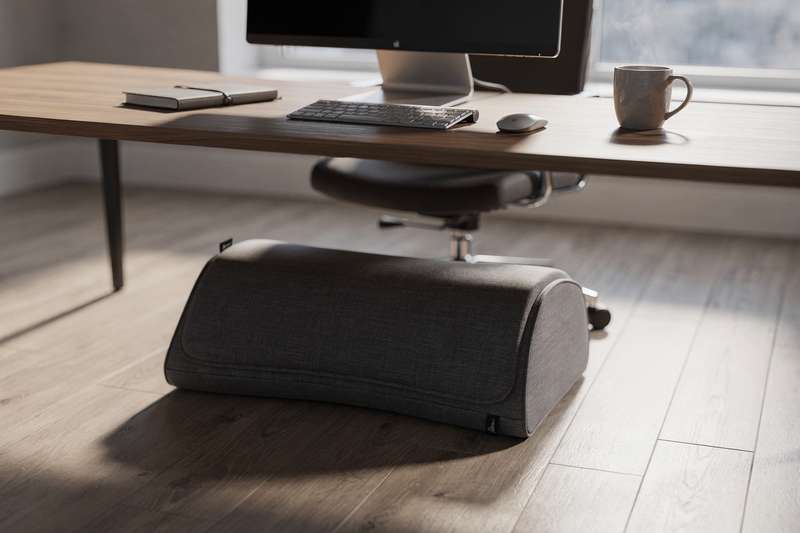
Picture a January morning at your desk. The room thermostat reads something acceptable and the radiators are ticking away somewhere near the ceiling, but your feet are resting on a floor that pulls warmth from your soles with alarming efficiency. You’ve already tried doubling your socks, laying down a rug, and pointing a compact fan heater at your ankles — the heater buzzed throughout every call you took, the rug helped for about ten minutes, and the extra socks made your shoes too tight to sit in comfortably. By mid-morning your toes are still numb, you’re shifting position every few minutes trying to find somewhere your feet don’t ache, and any sustained concentration has dissolved into a background discomfort that follows you through the rest of the day.
Cold feet at the desk are a genuine productivity problem, not minor inconvenience to push through. The solution isn’t more layers — it’s targeted warmth delivered directly where your feet rest, via a heated floor mat or an ergonomic footrest with a built-in heating element. These products draw a fraction of a fan heater’s electricity, operate silently, and address the problem at its source. The UK market offers two main formats: flat electric mats that warm the floor surface your feet rest on, and raised footrests that combine heat with height adjustment and vibration massage. This guide works through the options available on Amazon UK and identifies what actually works for typical British winter desk conditions — cold tile, concrete, laminate, and the aggressive air conditioning that makes offices chilly at desk level even when the thermostat claims otherwise.
How These Picks Were Chosen
Evaluating under-desk heating products for office use requires specific, practical criteria. Heat-up speed matters more than headline maximum temperature — a product that needs twenty minutes to reach a useful warmth is one you’ll switch off in frustration or forget to pre-heat before sitting down. Noise is critical in open-plan and shared spaces: any product using fans or air circulation will be audible in a quiet room and detectable on call microphones, while radiant and conductive designs operate in complete silence. Safety features are non-negotiable for a device running unattended under a desk for hours at a time: auto shut-off timers and overheat protection must be confirmed in the product specification, not assumed.
For footrest-style products, height and angle adjustability determines whether the product actively improves your seated posture or simply adds warmth to an already awkward foot position. Running costs matter for something used every working day through a British winter: wattage figures vary across this category enough to make the difference meaningful over four months. UK offices present specific challenges worth naming — many open-plan buildings run central air conditioning year-round, creating cold spots at desk level even when ambient temperature is technically acceptable, and older home working setups on ground-floor concrete or suspended timber never fully retain heat. The picks in this guide are assessed against those real-world conditions rather than ideal circumstances.
Three of the four picks here have substantial buyer review histories on Amazon UK, ranging from 140 to over 650 ratings — samples large enough to identify consistent performance patterns rather than first-impression outliers. The fourth pick, COMFIER’s memory foam model, has no buyer reviews at the time of writing and is evaluated on specifications and the brand’s established track record in this product category. That caveat is stated plainly in its section.
Best for Cold Concrete and Tile Floors
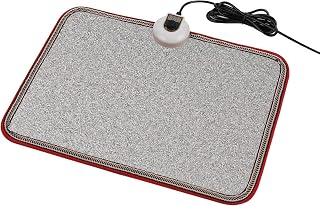
The Electric Heated Floor Mats Under Desk, Electric Foot Warmer – 230v Toes Warming Heater for Office and Home (Stone Grain) is the most-reviewed heated product in this roundup, with over 650 buyer ratings on Amazon UK at a 4.4-star average. That volume of reviews, accumulated over an extended period, reflects sustained real-world use from UK buyers across varied office environments — not a cluster of first-week impressions. A rating that holds steady across 650 reviews is a more useful signal than a higher average on a dozen.
This is a flat mat that sits on the floor under your desk. Your feet rest directly on the heated surface and warmth conducts upward through the soles. The 230v specification is important: this product is built for UK mains rather than imported with an adapter from another voltage standard, which matters for safety and reliability in a device intended to run for hours at a time. The stone grain surface finish gives it a neutral appearance that suits both home office setups and more formal desk environments, and the mat’s footprint is compact enough to fit under most standard desks without protruding into walkways.
The flat mat format is most effective on hard, cold surfaces — bare concrete, tile, laminate, or hardwood. These floor types drain warmth from your feet fastest, and the direct contact between the heating surface and your soles means warmth reaches the ball and toes of the foot rather than just the heel area. Buyer feedback consistently highlights the mat reaching a comfortable working temperature within a few minutes of switching on — practical enough to power on when you sit down rather than needing a pre-heating routine before your working day starts.
The limitations are worth naming clearly. There is no ergonomic height adjustment: your feet sit at floor level, flat, with no tilt option. If your chair and desk are configured so your feet land comfortably at floor height, this is irrelevant. If you benefit from a few extra centimetres of height to reduce lower-back pressure, this mat does not provide it — you would need a separate footrest underneath, adding bulk and complexity. The mat also holds a single flat position with no angle adjustment. For the specific scenario it targets — cold hard floor, uncomplicated cold-feet problem — that simplicity is an asset rather than a limitation.
There are no fans, no moving parts, and no noise of any kind. Silent operation under a desk is underappreciated: the persistent low-level hum of a fan heater or any air-circulation device erodes focus without you consciously registering it, and it is reliably detectable on microphones during calls. This mat produces nothing but warmth. Running costs sit far below any fan heater alternative — at the wattage typical of products in this category, daily electricity use across a standard working day is measured in a few pence rather than significant amounts.
Before ordering, measure the available space under your desk: a minority of reviews mention the mat being slightly smaller than expected. Confirm dimensions on the Amazon listing. The stone grain finish is linked here; other surface patterns are available as separate listings if you prefer a different appearance.
Best Overall Heated Footrest for Extended Desk Sessions
The COMFIER Heated Foot Rest Under Desk Vibration Massage, Ergonomic Footrest combines ergonomic height support, built-in heat, and vibration massage in a single product. With 305 UK reviews at 4.3 stars, it is the highest-reviewed footrest-style product in this guide — as distinct from a flat mat — and makes the clearest case for anyone dealing with cold feet and posture discomfort at the same time.
This is an ergonomic footrest first, with heating integrated into it rather than a foot warmer that happens to be shaped like a platform. Three adjustable angle settings let you position the foot surface at a tilt that suits your chair height and desk depth. For people who sit with feet partly dangling because the chair is set slightly too high for comfortable floor contact, or whose lower back suffers during long sessions from inadequate foot support, a correctly angled footrest reduces loading and the postural slump that develops over several hours. The heel support curve holds the foot in a natural resting position rather than leaving it flat on a rigid surface — a detail that makes itself felt over a full day at the desk.
Two heat settings cover mild office chill on the lower and colder conditions on the higher. Three vibration levels add a gentle massage effect through the soles of the feet. For people who sit in one position for extended periods, light mechanical stimulation supports circulation at the extremities — this is relevant for anyone who runs habitually cold in the feet or has a condition like Raynaud’s. The toe-touch controls are a practical detail: you activate and cycle through settings by pressing the footrest with your foot, with no reaching under the desk or interrupting a call to adjust the temperature.
The tradeoffs are real. This sits at a higher price point than the flat mat or the Snailax below, and the value depends on actually using all three functions. If warmth is the only requirement and your feet rest comfortably at floor level, the flat mat is simpler and cheaper to run across a winter. A number of reviewers note that vibration at higher settings produces a faint sound that is detectable in a very quiet room — not disruptive, but present. The three angle positions are fixed mechanical presets rather than a continuously variable range, so you are choosing between set options rather than dialling in a precise angle. The platform width suits most adults but may feel slightly tight for wider feet.
For readers dealing with both cold feet and posture issues from inadequate foot support, this is the most effective single product in the roundup. The 305-reviewer sample gives a meaningful picture of real-world performance rather than early-impression data, and the pattern in buyer feedback points consistently to satisfaction with both the heat output and the ergonomic benefit. Check the angle settings against your chair and desk combination before ordering to confirm one of the three presets matches your preferred foot position.
Best Value Heated Footrest with Double-Layer Warmth
The Snailax Foot Rest Under Desk, Heated Desk Footrest for Office Use with Vibration Massage, Feet Warmer with Double Layer Adjustable Height brings heat, vibration massage, and height adjustment to a lower price bracket than the COMFIER above. With 140 UK reviews at 4.0 stars, the feedback base is smaller but sufficient to read consistent patterns in buyer experience.
The double-layer construction refers to the layered build of the heating surface, designed to distribute warmth evenly across the full foot platform rather than concentrating heat at a central element and leaving edges cooler. Buyer feedback supports this: even heat from heel to toe is one of the more consistently noted positives in reviews. Uneven heating is a genuine problem in some cheaper products in this category, where you feel warm patches above the element and noticeably cooler areas at the edges, so the even distribution is a meaningful point of difference worth highlighting.
Height adjustment comes in multiple settings, letting you raise or lower the foot platform to match your seating position. Combined with the heating element and vibration massage, the Snailax is functionally comparable to the COMFIER for the core features — heat, adjustable height, vibration — though with a slightly simpler ergonomic profile. The physical footprint is more compact, which suits desks with limited under-desk clearance where a larger footrest would feel crowded, and it is lighter to move between a home desk and an office building. It is also worth knowing that Snailax lists a very similar product under a separate ASIN with nearly identical specifications and a slightly lower review count; the two appear to be variants of the same product line, so use this listing as your reference point.
The honest differences versus the COMFIER: controls are on the unit or cord rather than toe-activated, which means some reaching or bending to adjust settings during the working day. Several reviewers mention that in very cold conditions — when the room drops below around 15°C — the lower heat setting may feel insufficient and the higher setting gets used almost exclusively. This is worth knowing if your office or home working space runs genuinely cold through winter rather than just slightly cool.
The 4.0-star average reflects a wider spread of user experience rather than any specific consistent failing in the buyer feedback. For most readers who want a heated ergonomic footrest without spending at the upper end of the range, and who can accept cord-based controls, this is the sensible choice for the price tier. Check current stock and available colour options on the Amazon listing before ordering.
Best Memory Foam Heated Footrest for Long Sessions
The COMFIER Foot Rest with Heat Under Desk for Home Office Use, Foot Warmer requires a straightforward caveat before anything else: at the time of writing it has no buyer reviews on Amazon UK. That is a significant absence — there is no real-world feedback on heat performance, build quality, or long-term reliability. If you rely on reviews before buying, one of the other three picks is a better-evidenced choice. If you are open to a newer listing and the specific feature set addresses a need the others don’t, read on.
What separates this model from the other COMFIER in this guide is the memory foam top surface. Memory foam conforms to the shape of your foot, distributing pressure across the full contact area rather than creating concentrated load points at the heel or ball. For genuinely long desk sessions — eight hours or more in a single day — standard padding starts to feel harder as the hours accumulate, and a material that adapts to foot shape reduces that effect. The product is positioned partly for gaming desk setups where very long stationary sessions are common, but the same logic applies equally to intensive home office work or extended desk-based study.
The heating function follows COMFIER’s broader heated footrest approach: built-in warmth combined with adjustable height positioning so your feet sit at the correct angle relative to chair and desk. This dual purpose — warmth and ergonomic support — mirrors the value proposition of the reviewed COMFIER model above, applied here to a product with a more comfort-focused top surface. For users with plantar fasciitis, general foot soreness, or pressure sensitivity at the sole that makes a standard foam or fabric footrest surface uncomfortable over several hours, memory foam is the specific feature that addresses it where other options do not.
Without buyer reviews, the sensible approach is to check the Amazon product page at the time of purchase. If even a small number of verified UK reviews have appeared since this guide was written, they will give a clearer picture of real-world performance than any specification alone can. COMFIER’s existing products in this category — the 305-review model elsewhere in this guide — have a consistent record of functional heating and reliable controls, which offers a reasonable basis to expect similar quality standards here. That said, it remains inference rather than confirmed evidence.
This is the right pick only if memory foam comfort is a specific, named requirement. If warmth and adjustability are the priorities and foot pressure sensitivity is not an issue, the reviewed COMFIER or Snailax provide considerably more buyer-backed confidence. For anyone whose previous experience with firm footrests has left feet sore by mid-afternoon, this is the only product in the roundup that specifically addresses it — and the absence of reviews is a known and stated limitation rather than a hidden issue.
What to Look For in a Heated Under-Desk Footrest
- Heat source and format: Flat mats sit on the floor and warm feet at floor level via a direct heating element in contact with the sole. Footrest-style products raise and angle your feet while integrating the element into the platform surface. Choose based on whether ergonomic height adjustment is part of what you need. If your feet rest comfortably at floor level and cold is the only problem, a flat mat is simpler and generally cheaper to run.
- Auto shut-off and overheat protection: Both are non-negotiable for a heated product running under a desk for hours. Look for a timer-based shut-off, typically settable between 1 and 8 hours, and a thermal safety cut-off that prevents the element reaching dangerous temperatures. Confirm both are explicitly stated in the product specification — a product without auto shut-off is not suitable for unattended desk use.
- Power draw: Products in this category typically run between 40W and 150W depending on type and heat setting — a fraction of a standard fan heater’s consumption. The specific wattage matters when running the device for eight hours a day through a full British winter. Lower wattage generally means lower surface temperatures, sufficient for a mildly cool office but potentially underwhelming when a room drops below 12–15°C.
- Noise output: Radiant and conductive heating designs have no moving parts and make no sound. Products that circulate air to distribute heat will be audible in a quiet room and detectable on call microphones. If the product description mentions fans or air circulation, assume it produces noise and plan accordingly for your working environment.
- Height and angle adjustability: For footrest-style products, the number of height positions and angle presets determines how accurately you can match the platform to your chair-desk combination. Three preset positions is standard at mid-range. If you want a continuously variable angle, look for products that specifically describe continuous tilt adjustment. Flat mats offer no adjustability, which is fine if floor-level foot placement already suits your ergonomics.
- Surface material and cleanability: Fabric-covered footrests collect dust and grime across a winter of under-desk use. A removable, washable cover is a practical feature rather than a luxury extra. Flat mats are generally easier to wipe down, but check whether the heating surface can tolerate a damp cloth without risk to the electrical element.
- UK plug and 230v rating: Confirm explicitly that the product ships with a UK three-pin plug and is rated for 230v mains. Some imported products in this category come with two-pin plugs and adapters. Using an adapter on a device that generates sustained heat over extended periods is an unnecessary safety concern that is easy to avoid by checking before purchase.
Verdict
For most UK desk workers dealing with cold feet on a hard floor through the winter months, the Electric Heated Floor Mats Under Desk, Electric Foot Warmer – 230v Toes Warming Heater for Office and Home (Stone Grain) is the most straightforward starting point. It has the largest review base of any product in this roundup, it is built for UK mains, it operates in complete silence, and it solves the cold-floor problem without any setup complexity. You place it on the floor, plug it in, and your feet are warm within a few minutes. There is no height configuration, no vibration setting to cycle through — and for a reader whose only problem is numb toes from a cold floor, that directness is exactly right.
If your chair-to-desk setup leaves your feet poorly supported, or if lower-back discomfort is part of the picture during long desk sessions, the COMFIER Heated Foot Rest Under Desk Vibration Massage, Ergonomic Footrest addresses warmth and posture together. Its 305-reviewer base reflects real-world satisfaction with both the heat output and the ergonomic benefit, and for someone at the desk for six to eight hours a day through a long British winter, addressing two problems at once is worth the higher price. The Snailax is the practical choice if you want heat plus adjustability without spending at the top of the range. The COMFIER memory foam model is worth revisiting once buyer reviews appear — its memory foam surface covers a specific need none of the other picks addresses.
We were not paid to feature any specific product in this guide. No manufacturer or retailer provided samples, incentives, or early access. All assessments are independent and based on publicly available product specifications, verified buyer feedback patterns from Amazon UK, and broader product category research.
Quick Comparison Table



FAQ
Are under-desk heated footrests safe to leave on all day?
Most products in this category include auto shut-off timers and thermal overheat protection, making them suitable for extended daily use. Always confirm both safety features are explicitly listed in the product specification before buying. As a general precaution, avoid leaving any heated device running when you are away from your desk for a long period, and ensure the product rests on a stable, non-flammable surface clear of cables or loose fabric.
How much electricity does a heated under-desk mat or footrest use?
Products in this category typically draw between 40W and 150W depending on heat setting and product type — substantially less than a standard fan heater running at 1,000–2,000W. At a mid-range wattage running through an 8-hour working day, the electricity cost is modest at current UK rates. Check the specific wattage on the product listing and calculate against your unit rate if running costs are a priority for you.
Can a heated floor mat be used on carpet?
Many heated mats include anti-slip backing and work on low to medium-pile carpet as well as hard floors. On thick plush carpet, the mat may sit less stably and heat transfer through dense fibres is marginally less efficient — the carpet’s own insulating properties reduce the warmth reaching your feet. Check the specific product listing for floor compatibility guidance before buying, particularly if your office carpet sits over a cold concrete subfloor.
What is the difference between a heated floor mat and a heated footrest?
A heated floor mat sits flat at foot level — simple, low-profile, and suited to anyone whose feet rest comfortably at floor height. A heated footrest is a raised platform that lifts and angles your feet to support better seated posture, with a built-in heating element. The mat addresses temperature only; the footrest addresses temperature and foot-height ergonomics together. Which you need depends on whether posture is part of the problem or purely temperature.
Is a heated footrest suitable for people with Raynaud’s syndrome?
Targeted warmth at the feet can help manage discomfort associated with Raynaud’s, and models with vibration massage add a light circulatory effect alongside heat — which some people with circulation-related conditions find more effective than heat alone. These are not medical devices and do not replace specialist advice. If Raynaud’s significantly affects your daily comfort, discuss management approaches with your GP before relying on any specific product.
Do heated footrests work under sit-stand desks?
A flat heated mat works under any desk type, including sit-stand desks, as long as there is clear floor space. A raised footrest is designed for seated use — the angle and height support suits a sitting leg position — and should be moved to one side when the desk is raised for standing. Leaving a raised footrest underfoot while standing is both unnecessary and a trip hazard. Most products in this category are light enough to slide aside easily when switching between positions.