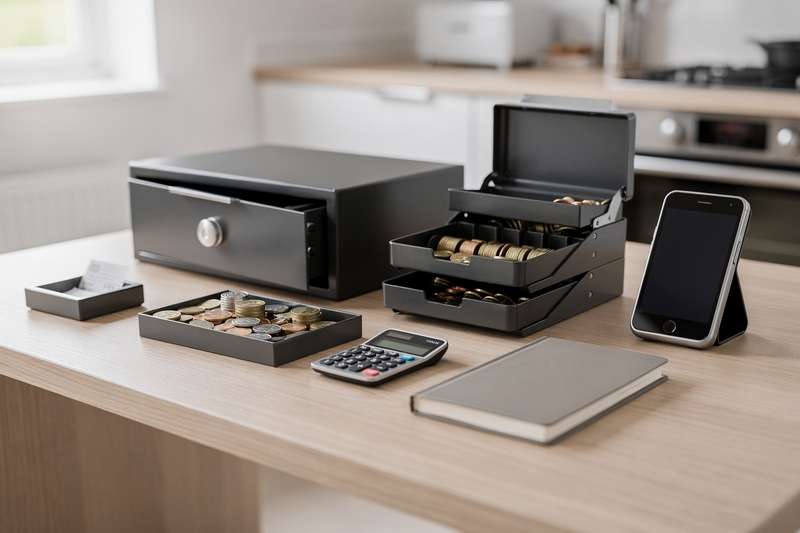
You run a small market stall, a community club, or maybe a home-based side business, and every week you face the same low-level chaos: loose change rattling around an old biscuit tin, a suspiciously worn £20 note that a customer swears is genuine, and no reliable way to keep your float sorted at the end of a busy Saturday. You’ve tried the obvious fixes — a cheap cash drawer that broke, a UV torch that gave off barely enough light to check a banknote — and you’re tired of products that looked fine online but fell apart or failed in practice.
Money handling doesn’t need to be complicated, but it does need to be reliable. Whether you’re managing a petty cash tin in a small office, running a school PTA fundraiser, or simply want a way to check that the notes you take at the door of your club night are legitimate, the right products make a noticeable difference. The problem is that the category on Amazon is cluttered: for every genuinely useful cash box or counterfeit detector, there are half a dozen near-identical listings of questionable quality. This guide cuts through that noise and focuses on the products that have earned real buyer trust and are genuinely appropriate for everyday UK money handling.
How These Products Were Evaluated
The shortlist for this guide was built by looking specifically at products within the money handling category — cash boxes, lockable tills, and counterfeit detection tools — that are actually available to UK buyers on Amazon. Each product was assessed against the following criteria: build quality signals from verified buyer feedback patterns, detection reliability (for counterfeit tools), practical usability (size, key security, portability), and rating credibility (minimum threshold of real reviews, not just a handful of early ratings). Off-topic products that appeared in Amazon search results — moving trolleys, storage bags, utility carts — were excluded regardless of their ratings, because they simply do not belong in a money handling guide. What you’ll find below are three distinct, genuinely relevant products backed by real buyer feedback.
Best Lockable Cash Box for Home and Small Business Use
The Best House Metal Coin Box with 2 Keys — 10 Inch, Blue is a straightforward, no-frills petty cash solution that does exactly what a cash box should: it locks, it organises, and it doesn’t feel like it’ll buckle the first time someone drops it. Rated 4.5 out of 5 stars from 220 reviewers, it sits in a clear spot in the market — competitively priced at the budget end while offering construction quality that outpaces the flimsy plastic alternatives you’ll often find at this tier.
The box is built from metal with a key lock mechanism and ships with two keys, which is a practical detail that gets overlooked until you lose one. The removable change tray inside lets you separate coins from folded notes, keeping your float organised when things get busy. At 10 inches, it’s large enough to hold a reasonable float — coins, rolled notes, and receipts — without being so bulky that it becomes awkward to store in a drawer or a bag. The blue colourway makes it easy to distinguish from similar boxes if you manage multiple floats (for example, a separate box per product category at a market stall). If blue isn’t your preference, the same box is available in black under ASIN B0DTTW7J9T at the same rating and price.
Real buyer feedback highlights a few consistent points. The lock is described as functional and secure without being fiddly — it clicks shut cleanly and the keys feel more substantial than those on cheaper alternatives. The removable tray fits standard UK coin denominations comfortably, though some reviewers with very large coin volumes note that the tray fills quickly during a busy shift. For a market trader, a community treasurer, or an office petty cash manager, that’s a minor compromise. Where this box struggles is with very high-volume cash environments: if you’re taking hundreds of transactions a day, a purpose-built cash drawer with a wider till integration would serve you better.
The portability aspect is worth emphasising. Unlike under-counter cash drawers that need to be wired to a till, this is fully self-contained — you can carry it to events, lock it in a car boot, or hand it off between volunteers without any setup. For one-off events, school fairs, or pop-up markets, that independence is genuinely useful. Just be aware that no standalone metal cash box is designed to resist a determined break-in; it’s a deterrent and an organiser, not a replacement for a proper safe.
Best Budget Counterfeit Detector for Occasional Use
If you only occasionally need to check notes — at a car boot sale, a monthly market, or a small charity event — the Ultraviolet UV Counterfeit Money Detector is a sensible starting point. Rated 4.4 out of 5 stars from 306 reviewers, it uses ultraviolet light to reveal the UV-fluorescent security features built into genuine UK polymer and paper banknotes — the thread, the hologram elements, and the serial number markings that don’t show up under normal light.
The appeal here is simplicity. There are no buttons to programme, no modes to scroll through, no software to update. You hold a note under the UV lamp and within a couple of seconds you can see whether the security strip glows as it should. For someone who handles cash infrequently but wants a basic level of protection against passable fakes, this is a low-effort, low-cost method that works. The 306-review base gives reasonable confidence that this isn’t a product that only performed well for a handful of early buyers.
The tradeoff is detection depth. UV light reveals one layer of banknote security, but a convincing fake can sometimes pass UV inspection if the counterfeiter has incorporated a fluorescent strip. A UV-only detector doesn’t check magnetic ink (MG), infrared patterns (IR), or note dimensions — all of which are tested by more sophisticated machines. For a busy retail environment where you’re taking dozens of transactions an hour, relying solely on UV detection would leave gaps. But for occasional, lower-stakes use — community events, private sales, small weekend markets — it offers a proportionate level of protection without the cost or complexity of a full counterfeit machine.
In practical terms, look for a model where the UV LEDs are concentrated enough to illuminate the full width of a banknote in one pass, rather than requiring you to slide the note around. Buyers of this particular detector generally find the lamp coverage adequate for standard UK note sizes. The device is compact and battery-powered, so it travels easily in a bag or market kit. Just keep spare batteries to hand — UV lamps that dim gradually can give false confidence if you don’t notice the light has weakened.
Best Counterfeit Detector for Busy Tills and Retail Use
For anyone taking cash at a regular pace — a café, a small shop, a hair salon, or a busy market stall — the ZZap D20+ Counterfeit Money Detector represents a meaningful step up in detection confidence. Rated 4.7 out of 5 stars from 122 reviewers, it uses three UV LEDs specifically to improve coverage across the surface of a note — a practical design choice that addresses one of the most common frustrations with cheaper single-LED UV detectors.
ZZap is a brand that has built a reasonable reputation in the UK cash-handling space, and the D20+ reflects that focus. The three-LED configuration means the UV light covers more of the note in a single pass, reducing the chance of missing a section of the security thread or the UV-reactive ink patterns. For a till operator checking notes quickly between serving customers, that speed and coverage matters. The unit is designed to sit on a counter comfortably and is compact enough not to dominate a small workspace.
Buyers consistently note that the D20+ is quick to use without a learning curve — you slide the note under the lamp and read the result immediately. That immediacy is important in a retail context where customers are waiting. The 4.7 rating from over 100 reviewers gives meaningful confidence in consistent real-world performance, rather than a small sample of early enthusiasts. Some reviewers mention using it specifically for checking UK polymer notes (the current £5, £10, £20, and £50 denominations), and the feedback on polymer note detection is positive.
The honest limitation is that the D20+ is still fundamentally a UV detector — it doesn’t incorporate MG or IR checking. If you handle very high cash volumes or operate in an area where sophisticated counterfeit notes are circulating, you’d want a multi-mode detection machine with MG and IR in addition to UV. For most small UK businesses, though, UV detection catches the vast majority of counterfeits in circulation, and the D20+ executes that function reliably. It’s a proportionate, practical choice for a counter environment where speed and ease of use are as important as detection depth.
What to Look For When Buying Money Handling Products
- Construction material for cash boxes: Metal construction is significantly more durable than plastic for cash boxes — look for steel rather than thin sheet metal, and check that hinges and the lock mechanism feel solid rather than flimsy. A cash box is only useful if it stays intact when handled regularly.
- Key security and spares: Any lockable cash box should ship with at least two keys. Ideally, the lock cylinder should be a standard size so replacement keys can be cut if needed. Single-key boxes are a risk in a shared or high-turnover environment.
- Removable coin tray and compartment layout: A removable tray that separates coin denominations from folded notes keeps your float manageable. Look for a tray that lifts out completely, so you can store documents or a float sheet underneath.
- Detection modes for counterfeit tools: UV detection is the baseline and suits occasional use. If you handle cash regularly, consider a device that also includes MG (magnetic ink) detection, which catches a different class of fakes. IR detection adds another layer. The more modes a device combines, the higher the detection confidence — but also the higher the cost, so match the tool to your actual risk level.
- LED count and lamp coverage: For UV detectors, more LEDs mean broader note coverage per pass. A single LED may require you to reposition the note; three or more LEDs typically illuminate the full width in one go. This matters when you’re working quickly.
- Portability vs. fixed installation: Decide before buying whether you need something portable (for events, markets, or shared spaces) or fixed (for a permanent shop counter). Portable devices need battery reliability; fixed devices can often use mains power for more consistent output.
- UK note compatibility: Since the UK switched to polymer banknotes for the £5, £10, £20, and £50 denominations, not all older counterfeit detectors are optimised for polymer. Check that any detector you buy specifically references polymer note detection — the security features in polymer notes respond differently to UV than traditional paper notes.
Verdict
For the majority of UK readers coming to this guide — someone running a small business, managing a community group’s float, or simply wanting basic fraud protection at a market stall — the combination of a lockable cash box and a reliable UV counterfeit detector covers the practical bases well.
If you need just one starting point, the Best House Metal Coin Box is a sensible, durable organiser that earns its keep through solid construction and practical internal layout. Pair it with the ZZap D20+ if you’re at a permanent till or counter where you need quick, confident note checking — the three-LED configuration and strong reviewer base make it the more assured choice for regular use. If your cash handling is genuinely occasional, the UV Counterfeit Money Detector at the budget tier does the job without unnecessary cost. The honest advice is to match the tool to your actual transaction volume: don’t under-invest if you’re busy, but don’t over-engineer a solution for a once-a-month fundraiser.
We were not paid to feature any specific product in this guide. All opinions are independent and based on publicly available specifications, verified buyer feedback patterns, and category research.
Quick Comparison Table


FAQ
What is the best way to organise petty cash for a small business in the UK?
A lockable metal cash box with a removable coin tray is the most practical solution for most small businesses. Keep a paper float sheet underneath the tray recording the starting balance, and reconcile it at the end of each session. Separate coin rolls from loose coins and fold notes face-up in denomination order to speed up counting.
How do I check if a UK banknote is genuine?
The Bank of England recommends the “feel, tilt, look” approach for polymer notes — feeling the raised print, tilting to check the hologram and colour-shift elements, and holding the note to the light to see the see-through window. A UV counterfeit detector adds a further check by revealing the fluorescent security thread and other UV-reactive markings that genuine notes carry.
Are UV counterfeit detectors reliable for UK polymer banknotes?
UV detection works for UK polymer notes, but polymer notes have different UV-reactive characteristics to older paper notes, so it’s important to choose a detector that specifies polymer note compatibility. UV alone won’t catch every fake — pairing it with the Bank of England’s visual checks gives a more robust verification process for everyday use.
What size cash box do I need for a market stall or event?
A 10-inch cash box is suitable for most market stall or event floats — it holds a full spread of UK coin denominations plus folded notes without being difficult to carry. If you’re running multiple product categories or need to keep different floats separate, consider buying two smaller boxes rather than one oversized one, and colour-code them to avoid mix-ups.
Can I use a household lockbox instead of a dedicated cash box?
A general lockbox can work, but a purpose-built cash box has a key practical advantage: the internal removable coin tray designed around standard coin sizes makes float management much faster. Generic lockboxes typically have no internal organisation, so you’d be fishing through a jumble of coins at the end of a shift. For frequent cash handling, a proper coin-tray layout pays for itself in time saved.
How many UV LEDs should a counterfeit detector have?
For occasional personal use, a single-LED UV lamp is workable, but you’ll need to move the note around to cover it fully. For a busy counter environment, look for three or more LEDs to illuminate the full width of a banknote in a single pass — this reduces checking time and the chance of missing a security feature. More LEDs also tend to indicate a better-quality lamp unit overall.